








Tennis Elbow: How to Train It Away (Rest Doesn't Work)
Jesper, 45, project manager from Frederiksberg, played padel two to three times a week. He had started three years ago, been captivated by the sport, and was now in a club with a regular training partner. It was his fixed weekly break from a busy working life with two teenage children and long meetings.
The pain started quietly. First as a mild soreness on the outside of the right elbow after a padel session. He didn't think about it. A couple of weeks later, he could feel it when he gripped the coffee mug in the morning. A few months later, it now also hurt to shake hands, open jam jars and carry his laptop bag into the office.
He did what many do. He took a two-week break from padel. It helped, but only until he played again. He bought a tennis elbow brace. He taped the arm. He did the exercises his padel partner had shown him from YouTube — various resistance band exercises with slow eccentric movements. He got massage from a massage therapist. He bought a new padel racket with anti-vibration.
Nothing lasted. The brace gave some relief, but the elbow still hurt. The tape gave a placebo effect for the first two training sessions. The resistance band exercises were boring, and he dropped off after three weeks. The massage felt good for one to two days.
After five months, he was considering quitting padel altogether. He was after all 45 and not 25 anymore. Maybe it was just that the body couldn't keep up anymore. But something in him refused to accept it. He therefore started googling, found us, read our client stories and booked a start-up conversation.
The first thing we explained to Jesper was that his tennis elbow is not an inflammation — even though it is often called "epicondylitis," which means "inflammation of the bony attachment." The modern understanding is entirely different. It is a tendon condition where the tendon does not have sufficient capacity relative to the load he subjects it to. The cure is therefore not rest or passive treatments. The cure is structured strength training with the right weight that gradually builds the tendon's tolerance up to the load you subject it to.
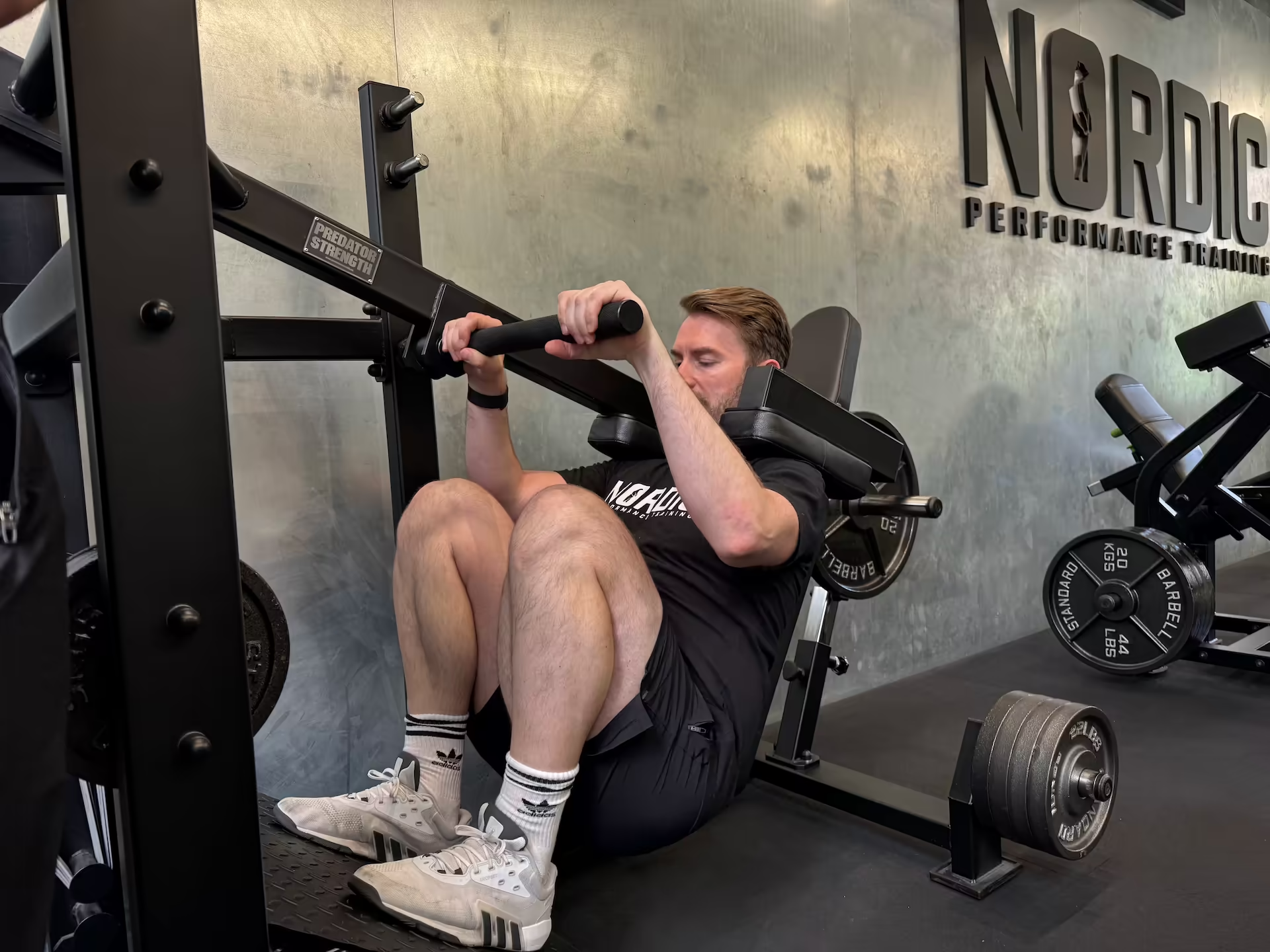
We started calmly with our standard full body program, where we added a biceps and a triceps exercise. Focus on good technique and gradual progression. We asked him to continue playing padel but reduced his playing time from his typical 90-minute sessions to a maximum of 30 minutes while we built the tendon stronger.
After four weeks, he felt a bit better and could now increase his playing time to 45 minutes per padel session. We explained to him that tendon adaptations take time, but the most important thing was that he could gradually do more and more, and that he was on exactly the right path.
After eight weeks, he began to feel the difference and could now train for over an hour at a time. After three months, the pain during padel was almost gone, and after six months he hadn't thought about his elbow in weeks, and he was now playing at full duration every session. He played padel two to three times a week as before. He still trained with us once a week, as he had grown to enjoy strength training and staying injury-free.
"We see it often. A man or woman in their 40s or 50s who has been captivated by padel, tennis or golf and who suddenly has pain in the elbow after months or years without problems. They've been told it's an inflammation — so they rest, tape, treat. But it's not an inflammation. It's a tendon that isn't strong enough. And a tendon only becomes strong enough to handle the load you demand of it in one way: by training it up to that level. Gradually, heavy, patiently. It is the slowest but most effective path. There are no shortcuts. No tape, no light resistance band exercises and no cortisone injections that build the capacity the tendon needs." — Mathias Busk, personal trainer & physiotherapist
What is tennis elbow?
Tennis elbow, or lateral epicondylalgia as it is professionally called, is a condition with pain on the outside of the elbow. Despite the name, tennis is only one of many causes. Today it is more commonly seen in padel players, tradespeople, office workers and people who perform repetitive grip-demanding movements in daily life or sport.
The tendons involved are the tendons that connect the forearm muscles to the elbow's outer bony attachment. One muscle in particular, the extensor carpi radialis brevis, is central. It is a muscle that is used every time you extend the wrist backward or grip something.
The diagnosis is often called "epicondylitis," where the suffix "-itis" suggests inflammation. But the modern understanding is that it is rarely a classic inflammatory condition. It is a tendinopathy — a degenerative and adaptive change in the tendon tissue itself that has become intolerant to the load it is subjected to.
It is the same principle we work with for nearly all overuse injuries. Shin splints is not an inflammation. Bursitis in the hip is rarely primarily a bursal inflammation. Achilles tendinopathy is not about "cooling down" an inflamed tendon. And tennis elbow is not an inflammation of the elbow's bony attachment. It is a tendon that isn't strong enough for what is demanded of it.
Golfer's elbow — the same condition, on the other side
Golfer's elbow (medial epicondylalgia) is precisely the same condition as tennis elbow — just on the inside of the elbow instead of the outside. It affects the muscles that flex the wrist forward and grip things.
Despite the name, golfer's elbow comes just as often from sources other than golf, just as is the case with tennis elbow. Tradespeople, office workers who use a lot of mouse, people who perform repetitive pronation movements (like turning a screwdriver) and people who play racket sports can all develop the condition.
The most important thing to understand is: the treatment is fundamentally the same. Whether it hurts on the outside or inside of the elbow, the treatment is the same — gradual, heavy strength training that builds the tendon's tolerance.
Symptoms of tennis elbow and golfer's elbow
The classic symptoms:
Pain on the outside of the elbow (tennis elbow) or inside (golfer's elbow) Worse with gripping — the coffee mug, the jam jar, the laptop bag Tenderness when pressing on the bony attachment on the outer or inner side of the elbow Reduced grip strength Pain that radiates down the forearm during loading Worse after activity — but also often in the morning after a day of loading
There is rarely swelling or warmth. It is not an acute injury, and it is not an inflammation in the classic sense.
Why do you get tennis elbow?
The short explanation is the same as for nearly all overuse injuries: your demands on the tendon have exceeded its physical capacity.
The longer explanation is that tendon tissue adapts to loading slowly. Muscles get stronger quickly — within weeks. Tendons adapt over months to years. When you suddenly increase your activity — a new sport, increased training volume, a new job with repetitive gripping — the tendon tissue can't keep up. It becomes overloaded relative to its current capacity.
The classic triggers are very recognizable:
Beginner or resumption of padel, tennis, golf or similar Increased volume in a sport you already practice New work or hobby with repetitive grip-demanding movements Periods of increased stress, where the body's general recovery is reduced Lack of strength training as a counterweight to the new loading
It is not because you "play wrong" or have "bad technique." It is not because your racket is wrong or your working position is bad. It is a normal overuse reaction that occurs when the loading increases faster than the tendon's capacity.
What does the research say?
There is a solid and growing evidence base that structured strength training is the most effective treatment for tennis elbow — when given time to work.
A Swedish randomized study from 2011 is one of the most cited studies in the field. 81 people with chronic tennis elbow — all with symptoms for more than three months — were randomly assigned to either daily structured strength training with a weekly increase in load or to a waiting list. After three months, the training group had a markedly greater and faster reduction in pain than the control group. The authors concluded: "Exercise is superior to wait-and-see in reducing pain in chronic lateral epicondylosis."
A large systematic review and meta-analysis from 2021 compiled 30 randomized studies with 2,123 participants and compared exercise-based interventions with passive treatments and cortisone injections. The conclusion was clear in direction: exercise achieves better effect on both pain and function at nearly all time points. In the short term, cortisone can provide faster pain relief, but in the medium and long term, exercise wins on nearly all outcomes.
More recent research also points to the fact that it doesn't need to be specifically "eccentric" training. It is the gradually increased load that generally works — regardless of whether it is eccentric, concentric or isometric. This matches what we see in our training center: structured strength training with gradually increased load, including heavy biceps, triceps and forearm exercises, delivers more lasting results than the classic "rehab exercises" performed in isolation at home.
Treatment of tennis elbow
The most important point first: you should not rest your elbow back to health. You should train it back to health.
It is the opposite approach of the classic one. Massage, ice, tape, resistance bands and tennis elbow braces can provide short-term relief — but they don't build capacity, and they don't change the underlying issue. A tendon that has lost capacity doesn't get it back from being spared. It only gets it back from being loaded — gradually and progressively.
What works
Progressive strength training of the arms and the entire body. The single intervention with the best evidence for tennis elbow is structured strength training. We build the arms stronger with heavy biceps and triceps exercises, and we build the rest of the body up in parallel. Not through light resistance band exercises with slow eccentric movements.
Patience with progression. Most people get markedly better within 12-24 weeks. That is longer than many expect. Tendinopathies are slow processes. Tendon tissue adapts over months, not weeks.
Consistency over time. Strength training is not something you do for 12 weeks and then stop. A tendon that has become strong remains strong as long as it continues to be loaded.
What doesn't work as primary treatment
Rest. Can provide short-term pain relief but makes the tendon weaker and less tolerant in the long term. As soon as you resume loading, the pain returns.
Tape, kinesio tape and tennis elbow braces. Passive interventions. Can provide mild placebo effect and short-term compression but don't build capacity.
Light resistance band exercises and isolated eccentric protocols. They have evidence for being better than nothing, but they don't have better evidence than heavy, progressive strength training in general.
Massage. Can provide short-term relief but doesn't make the tendon stronger.
Cortisone injection. Can provide rapid relief in the acute phase, but studies show that cortisone treatment has worse long-term results than doing nothing or strength training. That is an honest point clients deserve to hear.
It is not because these things are wrong to use. It is because they are symptom relief, not treatment. The actual problem is the tendon's capacity, and capacity is only built through loading.
Exercises for tennis elbow — how to train it strong
We don't have a special "tennis elbow protocol." We have a structured full body program that we adapt to the individual client. For clients like Jesper, it is these principles and exercises that do by far the most of the work:
We build the entire body up, not just the elbow. Full body strength training has a documented pain-dampening effect that is not limited to the area being trained. A stronger body overall is a more robust body.
We train the upper body broadly with some of these exercises:
- Machine Chest Press or Dumbbell Chest Press — for the muscles on the front of the upper body
- Cable Pulldown or Cable Row — for the muscles on the back of the upper body
- Dumbbell Lateral Raise or Cable Y-Raise — for the shoulder region
We train the lower body with some of these exercises:
- Hack Squat, Pendulum Squat or Split Squat — for the lower body
- Leg Curl — for the hamstrings and posterior chain
- Glute Bridge — for glute and hip strength
- Leg Extension — for the quadriceps and knee strength
We add arm-specific exercises:
- Cable Curl or Dumbbell Curls — builds direct strength in the biceps and the forearm flexors. It is particularly valuable for golfer's elbow, where the muscles on the inside of the forearm are involved.
- Cable Tricep Extension — builds direct strength in the triceps and also involves the muscles in the forearm.
- Cable Wrist Curls — used in cases where we assess that extra focus on forearm and grip strength is relevant. For most clients, one biceps and one triceps exercise is enough.
We use double progression: you work your way up in repetitions with the same weight, and when you hit the top of the range, you increase the weight. It is the simplest and most sustainable way to build strength over time.
These exercises fit easily into our standard full body program. You don't need a separate "tennis elbow program" or "golfer's elbow program" — you need structured strength training of the entire body, with the arms in particular focus.
Should you stop playing padel, tennis or golf?
Rarely. For most, it is about relative rest, not total rest.
We typically recommend reducing volume briefly and then increasing gradually again, as the tendon's capacity is built up.
Total break is rarely the way forward. It is often precisely what has kept people trapped in a pattern where the pain returns every time they try to play again. The tendon doesn't get stronger from being spared — it only gets stronger from being loaded.
When should you see a doctor?
Most cases of tennis elbow and golfer's elbow respond well to structured strength training. But some situations require medical evaluation:
- Acute trauma with sudden loss of strength
- Swelling, redness or warmth around the elbow (atypical for tendinopathy)
- Numbness, tingling or radiating pain down into the little finger/ring finger (may indicate nerve involvement)
- Locking or instability in the elbow
- Pain that does not improve after 3-6 months of structured training
If you are in doubt, contact your doctor.
Frequently asked questions about tennis elbow
What is tennis elbow?
Pain on the outside of the elbow. Despite the name, tennis is only one of many causes — it is seen just as often in padel players, tradespeople and office workers. Professionally it is called lateral epicondylalgia or tendinopathy, and it is not a classic inflammation but a tendon condition where the tendon tissue has lost capacity and become intolerant to loading.
What helps against tennis elbow?
Structured strength training. It is the single intervention with the best documented effect. The strength training builds the tendon's capacity. Tape, resistance bands, tennis elbow braces and massage can provide short-term relief, but they don't build the capacity that solves the problem long-term.
How long does it take to recover?
12-24 weeks with structured strength training is realistic for most. Some get better faster, others take longer. Tendinopathies are slow processes, and those who expect results in a couple of weeks are typically disappointed and stop too early.
Can you play padel, tennis or golf with tennis elbow?
Yes, in most cases. We typically recommend reducing volume briefly while the strength training gets going, and then increasing again. Total break is rarely necessary and often counterproductive — the tendon doesn't get stronger from being spared.
Does a tennis elbow brace help?
In the short term perhaps, long-term no. The brace can provide mild compression and placebo effect, but it doesn't build the tendon's capacity. It is comfort, not treatment.
Does massage help with tennis elbow?
In the short term yes, long-term no. Massage can provide short-term relief but doesn't make the tendon stronger, and it is the strength that solves the problem long-term.
What is the difference between tennis elbow and golfer's elbow?
Location. Tennis elbow causes pain on the outside of the elbow (lateral epicondylalgia). Golfer's elbow causes pain on the inside (medial epicondylalgia). The treatment is fundamentally the same — both are tendinopathies that respond to structured strength training of the arms.
Is cortisone injection a good idea for tennis elbow?
Rarely. Cortisone can provide rapid relief in the acute phase, but studies show that cortisone treatment has worse long-term results than doing nothing or strength training. The effect wears off after a few weeks, and the risk of relapse and tendon weakening is real. It is not a treatment we recommend as a primary approach.
Ready to train your way out of elbow pain?
If you have had tennis elbow or golfer's elbow for months and have tried everything from tape to resistance bands to rest — without anything lasting — we understand. It is a frustration we encounter often.
It is also a frustration that typically disappears when you experience that the tendon can actually be made better — not by being spared, but by getting the loading it needs.
The most important things are two. The first: That it is structured strength training with gradually increased loading — not tape, resistance bands or rest. The second: That it is something you are patient with. 12-24 weeks is realistic. There are no shortcuts, but the effect is real and lasts.
Book a free start-up conversation and hear how personal training in Copenhagen can look for you — either at our private training center or as a call, if that suits you better.
References
Karanasios, S., Korakakis, V., Whiteley, R., Vasilogeorgis, I., Woodbridge, S., & Gioftsos, G. (2021). Exercise interventions in lateral elbow tendinopathy have better outcomes than passive interventions, but the effects are small: A systematic review and meta-analysis of 2123 subjects in 30 trials. British Journal of Sports Medicine, 55(9), 477-485. https://pubmed.ncbi.nlm.nih.gov/33148599/
Pavlova, A. V., Shim, J. S. C., Moss, R., Maclean, C., Brandie, D., Mitchell, L., Greig, L., Parkinson, E., Alexander, L., Brown, V. T., Morrissey, D., Cooper, K., & Swinton, P. A. (2023). Effect of resistance exercise dose components for tendinopathy management: A systematic review with meta-analysis. British Journal of Sports Medicine, 57(20), 1327-1334. https://pubmed.ncbi.nlm.nih.gov/37169370/
Peterson, M., Butler, S., Eriksson, M., & Svärdsudd, K. (2011). A randomized controlled trial of exercise versus wait-list in chronic tennis elbow (lateral epicondylosis). Upsala Journal of Medical Sciences, 116(4), 269-279. https://pubmed.ncbi.nlm.nih.gov/22066975/
Table of Contents
Related Blog Posts


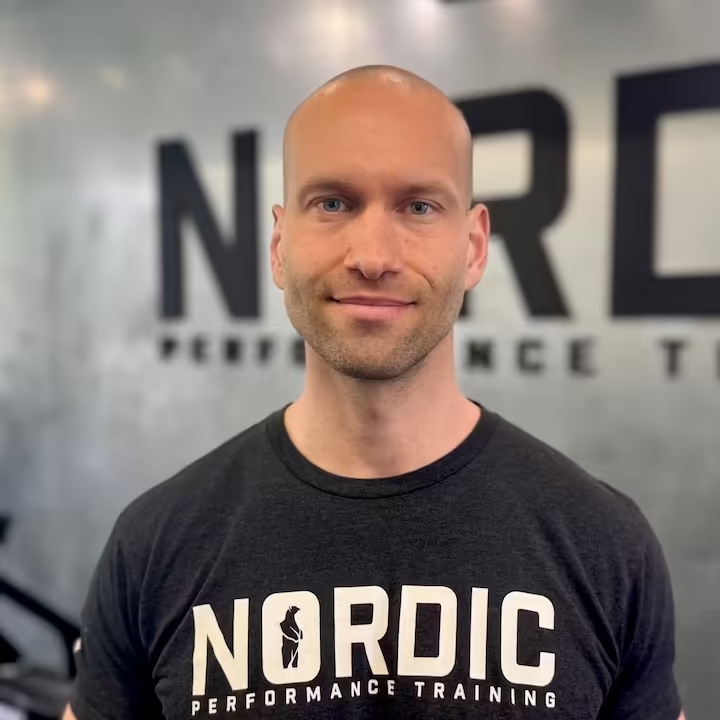
I’ve worked as a personal trainer for over 14 years and as a physiotherapist for over 8 years — and co-founded Nordic Performance Training with Kasper to give clients a professional, private, and structured training environment where results actually last. In that time, I’ve overseen more than 15,000 sessions and helped hundreds of clients rebuild after injuries, gain strength, improve their health, and stay consistent.
My approach combines practical experience with evidence from the latest research, making training both effective and realistic.
On this blog, I share the same methods we use every day at Nordic — so you can cut through the noise and focus on what truly works.



Related Blog Posts
.svg)