








Cable Row: Technique, Variations and Muscles
Cable row is one of our exercises in the upper body pull exercise category — and the natural partner to cable pulldown. Where pulldown pulls vertically, row pulls horizontally. Both can train the entire back musculature effectively, with different nuances and advantages and disadvantages to each.
Riad came to us with a frozen shoulder. He could barely lift his arm above horizontal, and he was convinced he had to stop training his upper body entirely. But fortunately, we taught him that wasn't the case. We dropped cable pulldown temporarily and replaced it with cable rows.
In row, you sit more upright relative to the cable's pull — the arm is therefore not elevated in the same way as in pulldown, and therefore didn't provoke his symptoms from the shoulder, but the back and shoulder muscles were still trained effectively. Over the next 18 months, we systematically worked up in weight, repetitions, and range of motion, and as the mobility returned, we gradually reintroduced pulldowns again. Today, Riad trains exactly as before he got the diagnosis, just much stronger in his entire body than ever before.
A frozen shoulder is just one example. We also often use cable row as a pulling exercise for women who are further along in their pregnancy and due to the size of the stomach can't sit comfortably in the pulldown machine. Or for clients with certain shoulder limitations as well as a natural variation for clients who have been running pulldowns for a while and want something new.
"Cable rows are one of the exercises we always have in our back pocket. When a client has difficulty lifting their arms overhead — regardless of the reason — a cable row can be the best alternative. They sit more upright relative to the cable's pull, and the arm is therefore not elevated to the same degree, but the back and shoulder muscles are still trained effectively. It's just an example of how we simply find a solution and work systematically toward better function." — Mikkel Krause, personal trainer & physiotherapist
What is cable row?
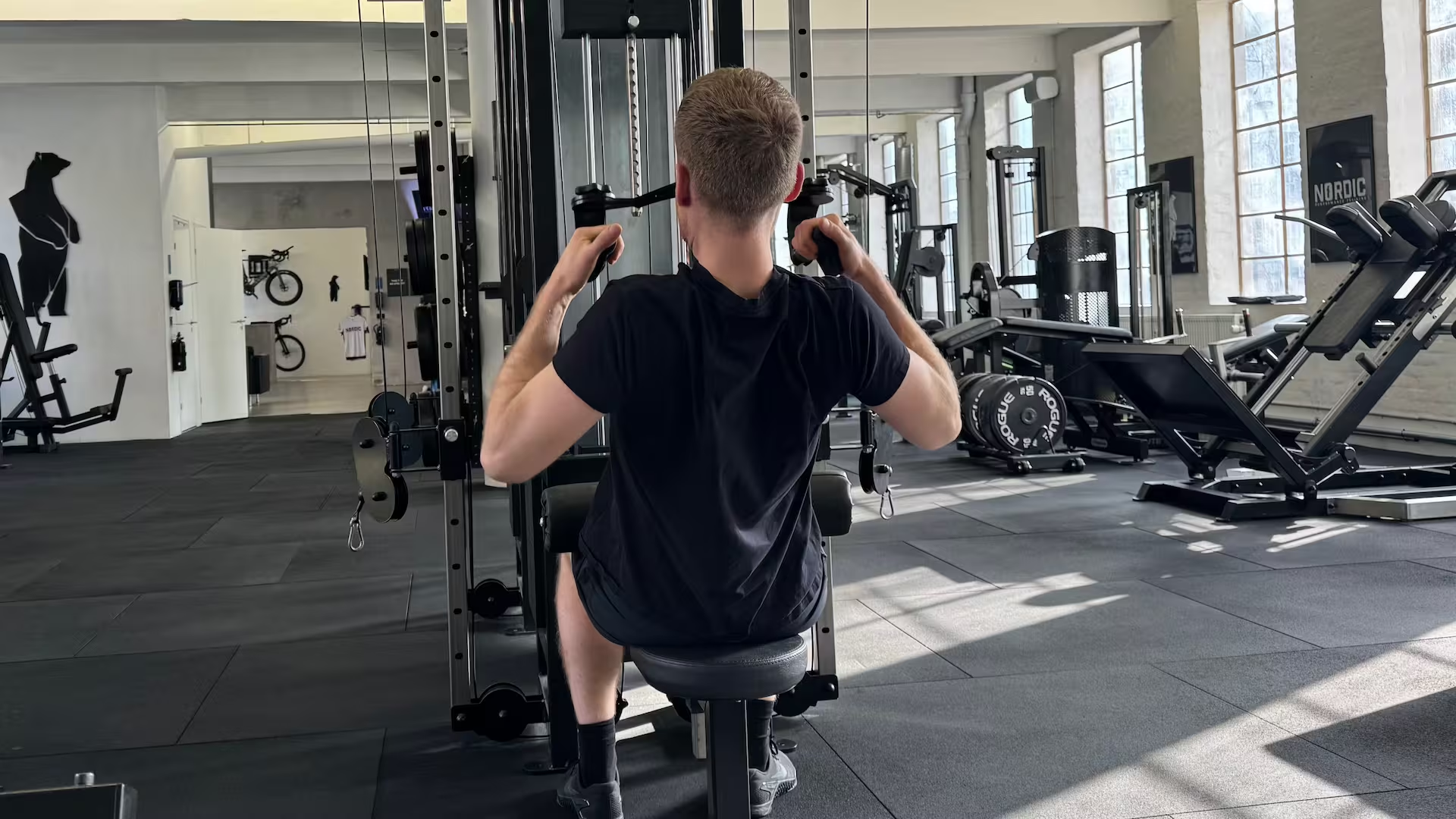
Cable row — or seated cable row as the most common variant is called — is a machine-based pulling exercise for the upper body. You sit in front of a cable machine, often with feet placed on a platform, grip either a narrow, medium, or wide handle of varying wrist angle, and pull it toward the torso with the elbows more or less out from the side of the torso.
The central aspect of cable row is arm path — the path the arms start and move along during the movement. In cable row, the arms move either backward and away from the midline or backward and down toward the side of the torso in a horizontal plane. That's precisely what distinguishes row from pulldown, where the arms move down toward the torso in a vertical plane. Arm path determines which muscles are activated most by the nervous system.
Cable row is available in almost all gyms and is our preferred pulling exercise when pulldown isn't the right solution — or as a natural variation in the program.
Which muscles does cable row train?
Depending on the variation and how it's performed, cable row primarily trains the broad back muscle latissimus dorsi, upper back musculature — rhomboids and middle and lower trapezius — as well as the rear deltoid. Which of these are activated the most depends on arm path and setup — precisely as in cable pulldown.
For the average trainee, there isn't a major practical difference in which muscles are trained in row versus pulldown. Both exercises train the back musculature effectively, and setup and arm path determine the nuances. The real difference is practical: pulldown provides more external stability via the thigh pad, which makes it easier to standardise and train harder. Row is more technically demanding and requires more trunk stabilisation — but is indispensable when pulldown isn't an option.
The shoulder's stabilising musculature — the rotator cuff — is actively engaged throughout the entire movement. The elbow flexors — biceps, brachialis, and brachioradialis — contribute as synergists during the pull.
Technique: Seated cable row
Setup: Sit with the feet solidly on the platform and the knees slightly bent. Grip the handle and lean either more forward or backward to find a starting position that positions the desired muscles best for performing the work — from there, extend forward and let the shoulder blades glide forward for a full stretch.
Movement: Pull the handle back toward the torso while the elbows move backward along or out from the side of the body, depending on the variant. The shoulder blade draws together and moves naturally in coordination with the upper arm — let it follow along instead of trying to actively squeeze it down and back from the start. In the end position: a short hold before you guide the handle in a controlled manner back to the starting position with full stretch and protraction of the shoulder blades.
Tempo: Pull in a controlled manner in, 2-3 seconds out. Full stretch in the starting position is important — it activates the back muscles over their entire length and is the prerequisite for standardisation of the repetitions.
Think about pulling the elbows backward rather than bending the arms — it's the upper arms via the shoulder joint that start the movement, and then the elbows follow naturally.
Wide Grip
Wide grip cable row is performed with a wider grip — typically a long bar — where the palms face downward. The wider grip intuitively changes arm path and biases horizontal abduction and upper back musculature. Good variation for those who want more focus on the upper back and rear deltoid. At Nordic, we use a semi-pronated grip, which is a middle ground between the palm facing downward and neutral grip. This makes it intuitive to keep the elbow at a height where you can come all the way back to full shoulder retraction, which also feels good compared to a straight bar.
Neutral Grip
Neutral grip is our standard variant — a grip at shoulder width with the palms facing each other. It gives a natural elbow position along the side of the body and good activation of the back muscles. Simple to learn and simple to standardise.
Variations
Seated Cable Row
Our primary variant. You sit with the feet placed on the platform for external stability — it gives the best conditions for training heavy and systematically. If you have access to a machine with a chest pad, you can support the upper body forward and remove all trunk stabilisation from the equation — this gives even better conditions for training heavy. That's typically a dedicated machine, however, and not a standard cable row setup.
Half Kneeling Cable Row
Half kneeling cable row is performed kneeling on one knee in front of a standard cable machine. It's a good alternative if you don't have access to a dedicated seated cable row machine. You can stabilise yourself against a bench or similar to get some opposing force. It's a bit more of a hassle to set up, but it's a functional solution in a gym without a seated cable row platform.
Single Arm Cable Row
Single arm cable row is performed with one arm at a time. It addresses strength imbalances between the sides and provides the opportunity to overcome the bilateral strength deficit — the nervous system activates the muscle mass more effectively when only one arm works at a time. Requires more active stabilisation of the torso, as the rotation must be counteracted throughout.
Standing Cable Row
Standing cable row is performed standing. Without external stability from a seat or platform, there's no opposing force to press against — and that markedly limits how heavy you can train. It's therefore also not a variant we use.
Progression
Cable row follows the same progression principle as all other exercises at Nordic Performance Training. Train within a fixed rep range and increase the weight systematically when you can complete all repetitions with good technique. Read more in our guide to double progression.
The most common mistakes
Incorrect shoulder blade movement. Many start with the shoulder blades already pulled back and together — or actively try to squeeze them down and back from the start. Both are suboptimal. It shortens the range of motion and forces the arms to take over the work. Let the shoulder blades glide forward before you start the pull and let them follow the upper arm naturally backward throughout.
Pulling with the arms instead of the back. The elbows start bending before the shoulder joint drives the movement. Think about bringing the upper arm backward — the elbows follow naturally.
Too much momentum and rocking in the upper body. The upper body swings backward to help the weight. This reduces the back muscle work markedly and makes it difficult to standardise. Keep the upper body stable and pull in a controlled manner.
Too limited range of motion. The pull stops too early without real contraction of the shoulder blades in the end position. Come all the way back and hold a short pause — it's an important part of the exercise.
Cable row vs. lat pulldown
Cable row and cable pulldown are both pulling exercises for the upper body — and they can complement each other naturally. Pulldown pulls vertically, row pulls horizontally. Setup and arm path determine which muscles are activated the most in both exercises, and for the average trainee there isn't a major practical difference in which muscles are trained.
The real difference is practical: pulldown provides more external stability via the thigh pad, which makes it easier to standardise and train harder. That's why pulldown is our primary pulling exercise for most clients. Row requires more trunk stabilisation and is technically more demanding — but is indispensable when pulldown isn't an option, or as a natural variation from program to program.
For people who train three or more times per week, both exercises can be included across sessions — one session with pulldown, one with row. Together, they cover the entire back musculature from both movement directions.
Read more in our cable pulldown guide.
Frequently Asked Questions About Cable Row
What does a cable row train?
Cable row primarily trains the back musculature — latissimus dorsi, rhomboids, and trapezius — as well as the rear deltoid and the elbow flexors. Which muscles are activated the most depends on arm path and setup. The shoulder's stabilising musculature works actively throughout the entire movement.
Which muscles do rows train?
Rows primarily train the back musculature — latissimus dorsi, rhomboids, and trapezius — as well as the rear deltoid. The elbow flexors contribute as synergists. Setup and arm path determine which parts of the back are activated the most. For the average trainee, there isn't a major practical difference in which muscles are trained in row versus pulldown.
What does low row train?
Low row — or seated cable row — primarily trains the back musculature with focus on latissimus dorsi, rhomboids, and trapezius. The term "low row" refers to the cable being pulled from a low position, which gives a horizontal to upward pull and biases the upper back musculature and shoulder joint retraction.
Is cable row better than barbell row?
For most people, cable row is a better starting point. Barbell row requires good mobility in the hip and lower back and is technically demanding — particularly with heavy weight. Cable row provides comparable back activation with lower technical demands and is easier to standardise and increase systematically in weight.
What's the difference between cable row and lat pulldown?
Cable row pulls horizontally and requires more trunk stabilisation than pulldown. Lat pulldown pulls vertically and provides more external stability via the thigh pad — this makes it easier to standardise and train harder. For the average trainee, there isn't a major difference in which muscles are trained — it's the practical setup that distinguishes them.
Want to train with us?
We always have a solution that suits you — regardless of starting point.
Book a free start-up conversation and hear how personal training in Copenhagen can look for you — either in our private gym or as a call, if that suits you better.
References
Vasconcelos, C. M. W. A., Lopes, C. R., Almeida, V. M., Krause Neto, W., & Soares, E. (2023). Effect of different grip position and shoulder-abduction angle on muscle strength and activation during the seated cable row. International Journal of Strength and Conditioning, 3(1). https://doi.org/10.47206/ijsc.v3i1.190
Lehman, G. J., Buchan, D. D., Lundy, A., Myers, N., & Nalborczyk, A. (2004). Variations in muscle activation levels during traditional latissimus dorsi weight training exercises: An experimental study. Dynamic Medicine, 3(1), 4. https://doi.org/10.1186/1476-5918-3-4
Fenwick, C. M. J., Brown, S. H. M., & McGill, S. M. (2009). Comparison of different rowing exercises: Trunk muscle activation and lumbar spine motion, load, and stiffness. Journal of Strength and Conditioning Research, 23(2), 350–358. https://doi.org/10.1519/JSC.0b013e3181942019
Table of Contents
Related Blog Posts


I’ve worked as a personal trainer for over 12 years and as a physiotherapist for over 10 years — and co-founded Nordic Performance Training with Lucas 8 years ago to give clients a professional and structured way to train. Since then, I’ve helped hundreds of people build strength, stay consistent, and feel better through evidence-based methods that actually work.
Along the way, I’ve completed advanced certifications and mentored under leading experts in various fields, and I’ve taught many trainers and physiotherapists internationally.
On this blog, I share the same practical tools, insights, and strategies we use every day at Nordic — so you can train smarter, stay consistent, and get real results.



Related Blog Posts
.svg)