









Strength Training Progression: How to Use Double Progression
Most people think that progress in strength training is about training harder. Pushing yourself more. Finding the perfect program with the right amount of variation and the newest exercises from Instagram.
Sounds logical, right? More effort, better results.
But after thousands of personal training sessions with our clients, we see something different.
The strongest clients are rarely those who train the hardest. They're the ones who follow a simple system – week after week, month after month – while everyone else searches for the next brilliant method.
That system is called double progression.
It's not sexy. It's not new. And it requires a quality that few will admit they lack: patience.
Jakob trained for eight years without knowing if he was getting stronger
Jakob is 37 years old, works as an account manager in Copenhagen, and had been training for eight years when he came to us. He was the type who never skipped a workout. Never.
Eight years of sweat-drenched training sessions. Eight years of sore muscles and the satisfying feeling of having "done something." Eight years of changing programs, because the old one just wasn't working anymore.
But when we asked him how much stronger he had become, he hesitated.
"I actually have no idea," he finally said. "I just pick the weight that feels right on the day. Sometimes 80 kilos, other times 70. It depends on my energy, my mood, how well I slept."
A lot of people do that.
And that's precisely why most people never get particularly strong – even though they spend years in the gym. Not because they're lazy. Not because they lack willpower. But because they confuse activity with progress.
They train. But they don't know if they're actually improving.
It's guesswork disguised as intuition.
What is double progression?
Double progression is the opposite of guesswork. It's a system that tells you exactly when to do what – and turns progress into something you can see and measure. Not something you hope for.
You work with two variables: reps and weight.
Instead of trying to increase the weight every week – which quickly becomes impossible – you first focus on increasing the number of reps. When you reach your goal, you increase the weight and start over.
Imagine climbing a staircase. You can't jump three steps at a time – you'd fall. Instead, you take one step, find your footing, and then take the next.
One step at a time. That's the whole secret.
Here's what it looks like in practice:
You choose a rep range – let's say 6-8 reps. You start with a weight you can lift 6 times with good technique.
Over the following weeks, you work your way up to 8 reps in all your sets. When you succeed, you add weight and start over with 6 reps.
- Week 1: 80 kg × 6, 6, 6
- Week 2: 80 kg × 7, 7, 6
- Week 3: 80 kg × 8, 7, 7
- Week 4: 80 kg × 8, 8, 8
- Week 5: 82.5 kg × 6, 6, 6
And then you repeat the process. Again. And again. And again.
It's not more complicated than that. And that's exactly why it works.
Why simple systems beat complex ones
Your body gets stronger from what you do regularly. Not from what you constantly change.
That should be obvious. But it isn't – because we live in a culture that rewards complexity. We believe that important problems require sophisticated solutions. That if something is simple, it can't be effective.
So we jump from program to program. Switch exercises because we get bored. Pick the weight that "feels right." And keep starting over without realizing it.
It's procrastination disguised as optimization.
Double progression forces you to stay with the same exercise long enough for your body to respond. It gives you a clear goal for every single workout: Beat what you did last time.
Either you got more reps, or you didn't.
No guesswork. No "it feels like maybe I got a little stronger today." Just numbers on a piece of paper.
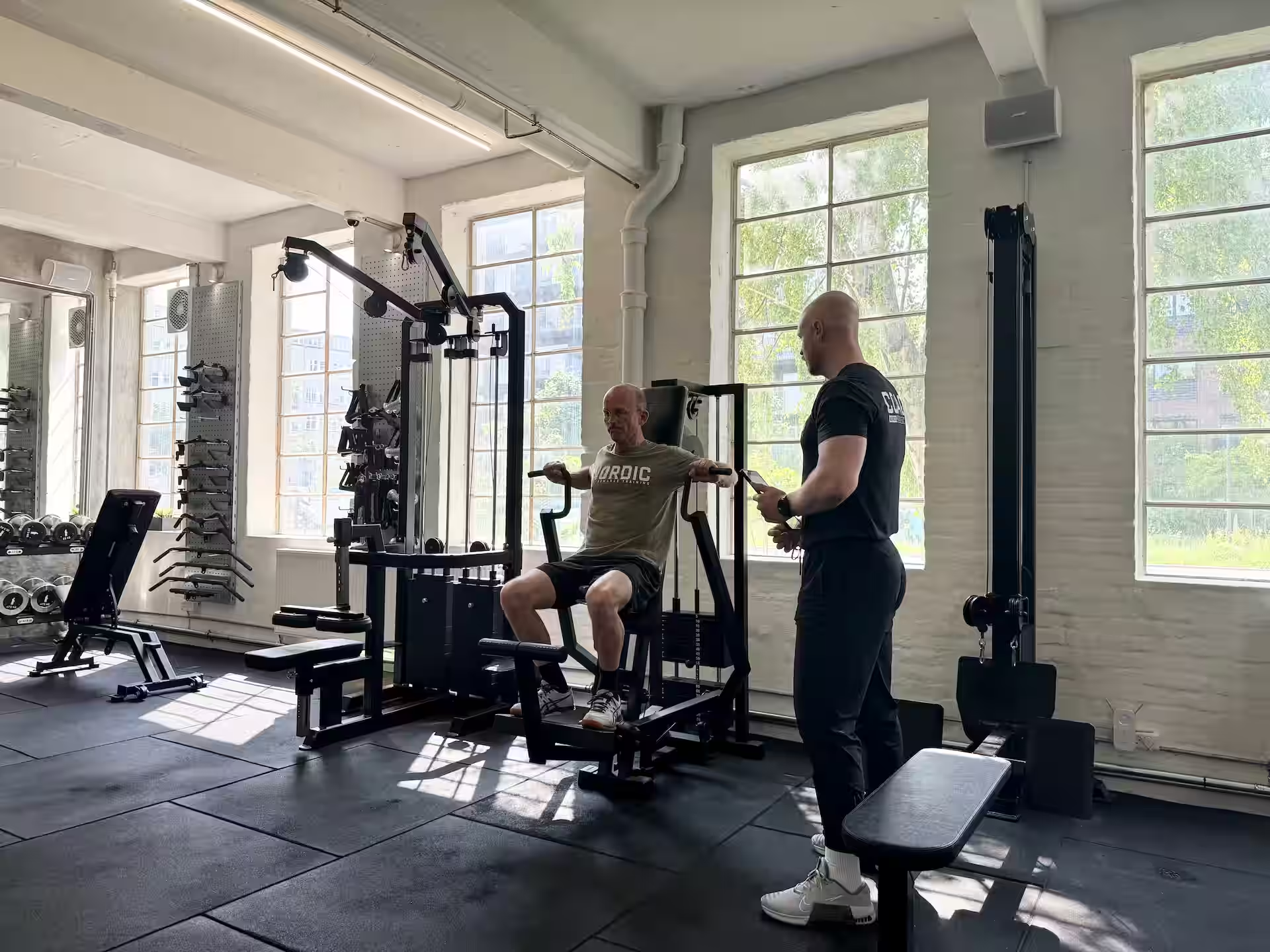
Jakob described it like this after two months: "For the first time in eight years, I actually know if I'm making progress. It might sound trivial – but it changed everything for me. I have something to chase. Something concrete."
How to get started
1. Choose your rep range
We typically use 6-8 reps. It's heavy enough to build strength and muscle, but not so heavy that technique falls apart.
The exact number isn't what matters most.
What matters most is that you choose one range and stick with it. Don't change it because you read something new. Don't adjust it because it feels a bit boring. Just stick with it.
2. Find your starting weight
Choose a weight you can lift for the lowest number of reps in your range with good technique – while still having 1-2 reps left in the tank.
If your range is 6-8, you should be able to do 6 clean reps without completely exhausting yourself.
Can you only do 4-5? Too heavy.
Could you easily do 10? Too light.
Most people start too heavy. They want to impress themselves – or others. But it's a trap. Start conservatively. There's plenty of time to build up.
3. Write it down
Every time you train, record what you did. Weight, sets, reps.
It doesn't need to be fancy. A note on your phone is fine.
But it must be written down. Without tracking, you're guessing – and guessing is exactly what we're trying to get away from.
You can't improve what you don't measure.
4. Increase reps first
Your goal is to reach the top number of reps in your range across all your sets.
If you're doing 3 sets in the 6-8 range, you need to hit 8, 8, 8.
That rarely happens in one week. Maybe it goes like this:
- Week 1: 6, 6, 6
- Week 2: 7, 6, 6
- Week 3: 7, 7, 6
- Week 4: 8, 7, 7
- Week 5: 8, 8, 7
- Week 6: 8, 8, 8
Six weeks to reach the goal?
That's completely normal. In fact, that's how it should be. Patience isn't passivity – it's strategy.
5. Increase the weight and start over
When you hit your goal, add the smallest possible weight.
Typically 2.5 kg for upper body exercises. 5 kg for leg exercises.
Now you start over with 6 reps and repeat the entire process.
It might sound boring. It might sound too simple to work. But that's exactly the point: The methods that work are rarely exciting. They're just effective.
When progress slows down
Here's something nobody tells you: The stronger you get, the slower it goes.
In the beginning, it feels almost magical. You add a rep every week. Your bench press goes from 60 to 80 to 100 kg. You feel unstoppable, as if you've found a secret formula everyone else has overlooked.
But at some point – maybe after three months, maybe after a year – the pace changes.
Suddenly it takes two or three weeks just to add one extra rep. You start to doubt. Is this even working anymore? Should I try something else?
No.
It doesn't mean you're doing something wrong. It means you're no longer a beginner.
In the beginning, progress comes primarily from your nervous system. Your brain learns to activate your muscles more efficiently. That happens relatively quickly – and it feels fantastic.
But once the nervous system has "woken up," the rest is about building new muscle mass. And muscles grow slowly. Very slowly.
That's why we adjust the strategy. Instead of trying to improve all three sets at once, we focus on one set at a time:
- Week 1: 100 kg × 6, 6, 6
- Week 2: 100 kg × 7, 6, 6
- Week 3: 100 kg × 7, 7, 6
- Week 4: 100 kg × 7, 7, 7
- Week 5: 100 kg × 8, 7, 7
It doesn't look like much on paper. One rep here, one rep there.
But that's exactly how strength is built over time. Small adjustments, week after week. Patience over heroic efforts.
Most people won't accept that. They want faster results, so they switch programs. And start over. Again.
Three levels of progression
To give you a realistic picture – here's how double progression typically looks over 24 weeks for different experience levels:
Notice the difference.
The beginner adds 35 kg to their lift over 24 weeks. The advanced lifter adds 5 kg. Both make progress. Both get stronger. But the pace is vastly different.
That's not a problem. That's reality.
And the sooner you accept it, the sooner you stop chasing programs that promise unrealistic results.
Four mistakes to avoid
1. Switching exercises too early
Every time you switch exercises, you start over. You have to learn the movement, find the right weight, and spend weeks just getting going.
It might feel productive. It might feel like you're "mixing it up" and challenging your body in new ways.
But in reality, you're wasting time.
Stay with the same exercise for at least 8-12 weeks. Preferably longer. The clients who get strongest are the ones who stick with it longest.
2. Increasing weight too quickly
Impatience is your enemy.
If you add 5 kg when you should have only added 2.5 kg, you risk falling back to fewer reps than necessary. Then it takes even longer to move forward.
Take the small jumps. They add up over time.
2.5 kg per month doesn't sound like much. But that's 30 kg in a year. How many people do you know who added 30 kg to their bench press in the last year?
3. Ignoring bad weeks
Some weeks you won't hit what you did last time. It happens.
Sleep, stress, illness, busy periods at work, kids waking up at night – all sorts of things affect your performance.
One bad week means nothing. The problem only arises if it becomes a pattern over several weeks. Then it's time to look at what's happening outside the gym.
4. Pushing yourself to failure every set
If you completely exhaust yourself on every set, you destroy your ability to perform on the next ones. And you accumulate fatigue that affects your next workout.
Stop with 1-2 reps left in the tank.
It might feel wrong. It might feel like you're cheating. But it's actually smarter training. You're building strength – not fatigue.
Small progress is still progress
Just because the numbers don't go up every week doesn't mean you're standing still.
You can absolutely have gotten stronger – even if the machine only allows jumps of 2.5 kg, and you're not quite ready for it yet.
Maybe you're lifting the weight with better control. Maybe it feels lighter. Maybe your tempo is more stable. Maybe you don't have to fight as hard for the last rep.
The progress is happening. It's just not always visible in the numbers.
Jakob discovered this after four months. His weight on bench press had only gone up 7.5 kg – but his technique was unrecognizable. "I lift in a completely different way now," he said. "More controlled. More confident. It feels like the weight does what I want it to."
That's also progress. Just a different kind.
Strength training isn't about magic or secret techniques. It's not about the perfect program or the optimal exercise.
It's about showing up, following a plan, and continuing long enough for your body to respond.
Most people stop too early. They change direction just when it's starting to work. They look for something new because the old thing feels boring.
But those who keep going?
They end up in a completely different place than everyone else.
Double progression gives you the plan. The rest is up to you.
Want a complete training program that uses double progression?
Read our guide to Full Body training, where we cover everything from exercise selection to program structure.
One thing double progression can't solve
You now have a system that tells you exactly when to increase weight and reps. That's half the equation.
The other half is technique.
Because it doesn't help to add 2.5 kg if your movement is crooked. Or if you're activating the wrong muscles. Or if you have mobility issues you don't know you have.
It's hard to see yourself. And that's exactly why many people choose to get help.
If you live in Copenhagen and want someone to look at your training, we offer a free introductory consultation. No obligations – just a conversation about where you are and where you want to go.
Book your free start-up conversation here.
References
Schoenfeld, B. J., Grgic, J., Van Every, D. W., & Plotkin, D. L. (2021). Loading recommendations for muscle strength, hypertrophy, and local endurance: A re-examination of the repetition continuum. Sports, 9(2), 32. https://doi.org/10.3390/sports9020032
Ralston, G. W., Kilgore, L., Wyatt, F. B., & Baker, J. S. (2017). The effect of weekly set volume on strength gain: A meta-analysis. Sports Medicine, 47(12), 2585–2601. https://doi.org/10.1007/s40279-017-0762-7
Damas, F., Phillips, S. M., Libardi, C. A., Vechin, F. C., Lixandrão, M. E., Jannig, P. R., Costa, L. A. R., Bacurau, A. V., Snijders, T., Parise, G., Tricoli, V., Roschel, H., & Ugrinowitsch, C. (2016). A review of resistance training-induced changes in skeletal muscle protein synthesis and their contribution to hypertrophy. Sports Medicine, 46(8), 1071–1085. https://pubmed.ncbi.nlm.nih.gov/25739559/
Fisher, J., Steele, J., & Smith, D. (2013). Evidence-based resistance training recommendations for muscular hypertrophy. Medicina Sportiva, 17(4), 217–235. https://www.researchgate.net/publication/228830087_Evidence-Based_Resistance_Training_Recommendations
Table of Contents
Related Blog Posts




I’ve worked as a personal trainer and physiotherapist for many years and I bring a calm, professional presence to every session, helping people feel comfortable and confident in the gym no matter their starting point.I help my clients build structure and consistency and the habits that drive real, lasting progress.
My approach is clear, effective, and sustainable, and I have extensive experience helping clients train safe and effectively with pain.
On this blog, I share the same practical methods we use at Nordic every day — so you can train with confidence and keep moving forward.



Related Blog Posts
.svg)