









Biceps Exercises: The Complete Guide to Biceps Curl [2026]
Ditte, 44, works at the airport and has tried to get started with personal training several times over the years. But it always became too complicated — too many exercises, too many details to keep track of — and she ended up giving up every time. In the periods in between, she trained a bit on her own but often got pain. Particularly at the front of the shoulder, a pain that came and went and never really disappeared.
When she came to us, we started calmly. A simple full body program with the most important, basic exercises. But we also added something she hadn't tried before: incline biceps curl. Not primarily to build bigger arms — but because the exercise taught her shoulder blade to remain stable under load. When the shoulder blade slides forward instead of holding its position, it's precisely that movement that provoked her shoulder pain. Incline curl built that capacity in a way that was simple to learn and easy to continue working with.
After a few months, the shoulder pain was gone. And as a bonus, she got strong and well-trained arms.
"We use biceps and triceps exercises for more than just building bigger arms. They build robust elbows and shoulders that can handle everyday loading — and they supplement precisely what the big pressing and pulling exercises don't target effectively. It doesn't take much: one biceps exercise and one triceps exercise, 2 times per week. That's precisely what I do myself — and it's enough to keep getting stronger, year after year, without having to start over." — Simon, physiotherapist at Nordic Performance Training
This guide covers the most important biceps exercises, how to do them correctly, and when it makes sense to add them to your programme.
What is biceps — and why train it in isolation?
Most people think of "biceps" as one muscle. But the elbow flexor group actually consists of four muscles: biceps brachii with its long and short head, brachialis, and brachioradialis. They're activated differently and contribute more or less to bending the elbow depending on where in the movement the weight is heaviest and how both the shoulder and the wrist are positioned while the elbow bends.
Biceps brachii crosses both the shoulder and elbow joint. It's relatively stronger compared to the other elbow flexors when the elbow is fully extended and the forearm is supinated — that is, with the palm facing upward. That's why a supinated grip activates biceps the most — something bodybuilders intuitively figured out long before scientific studies were conducted on the subject.
Brachialis sits under biceps and only crosses the elbow joint. It's unaffected by grip position and works effectively in all curl variations.
Brachioradialis runs along the top of the forearm and is relatively stronger compared to the other elbow flexors close to full elbow flexion with a pronated grip — palm pointing downward — in contrast to biceps.
The elbow flexors are already trained in all pulling exercises — cable pulldown, cable row, and chin-ups. They develop biceps and the other muscles well enough to function well in everyday life. But biceps and the other elbow flexors aren't fully activated as the primary muscle — they contribute as synergists, and the direct stimulus is limited compared to an isolated curl. That's precisely the gap our curl variations give us the opportunity to close, when it's relevant.
When does isolated biceps training make sense?
If you train once per week, direct biceps training is not necessary. Your time is better spent on the big pressing and pulling exercises and the rest of an effective full body program.
If you train two or three times per week, 4-6 sets of direct biceps work per week is an effective addition. It takes 8-10 minutes at the end of the session. It's not all our clients who have isolated arm exercises in their programme — but for those who do, there's always a specific reason that justifies it.
Biceps curl — technique and variations
EZ-bar cable curl
Our starting point for most clients. Simple to set up, can be micro-loaded in 0.5 kg increments, and hits all the elbow flexors effectively. The semi-supinated grip on the EZ-bar feels comfortable and is gentle on the wrists.
An advantage of using cable for biceps training is that the friction in the cable reduces the load slightly on the way down compared to the way up. This is particularly relevant for the elbow flexors, as they're one of the muscle groups that most easily become sore and fatigued from heavy training. With cable, you can train hard and effectively without the body spending unnecessary energy recovering afterwards.
Setup: Stand in front of the cable machine with the EZ-bar handle mounted low. Grip the handle with a semi-supinated grip — pull the shoulders slightly up and back to stabilise the shoulder girdle and upper back.
Execution: Bend the elbows in a controlled manner up toward full elbow flexion. At the top: a short hold before you slowly lower the weight back to full extension. The upper arms remain stable — it's only the forearms that move.
Tempo: Controlled up in 2-3 seconds, slowly down.
Incline dumbbell curl
A primary variant for many of our clients — and not primarily chosen to maximise biceps activation, but because it builds strength and control over the entire shoulder girdle.
When the arm hangs vertically downward and positioned behind the torso, the shoulder must actively stabilise the position throughout the entire movement — the shoulder blade must be kept stable and prevented from sliding forward. That's precisely the capacity that was missing in Ditte, and one of the reasons she experienced pain at the front of the shoulder when the training began to get challenging.
For clients with shoulder pain or reduced scapular control, incline curl is therefore not just a biceps exercise — it's an exercise that systematically builds the stability that prevents and treats precisely that type of shoulder irritation.
Setup: Set the bench to approximately 60 degrees. Sit with the back against the bench and let the arms hang freely down along the sides with a dumbbell in each hand.
Execution: Bend the elbows in a controlled manner up toward full elbow flexion with a supinated grip. Keep the shoulder blades active and stable — don't let them slide forward. At the top: a short hold before you lower slowly and in a controlled manner back to full extension.
Tempo: Controlled up, slowly down.
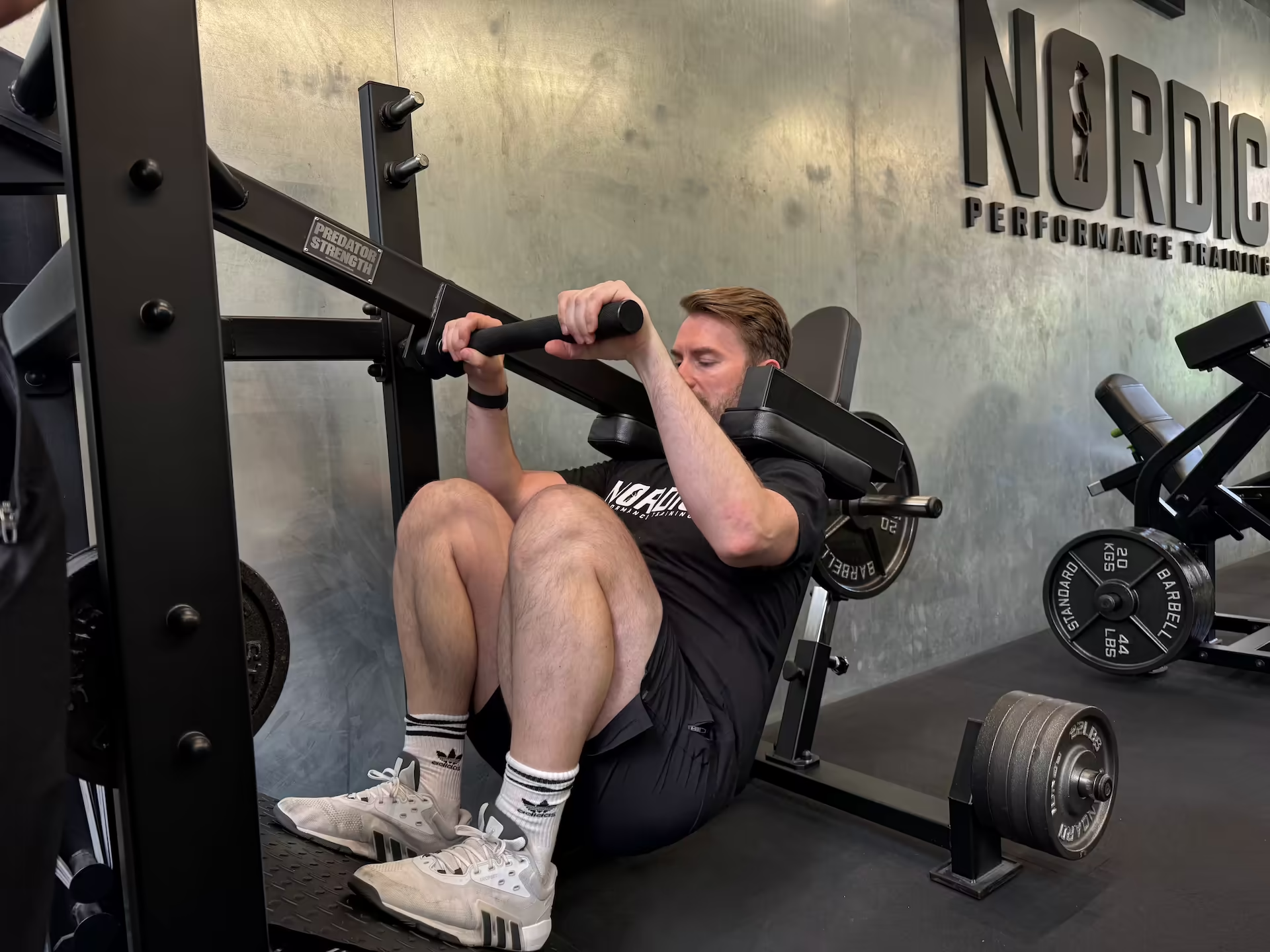
Dumbbell preacher curl (supinated, unilateral)
For more experienced clients who want to maximise the load on biceps brachii. The upper arm rests on the pad and the shoulder is fixed — the entire movement is locked around the elbow joint. This provides external stability and makes it possible to train hard without the technique collapsing.
The resistance profile is favourable for biceps: on a 45-degree preacher bench, the resistance is heaviest at a point relatively close to full elbow extension — precisely where biceps has its best leverage compared to the other elbow flexors. We do it unilaterally — one arm at a time — because you can push harder and get more out of each set than if both arms work simultaneously. It also provides the opportunity to address any imbalances between the sides.
Execution: Place the upper arm solidly on the pad with a supinated wrist. Bend the elbow in a controlled manner up toward full elbow flexion. At the top: a short hold before you lower slowly and in a controlled manner back to full extension.
Semi-pronated EZ-bar cable curl
A targeted variation for clients who specifically want to develop brachioradialis — the muscle that runs along the top of the forearm. The semi-pronated grip on the EZ-bar reduces biceps' contribution and lets brachioradialis take more of the work.
The same advantage as with EZ-bar cable curl applies here: the cable friction reduces the load on the way down and decreases the risk of unnecessary accumulation of fatigue in the elbow flexors.
Not a standard exercise, but a relevant addition for those who want to target that part of the elbow flexor group.
Hammer curl
Hammer curl is performed with a neutral grip — palms facing each other. It removes some of biceps' contribution and lets brachialis take more of the work. A good variation for those who want more focus on brachialis or experience discomfort in the wrist with a supinated grip. Not an exercise we use in our programmes, but a natural choice for those who want to vary.
The most common mistakes
Too heavy weight and swinging with the body. The upper body swings backward to help the weight up. This reduces the biceps work markedly and makes it impossible to standardise technique and measure your progress. You're not lifting more because your biceps has gotten stronger, but because you're changing the technique. Reduce the weight, keep the body stable, and don't increase weight faster than you're actually getting stronger.
Elbows wandering far forward. The elbows are brought far forward at the top of the movement. This reduces the range of motion and deprives biceps of some of the work. Keep the upper arms stable along the side of the body.
Too fast eccentric phase. The weight is released down instead of being lowered in a controlled manner. The eccentric phase is important for standardisation and injury prevention — always lower slowly in 2-3 seconds.
Too limited range of motion at the bottom. The elbow is not fully extended at the bottom. Full extension is crucial for standardisation of technique and training of all muscle fibres.
Too large weight jumps. The elbow flexors are one of the muscle groups that most easily accumulate fatigue — and because you don't use particularly heavy weight in isolation, even a small jump becomes percentage-wise very large. A jump from 12 kg to 13.75 kg is almost a 15% increase in one week. That's far too much. You just train harder — you don't get stronger — and you'll guaranteed hit a plateau. Use 0.5 kg increments and follow double progression with systematic, controlled increases.
Do you need isolated biceps training?
For most who train once per week: no. Cable pulldown, cable row, and chin-ups train the elbow flexors sufficiently, and your time is better spent on the big exercises.
For those who train two or three times per week: 4-6 sets of direct biceps work per week is an effective addition that takes 8-10 minutes at the end of the session. It hits the spot the pulling exercises don't deliver full stimulus — and builds the robustness in elbows and shoulders that allows the body to hold up to training year after year.
It's important to emphasise, however, that most clients who have specific goals of stronger or more defined arms achieve them anyway without isolated arm exercises — it perhaps goes slightly slower, but the programme is easier to stick with with fewer exercises. Prove to yourself first that you can keep up a simple programme for a longer period before you add more exercises.
Ditte is a good example. She got stronger arms and pain-free shoulders — not because we added a complicated arm programme, but because we found the one exercise that solved both problems at once.
Read more about chin-ups and pull-ups in our pull-ups guide and about triceps exercises in our triceps exercises guide.
Biceps and shoulder pain
Pain at the front of the shoulder is often associated with irritation of the biceps long head tendon — the tendon that connects the long head of biceps with the shoulder joint. But shoulder pain is multifactorial. Sleep, stress, work posture, previous injuries, and general loading all play a role — and it's rarely one single thing that's the whole explanation.
One of the factors we can do something about in training is how the exercises are performed. Lack of scapular control — the shoulder blade sliding forward under load instead of holding its position — is one of the movement patterns that over time can contribute to irritation at the front of the shoulder. Precisely as we saw with Ditte.
Incline curl is in that context not just a biceps exercise. It's an exercise that systematically builds the scapular stability that can prevent and reduce precisely that type of shoulder irritation. Not as a treatment in itself — but as part of a programme that builds a shoulder that's stronger and more robust over time.
If you have persistent pain at the front of the shoulder, read more in our guide to impingement in the shoulder.
Frequently Asked Questions About Biceps Exercises
What is the best biceps exercise?
The best biceps exercise is the one you can perform with good technique and increase systematically over time. Our starting point is EZ-bar cable curl — simple, gentle on wrists and elbows, and easy to micro-load. For more experienced clients, we also use incline dumbbell curl, dumbbell preacher curl, or pronated curl depending on the goal.
How can you train biceps?
Biceps is trained effectively with curl variations — cable curl, dumbbell curl, or preacher curl. Biceps is also activated in all pulling exercises like cable pulldown and chin-ups. For most people, 4-6 sets of direct biceps work per week is more than sufficient as a supplement to the pulling exercises.
How often should you train biceps?
For most people, 1-2 times per week is sufficient. If you train once per week, direct biceps training is not necessary, as it takes time from more important exercises. If you train two or three times per week, 4-6 sets of direct biceps work per week is an effective addition placed at the end of the session.
What's best to train together with biceps?
Biceps is naturally trained as part of a full body programme after the big compound exercises. If you want to add isolation, it's placed at the end of the session. Read more in our Full Body program guide.
Biceps exercises at home — what works?
Dumbbell curl, incline curl, and hammer curl can all be done at home with dumbbells. Chin-ups are also an effective home exercise that trains biceps hard. Cable is preferred in a gym because the friction reduces the load on the way down and the resistance profile can be adjusted.
Is there a difference in biceps exercises for women and men?
No — the anatomy is the same and the same exercises apply for everyone. The only difference is starting weight and progression, which is always adapted individually.
Want to train with us?
We help you find the programme that suits your body and your everyday life — simple, effective, and without unnecessary complexity.
Book a free start-up conversation and hear how personal training in Copenhagen can look for you — either in our private gym or as a call, if that suits you better.
References
Coratella, G., Tornatore, G., Longo, S., Toninelli, N., Padovan, R., Esposito, F., & Cè, E. (2023). Biceps brachii and brachioradialis excitation in biceps curl exercise: Different handgrips, different synergy. Sports, 11(3), 64. https://doi.org/10.3390/sports11030064
Marcolin, G., Panizzolo, F. A., Petrone, N., Moro, T., Grigoletto, D., Piccolo, D., & Paoli, A. (2018). Differences in electromyographic activity of biceps brachii and brachioradialis while performing three variants of curl. PeerJ, 6, e5165. https://doi.org/10.7717/peerj.5165
Haugen, M. E., Vårvik, F. T., Larsen, S., Haugen, A. S., van den Tillaar, R., & Bjørnsen, T. (2023). Effect of free-weight vs. machine-based strength training on maximal strength, hypertrophy and jump performance — a systematic review and meta-analysis. BMC Sports Science, Medicine and Rehabilitation, 15(1), 103. https://doi.org/10.1186/s13102-023-00713-4
Table of Contents
Related Blog Posts

I’ve worked as a personal trainer for over 12 years and as a physiotherapist for over 10 years — and co-founded Nordic Performance Training with Lucas 8 years ago to give clients a professional and structured way to train. Since then, I’ve helped hundreds of people build strength, stay consistent, and feel better through evidence-based methods that actually work.
Along the way, I’ve completed advanced certifications and mentored under leading experts in various fields, and I’ve taught many trainers and physiotherapists internationally.
On this blog, I share the same practical tools, insights, and strategies we use every day at Nordic — so you can train smarter, stay consistent, and get real results.



Related Blog Posts
.svg)