







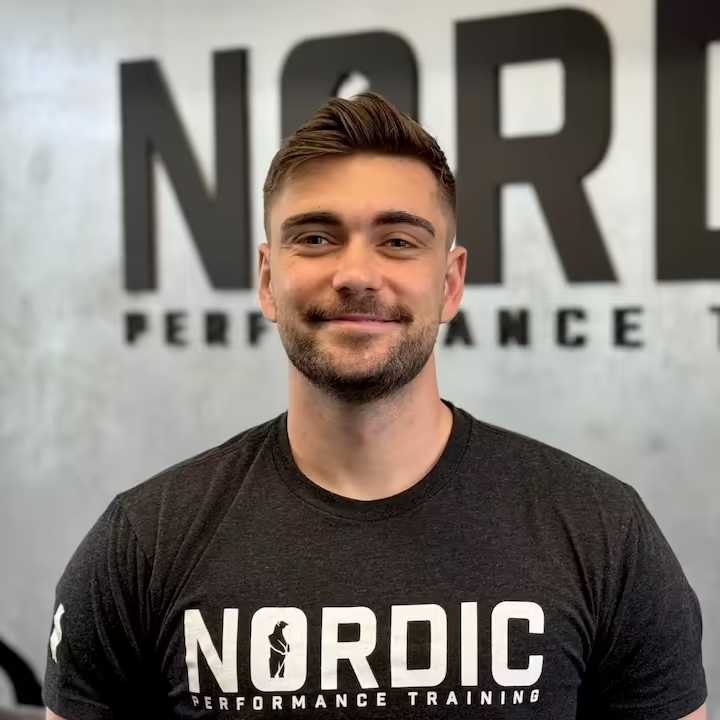

Shoulder Impingement: Exercises and Treatment That Work
Jette was 38 years old and wanted to lose weight. She signed up for group training at a CrossFit center, and in the beginning it was great — it was social, energetic, and the teammates pushed each other to go all out.
But after a few months, her shoulder started to hurt. Especially everything that involved arms overhead — wall balls, snatches, shoulder press — provoked the pain. She kept going anyway. It was fun after all, and you didn't want to cancel on the team.
The problem was that Jette had gone from nothing to a large amount of unaccustomed movements in uncontrolled weight and volume in a short time. The shoulder became overloaded — not because something was wrong with it, but because it wasn't prepared for what it was being asked to handle. And when she didn't get guidance to dial back what was provoking it, it slowly got worse.
Eventually she couldn't participate at all. Even the rowing machine and holding onto the handlebars on the stationary bike hurt too much. She stopped training entirely — the exact opposite of what she needed.
When Jette came to us, she was frustrated and anxious that her shoulder was "ruined." Her doctor had said shoulder impingement — a word that sounds as if something is pinching inside the joint. It isn't. And that explanation was part of the problem.
We started over. Systematically. With exercises the shoulder could tolerate, and a structure where we could always dial up or down depending on how it responded to the previous training session. As the shoulder improved, Jette supplemented with spinning classes and slowly began incorporating better food choices into her daily life.
After 12 months of personal training with us, she had lost weight, become markedly stronger — and no longer had shoulder pain.
"I came to get help with my shoulder. I hadn't expected that I would both become pain-free, end up losing weight and become stronger than ever. One thing just followed the other." — Jette
What is shoulder impingement?
If you have been told that you have shoulder impingement — or impingement syndrome, as it is also called — then you have probably been given an explanation that involves something "pinching" inside the shoulder joint. Perhaps you've even heard that a nerve is pinched in the shoulder. It isn't.
The name is misleading. "Impingement" stems from a mechanical explanatory model from 1972, where it was believed that a bony prominence on the top of the shoulder pinched the tendons underneath when you lifted the arm. That model does not hold up according to more recent research. That is why the condition today is professionally called subacromial pain syndrome — but we just call it shoulder pain. Because that is what it is: pain that typically arises with movement above shoulder height or lifting out to the side.
And you are far from alone. 44-65 % of all consultations for shoulder pain are diagnostically placed in this category. It is the most common cause of shoulder pain overall.
The most important thing to understand is that your shoulder is not ruined. There is nothing pinching, and there is nothing that needs to be "fixed" mechanically. The pain is typically caused by overloading — exactly as in Jette's case — and it responds very well to the right approach.
Are frozen shoulder and impingement the same thing?
No. They are two different conditions that are often confused but require different understanding.
With shoulder impingement — that is, what we call shoulder pain — it is primarily pain with movement that is the problem. You can typically still move the arm, but it hurts, especially when you lift it out to the side or overhead. The range of motion is there — but it is painful.
With a frozen shoulder, it is stiffness and loss of range of motion that dominates. The shoulder gradually locks up, and you lose the ability to move it — regardless of whether you try yourself or someone helps you. It is a fundamentally different condition with a different course.
If you are unsure about what you have, a physiotherapist can quickly differentiate between the two. But regardless of the diagnosis, the principle is the same: active training adapted to what you can tolerate is the way forward.
Symptoms of shoulder impingement
The most typical symptom is pain when you lift the arm out to the side or overhead — particularly in the area just below and just above 90 degrees of shoulder elevation, what many call "the painful arc." The pain typically sits on the front or outside of the shoulder and can radiate down typically the outside of the upper arm.
Other common symptoms: Pain with repetitive movements, especially overhead activities — which was exactly what Jette experienced with wall balls and snatches. Stiffness in the shoulder and nighttime pain, particularly if you lie on the affected side. Just like with a neck pain and lower back pain, nighttime pain can disrupt sleep and affect mood and energy in daily life. Weakness or a feeling of insecurity in the shoulder, especially when lifting.
Who is affected? Shoulder impingement is particularly common in people who suddenly increase the amount of shoulder-loading activity — like Jette with CrossFit.
But it also affects people with sedentary jobs who rarely use the shoulder through its full range of motion, athletes with many overhead movements, and people with repetitive one-sided work — hairdressers, painters, electricians — where the shoulder is loaded in the same positions hour after hour. What they all have in common is typically that the load exceeds what the shoulder is prepared for — either in volume or intensity.
Why surgery and passive treatment don't work
This is the most important section of the article. Because what the research shows goes directly against what many are still being told.
Surgery is no better than a sham operation
Yes, you read that right. The most widespread operation for shoulder impingement — subacromial decompression, where bone and tissue are removed to "make room" — has been tested against a sham operation where the surgeon only looked into the joint without doing anything. And the result is unequivocal.
A large Finnish study followed 210 patients in three groups: real operation, sham operation and exercise therapy. At the 2-year follow-up, there was no clinically meaningful difference between the groups. All three improved — but the operation added nothing. At the 5-year follow-up, the conclusion was the same.
A large British study published in The Lancet found exactly the same: surgery was no better than the sham operation. The difference compared to no treatment was of uncertain clinical significance.
A Cochrane review from 2019, which compiles all available evidence, concludes with high certainty: subacromial decompression provides no clinically important benefits over a sham operation — neither in pain, function nor quality of life.
The researchers behind the Finnish study themselves recommend dropping the term "impingement," because the mechanical theory is outdated. Nothing is pinching. And if nothing is pinching, it doesn't make sense to operate to "make room."
This is a strong indication that it is not a mechanical fault that needs to be corrected — but a pain problem that needs to be managed. And that is precisely why the diagnostic name is part of the problem. When you hear "impingement," you think something mechanical. Something pinching. Something you need to protect. That creates an understanding that leads you away from the only thing that actually works: using structured training.
Cortisone injections
A cortisone injection in the shoulder can provide short-term pain relief, and it can have its place in acute cases where the pain is unbearable. But it doesn't change the cause. Up to 90 % of people with this type of shoulder pain achieve good results with conservative treatment alone — structured training and time. Injections should not be the first choice, and they should not be repeated indefinitely.
The scanning trap
If you have had an MRI of the shoulder, you may have been told that there are "changes" or "wear." But here is what most people don't hear: MRI scans regularly find changes in people who have no pain at all. Studies show that asymptomatic people often have the same findings as those in pain. This applies to the shoulder, to the back, to the neck and to the knees.
A finding on a scan is not necessarily an explanation for your pain. And it is certainly not a verdict on what you can and cannot do.
Massage, rest and ice
Passive treatments can provide temporary relief — and that has its own value if you need to take the edge off the pain. But they don't change anything about the course of the condition. They are symptom treatment, not cause treatment. And rest alone — the approach many instinctively choose — typically prolongs the course.
The great irony of "impingement" is that the name sounds like something you need to protect the shoulder from loading to avoid. The evidence says the exact opposite: progressive loading is the medicine.
Shoulder impingement exercises: Why the specific exercise matters less than you think
When you search for shoulder impingement exercises, you typically find lists of isolated rotator cuff exercises, external rotation with a resistance band and scapular stability exercises. Those exercises work. But here is the point: none of them have been shown to work better than general strength training.
The research shows that it is the activity and the controlled and increasing load over time that creates the improvement — not the specific exercise. Scapular stabilization, rotator cuff training and eccentric training all produce good results. But so does a well-structured strength training program. Plus a general improvement in strength.
That is why we don't give our clients an isolated shoulder rehabilitation protocol.
We give them a strength training program — and adapt it so that the shoulder is trained progressively within an acceptable pain range.
"We see it again and again: people come with a list of 'specific shoulder exercises' they've been doing without improvement — often resistance band exercises. But what actually works is giving them a structured strength training program — and then adapting what needs to be adapted." — Lucas Iversen, physiotherapist
What we specifically do — and what Jette did
"I had tried pushing through for months and the only thing I got out of it was that it got worse. At Nordic Performance Training, it was the first time anyone said: we start with what you can do, and then we build up slowly from there." — Jette
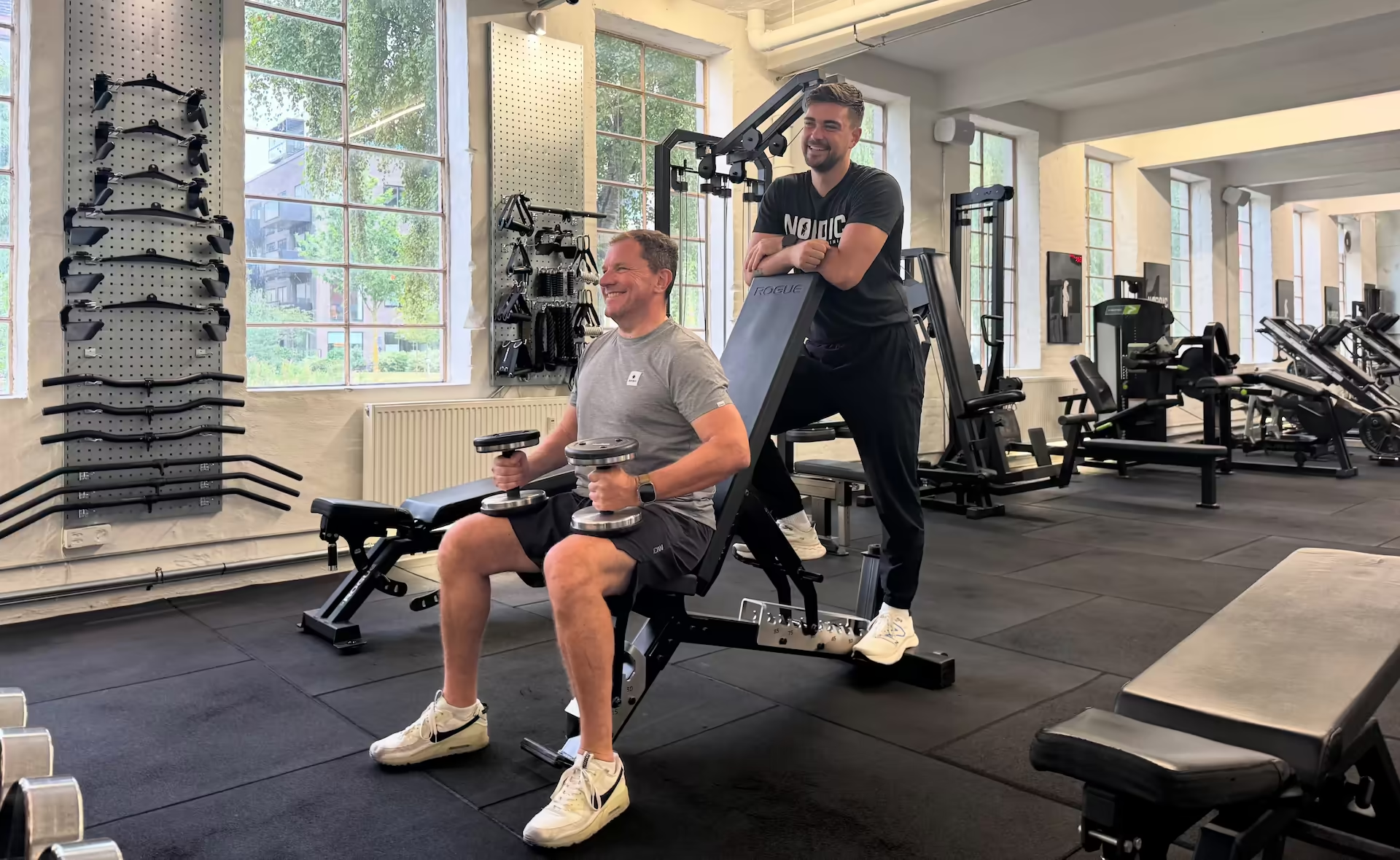
When Jette started with us, she could do almost nothing with her shoulder. We started with the exercises she could tolerate and built up slowly from there.
Press exercises: Machine Chest Press with a weight that didn't provoke the pain. Here Jette learned to move with a natural flow — retraction of the shoulder joint with simultaneous retraction of the shoulder blades for a controlled stretch of the chest — rather than just pressing a weight from A to B. This is not just strength training, it is movement training that feels comfortable for the nervous system and is better mechanically.
Pull exercises: Cable Pulldown, where she learned the opposite movement — elevation with scapular protraction and upward rotation. Again a natural flow, not a sequentially divided movement.
Shoulder isolations: Cable Lateral Raise and Cable Y-Raise rather than dumbbells. Cables can be set up so that the resistance is not heaviest in the painful area — the range that many call "the painful arc." With dumbbells, the load is always greatest precisely where it typically hurts the most. With cables, we can shift the resistance profile so the exercise can be performed pain-free or with minimal discomfort. This does not mean that dumbbells are bad — there are many with shoulder pain who can easily perform them, as long as the technique is adapted. But we always have alternatives and ways to optimize for the individual.
Biceps and triceps exercises — which in reality are also shoulder work: This is something most people overlook. When you do an Incline Dumbbell Curl, the shoulder is in extension and external rotation (the upper arm behind the torso, rotated outward) while you flex the elbow. When you do an Overhead Cross Cable Triceps Extension, the shoulder is lifted above shoulder height and rotated inward. In both cases, you are stabilizing the shoulder and shoulder blades while performing flexion or extension at the elbow — you are training the shoulder's end-range positions by proxy. Additionally, the long heads of the biceps and triceps cross the shoulder joint and contribute directly to stability. Your "arm exercises" are thus also shoulder rehabilitation and part of the entire pain-modulating effect we get from general strength training.
Lower body: Exactly as normal. Shoulder pain changes nothing about your ability to squat, do leg curls or leg extensions. Additionally, you get a lot of static work around the shoulder by stabilizing yourself during the execution of leg exercises in the machines.
Increases in weight and repetitions followed our double progression method: a repetition zone of typically 6-8 reps, where the weight increases when you reach 8 repetitions in all sets with good technique. Our training machines make it possible to increase by 0.5 to 2.5 kg at a time — crucial for precise dosing when the shoulder is sensitive.
The structure meant that we could always adjust. If the shoulder responded poorly to the previous training session, we dialed down a little. If it responded well, we repeated or dialed up a little.
No guesswork, no uncontrolled loading. Just systematics.
As the shoulder improved, Jette supplemented with spinning classes — and slowly began incorporating better food choices into her daily life. One thing drove the other. More energy, better mood, more motivation.
After 12 months, she was in a different place. Stronger. Lighter. And completely pain-free.
When should you see a doctor?
Most cases of shoulder impingement — that is, shoulder pain — do not require acute medical evaluation. It is typically an overuse condition that responds well to structured training over time.
But see a doctor if: You experience sudden loss of strength in the arm, where you cannot lift it or grip things. This may indicate an acute tendon injury that requires a different evaluation. You have had a trauma — a fall, a collision — and the pain arose in direct connection with it. You experience neurological symptoms such as numbness, tingling or radiating pain down into the hand. This may have a different cause than the shoulder. The pain worsens despite active training over 3-6 months. In most cases, there should be progress within that timeframe — if not, it is worth getting a renewed evaluation.
FAQ about shoulder impingement
What does impingement mean?
The word means 'pinching' — but it is misleading. It suggests that something is pinching mechanically inside the shoulder joint. More recent research shows that this explanation does not hold. The condition is today professionally called subacromial pain syndrome, because it more accurately describes what is happening: pain in the shoulder, not a mechanical defect.
What do you do for shoulder impingement?
The most effective approach is structured strength training within an acceptable pain range — with progressive loading over time. Up to 90 % achieve good results with this approach alone. Passive treatments such as massage and injections can provide temporary relief but don't change the course of the condition. And surgery has been shown to be no better than a sham operation.
What do you do for impingement syndrome?
Impingement syndrome is another word for shoulder impingement. The approach is the same: active, structured training adapted to what your shoulder can tolerate. Inactivity typically prolongs the course — progressive loading shortens it.
How long does shoulder impingement take to go away?
2-6 months with structured strength training 1-3 times per week. The duration depends more on your activity level than on treatment type. Those who remain active and train systematically get through it faster than those who wait.
Can you train with shoulder impingement?
Yes — and you should. Structured training within an acceptable pain range is the best-documented approach. The key is to adapt the exercises, not to stop training. Inactivity prolongs the course.
Should you have surgery for impingement?
No. Several large studies show that surgery for shoulder impingement is no better than a sham operation. A Cochrane review from 2019 confirms this with high evidence quality. Start with structured strength training.
What is the difference between impingement and a rotator cuff injury?
Shoulder impingement — or subacromial pain syndrome — is primarily a pain problem. The tendons are irritated and overloaded but not necessarily damaged. A rotator cuff injury involves an actual tear in one or more of the four tendons that stabilize the shoulder joint. However, mild and moderate rotator cuff injuries also respond well to structured strength training.
Ready to get through your shoulder pain?
If you have shoulder pain and are unsure about what you can and cannot do, we understand. It is frustrating — especially when you have been told that something is "pinching."
But your shoulder is not ruined. You most likely do not need an operation. And you certainly do not need to stop training.
Book your free start-up conversation, and we will go through together how a training program can look for you — exactly as we did with Jette. You leave with a plan, regardless of whether you choose to train with us or not.
References
Paavola, M., Malmivaara, A., Taimela, S., et al. (2018). Subacromial decompression versus diagnostic arthroscopy for shoulder impingement: randomised, placebo surgery controlled clinical trial. BMJ, 362, k2860. https://doi.org/10.1136/bmj.k2860
Paavola, M., Kanto, K., Ranstam, J., et al. (2020). Subacromial decompression versus diagnostic arthroscopy for shoulder impingement: a 5-year follow-up of a randomised, placebo surgery controlled clinical trial. British Journal of Sports Medicine, 55(2), 99-107. https://doi.org/10.1136/bjsports-2020-102216
Beard, D. J., Rees, J. L., Cook, J. A., et al. (2018). Arthroscopic subacromial decompression for subacromial shoulder pain (CSAW): a multicentre, pragmatic, parallel group, placebo-controlled, three-group, randomised surgical trial. The Lancet, 391(10118), 329-338. https://doi.org/10.1016/S0140-6736(17)32457-1
Karjalainen, T. V., Jain, N. B., Page, C. M., Lähdeoja, T. A., Johnston, R. V., Langford, B., ... & Buchbinder, R. (2019). Subacromial decompression surgery for rotator cuff disease. Cochrane Database of Systematic Reviews, 1(1), CD005619. https://doi.org/10.1002/14651858.CD005619.pub3
Consigliere, P., Haddo, O., Levy, O., & Sforza, G. (2018). Subacromial impingement syndrome: management challenges. Orthopaedic Research and Reviews, 10, 83-91. https://doi.org/10.2147/ORR.S157864
Creech, J. A., & Silver, S. (2023). Shoulder Impingement Syndrome. StatPearls. StatPearls Publishing. https://www.ncbi.nlm.nih.gov/books/NBK554518/
Table of Contents
Related Blog Posts


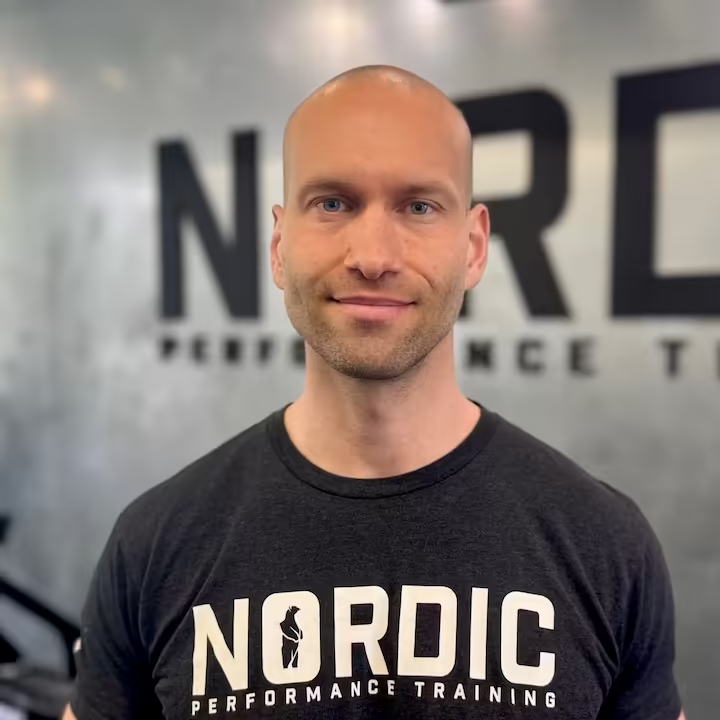
I’ve worked as a personal trainer for over 14 years and as a physiotherapist for over 8 years — and co-founded Nordic Performance Training with Kasper to give clients a professional, private, and structured training environment where results actually last. In that time, I’ve overseen more than 15,000 sessions and helped hundreds of clients rebuild after injuries, gain strength, improve their health, and stay consistent.
My approach combines practical experience with evidence from the latest research, making training both effective and realistic.
On this blog, I share the same methods we use every day at Nordic — so you can cut through the noise and focus on what truly works.




Related Blog Posts
.svg)