









Neck Pain Exercises: 5 Strength Exercises That Actually Work
The complete guide to understanding stiff neck — and why structured strength training delivers better and more lasting results than neck massage, resistance band exercises and ergonomic pillows.
The first time Mette came into our private training center in Copenhagen, it was because she had heard from an acquaintance that strength training could help her get rid of her tense neck muscles and the recurring stiff neck episodes she had been struggling with for over three years. She was skeptical at first, as she had already been through two different chiropractor courses of treatment, a course with a traditional physiotherapist and had acquired an ergonomic office chair for 12,000 kr with a special pillow that promised "optimal cervical support."
"I've tried everything," she said. "Massage helps for a couple of days, but then it comes back. My chiropractor says my cervical vertebrae are misaligned and need to be adjusted. My physiotherapist treated me with ultrasound and handed me a pamphlet with 10 resistance band exercises that I'm supposed to do 15 minutes every day. But it's as if none of it really works."
Mette is 38 years old, a project manager, and sits in front of a screen most of the day. A working life that is not far removed from most Copenhageners.
After more than 8 years of structured strength training in our private training center in Copenhagen, we see the same pattern again and again: Capable, resourceful people who spend time and money on treatments that only provide temporary relief — while the solution that actually works long-term is the simplest of them all. It just requires that it is performed correctly and consistently:
Not resistance band exercises. Not neck massage. Not ergonomic gadgets. Real strength training, 1-2 times per week, with exercises that make the entire body stronger and more resilient.
Mette's stiff neck didn't disappear because of one magic exercise. It disappeared because she stopped treating her neck as an isolated problem and started training her body as a complete system.
What is a stiff neck?
A stiff neck is a sudden stiffness or pain in the neck region, often combined with reduced range of motion. You may not be able to turn your head to one side, it can radiate up into the head or out into the shoulders, and it feels as if something has "locked up."
It sounds dramatic. But it rarely is.
In the vast majority of cases, a stiff neck is a harmless, self-limiting episode. There is no damage, nothing is broken, and nothing requires acute treatment. It is the body's way of reacting — often to a combination of sedentary work, poor sleep, stress or simply an awkward movement.
It's a bit like waking up with a muscle cramp in your calf. It hurts. It's uncomfortable. But it doesn't mean your leg is broken.
Symptoms and when it resolves
Typical symptoms of a stiff neck include stiffness and pain with movement, soreness in the neck and shoulder muscles, tension headache and in some cases pain radiating into the shoulder or arm.
Here is the most important thing you need to know: Most acute episodes of stiff neck subside on their own within days to weeks — regardless of which treatment you choose. Research shows that most cases of acute neck pain resolve spontaneously. Treatment appears to have limited effect on the natural course.
So it is not your chiropractor visits over a 3-week period that fixed it. It was simply just time. Researchers call it "natural history" — the natural course of disease. Just like a common cold has a course that ends with you getting better regardless of whether you take vitamin C or not, most episodes of stiff neck have a course that ends with improvement regardless of which treatment you choose. The body is extraordinarily good at healing itself. The problem arises when we attribute the healing to whichever treatment we happened to receive along the way.
But — and this is an important "but" — neck pain has a pronounced tendency to return. Studies show that between 50 and 85 percent of those who experience neck pain report pain again within 1-5 years. And this is precisely where the story changes. Because the question is not how you get rid of this episode. The question is what you do to stand stronger when the next one comes.
Think about this: When you get the flu, it's extremely uncomfortable. But you can tolerate it because you know it will pass. You've learned that. It's part of your understanding of what the flu is. But when it comes to bodily pain — stiff neck, back pain — something different happens. Many people begin to imagine that something is broken. That a vertebra is out of place. That the disc has been pushed out of position. This kind of catastrophic thinking is entirely understandable, but it actually worsens and prolongs the pain experience, because the nervous system reacts to the perceived danger — not just the physical condition. It is not imaginary. It is neurobiology. And it means that a large part of the solution is about changing the way you understand and relate to your pain.
How common is neck pain?
Neck pain affects up to two out of three people at some point in their lives. This makes it the fourth most common cause of disability globally, surpassed only by back pain, depression and joint pain.
Annually, over 30 percent of the population experiences neck pain. The numbers are higher among women, higher in high-income countries, and higher in cities than in rural areas. Office workers and people who work extensively in front of screens have a particularly high prevalence.
In other words: If you've had a stiff neck, you're not special. You're just a completely normal person with a completely normal body.
And that's actually good news. Because it means your neck isn't broken. It's just reacting, as bodies tend to do.
Why most treatments don't work long-term
When you get a stiff neck, the natural reaction is to seek out something that can remove the pain. A massage. A chiropractor visit. Resistance band exercises. A new ergonomic pillow.
And many of those things can actually feel nice in the moment. Massage can provide short-term relief. An adjustment at the chiropractor can give a feeling that something "falls into place." But when we look at what the research actually shows, a clear picture emerges.
The problem with passive treatment
Manual treatment — massage, chiropractic, acupuncture — can reduce pain in the short term. But it does nothing about the underlying cause. It doesn't make you stronger. It doesn't improve your conditioning. It doesn't strengthen the muscles that support your neck. And it often doesn't change your view of your body's resilience, in the same way that the experience of becoming stronger and more robust does during structured strength training.
Think of it as the difference between taking a headache pill, rather than fixing what's giving you the headache. For example sleep, fluid intake, stress-reducing measures.
At best, passive treatment provides acute pain relief. In most cases, the only thing you get out of it is temporary pain relief and talking to another person about your pain. There are no actual health-promoting effects. No building of strength. No prevention of the next episode.
And when the pain returns — as it statistically does for more than half — you start over.
The problem with resistance bands and isolation exercises
Many physiotherapists and trainers recommend resistance band exercises and small isolation exercises for the neck. Side bends with the hand against the head. Nodding movements with a resistance band. Static holds for 10 seconds.
The exercises are not wrong in themselves. But they have three fundamental problems:
First, the load is too low to make you stronger. Your body only adapts when it is challenged beyond what it is accustomed to. A resistance band with minimal resistance rarely does that.
Second, there is no way to create structured progression. You cannot gradually and precisely increase the load on a resistance band in the same way you can on a machine or with dumbbells. And without a progression plan to ensure progress, there is no sustained adaptation.
Third, they provide no general health effects. You get no improvement in your overall strength, your bone density, your mental health or your metabolism. You just move your neck in isolation, without enough resistance to create a real change. Furthermore, it often just contributes to you hyperfocusing on one area of your body — the part that currently hurts — which again can have an amplifying effect on the brain's perception of danger.
Mette had done her resistance band exercises for three months. Her neck was just as stiff, and she was just as frustrated.
Why strength training works — also against neck pain
Now it gets interesting. Because strength training gives you something that no other treatment can: a body that is stronger, healthier and more resilient — including the neck.
And the evidence is convincing. A comprehensive series of Danish studies has consistently shown that strength training for the neck and shoulder region reduces pain significantly in office workers. Not resistance band exercises. Not ergonomic adjustments. Strength training.
One of the studies showed that even very small amounts of structured strength training reduced frequent neck pain significantly. Another found that strength training 1-3 times per week for 20 weeks produced marked pain reduction — both for those who already had pain, and as prevention for those who did not.
Pain modulation: Your body has its own painkilling system
When you strength train, you activate a phenomenon that researchers call exercise-induced hypoalgesia — a bodily reduction of pain sensitivity that occurs during and after training.
It works a bit like the body's own painkilling system. When you load the muscles heavily enough, the body releases endorphins and other pain-dampening substances that increase your pain threshold. Research shows that strength training can increase the pain threshold by 15-20 percent.
Over time, with repeated training, this effect can become more permanent. This is called training-induced hypoalgesia — a lasting reduction in baseline pain sensitivity.
So strength training doesn't just give you bigger muscles. It literally changes how your nervous system processes pain signals.
Strength prevents relapse
Here is the argument that really should move the needle: Neck pain often returns. Between 50 and 85 percent experience it again within 1-5 years.
Strength training is the best insurance you can take out. At best, you get both pain relief and all the health-promoting effects — better sleep, more energy, stronger bones, better mood, increased metabolism. At worst, you become stronger and healthier, and the pain resolves on its own with time anyway.
Compare that to passive treatment: At best, you get acute pain relief, but in most cases you get nothing other than a financial cost.
Top 5 exercises for neck pain
The five exercises we recommend are not neck isolation exercises. They are real strength training exercises that train the entire upper body — and that strengthen the structures that support and offload the neck.
They are infinitely more effective than resistance band exercises, neck massage and other passive approaches. And they can all be integrated into a regular Full Body program, so you don't need a separate "neck program."
1. Cable Y-Raise
Cable Y-Raise targets your shoulders and upper back with particular focus on the lower trapezius and promotes the movement of the shoulder blade that is the biomechanical counterpart to sitting hunched in front of a computer. The exercise strengthens the structures that help offload the neck and improve control of the shoulder blades.
Think of it as lifting the shoulders in the opposite direction of the collapsed position they have been sitting in all day. See a demo-video here.
2. Wide Grip Cable Pulldown
This variant of cable pulldown targets the upper back, neck and the back of the shoulders. Performed slightly leaned back, with focus on pulling the elbows out to the side and back, it contributes to better posture and increased range of motion in the upper back and shoulder.
It is particularly relevant for you who sit a lot, because it actively counteracts the forward-leaning posture that many hours in front of a screen creates. See a demo-video here.
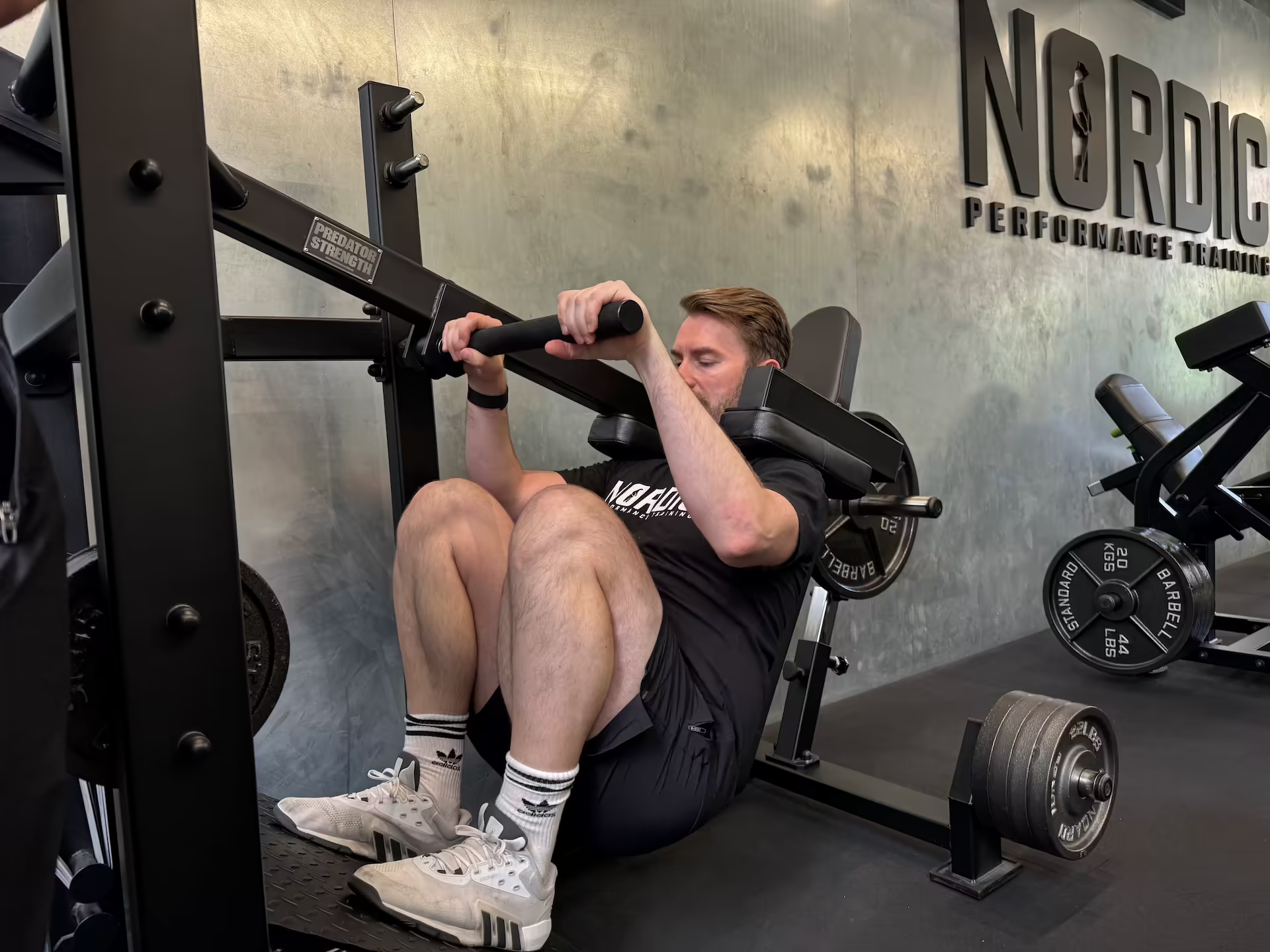
3. Chest Press Machine
It may sound counterintuitive to recommend a chest exercise for neck problems. But a good chest press machine gives you a large range of motion with slight lift in the upper back, contraction of the shoulder blades and full stretch of the chest muscles.
It trains controlled movement of the shoulder blades under load and can improve overall shoulder and neck function. And it does so while you become stronger in the entire upper body. It is actually the exercise that most of our clients feel makes the biggest difference. See a demo-video here.
4. Cable Row (Semi-Pronated Grip)
Cable Row strengthens the mid trapezius and the muscles that pull the shoulder blades together — precisely the structures that counteract the forward head posture that is so widespread among office workers. And it also challenges the uppermost neck muscles. Because when you have recurring episodes of pain in a muscle, it is often a better idea to strengthen it than to rest it.
When the exercise is performed with the chest lifted and focus on controlled contraction of the shoulder blades, it becomes particularly effective at supporting the neck. It's not about pulling with the arms. It's about activating the back and neck. See a demo-video here.
5. Dumbbell Lateral Raise
Lateral Raise strengthens the middle part of the outer shoulder muscle, the rotator cuff muscles and the neck. It is usually easiest to start with a Y-Raise in the cables if you have neck tension, but as a progression this is a good way to challenge your neck and shoulder further.
What really speaks for this exercise is how simple and practical it is. See a demo-video here.
Free program: How to get started
You don't need a separate neck program. On the contrary. The five exercises above can all be part of a good Full Body program that you can do 1-3 times per week.
If you train 1-3 times per week with Full Body
All five exercises are already covered in our free Full Body programs. Cable Pulldown, Cable Row, Chest Press and Lateral Raise are standard exercises in our program. Cable Y-Raise can be integrated as a variation of the shoulder isolation exercise.
In other words: If you follow a structured Full Body program, you are already training the most important muscle groups for preventing and relieving stiff neck — without adding anything extra.
You can find our free Full Body programs for 1, 2 and 3 weekly training sessions in our Full Body Program guide.
If you want to add extra focus on the neck
If you have recurring neck problems and want to give the area a bit of extra attention, you can swap your standard Cable Pulldown for a Wide Grip variant and add Cable Y-Raise as a supplement to your Lateral Raise.
It takes zero extra time. You simply replace one exercise with another that has more focus on the upper back and neck. Simple, effective and realistic.
Tension headache and the neck
Tension headache often stems from tense neck and shoulder muscles, and the solution is the same capacity-building that the rest of this guide is about. We've written a dedicated article on why strength training works for tension headache, and how to get started: tension headache and training.
When should you seek professional help?
A stiff neck is in the vast majority of cases harmless and self-limiting. But there are situations where you should contact a doctor:
Radiating pain, numbness or tingling down the arm, especially if accompanied by weakness in the hand. Neck pain after a trauma, such as an accident or a fall. Pain that becomes progressively worse over weeks without improvement. Accompanying symptoms such as fever, weight loss or general malaise. If you experience coordination problems or difficulty walking together with neck pain.
These symptoms are rare. But they are important to know. If you are in doubt, contact your doctor.
For everyone else — the vast majority — the principle applies: Keep going. Get stronger. And try not to panic and stress about your pain.
Frequently asked questions about stiff neck
Can you train with a stiff neck?
Yes, in most cases. An acute stiff neck is not a contraindication for strength training. It may be necessary to adjust load and exercise selection for the first few days, but staying active is generally better than lying still. Start with what you can, and build up gradually.
How long does a stiff neck last?
Most acute episodes subside within days to weeks. If the pain persists for more than 6-8 weeks, it is a good idea to seek professional guidance — not to "fix" the neck, but to get help with a structured approach to building strength and confidence.
Is massage good for a stiff neck?
Massage can provide short-term pain relief, and there is nothing wrong with that. But it doesn't make you stronger, and it doesn't prevent future episodes. If you choose massage, use it as a supplement to strength training — not as a replacement.
Which neck exercises help against a stiff neck?
The most effective neck exercises are not isolated neck exercises, but strength training exercises that load the entire upper body with focus on the upper back, shoulders and chest. Cable Y-Raise, Cable Pulldown, Chest Press, Cable Row and Lateral Raise are our top five.
Can strength training prevent a stiff neck?
Yes. Danish research from the National Research Centre for the Working Environment shows that strength training for the neck-shoulder region both reduces existing pain and prevents new episodes — even with a relatively small time investment.
Ready to build a stronger neck?
If you are tired of treating symptoms and ready to build real strength, let's have a talk.
Book a free start-up conversation at our private gym in Copenhagen. We help you find the right Full Body program — regardless of whether you train one, two or three times per week.
You get a plan that fits your life. Not a 15-minute resistance band program you never do anyway. But a structured training program that makes your entire body stronger — neck included.
Mette has now trained with us for 14 months. Her neck? It's fine. But that's not what she's most proud of. It's that for the first time in her life she can say: "I'm a person who strength trains twice a week." The neck pain disappeared somewhere along the way. Not because she treated it — but because she built a body that was stronger than the challenges everyday life presents her with.
A stiff neck is not a disease. It is a part of life. And the best way to handle it is not to treat it, but to build a body that can do more.
References
Cohen, S. P. (2015). Epidemiology, diagnosis, and treatment of neck pain. Mayo Clinic Proceedings, 90(2), 284–299. https://pubmed.ncbi.nlm.nih.gov/25659245/
Côté, P., Cassidy, J. D., Carroll, L. J., & Kristman, V. (2004). The annual incidence and course of neck pain in the general population: a population-based cohort study. Pain, 112(3), 267–273. https://pubmed.ncbi.nlm.nih.gov/15561381/
Andersen, L. L., Jørgensen, M. B., Blangsted, A. K., Pedersen, M. T., Hansen, E. A., & Sjøgaard, G. (2008). A randomized controlled intervention trial to relieve and prevent neck/shoulder pain. Medicine and Science in Sports and Exercise, 40(6), 983–990. https://pubmed.ncbi.nlm.nih.gov/18461010/
Andersen, C. H., Andersen, L. L., Gram, B., Pedersen, M. T., Mortensen, O. S., Zebis, M. K., & Sjøgaard, G. (2012). Influence of frequency and duration of strength training for effective management of neck and shoulder pain: a randomised controlled trial. British Journal of Sports Medicine, 46(14), 1004–1010. https://pubmed.ncbi.nlm.nih.gov/22753863/
Gram, B., Andersen, C., Zebis, M. K., Bredahl, T., Pedersen, M. T., Mortensen, O. S., Jensen, R. H., Andersen, L. L., & Sjøgaard, G. (2014). Effect of training supervision on effectiveness of strength training for reducing neck/shoulder pain and headache in office workers. BioMed Research International, 2014, 693013. https://pubmed.ncbi.nlm.nih.gov/24701581/
Rice, D., Nijs, J., Kosek, E., Wideman, T., Hasenbring, M. I., Koltyn, K., Graven-Nielsen, T., & Polli, A. (2019). Exercise-induced hypoalgesia in pain-free and chronic pain populations: state of the art and future directions. The Journal of Pain, 20(11), 1249–1266. https://pubmed.ncbi.nlm.nih.gov/30904519/
Table of Contents
Related Blog Posts



I’ve worked as a personal trainer and physiotherapist for many years and I bring a calm, professional presence to every session, helping people feel comfortable and confident in the gym no matter their starting point.I help my clients build structure and consistency and the habits that drive real, lasting progress.
My approach is clear, effective, and sustainable, and I have extensive experience helping clients train safe and effectively with pain.
On this blog, I share the same practical methods we use at Nordic every day — so you can train with confidence and keep moving forward.




Related Blog Posts
.svg)