






Every transformation here is real — written by the client’s own coach.
These stories show how structured, consistent strength training works across different goals, ages, and starting points.
Each story shows a real process — what the client struggled with, how we structured the training, and the results that followed.
How Zarina Went From "My Body Is Done at 28" to Running Again After 8 Years
Zarina was 27 years old when she walked into our gym. Her body felt like an 80-year-old's, she told us.
She hadn't run in eight years. Not because she didn't want to. But because every time she tried, she got intense pain in her left knee, groin, back, and glute. Pain that made her stop immediately.
She had sought help from physiotherapists, osteopaths, and chiropractors. She had been given various diagnoses: Crooked spine. Crooked pelvis. Runner's knee. Jumper's knee. Unstable shoulders. Each practitioner gave her diagnoses and exercises — strange, "specific" movements that were supposed to "fix" her body.
But nothing helped. The pain got worse and worse. And each diagnosis added a new layer of anxiety and limitation.
"I had so much pain that I couldn't make heads or tails of my own body," Zarina said. "My body felt closer to 80 years old than my actual age."
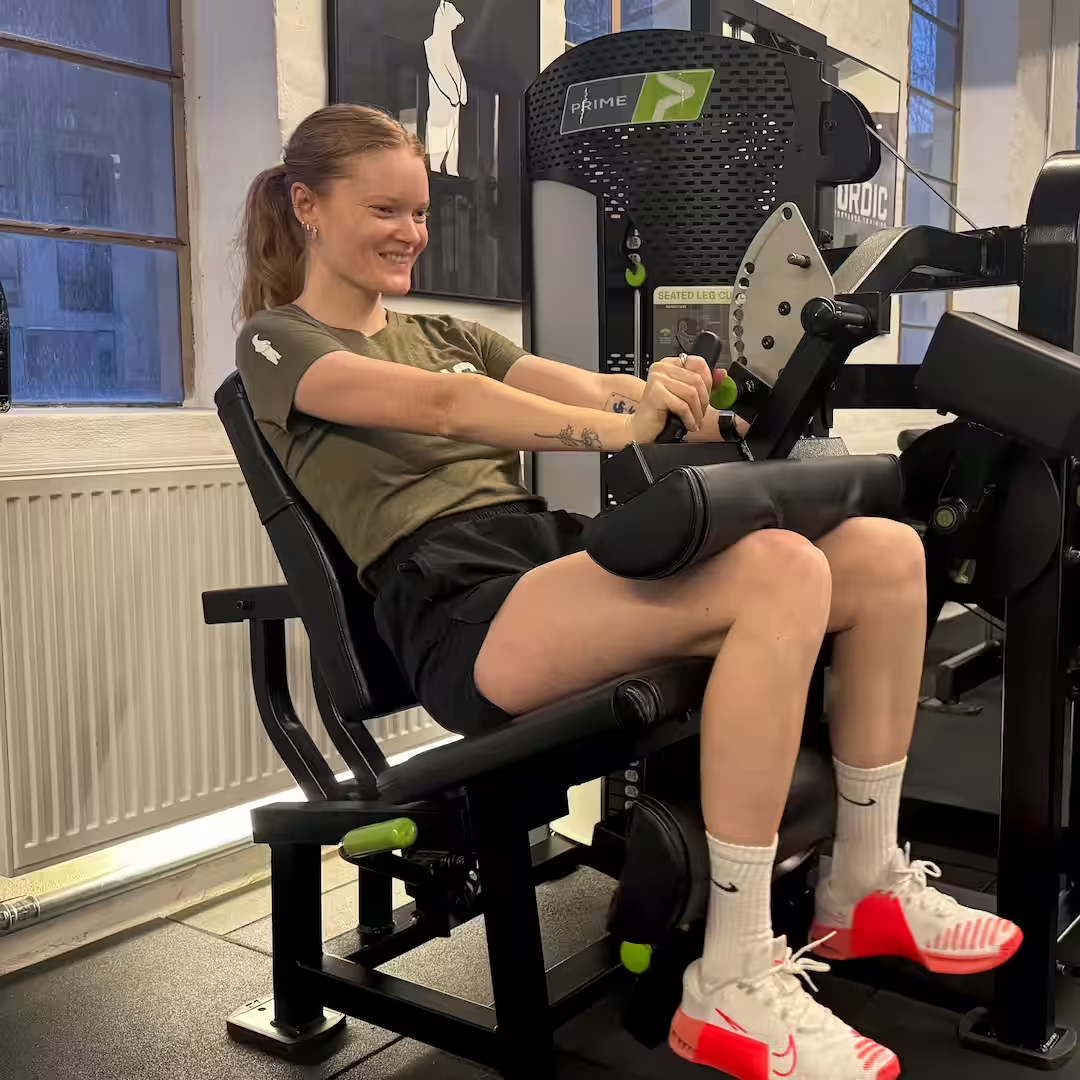
After 6 months of structured strength training twice a week, Zarina started running again. We built up quietly and gradually, and now, 12 months after she started with us, she can run 5 kilometers in about 25 minutes. Completely pain-free.
Here is how a now 28-year-old student discovered that her body wasn't broken. It just needed the right approach — and a trainer who believed in her, even when she didn't believe in herself.
When Diagnoses Become Your Identity
Zarina had involuntarily collected diagnoses over the years. Each practitioner had added a new diagnosis. Each diagnosis told her what she was no longer allowed to do or could do.
"I had been told that I had a crooked spine, crooked pelvis, unstable shoulders, runner's knee, jumper's knee," she said. "Every time I sought help, I got a new explanation for why my body wasn't good enough. And new exercises that were supposed to 'fix' the problem."
But the exercises didn't help. On the contrary. They made her feel more fragile.
"I had to do very specific, strange exercises," she said. "Stretch this, activate that, stabilize something else. It all felt so complicated. And I just became more focused on everything that was wrong."
This is a pattern we see again and again: People who are told that their bodies are "wrong" begin to believe it. And the belief becomes reality.
As we write in our article about rebuilding body confidence: "When an authoritative health professional gives you a diagnosis, your brain becomes hyperfocused on it. The diagnosis begins to fill a disproportionate amount of space in your consciousness. And in the worst case, it becomes a part of your identity."
For Zarina, diagnosis overload became a downward spiral:
- The diagnosis created focus on structural "problems"
- The fear of making it worse led to avoidance
- Less activity made her weaker
- Weakness created more pain
- More pain confirmed the diagnosis
- Even more avoidance
"I can't move like my peers," she said about how she saw herself. "I can't identify with my body. I feel alone in my pain, I have no idea who can help me or how."
"I could have sworn that I would never run again," Zarina reflected.
The Shift: From Focus on Limitations to Focus on Abilities
When Zarina came to us in February, her expectations were small.
"I just wanted to be pain-free in everyday life," she said. "I had long since given up the thought of running again."
But I didn't think we should settle.
"Lucas had significantly higher ambitions than me," Zarina said. "He saw the bigger perspective, something I had long since given up on. So I was probably quite skeptical in the beginning — 'yeah yeah, we'll see, but good that you believe in it.'"
Our approach at Nordic Performance Training was radically different from everything Zarina had tried before:
- No focus on diagnoses: We didn't discuss her so-called "crooked spine" or "unstable shoulders." We asked: What can your body handle right now?
- No corrective exercises: No focus on "fixing" anything. Just simple, structured strength training that made her gradually stronger.
- Focus on capacity, not limitations: Instead of talking about what she couldn't do, we focused on everything she could do — and how we could build further from there.
As I like to say: "Focus on what you can control and improve, and forget the rest."
The exercises Zarina trained:
- Machine Chest Press
- Cable Pulldown
- Hack Squat
- Lying Leg Curl
- Leg Extension
- Dumbbell Lateral Raise
Same exercises every week. Gradually heavier weights. No specific "pain-correcting" movements. Just systematic strength development.
"I thought the pain quickly became less," Zarina said. "And my belief that she could come to run again also made a huge difference."
"Lucas had significantly higher ambitions than me. I just wanted to be pain-free in everyday life, but he saw the bigger perspective — something I had long since given up on." — Zarina
The Breakthrough: When the Belief Returns
Transformation is not just about physical changes. It's about identity shifts.
For Zarina, the breakthrough happened gradually over months:
Month 1-3: The pain began to decrease. Not dramatically, but consistently. She got stronger in the gym. And most importantly: She began to trust that movement wasn't harming her.
Month 4-6: I suggested she start running again. Short. Slowly. Just to test.
"I was skeptical," Zarina said. "But suddenly I was out running again. Longer and longer. Then I could feel my old identity as a runner sneaking back. And then I really started to believe in it myself."
Month 6-12: Zarina's identity shifted completely. From "someone with chronic pain" to "someone who runs and trains structured."
"I love the training structure I've gotten, because now it means I can just turn off my brain and do what needs to be done," she said.
An important element in Zarina's breakthrough was that she had a place to share her worries.
"I shared all my worries and frustrations with Lucas," she said. "If something felt wrong, I knew I could talk to Lucas about it on Monday at our training session. That helped — even though the majority of the time it turned out to be nothing. But then it didn't get to boil over from overthinking."
Zarina's Transformation
After 12 months with 2x weekly training:
Strength gains:
- Machine Chest Press: 15 kg → 35 kg (+133%)
- Hack Squat: 20 kg → 40 kg (+100%)
- Leg Extension: 10 kg → 30 kg (+200%)
- Lying Leg Curl: 15 kg → 25 kg (+67%)
- Cable Pulldown: 36 kg → 50 kg (+39%)
- Visible muscle development
Consistency:
- 97% attendance through 12 months
- Followed the plan to perfection
Pain-free:
- Completely pain-free after many years of "chronic" pain
- No limitations in everyday life
Functional capacity:
- Gone from not being able to run 100m without intense pain to 5km in approx. 25 minutes pain-free
- Can move freely without fear
"Now I can finally use my body again for whatever I want — whether it's running, bike rides, or something else, I'm ready," Zarina said.
Identity shift:
- From "I can't do what my peers can" to "I feel even more amazing than I ever could have imagined"
- From "I'm not someone who strength trains" to "I can't imagine being without it"
- From alone in her pain to confident in her body
"I feel like myself again, actually I feel even more amazing than I ever could have imagined." — Zarina
Why This Works — Even With Many Diagnoses
Zarina's story illustrates a fundamental principle: The diagnosis is not necessarily the problem. It's what you think about the diagnosis.
As we explain in our article about body confidence: "Those who have the hardest time getting strong are not those with the 'worst' scan results. It's those who have been told they are fragile."
Zarina had many diagnoses. But none of them fully explained her pain. And most importantly: None of them prevented her from getting strong.
"What made the difference was shifting focus," I explained. "Instead of talking about everything Zarina couldn't do, we focused on what she could do — and expanded it gradually."
Capacity-focused thinking:
- Limitation focus: "My back hurts, so I'm not allowed to lift"
- Capacity focus: "What can I lift right now, and how can I get stronger?"
- Limitation focus: "I have a knee injury, so I can never run again"
- Capacity focus: "Let's build strength first, then we'll test running when the body is ready"
"I understand now that strength training is the foundation that allows me to move however I want." — Zarina
My coaching philosophy was clear: "Patience, focus on abilities over limitations, positive thoughts about training and movement, and setting the bar high — even if we don't reach all the way up, we still reach higher than if the bar was set low."
Zarina's incredible attendance of 97% shows that she bought into this approach. She trusted the process. She was patient. And the result speaks for itself.

Ready to Shift Focus From Limitations to Capacity?
Zarina spent eight years fighting with pain and diagnoses. 6 months later with she was pain-free and started running again, and 12 months later she feels "even more amazing" than she had ever imagined.
If you are tired of diagnoses that limit you, and want an approach that focuses on what your body can do — not what it can't — then let's have a talk.
Book a free start-up conversation at our private gym in Copenhagen, and experience how structured personal training can rebuild your confidence in your body.
Because your body is not broken. It just needs the right approach — and a personal trainer who believes in you, even when you don't believe in yourself.
Table of Contents
Other Client Stories


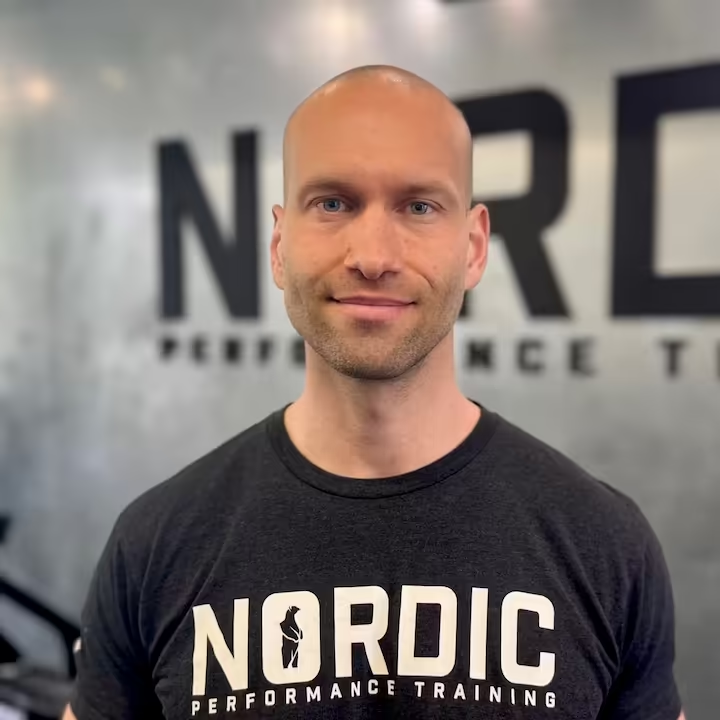
I’ve worked as a personal trainer for over 14 years and as a physiotherapist for 8 years — and co-founded Nordic Performance Training with Kasper to give clients a professional, private, and structured training environment where results actually last. In that time, I’ve overseen more than 50,000 sessions and helped thousands of clients rebuild after injuries, gain strength, improve their health, and stay consistent.
My approach combines practical experience with evidence from the latest research, making training both effective and realistic.
On this page, I share real client stories — so you can see what structured, consistent training looks like in practice.


Other Client Stories


.svg)