







Lower Back Pain Exercises: 5 Strength Exercises That Work Better Than Stretching and Manual Therapy
The complete guide to understanding lower back pain — and why structured strength training delivers better and more lasting results than core exercises, stretching and massage.
Christian was 34 years old when he came to us after seven years of battling recurring back pain and episodes of acute lower back pain. He had received three different diagnoses — disc herniation, spinal osteoarthritis and "unstable lumbar spine" — and had been treated with everything from chiropractic and acupuncture to McKenzie exercises and a six-week core stability program with a physiotherapist.
"I'm afraid to bend down," he said at the first consultation. "My chiropractor says my L4/L5 is worn out and that I need to avoid loading my back. But I'm 34 — I can't live the rest of my life without lifting anything."
Christian is not unique. We see it often.
After more than 8 years of structured strength training in our private training center in Copenhagen, we see the same pattern again and again: People who have been given a diagnosis, a scan and an explanation — and who are now more afraid of their own back than they are troubled by the pain itself. They have been told that something is wrong and that they need to be careful. And that narrative keeps them stuck in a cycle of fear, inactivity and repeated courses of treatment.
The solution that actually works long-term is the simplest of them all. It just requires that it is performed correctly and consistently:
Structured strength training.
Not the plank. Not McKenzie exercises. Not stretching for the lower back. Real strength training, 1-3 times per week, with exercises that make the entire lower body stronger and more resilient.
Christian's lower back pain didn't disappear because he "fixed" his L4/L5. It disappeared because he stopped protecting his back and started loading it progressively — and discovered that it could handle far more than he thought.
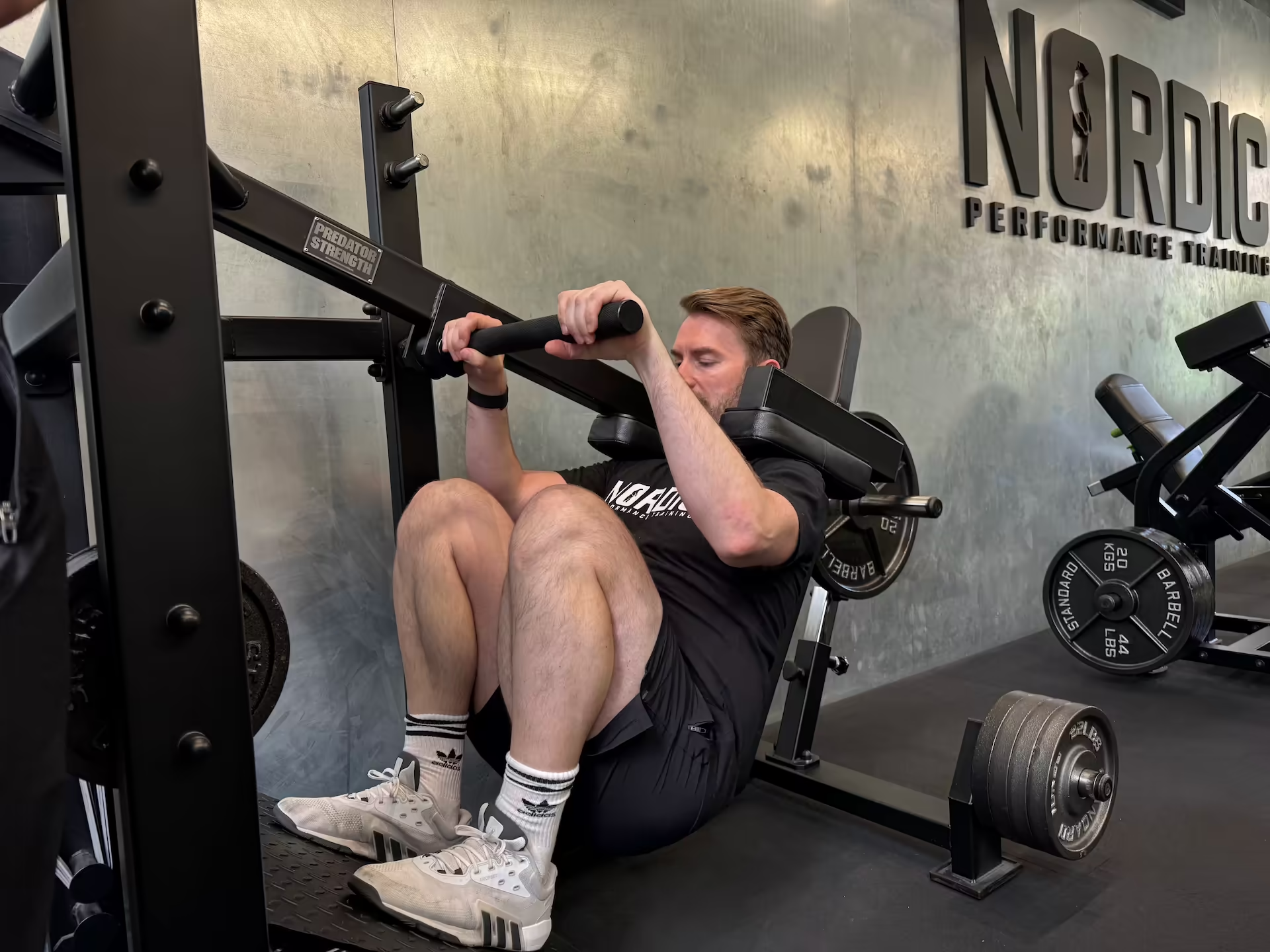
Today he hack squats 110 kg.
What is acute lower back pain?
Acute lower back pain — also called lumbago — is a sudden stiffness or pain in the lower back, often combined with reduced range of motion. You may not be able to bend forward, it can radiate into the buttock or down the leg, and it feels as if the back has "locked up."
It sounds and feels dramatic. But it rarely is.
In the vast majority of cases, acute lower back pain is a harmless, self-limiting episode. There is no damage, nothing is broken, and nothing requires acute treatment. It is the body's way of reacting — often to a combination of unaccustomed loading, poor sleep, stress or simply an awkward movement.
Symptoms and when it resolves
Typical symptoms of acute lower back pain include stiffness and pain with movement, soreness in the lower back muscles, pain that worsens with bending or twisting, and in some cases radiating pain into the buttock or leg.
Here is the most important thing you need to know: Approximately 90 percent of acute episodes of lower back pain resolve on their own within six weeks — regardless of which treatment you choose. For most people, the pain begins to subside markedly within the first week.
So it is not your practitioner's efforts that fixed it. It was simply time. Researchers call it "natural history" — the natural course of disease. Just like a common cold has a course that ends with you getting better regardless of whether you take vitamin C or not, most episodes of acute lower back pain have a course that ends with improvement regardless of which treatment you choose. The body is extraordinarily good at healing itself. The problem arises when we attribute the healing to whichever treatment we happened to receive along the way.
But — and this is an important "but" — back pain has a pronounced tendency to return. Studies show that approximately 33 percent experience a new episode within the first year, up to 50 percent within two years, and up to 70 percent within five years. And this is precisely where the story changes. Because the question is not how you get rid of this episode. The question is what you do to stand stronger when the next one comes.
Think about this: When you get the flu, it's extremely uncomfortable. But you can tolerate it because you know it will pass. You've learned that. It's part of your understanding of what the flu is. But when it comes to bodily pain — lower back pain, stiff neck — something different happens. Many people begin to imagine that something is broken. That a disc has been pushed out. That the back is "worn out." This kind of catastrophic thinking is entirely understandable, but it actually worsens and prolongs the pain experience, because the nervous system reacts to the perceived danger — not just the physical condition. It is not imaginary. It is neurobiology. And it means that a large part of the solution is about changing the way you understand and relate to your pain.
How common is lower back pain?
Back pain affects over 80 percent of all people at some point in their lives. This makes it the most common cause of disability globally — ahead of all other diseases and conditions. In 2021, over 600 million people were living with lower back pain worldwide.
Annually, 15-20 percent of the population experiences back pain at any given time. The numbers increase with age, are higher among women, and are particularly prevalent among office workers and people with sedentary jobs.
In other words: If you've had lower back pain, you're not special. You're part of the large majority.
And that's actually good news. Because it means your back isn't broken. It's just reacting, as bodies do.
Why most treatments don't work long-term
When you get acute lower back pain, the natural reaction is to seek out something or someone that can remove the pain. A chiropractor. A physiotherapist with a focus on core stability. Stretching exercises from YouTube. A new office chair.
And many of those things can actually feel nice in the moment. Massage can provide short-term relief. A set of McKenzie exercises can feel as if something "opens up." But when we look at what the research actually shows, a clear picture emerges.
And here is the paradox: Research shows that the worst thing you can do with acute back pain is to get a scan and a diagnosis too early. Patients who receive an MRI within the first month have a markedly worse prognosis — not because the scan finds something dangerous, but because it almost always finds something normal that is presented as something dangerous. Suddenly you have a disc herniation or osteoarthritis, and now you are afraid to move.
The best thing you can do? The opposite. Keep going. Move. And when the acute phase has settled, start training.
Bed rest worsens back pain. Inactivity prolongs it. And early activity — especially strength training — reduces both pain and the risk of it returning.
The problem with passive treatment
Manual treatment — massage, chiropractic, acupuncture — can reduce pain in the short term. But it doesn't make you stronger, doesn't improve your conditioning and doesn't change your body's resilience. Think of it as the difference between taking a headache pill and fixing what's giving you the headache.
And when the pain returns in a month or three — as it statistically does for a third within the first year — you start over.
The problem with core exercises and stretching
For the back, it is unfortunately not basic strength training but core exercises that dominate the recommendations. McKenzie exercises, McGill Big 3, plank exercises or cat-camel. The exercises are not wrong in themselves, but they have three fundamental problems: The load is too low to create real strength adaptation. There is no way to increase the load over time. And they provide no general health effects — you just train your "core" in isolation, often with a hyperfocus on the area that hurts, which often amplifies the brain's perception of danger.
The premise itself is also questionable. The idea that you need to isolate and "reactivate" specific deep muscles such as the transversus abdominis and multifidi — which many physiotherapists still recommend — has been thoroughly challenged in the research. All trunk muscles work together as a unit. You cannot meaningfully isolate one muscle from the others. Your trunk is stabilized far more effectively through heavy compound exercises like hack squats, where the entire musculature works under real load, than through conscious "core activation" on a mat.
Christian had done his McKenzie exercises and planks faithfully for four months. His back was just as bad, his fear of loading it had only grown — and he hadn't become the slightest bit stronger. On the contrary.
Why strength training works — also against back pain
Now it gets interesting. Because strength training gives you something that no other treatment can: a body that is stronger, healthier and more resilient — including the back.
And the evidence is massive. A large meta-analysis from 2021, based on 249 randomized studies with over 24,000 participants, concluded that exercise is more effective than education alone and more effective than non-active physiotherapy for reducing pain and improving function in people with chronic lower back pain. Clinical guidelines from the WHO, the Danish Health Authority, the American College of Physicians and the British NICE all agree: The first thing you should do for back pain is to exercise — not take medication, get a scan or seek out manual therapy.
But not just any exercise. Progressive structured strength training — the type of training where you gradually increase the load over time — has been shown to reduce relapse markedly. One study found that a group that followed progressive structured strength training had a relapse rate of only 8 percent, while the control group that did not strength train was at 33 percent.
This doesn't mean you should throw yourself into heavy training from day one. On the contrary. Start light, use good training machines that stabilize and guide the movement, and increase the load gradually as you feel confident and actually get stronger. That is the whole point of progressive training — you meet the body where it is and build systematically from there.
Pain modulation: Your body has its own painkilling system
When you strength train, you activate a phenomenon that researchers call exercise-induced hypoalgesia — a reduction of pain sensitivity that occurs during and after training.
Imagine it as a volume knob for pain signals. When you load the muscles heavily enough, the body turns down the sensitivity. Research shows that strength training can increase the pain threshold by 15-20 percent — not only in the trained areas, but also in the rest of the body.
Over time, with repeated training, this effect can become more permanent. The body learns to handle load and pain more efficiently. This is a fundamentally different approach than passive treatment on a table, which only dampens the signal briefly.
So strength training doesn't just give you bigger muscles. It literally changes how your nervous system processes pain signals.
Strength prevents relapse
Here is the argument that really should move the needle: Back pain often returns. Up to 50 percent experience it again within two years, and up to 70 percent within five years.
Strength training is the best insurance you can take out. At best, you get both pain relief and all the health-promoting effects — better sleep, more energy, stronger bones, better mood, increased metabolism. At worst, you become stronger and healthier, and the pain resolves on its own with time anyway.
Compare that to passive treatment: At best, you get acute pain relief. In most cases, the only thing you get is a bill.
The math is quite simple.

Top 5 back exercises for lower back pain
The five exercises we recommend are not core isolation exercises. They are real strength training exercises that train the entire lower body — and that by virtue of their biomechanics specifically strengthen the structures that support and offload the back.
They are infinitely more effective than planks, stretching and other low-intensity approaches. And they can all be integrated into a complete strength training program, so you don't need a separate "back program."
1. Hack Squat
Hack Squat is a machine-based squat variant that loads all the muscles in the lower body — primarily the quadriceps, adductors and glutes — while the machine stabilizes your back in a fixed track. This makes it ideal for people with back pain, because you can train heavy and progressively, easily adjust the weight, and avoid worrying about balance and technique to the same degree as with free squats.
The exercise loads the back muscles isometrically — meaning the spine is held stable under load. This is precisely the type of loading that builds resilience in the structures that support the lower back.
2. Split Squat
Split Squat trains each leg separately, which forces the body to stabilize the pelvis and lower back under load. It provides a strong training stimulus for the glutes, adductors and quadriceps — all muscle groups that play a central role in offloading and supporting the lower back.
For many with back pain, unilateral training is a good way in, because you can work with lower total load while the local muscle activation is high. Split Squat is also a really good alternative to Hack Squat if you don't have access to a Hack Squat machine.
3. Glute Bridge
Glute Bridge targets the glutes directly and simultaneously activates the abdominal muscles. It is one of the most effective exercises for strengthening the posterior chain — the muscle group that is most directly responsible for stabilizing and protecting the lower back.
Perform it with progressive load — either with a barbell across the hips or in a machine variant — and you have an exercise that goes far beyond what a bodyweight plank can offer.
4. Leg Curl
Leg Curl isolates the hamstring muscles. Tight or weak hamstrings are frequently seen in people with back pain — whether one causes the other, or they merely coincide, is still debated. But what we do know is that the hamstrings have a direct mechanical connection to the pelvis, and that weak hamstrings change the conditions under which your back works during daily movements.
Regardless of what came first, it makes sense to strengthen them.
5. Leg Extension
Leg Extension primarily strengthens the rectus femoris, which is one of the 4 muscles in the quadriceps. Just as the hamstrings have a mechanical connection to the back of the pelvis, the rectus femoris — the largest of the four quadriceps muscles — has a direct connection to the front. Weak or tight quadriceps thus affect pelvic position in the same way, just from the opposite side. Strong quadriceps also give you a more robust lower body in daily movements like getting up from a chair, walking stairs and lifting from the floor.
Lower back pain — exercises that strengthen
Many search specifically for exercises targeted at the lower back. And that's understandable — that's where it hurts. But here is the point: The most effective exercises for lower back pain are not exercises that isolate the lower back. They are exercises that strengthen the entire body.
Hack Squat and Split Squat train the entire lower body, while the back muscles work isometrically to keep you stable. Glute Bridge targets the glutes directly — the muscle group most responsible for stabilizing the lower back. Leg Curl and Leg Extension strengthen the back and front of the pelvis respectively and improve the mechanical conditions under which your back works.
But you don't need to think of it as a "back program." All five exercises are standard exercises in a well-structured training program that trains the entire body. And that is precisely the point: The solution to back pain is not to hyperfocus on the back, but to make the entire body stronger.
Spinal osteoarthritis — can strength training help?
Many with back pain have a scan that shows "degenerative changes," "disc herniations" or "spinal osteoarthritis." They are worried, and that's understandable — the words sound serious. But here is what the research actually shows:
A large systematic review examined MRI scans of the spine in people without back pain. The results were striking: Among 20-year-olds without symptoms, 37 percent already had disc degeneration. Among 50-year-olds, it was over 80 percent. And among 80-year-olds, 96 percent had disc degeneration — still without pain.
Taking an MRI of the back of a 40-year-old and becoming worried about "osteoarthritis" is like taking a photo of your face and being surprised about wrinkles. These are normal age-related changes, not injuries.
The diagnosis of "spinal osteoarthritis" thus tells you very little about why you are in pain. But it can tell you a whole lot about what you don't need to be afraid of. Structural changes are normal. And strength training is the best treatment regardless of whether you have been given a diagnosis or not — because it addresses function, strength and resilience, not imaging findings.
Back exercises you can do in the gym
All five exercises in this article can be done with standard machines in a gym. You don't need a separate program just for back training — you need a structured training program with the right dosage and progression over time.
What matters is not which machines you have access to, but that you train with a plan: The right exercises, the right load, and a systematic progression that ensures you actually get stronger week by week.
Free program: How to get started
You don't need a separate back program. On the contrary. The five exercises above can all be part of a well-structured Full Body program that you can do 1-3 times per week.
If you train 1-3 times per week
All five back exercises are already covered in our free Full Body programs. Hack Squat or Split Squat are standard exercises for the lower body, Leg Curl and Leg Extension are isolation exercises for the legs, and Glute Bridge can be integrated as a glute-focused exercise.
In other words: If you follow a structured training program, you are already training the most important muscle groups for preventing and reducing lower back pain — without adding anything extra.
You can find our free training programs for 1, 2 and 3 weekly training sessions in our Full Body Program guide.
When should you seek professional help?
Acute lower back pain is in the vast majority of cases harmless and resolves on its own. But there are situations where you should contact your doctor:
Sudden onset weakness in the legs or problems controlling bladder or bowel (cauda equina syndrome — rare but serious). Radiating pain with increasing numbness or weakness in the leg or foot. Back pain after a trauma, such as an accident or a fall. Pain that becomes gradually worse over several weeks without improvement. Accompanying symptoms such as fever, unexplained weight loss or general malaise.
These symptoms are rare. But they are important to know. If you are in doubt, contact your doctor.
For everyone else — the vast majority — the principle applies: Keep going. Get stronger. And try not to panic and stress about your pain.
Frequently asked questions about lower back pain
Can you train with lower back pain?
Yes, in most cases it is both safe and recommended to train with lower back pain. The research is clear: Bed rest and inactivity worsen back pain, while activity promotes healing.
It may be necessary to adjust load and exercise selection for the first few days, but the goal should always be to get going again as quickly as possible. Start light, use machines that stabilize the movement, and increase the load gradually as you feel confident.
How long does acute lower back pain last?
Most episodes of acute lower back pain resolve within six weeks, and many experience marked improvement within the first week — regardless of treatment.
If the pain persists for more than 6-8 weeks, it is a good idea to seek professional guidance — not to "fix" the back, but to get help with a structured approach to building strength and confidence in movement again.
Are core exercises good for lower back pain?
Core exercises like planks and bird-dogs are not harmful, but they are insufficient as a long-term solution. There is no way to increase the load over time, they provide too low a load to create real strength adaptation and have no general health effects.
The premise itself of isolating "deep core muscles" has also been challenged in the research. Heavy compound exercises like squats train the trunk far more effectively under real load than any amount of planks or bird-dogs.
Can strength training help with spinal osteoarthritis?
Yes. Structural changes such as disc degeneration and osteoarthritis are normal age-related changes found in the majority of the population — including those entirely without pain. 37 percent of 20-year-olds without back pain already have disc degeneration on MRI.
Strength training addresses function and strength, not imaging findings, and is the most effective approach regardless of whether you have been given a diagnosis or not.
Is it dangerous to squat with back pain?
No, not generally. A machine-based variant like Hack Squat gives you the ability to load the legs heavily while the back is stabilized in a fixed track.
This is precisely the type of controlled loading that builds resilience — not the type that causes harm. Start with a load you can handle, and build up gradually over time.
Ready to build a stronger back?
If you are tired of treating symptoms and ready to build real strength, let's have a talk.
Book a free start-up conversation at our private gym in Copenhagen. We help you find the right training program — regardless of whether you train 1, 2 or 3 times per week.
You get a plan that fits your life. Not a 15-minute core program you never do anyway. But a structured training program that makes your entire body stronger — back included.
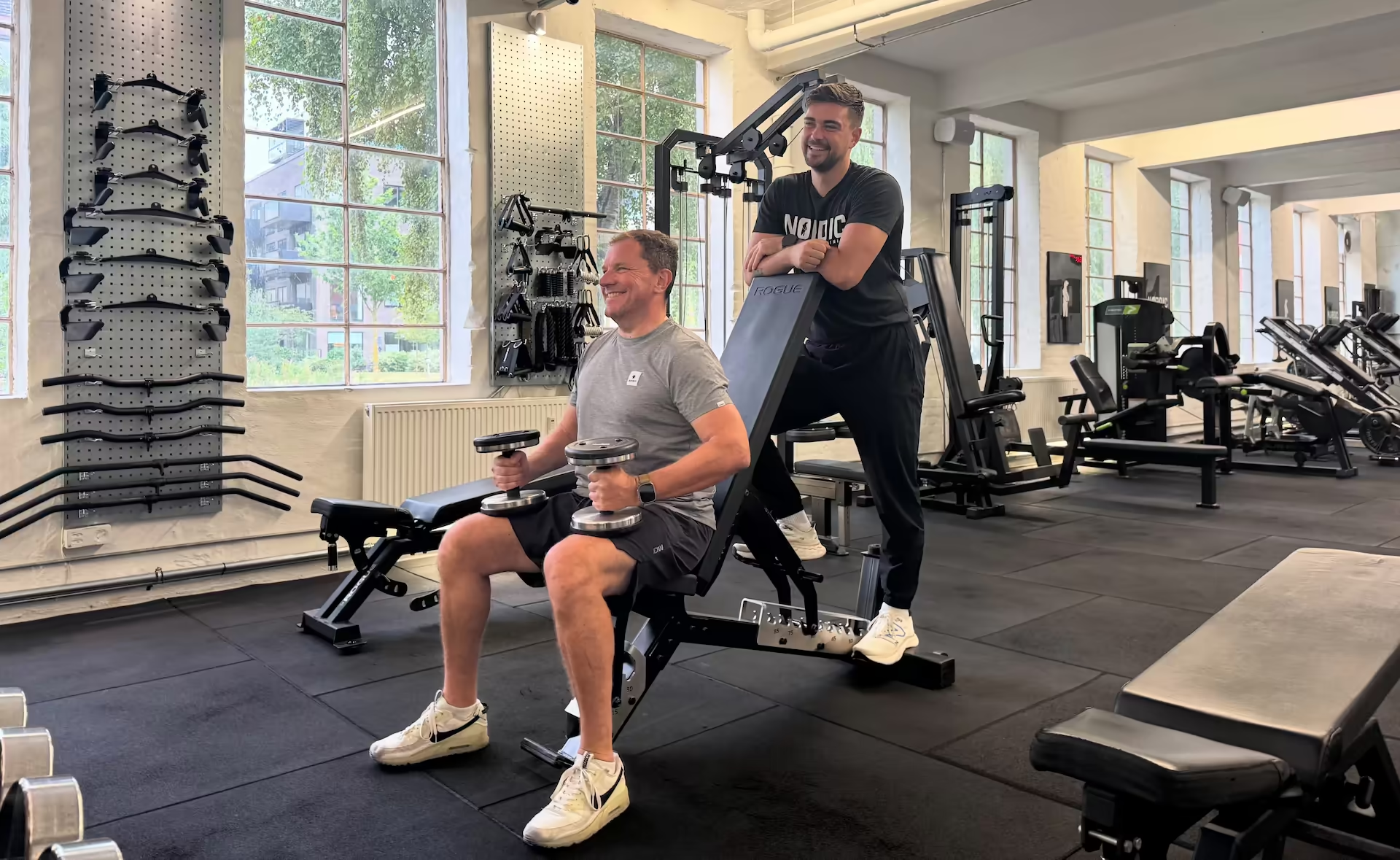
Christian has now trained with his personal trainer at our Private Gym for over two years. His Hack Squat has gone from 50 kg to 110 kg and he hasn't had acute lower back pain in 18 months. But that's not what has changed the most. It's that he has stopped being afraid to use his back. He lifts his children, does yard work, cleans out the basement and carries moving boxes — without thinking about it.
His scan images? If he got a new one, it would presumably still show the same disc herniation and spinal osteoarthritis. But that is completely irrelevant. Because Christian has learned what the research has shown for years: A strong back is a healthy back. Regardless of what an MRI tells you.
Lower back pain is not a disease. It is a part of life. And the best way to handle it is not to treat it, but to build a body that can do more.
References
Brinjikji, W., Luetmer, P. H., Comstock, B., Bresnahan, B. W., Chen, L. E., Deyo, R. A., Halabi, S., Turner, J. A., Avins, A. L., James, K., Wald, J. T., Kallmes, D. F., & Jarvik, J. G. (2015). Systematic literature review of imaging features of spinal degeneration in asymptomatic populations. American Journal of Neuroradiology, 36(4), 811–816. https://pubmed.ncbi.nlm.nih.gov/25430861/
Hayden, J. A., Ellis, J., Ogilvie, R., Malmivaara, A., & van Tulder, M. W. (2021). Exercise therapy for chronic low back pain. Cochrane Database of Systematic Reviews, 9, CD009790. https://pubmed.ncbi.nlm.nih.gov/34580864/
Webster, B. S., Bauer, A. Z., Choi, Y., Cifuentes, M., & Pransky, G. S. (2013). Iatrogenic consequences of early magnetic resonance imaging in acute, work-related, disabling low back pain. Spine, 38(22), 1939–1946. https://pubmed.ncbi.nlm.nih.gov/23883826/
Lederman, E. (2010). The myth of core stability. Journal of Bodywork and Movement Therapies, 14(1), 84–98. https://pubmed.ncbi.nlm.nih.gov/20006294/
Rice, D., Nijs, J., Kosek, E., Wideman, T., Hasenbring, M. I., Koltyn, K., Graven-Nielsen, T., & Polli, A. (2019). Exercise-induced hypoalgesia in pain-free and chronic pain populations: state of the art and future directions. The Journal of Pain, 20(11), 1249–1266. https://pubmed.ncbi.nlm.nih.gov/30904519/
Calatayud, J., Guzmán-González, B., Andersen, L. L., Cruz-Montecinos, C., Morell, M. T., Roldán, R., Ezzatvar, Y., & Casaña, J. (2020). Effectiveness of a group-based progressive strength training in primary care to improve the recurrence of low back pain exacerbations and function: a randomised trial. International Journal of Environmental Research and Public Health, 17(22), 8326. https://pubmed.ncbi.nlm.nih.gov/33187076/
Table of Contents
Related Blog Posts


I’ve worked as a personal trainer and physiotherapist for many years and I specialize in making complex training concepts simple, practical, and easy to apply — whether the goal is building muscle, improving performance, or training with more confidence.
My focus is on combining clear communication with evidence-based methods, so clients not only know what to do but also understand why it works.
On this blog, I share the same insights and strategies we use at Nordic every day — helping you train with purpose, clarity, and results.




Related Blog Posts
.svg)