







Leg Extension: Technique, Benefits and Variations
Leg extension is one of those exercises that often gets deselected — or not considered at all — because you already have a squat in your program. But there can actually be many benefits to adding a leg extension to your program. And we see this daily in practice in our private gym in Copenhagen.
Tea, 33, had had pain in her knee since her teenage years. The diagnosis she had received was Osgood-Schlatter — a condition that causes load-related pain at the kneecap, typically developed during the growth years and for many a problem that follows them into adult life. She had tried leg extensions before, but the experience had been unpleasant. It felt wrong, and she experienced pain in certain positions and never saw any clear progress. She had come to the conclusion that her knee simply couldn't tolerate the exercise.
When she came to us, she was surprised that leg extensions were part of her program. She had only experienced it as an exercise that was bad for the knees.
But our machine — and the way she was instructed to perform the exercise — gave her an entirely new perception of the exercise. The resistance profile on our machine is set so that the weight is heaviest where the muscles that extend the knee are strongest and best equipped to handle the load — and lighter in the top position, where the muscles are relatively weaker and where she most often felt the pain most in the knee.
By matching the body's natural strength curve, Tea could now load the knee progressively without provoking the pain. Additionally, we controlled the tempo carefully — a weight that is "heavy enough," performed slower and more controlled than she had previously tried. It is, beyond the resistance profile, largely the speed that provokes the patellar tendon — not the weight in itself.
Combined with our hack squat and lying leg curl, she could for the first time in many years build real strength in the quads through the full range of motion.
"Tea is a good example that it's not the exercise that's the problem — it's how it's set up and the way it's performed. A leg extension that's heaviest where the knee is weakest can provoke already existing pain. One that's heaviest in the start to mid position, performed slowly and controlled, can be what it takes to reverse the negative spiral and finally provide the progress you've been striving for. That's the difference our machine and approach makes." — Mathias, physiotherapist at Nordic Performance Training
Leg extension is not a "bodybuilding exercise" you can skip if you "just" squat. It's a core exercise in our concept — and this guide explains precisely why.
What is leg extension?
Leg extension — or knæstræk as it's called in Danish — is an isolation exercise for the quads. You sit in the machine, start with the knees bent, and extend the legs out to fully extended knees. That's the movement. Simple, controlled, and very effective.
That it's an isolation exercise means that only one joint — the knee — moves actively. Which in this case is an advantage. And precisely what makes leg extension unique: you can load the quadriceps directly and in a controlled manner, without other muscles or joints limiting how hard you can work.
Leg extension is almost always performed in a machine. That's not a coincidence — the exercise requires external resistance applied directly to the lower leg, and that's close to impossible to replicate effectively without a machine. Which is why leg extension is a fixed part of our training concept.
Which muscles does leg extension train?
Leg extension trains the quadriceps — the large muscle group on the front of the thigh consisting of four muscles: vastus lateralis, vastus medialis, vastus intermedius, and rectus femoris. All four work together to extend the knee.
But the crucial thing about leg extension is rectus femoris. It's the only one of the four quadriceps muscles that crosses the hip joint — it goes from the pelvis down over the knee and therefore has two functions: it flexes the hip and extends the knee. It's precisely this dual function that means it's not targeted effectively in squats.
In a squat, the hip is flexed, which means rectus femoris is shortened over the hip joint. Even though it lengthens over the knee on the way down — and therefore doesn't change net length markedly — the shortened position over the hip means it cannot develop maximal force. This is called active insufficiency. The result is that the vasti take over the majority of the knee extension work, while rectus femoris doesn't get the stimulus it needs. In leg extension, you sit with the hip in a locked, relatively extended position — active insufficiency is eliminated and rectus femoris can work freely through the full range of motion.
This explains a pattern we see again and again: people who squat heavy but have a surprisingly disproportionately weak leg extension. Rectus femoris has simply never been trained properly.
Quadriceps is the primary muscle behind all the movements we take for granted: standing up from a chair, walking on stairs, landing from a jump, preventing falls. Weak quads are one of the strongest predictors of loss of functional capacity with age. Leg extension is one of the most direct and controlled ways to strengthen them.
Technique: How to do leg extension correctly
Setup
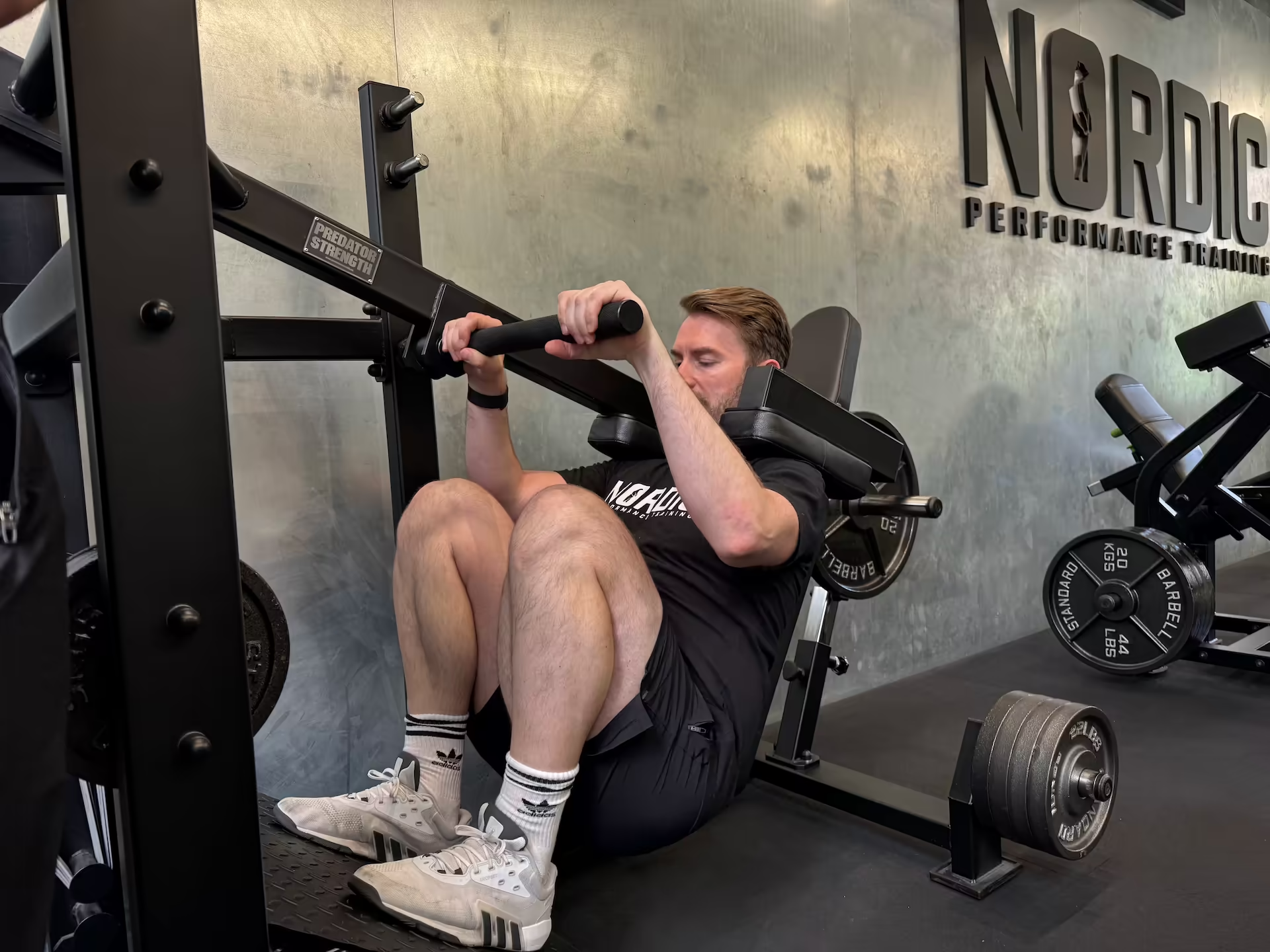
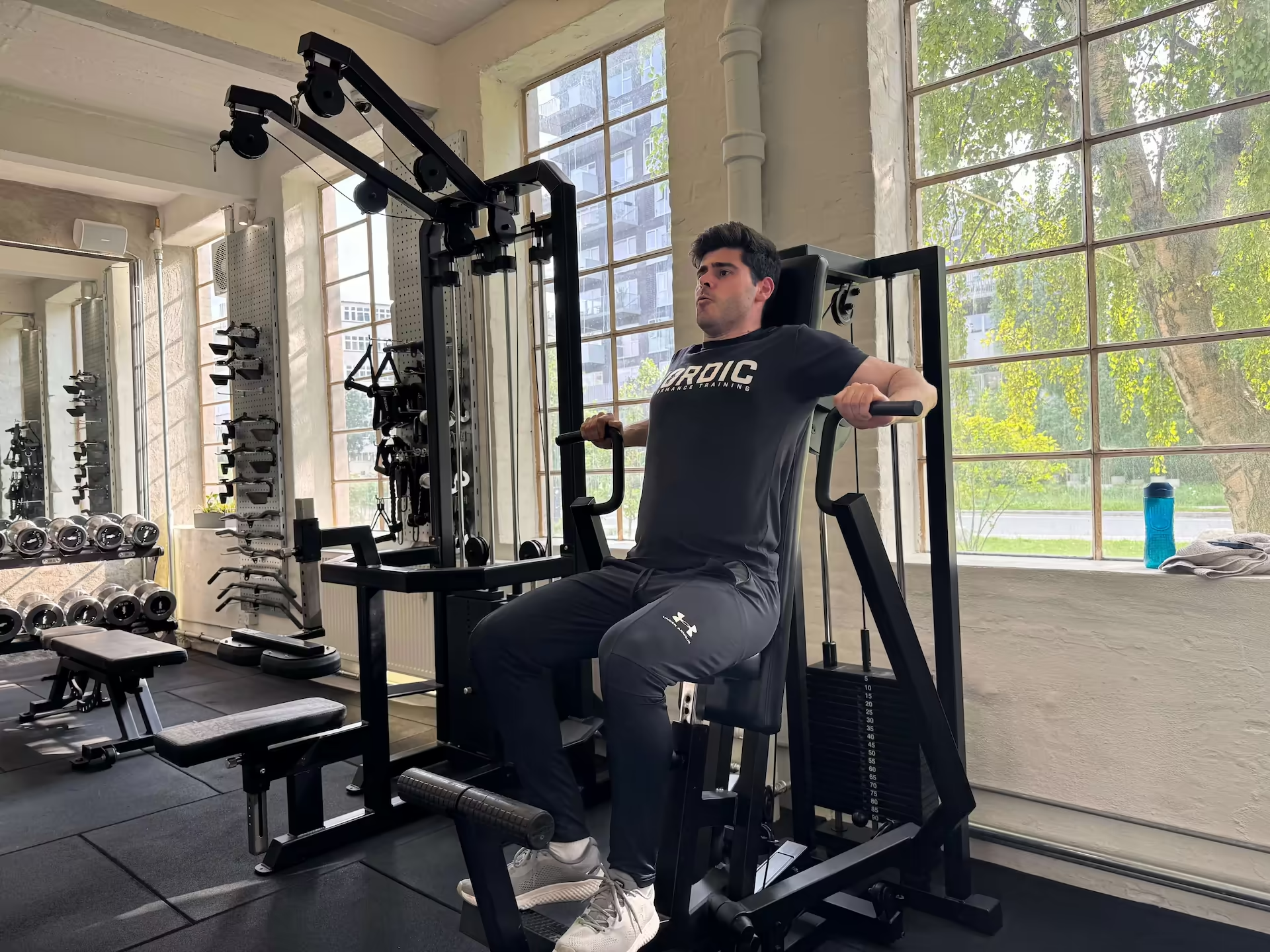
Adjust the seat so the knee joint is in line with the machine's axis of rotation. That's the most important technical requirement. If you sit too far forward or backward, the exercise becomes less effective and can feel uncomfortable in the knee.
The pad placement should be on the lower part of the lower leg — not on the foot or high up toward the knee. The closer the pad sits to the knee, the shorter the moment arm and the lighter the weight feels. The further down toward the ankle, the heavier the weight becomes.
Sit with the back flat against the back rest, hold the handles, and actively pull the hip down into the seat. This stabilises the upper body, ensures the entire movement happens at the knee, and prevents using momentum by lifting the hip and letting it fall back down as you kick the weight up.
Execution
Extend the legs in a controlled manner up to fully extended knees. Avoid "throwing" the weight up with momentum — the movement should be even and controlled all the way. At the top position: a short hold or a controlled pause before you lower slowly back to the starting position.
Lower the weight in a controlled manner on the way down. It's not about making the descent harder — it's about standardisation and control. The weight must not fall freely down and be caught at the bottom. You should be in control of the weight the entire way — not the other way around.
Tempo and control
You generally lift as fast as you can upward, as long as it's controlled and doesn't feel uncomfortable. The weight is lowered in approximately 3 seconds. This ensures that momentum doesn't take over and that the muscles are under tension throughout the full range of motion. It's important that you are in control of the weight — not that the weight controls you.
The most common mistakes
Too heavy weight and use of momentum. The most frequent mistake. The weight is thrown up with a jerk instead of being lifted in a controlled manner. This reduces the muscle work throughout the full range of motion — particularly in the part of the movement that can't be trained in other exercises — and makes it very difficult to standardise and measure real progress.
Incorrect ankle pad placement. The pad is placed too close to the knee, which reduces the moment arm and makes the exercise artificially easy. Place the pad on the lower part of the lower leg for optimal load — just above the ankle joint, without being on the foot itself.
Lack of control in the eccentric phase. The weight is released down instead of being lowered in a controlled manner. The eccentric phase is crucial for standardisation and for the exercise feeling good to perform.
Lack of full range of motion. The knee is not fully extended at the top. Full extension activates the lower part of the quadriceps (VMO) and can only be trained effectively in a leg extension. Additionally, it provides a standardisation point — if you can't extend fully under control, the repetition doesn't count.
Carsten, 69, came to us without any experience with strength training. Despite our squat machines being simple, it was too much for him to start with. We chose to begin with leg extension as an alternative, since it was more manageable for him. He went from 5 kg to 30 kg over 3 months. That was enough for his quadriceps to be strong and his confidence to grow enough that he was comfortable doing hack squats — and today hack squat is a fixed part of his program, along with leg extensions.
"Leg extension is the easiest way to get started with strengthening the quads. There are far fewer balance and technique demands to learn from scratch. Additionally, you don't have a heavy weight on your shoulders, which can be a bit overwhelming for some in the beginning. In leg extension, you sit down and extend your legs. That's enough to start the progress and can build a lot of strength in the legs, which transfers to everything else in training and life outside the gym." — Lucas, physiotherapist at Nordic Performance Training
Variations
Standard leg extension (machine)
The primary variant and the one we use at Nordic Performance Training. Both legs work simultaneously, the movement path is guided by the machine, and the load matches the body's strength curve. Use double progression — train within a fixed rep range and increase the weight systematically when you can complete all repetitions with good technique.
An important detail: many machines are heaviest at the top of the movement — where the quad is weakest. This invites throwing the weight up, makes it difficult to train heavy enough at the bottom, and is for many the reason they experience knee pain in leg extension. A machine should at minimum be equally heavy throughout the entire movement. Our leg extension is set to be heaviest at the bottom and mid-range and decrease as you reach the top — this matches the body's strength curve naturally. That in itself is enough for clients who previously had knee pain in other machines to now train pain-free.
Single-leg leg extension
Each leg works separately. This reveals and works on strength imbalances between the legs — and it takes the activation concept a step further. When both legs work simultaneously, the nervous system has a harder time fully activating the muscle mass on each leg — the so-called bilateral strength deficit. By training one leg at a time, you overcome this and recruit more muscle fibres per repetition. This provides an extra activation adaptation for those who are already close to their max.
For the vast majority, standard leg extension is more than sufficient. The single-leg variant is relevant for those who are close to their maximal level and want to push the activation a little further.
Home alternatives
Leg extension requires a machine to provide real and progressive load. Ankle weights and resistance bands can provide light stimulus, but they cannot replicate the resistance profile or degree of load from a good machine. It can be sufficient for rehabilitation after surgery or after a period of bed rest — but building real, progressive, and systematic strength requires a machine.
If you still want an exercise you can do at home that isolates the quadriceps, sissy squat is the best alternative. It's a single-joint knee extension exercise that, like leg extension, is performed with a relatively extended hip — and thereby avoids active insufficiency in rectus femoris. The exercise is hardest at the bottom and easier at the top, so if you also want resistance in the extended position, you can put a resistance band around the hamstring that provides extra resistance as you approach full extension. This solves some of the problem the machine solves automatically.
Nikolaj, 28, is a CrossFit athlete. When he came to us, he squatted 120 kg in hack squat at his first session. His leg extension, however, was only 50 kg. That's a significant strength gap — and one that explains a lot. He wasn't used to isolating his quads. After 6 months of full body training once per week — where leg extension was his isolation exercise after hack squats — he went from 50 kg to 90 kg in leg extension. His barbell back squat in CrossFit went from 160 kg to 180 kg.
"Nikolaj thought he just needed to squat more to get stronger in his squat. But one of the things he was missing was the ability to activate more of his muscle fibres in the quads. Leg extension filled that gap — and the transfer to back squat was direct and measurable." — Kasper, physiotherapist at Nordic Performance Training
Leg extension and knee pain
Leg extension has an undeserved bad reputation regarding knee pain. It stems primarily from older research and a too mechanical understanding of pain. Additionally, the fact that many machines have a poor resistance profile — heaviest in the top position — means that many use too heavy a weight and lift in a way their knee isn't ready for.
A good leg extension machine — with a resistance profile that matches the body's strength curve — is one of the best exercises for knee rehabilitation. It's controlled, isolated, and easy to dose. You can start very light, increase weight gradually, and work the knee through the full range of motion without the greater demands on balance and coordination that compound exercises place.
Leg extension is actively used in knee rehabilitation precisely because the load is so easy to manage. You decide precisely how heavy, how fast, and how deep. This makes it ideal in periods with knee pain — not as an exercise you avoid, but as an exercise you adapt.
Read more in our guide to knee exercises.
Frequently Asked Questions About Leg Extension
What is leg extension called in Danish?
Leg extension is called knæstræk or benstræk in Danish. Both terms are used — "leg extension" is, however, the most widely used in a training context in Denmark.
Which muscles does leg extension train?
Leg extension trains the quadriceps — the four muscles of the front thigh. All four are activated, but leg extension is the only exercise that also gives rectus femoris proper stimulus — the quadriceps muscle that crosses the hip joint and that squats don't target sufficiently. This makes leg extension an important supplement to all squat variants.
How do you do leg extension?
Sit in the machine with the knee joint placed directly out from the machine's axis of rotation and the leg pad on the lower part of the lower leg. Extend the legs in a controlled manner up to fully extended knees and lower slowly back. Avoid momentum — the movement should be even and controlled all the way.
Is leg extension bad for the knees?
No — with correct technique, appropriate load, and a machine with a good resistance profile, leg extension is a gentle and effective exercise. It's actively used in knee rehabilitation precisely because the load is easy to dose and control.
Can leg extension replace squats?
No — and vice versa. Leg extension and squat complement each other. Squat is a compound exercise that trains the entire lower body. Leg extension isolates the quadriceps — particularly rectus femoris — in a way squats don't. Both have their place in a complete leg program.
Want to train with us?
Leg extension is one of our core exercises — and one of the exercises that most often makes the decisive difference for clients who have struggled with knee pain for years and can now train without pain.
We have a system and a concept that works — and you can start right now. As part of personal training in Copenhagen — book a free start-up conversation. Either in our private gym or as a call, if that suits you better.
References
Larsen, S., Sandvik Kristiansen, B., Swinton, P. A., Wolf, M., Bao Fredriksen, A., Nygaard Falch, H., van den Tillaar, R., & Østerås Sandberg, N. (2024). The effects of hip flexion angle on quadriceps femoris muscle hypertrophy in the leg extension exercise. Journal of Sports Sciences, 43(2), 210–221. https://doi.org/10.1080/02640414.2024.2444713
Mitsuya, H., Nakazato, K., Hakkaku, T., & Okada, T. (2023). Hip flexion angle affects longitudinal muscle activity of the rectus femoris in leg extension exercise. European Journal of Applied Physiology, 123(6), 1299–1309. https://doi.org/10.1007/s00421-023-05156-w
Kubo, K., Ikebukuro, T., & Yata, H. (2019). Effects of squat training with different depths on lower limb muscle volumes. European Journal of Applied Physiology, 119(1), 193–203. https://doi.org/10.1007/s00421-018-4018-3
Malliaras, P., Cook, J., Purdam, C., & Rio, E. (2015). Patellar tendinopathy: Clinical diagnosis, load management, and advice for challenging case presentations. Journal of Orthopaedic & Sports Physical Therapy, 45(11), 887–898. https://doi.org/10.2519/jospt.2015.5987
Table of Contents
Related Blog Posts

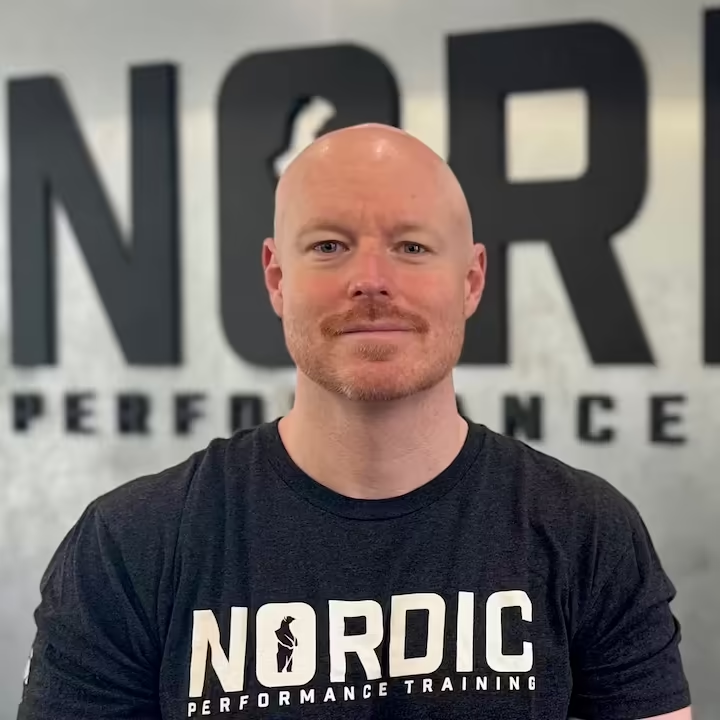
I’ve worked as a personal trainer for over 12 years and as a physiotherapist for over 10 years — and co-founded Nordic Performance Training with Lucas 8 years ago to give clients a professional and structured way to train. Since then, I’ve helped hundreds of people build strength, stay consistent, and feel better through evidence-based methods that actually work.
Along the way, I’ve completed advanced certifications and mentored under leading experts in various fields, and I’ve taught many trainers and physiotherapists internationally.
On this blog, I share the same practical tools, insights, and strategies we use every day at Nordic — so you can train smarter, stay consistent, and get real results.



Related Blog Posts
.svg)