







Knee Pain: Top 6 Strength Exercises That Actually Work
Guide to knee pain from the physiotherapists behind Denmark's highest-rated private training center — exercises for fluid on the knee, inner knee pain, overuse and osteoarthritis.
Jette was 58 years old and had been experiencing pain in her left knee for over two years when she contacted us. She had been diagnosed with knee osteoarthritis by her own doctor and was referred to physiotherapy, where she did balance exercises and light resistance band exercises for eight weeks. It helped a little while she was there. Afterwards, the pain returned.
"My doctor says it's osteoarthritis and that it can only get worse," she told us. "He said I'll probably need a new knee in a few years. So now I barely dare use it."
Jonas was 42 and ran three times a week until he developed pain around the kneecap. His doctor sent him for an MRI, which showed a "frayed meniscus" and "early degenerative changes." He was referred to physiotherapy — six weeks of clamshells, balance training and light squats without weight. Afterwards he stopped running, avoided stairs and was convinced that his knee was ruined.
Two different people. Two different diagnoses. Same pattern: A scan, a diagnosis, a treatment plan that didn't make the knee stronger — just more fragile.
We see it often. Knee pain strikes across ages — from the runner in their 30s with pain behind the kneecap to the office worker in their 50s with osteoarthritis. It is one of the most common reasons people visit their doctor.
What we did with both Jette and Jonas was the opposite of protecting their knees. We started loading them. Gradually, in a controlled manner and with measurable progress — with real strength training exercises in training machines. Today Jette hack squats 50 kg and has dropped the conversation about knee surgery. Jonas hack squats 90 kg and runs three times a week again.
This article gives you the knee exercises and the knowledge you need — regardless of whether you have fluid on the knee, inner knee pain, an overloaded knee, a meniscus injury or osteoarthritis. And it explains why structured strength training — not rest and resistance bands — is the best investment you can make for your knees.
Why most knee exercises don't work
If you search for knee exercises, you typically find the same thing: Light exercises with resistance bands. Single-leg balance training. Clamshells. Wall sits. Terminal Knee Extensions. Perhaps a set of light squats with low weight or even none at all.
That is precisely the kind of exercises both Jette and Jonas had tried countless times before they came to us — without it making a real difference.
The problem is not that the exercises are wrong in themselves. The problem is that they have three fundamental limitations:
The load is too low to create real strength adaptation
A clamshell with a thin resistance band or a wall sit for 30 seconds does not challenge your muscles enough to make them stronger. It's like trying to train for a marathon by only going for walks.
There is no way to increase the load over time
Progressive overload — systematically increasing the load — is the most well-documented mechanism for building strength. Resistance band exercises and bodyweight exercises have a very low ceiling. When you've done 3 sets of 15 clamshells for two weeks, then what? A thicker band? That's not progression. That's stagnation.
They don't address the actual problem
For most people with knee pain, the problem is not a lack of "activation" of specific muscles. The problem is that the knee cannot tolerate load at its end ranges — full extension and full flexion. You don't solve that problem with light exercises in a limited range of motion. You solve it by gradually building strength and tolerance in precisely the positions that hurt.
This is where strength training fundamentally differs from traditional rehabilitation exercises.
Why strength training works — also against knee pain
When we talk about strength training for knee pain, it's not about "activating" muscles or "stabilizing" joints. It's about three things:
Full range of motion under load — with the right equipment
Most people with knee pain have lost tolerance at the end ranges. It hurts to extend the knee fully — the top of a Leg Extension. And it hurts to flex it fully — the bottom of a deep squat. The solution is not to avoid those positions. It is to rebuild strength in them, gradually and in a controlled manner.
But that requires equipment that works with you — not against you. Every exercise has what is called a strength curve: a profile for where in the movement you are strongest and weakest. And that profile must match the machine's resistance.
Take Leg Extension as an example. Some Leg Extension machines are very heavy at the top of the movement — precisely where you are naturally weakest and where most people with knee pain have the most pain. If the machine fights against you in the position you're trying to rebuild, it often does more harm than good. A good Leg Extension machine has a resistance profile that matches your strength curve, so the load feels even throughout the entire movement.
The same principle applies to squats. In a Hack Squat, the bottom of the movement is the hardest — and it's also where most people with knee pain have the most discomfort. Assistance bands solve this: A band assists at the bottom and gradually releases toward the top. This gives you a more uniform resistance profile, so you can work your way into full knee flexion without the heaviest part of the exercise hitting you precisely where it hurts. The band stays, and you gradually add more weight — because your strength curve doesn't change, so the resistance profile must remain correct.
Progressive loading — with double progression
Start at an appropriate level and build from there. That is the entire essence of strength training — and it is what separates it from everything else.
We use a method called double progression: You start with a given weight and a repetition range — for example 6-8 repetitions. First you work your way up in repetitions with the same weight. When you can do 8 repetitions with good technique, you increase the weight and start again from 6. Then you build up again.
It sounds simple, and it is. But it is also extremely effective, because it ensures that the load increases systematically over time — without having to make big jumps. Training machines make it possible to increase by very few kg at a time. That precision is something neither resistance bands, bodyweight nor balance training can offer.
This is how we do it in practice: Choose a repetition zone — typically 6-8 repetitions Start with a weight you can lift with good technique and 2 repetitions in reserve Increase the number of repetitions in each set over time When you reach the maximum in all sets, increase the weight and start over Repeat the process
Pain-free as a consequence — not as a prerequisite
You don't need to be pain-free to start. Mild discomfort during training is acceptable and often part of the process. The pain subsides as strength and tolerance increase — it doesn't need to be treated away first before you can begin training. It is the training that helps remove it — and makes you stronger and healthier in the process.
The opposite — waiting for pain-free status before you begin training — sets a familiar downward spiral in motion: The pain creates fear. The fear leads to avoidance. Avoidance leads to weakness. Weakness makes the knee more vulnerable. And the vulnerability confirms the fear. That is precisely the spiral we see in most people who come in with knee pain — and precisely the one that strength training breaks. (We have written an entire article about that mechanism and how you break free from it.)
But here is an important nuance: If it hurts with every single repetition — particularly in a specific part of the movement — it is not a matter of "pushing through." It is often a matter of wrong equipment or wrong technique. A Leg Extension machine with a skewed resistance profile that is heaviest at the top can hurt even at low weight — not because your knee can't handle it, but because the machine loads the most precisely where you are weakest. Combine that with an execution that is not biomechanically optimal, and you have the recipe for pain that just gets worse.
This is where an experienced health professional with strength training expertise makes a crucial difference. When the resistance profile matches your strength curve and the technique is biomechanically optimal, you can safely train through mild discomfort — because the load hits correctly. But without that assessment, you risk pushing through something that shouldn't be pushed through. The solution is not to stop training. It is to find the right equipment, the right technique and the right guidance.
And the evidence is massive. A large Cochrane meta-analysis based on 54 randomized studies showed that exercise provides significant pain reduction and functional improvement in knee osteoarthritis — with effects that last for at least 2-6 months after the end of the program. Other studies show that strength training can reduce knee pain by 30-50 percent — an effect that matches pain medication such as NSAIDs, but without side effects and with a wide range of health-promoting bonus effects.
Strength training also activates a phenomenon that researchers call exercise-induced hypoalgesia — a reduction of pain sensitivity that occurs during and after training. Your body literally turns down the pain signals when you load the muscles heavily enough. Over time, that effect can become more permanent.
Top 6 knee exercises for knee pain
The six exercises we recommend are not rehabilitation exercises. They are real strength training exercises that train the entire lower body — and that by virtue of their biomechanics make the knee stronger, more tolerant and more resilient.
The knee is stabilized by four ligaments and two menisci, but the most important support system is the musculature: The quadriceps controls extension and stabilizes the kneecap. The hamstrings control flexion. The glutes control the knee's position under load. These are the primary muscles that the exercises below train — under real load, not with resistance bands.
The exercises are the same regardless of whether you have fluid on the knee, inner knee pain, overuse or osteoarthritis. The difference lies in the starting point: load, range of motion and how quickly you increase the weight. The exercises are the same.
1. Hack Squat
Hack Squat is a machine-based squat that loads the entire lower body — primarily the quadriceps, adductors and glutes — while the machine stabilizes your back in a fixed track. For the knee, it is crucial because you can work your way into deep knee flexion under controlled conditions.
That is precisely the end range that most people with knee pain have lost tolerance in. And that is precisely the one you need to rebuild. Start with a depth you can handle, and work your way gradually deeper over weeks and months.
Tip: Reverse bands — where a band assists at the bottom of the movement and gradually releases toward the top — can be an excellent tool here. They change the resistance profile so that the heaviest part of the exercise becomes lighter, while you still load fully at the top. This makes you want to go down to the bottom and achieve full knee flexion pain-free.
2. Pendulum Squat
Pendulum Squat resembles Hack Squat, but the machine swings in a pendulum arc rather than a linear track. This changes the loading curve, making the exercise more knee-dominant — the knee works harder throughout the entire movement, especially in the deep position.
This makes Pendulum Squat a natural progression from Hack Squat for those with knee pain. When you have built up tolerance in Hack Squat, Pendulum Squat can challenge the knee further under controlled conditions. Reverse bands work here in precisely the same way: assistance at the bottom.
3. Split Squat
Split Squat trains each leg separately, which gives you the opportunity to address imbalances between the right and left side. It forces the hip to stabilize, and it provides strong activation of the glutes, adductors and quadriceps.
For people with knee pain, unilateral training is often a good way in, because you can work with lower total load while the local muscle activation is high. Split Squat is also a good alternative if you don't have access to a Hack Squat or Pendulum Squat machine.
4. Leg Extension
Leg Extension isolates the entire quadriceps directly, and the goal is to achieve full knee extension at the top, which is crucial for people with knee pain.
Leg Extensions are often advised against for knee problems. But that is a recommendation based on outdated caution, not on evidence. Controlled Leg Extension in an appropriate range of motion with the right resistance rebuilds precisely the strength you are missing. And specifically the top of the movement — the last 20-30 degrees toward full extension — is where most people with knee pain are weakest. That is where you need to get stronger.
Start with a range of motion you can tolerate, and expand it gradually over time. That is how you rebuild tolerance in full knee extension under load.
5. Leg Curl
Leg Curl isolates the hamstring muscles. Strong hamstrings contribute to knee stability by controlling the flexion movement and decelerating knee extension. For most people with knee pain, the hamstrings are often undertrained. Leg Curl is a simple, machine-based exercise with a clear progression pathway. Start light, increase gradually.
6. Glute Bridge
Glute Bridge targets the gluteus maximus directly and strengthens the posterior chain — one of the muscle groups most responsible for offloading the knee joint in all daily movements such as walking, stair climbing and sit-to-stand.
Perform it with progressive load — either with a barbell across the hips or as in the video with a machine — and you have an exercise that goes far beyond what a bodyweight clamshell can offer.
Fluid on the knee: What it means and what you can do
Fluid on the knee — also called water on the knee or a swollen knee with fluid — is one of the most common reasons people seek help. The knee feels tight, swollen and difficult to bend fully.
Fluid on the knee is not a disease in itself. It is a reaction. The knee joint always produces a small amount of synovial fluid that lubricates and nourishes the cartilage. But when the joint is irritated — from overuse, a sudden movement, or underlying osteoarthritis — the body increases production. The result is swelling.
For most people, it is harmless and resolves on its own. The most important thing is to avoid total rest, which actually worsens it, and instead keep going with adapted activity. Fluid on the knee and osteoarthritis often go hand in hand — in people with knee osteoarthritis, intermittent swelling is completely normal.
And here we hit the same paradox as with back pain: Many with fluid on the knee get an MRI that shows "meniscal changes" or "cartilage wear" — and suddenly they are afraid to load the knee. The research shows something surprising: When you scan knees of people who have no pain, you still find "damage." A large study in the New England Journal of Medicine scanned the knees of nearly 1,000 people between 50 and 90 years old — and 60 percent of those entirely without symptoms had meniscal changes on the MRI scans. Another systematic review of 63 studies showed the same picture: 43 percent of all healthy people over 40 have cartilage defects in the knee, without any form of pain.
Jette's MRI showed osteoarthritis. But so do MRIs in most people over 50 — including those entirely without pain. Her doctor said she would probably need a new knee. Today she hack squats 50 kg.
And the exercises? They are the same as above. Strength training with gradual progression. It's not about finding special "fluid exercises" — it's about strengthening the muscles that offload the joint, so the irritation subsides. Start with a load and a range of motion your knee can tolerate, and build up gradually.
See a doctor for sudden, severe swelling after trauma, significant redness and warmth, or if the swelling does not subside within a couple of weeks.
Irritated bursa in the knee: Exercises
An irritated bursa in the knee (bursitis) typically causes a localized swelling — often in front of the kneecap or on the inner side — and differs from general fluid on the knee in that it is the bursa outside the joint that is irritated, not the joint cavity itself.
Avoid direct pressure on the tender area — meaning don't kneel on it. But don't stop strength training. The six exercises above are all safe with bursitis, because they load the muscles without placing pressure directly on the bursa. Start perhaps with a slightly lower load and slower tempo in the acute phase and increase as the irritation subsides.
Inner knee pain: Exercises that help
Inner knee pain is one of the most common pain presentations we see. The most common causes are pes anserinus tendinopathy (irritation of the tendon attachment on the inner side of the shinbone), medial meniscus problems or irritation of the medial collateral ligament — one of the four ligaments in the knee.
But regardless of the specific cause, the pattern is almost always the same: The muscles around the knee and hip are too weak to control the load. The knee "collapses" inward during walking, stair climbing and bending, and the repeated faulty loading causes the pain.
The solution is not specific "inner side exercises." The solution is to make the entire lower body stronger — and that is precisely what the six exercises do. Hack Squat and Pendulum Squat in full depth. Split Squat, which forces the hip to stabilize. Glute Bridge, which strengthens the glutes. Leg Extension and Leg Curl, which strengthen the front and back.
A strong knee doesn't collapse inward. It's not a matter of "activation" — it's a matter of strength.
Overloaded knee: Exercises for rebuilding
An overloaded knee is fundamentally about one thing: Your knee was asked to do more than it could handle. Either because the load increased too quickly — a sudden increase in running volume, a new sport, an unaccustomed period of high activity — or because the knee simply wasn't strong enough for what you were already doing. The two most common diagnoses are patellofemoral pain syndrome (pain in front of and around the kneecap) and patellar tendinopathy (often called "jumper's knee"). Up to 25 percent are affected by patellofemoral pain syndrome at some point in their lives.
Many in this group — like Jonas — also get an MRI that shows meniscal changes or cartilage wear. But as we described above, those findings are almost always normal for the age. Meniscus injury rehabilitation is not about "repairing" the meniscus with light exercises. It is about making the knee strong enough to function optimally — regardless of what a scan shows.
It is a capacity problem. And there are really only two paths forward: Do less and accept the limitation — or get stronger so that what you want to be able to do no longer exceeds what your knee can handle. We recommend the latter.
The exercises are again the same. The difference is the starting point: With an acutely overloaded knee, you might start with a limited range of motion in Leg Extension and a shallower depth in Hack Squat. But the goal is always the same — full ROM under load, progressive increase, pain-free as a result.
Free program: How to get started
You don't need a separate knee program. The six exercises above can all be part of a well-structured Full Body program that you can do 1-3 times per week.
Hack Squat, Pendulum Squat or Split Squat are standard exercises for the lower body. Leg Extension and Leg Curl are isolation exercises for the legs. And Glute Bridge can be integrated if you want extra focus on the glutes.
In other words: If you follow a structured strength training program, you already cover the most important exercises for the knee — the muscle groups that prevent and reduce knee pain — without adding anything extra.
You can find our free training programs for 1, 2 and 3 weekly training sessions in our Full Body Program guide.
When should you seek professional help?
Knee pain is in the vast majority of cases harmless and can be managed with correct training. But there are situations where you should contact your doctor:
A knee that "locks" and cannot be fully extended or flexed, combined with a mechanical sensation of something being caught. Acute swelling after a trauma, such as a twist or a fall. Nighttime pain that wakes you and is not related to loading. Increasing instability — a feeling that the knee "gives way." No improvement after 6-8 weeks of structured strength training.
These symptoms are rare. But they are important to know. Most knee injuries and knee pain can be managed with correct training — but serious cases may require an individual assessment to find the right starting point.

Frequently asked questions about knee exercises
Can you train knee pain away?
Yes. Strength training can reduce knee pain by 30-50 percent — an effect that matches pain medication, but without side effects. Training doesn't cure osteoarthritis, but it strengthens the muscles, offloads the joint and changes the way the nervous system processes pain signals. In addition, you get health-promoting bonus effects like better sleep, more energy and stronger bones.
Is it good to walk when you have knee pain?
Yes. Walking increases the circulation of synovial fluid, which nourishes the cartilage and reduces stiffness. Start with short walks of 10-15 minutes and increase gradually. Mild discomfort is completely normal and not dangerous — only stop for sharp pain. Walking is an excellent way to stay active between training sessions, but it does not replace strength training. You don't walk your way out of knee pain. You train your way out of it.
Which exercises strengthen the knee best?
Exercises that allow progressive loading and full range of motion: Hack Squat, Pendulum Squat and Split Squat for deep knee flexion, Leg Extension for full knee extension, and Glute Bridge and Leg Curl for the posterior chain. A balanced strength training program that covers the entire lower body is far more effective than isolated resistance band exercises.
Is squatting harmful with knee pain?
No. Squat is one of the best exercises for strengthening the lower body, and the research does not show that squats damage the knee joint — not even with osteoarthritis. It's about dosage: Start with a depth you can tolerate, and work your way gradually deeper and heavier over time. Machine-based variants such as Hack Squat and Pendulum Squat make it easy to control both depth and load.
What does fluid on the knee mean?
Fluid on the knee is an irritation reaction — typically caused by overuse, an acute injury or underlying osteoarthritis. In most cases, it is harmless and resolves with adapted activity and time. Strength training with gradual progression is the best long-term strategy. See a doctor for acute swelling after trauma, significant redness and warmth, or if the swelling does not subside within a couple of weeks.
Ready to make your knees stronger?
If you are tired of resistance bands and balance exercises that don't move the needle — and ready to actually build strength in your knees — let's have a talk.
Book a free start-up conversation at our private gym in Copenhagen. We are physiotherapists with over 8 years of experience and more than 3,000 clients — many with exactly the knee problems you are dealing with right now.
You get a structured strength training program and the expert guidance along the way that makes your knees stronger week by week.
Jette has now trained with us for a year and a half. Her knee pain has been reduced by over 80 percent, she walks stairs without thinking about it, and she hack squats 50 kg in full depth. Most importantly: She is no longer waiting for a knee operation. That conversation is no longer relevant.
Jonas runs again. Three times a week, like before. His MRI presumably still shows a frayed meniscus and degenerative changes. But that is completely irrelevant — because his knee can do more than ever.
Her doctor said it could only get worse. His doctor said he should take it easy. Their knees said something different.
References
Englund, M., Guermazi, A., Gale, D., Hunter, D. J., Aliabadi, P., Clancy, M., & Felson, D. T. (2008). Incidental meniscal findings on knee MRI in middle-aged and elderly persons. New England Journal of Medicine, 359(11), 1108–1115. https://pubmed.ncbi.nlm.nih.gov/18784100/
Culvenor, A. G., Øiestad, B. E., Hart, H. F., Stefanik, J. J., Guermazi, A., & Crossley, K. M. (2019). Prevalence of knee osteoarthritis features on magnetic resonance imaging in asymptomatic uninjured adults: a systematic review and meta-analysis. British Journal of Sports Medicine, 53(20), 1268–1278. https://pubmed.ncbi.nlm.nih.gov/30279192/
Bennell, K. L., & Hinman, R. S. (2011). A review of the clinical evidence for exercise in osteoarthritis of the hip and knee. Journal of Science and Medicine in Sport, 14(1), 4–9. https://pubmed.ncbi.nlm.nih.gov/20851051/
Fransen, M., McConnell, S., Harmer, A. R., Van der Esch, M., Simic, M., & Bennell, K. L. (2015). Exercise for osteoarthritis of the knee. Cochrane Database of Systematic Reviews, 1, CD004376. https://pubmed.ncbi.nlm.nih.gov/25569281/
Rice, D., Nijs, J., Kosek, E., Wideman, T., Hasenbring, M. I., Koltyn, K., Graven-Nielsen, T., & Polli, A. (2019). Exercise-induced hypoalgesia in pain-free and chronic pain populations: state of the art and future directions. The Journal of Pain, 20(11), 1249–1266. https://pubmed.ncbi.nlm.nih.gov/30904519/
Table of Contents
Related Blog Posts

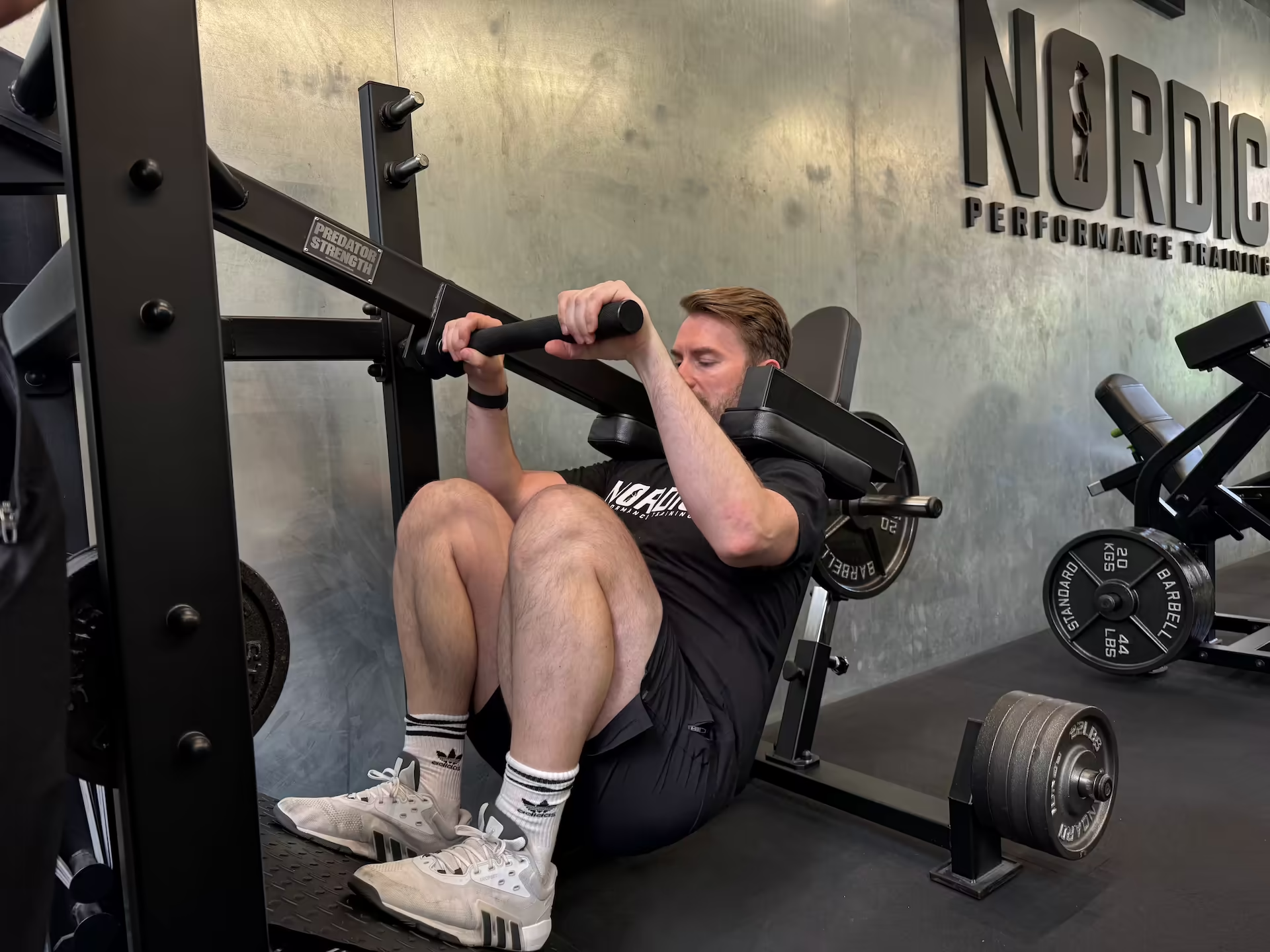

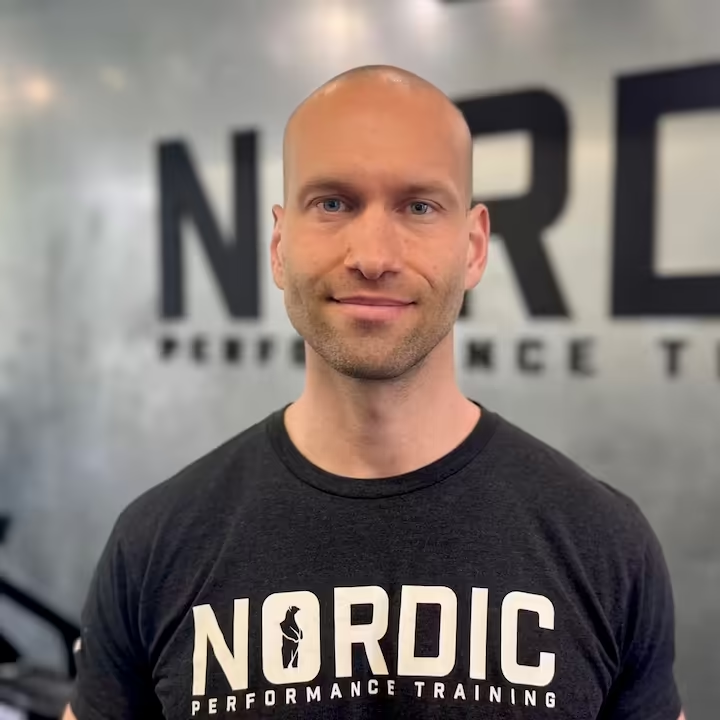
I’ve worked as a personal trainer for over 14 years and as a physiotherapist for over 8 years — and co-founded Nordic Performance Training with Kasper to give clients a professional, private, and structured training environment where results actually last. In that time, I’ve overseen more than 15,000 sessions and helped hundreds of clients rebuild after injuries, gain strength, improve their health, and stay consistent.
My approach combines practical experience with evidence from the latest research, making training both effective and realistic.
On this blog, I share the same methods we use every day at Nordic — so you can cut through the noise and focus on what truly works.



Related Blog Posts
.svg)