








Leg Curl: Technique, Variations and Benefits
A well-executed leg curl is one of those exercises most often missing from many people's training programme — not because they don't want to train the hamstrings, but because they think they're already doing it in their squats.
Mette, 42, from Christianshavn, had been to personal training on several occasions over the past many years. The programmes were always built around free weights and bodyweight exercises — she had been told that squat was all she needed to train all the muscles in the lower body. She trained hard and regularly, but never really progressed in strength, and the knees slowly but surely started to bother her. Not acutely, not dramatically — just a persistent soreness that never really went away.
When she came to us, one of the first things we changed was adding leg curl as a fixed part of the programme. Not instead of compound exercises like squat — but as the supplement that actually trains the hamstrings, which squats, contrary to what many believe, don't manage to do at all.
We believe the hamstrings should be trained directly, in isolation, and with gradually increasing load. And that was, despite several years of training experience, something Mette's hamstrings had never tried.
Over the following months, the knee pain gradually disappeared. Not because we treated or spared the knees — but because we strengthened them "all the way around" with exercises that complemented each other.
"Squat and leg curl. It's actually as simple as that. A squat trains almost the entire lower body — except the hamstrings. A leg curl closes precisely that gap. Together they cover all the most important muscle groups in the legs. Most people who come to us have never trained the hamstrings directly. And we of course make sure they do." — Mathias, physiotherapist at Nordic Performance Training
Leg curl is not a supplement you can skip if you already squat. It's the other half of a complete leg training — and this guide explains precisely why.
What is leg curl?
Leg curl — or knæbøj as it's called in Danish — is an isolation exercise for the hamstrings. You start with the legs extended and bend the knees, so the heels move toward the buttocks, under resistance. That's the movement. Simple, controlled, and very effective.
That it's an isolation exercise means that only one joint — the knee — moves actively. That's precisely what makes leg curl so effective: the hamstrings are loaded directly, without other muscles taking over or limiting how many signals the brain can send to the hamstrings.
Leg curl is almost always performed in a machine — either lying (prone on the stomach) or seated (sitting). Both variants isolate the hamstrings effectively, but in slightly different ways. More on that below.
Which muscles does leg curl train?
Leg curl primarily trains the hamstrings — the hamstring musculature consisting of three muscles: biceps femoris, semitendinosus, and semimembranosus. All three cross both the hip joint and the knee joint, and their primary function is to bend the knee and extend the hip. Gastrocnemius — the large calf muscle — works as a synergist and contributes to the knee flexion in the first part of the movement.
Leg curl trains the hamstrings in their knee flexion function — and that's the function squats and most other leg exercises don't target at all. In a squat, the hamstrings are only minimally activated and contribute primarily as stabilisers. They are not the primary driver in the movement and don't get nearly the stimulus they need.
For most people, a good leg curl is more than sufficient to build strong, healthy hamstrings. RDL and stiff-legged deadlift train the hamstrings from a different angle — in a lengthened position over the hip joint — but are technically demanding exercises with a steep learning curve. Leg curl gives you most of the benefit with a fraction of the complexity.
This means that even people who squat regularly often have surprisingly weak hamstrings in the knee flexion function. Research shows that reduced hamstring strength is associated with knee pain — particularly patellofemoral pain and knee osteoarthritis. The hamstrings actively brake the knee with every step you take and absorb force eccentrically during landing and direction changes. That's precisely the capacity leg curl trains directly.
Technique: How to do leg curl correctly
Lying leg curl
Lying leg curl — also called prone leg curl — is performed lying on the stomach with the hip in a relatively extended position and the pelvis neutral. It's the primary variant in our programme. The machine has a fixed, controlled movement path, but still requires you to actively stabilise the body during the movement.
Setup: Lie on your stomach with the knee joints placed directly out from the machine's axis of rotation. The kneecap should be placed just below the edge of the thigh pad and the calf pad just above the ankle. Grab the handles and activate the back muscles by pulling lightly on them — this stabilises the pelvis and torso and prevents you from sliding backward during the movement. This gradually becomes more important the stronger you get and the heavier the weight is.
Execution: Bend the knees in a controlled manner, so the heels move toward the buttocks, while you keep the pelvis stable and make sure the knees don't lift from the surface. At the top: a short hold before you lower slowly and in a controlled manner back to the starting position. The hips must not lift much and uncontrollably when the knees are extended at the bottom — that's a sign that the weight is too heavy and that you're using too much momentum by lifting the hip and aggressively moving it back down to set the weight in motion with the entire body.
Tempo: Controlled up, 3 seconds down. The hamstrings should be under tension the entire way.
Seated leg curl
Seated leg curl is performed sitting and, in contrast to lying leg curl, with the hip in a flexed position. When the hip is flexed and the knees are extended, the hamstrings are lengthened over the hip joint — they work over a greater part of their length-tension curve and thereby get stimulus in the stretched position. This makes seated leg curl particularly relevant for prevention of hamstring injuries, as strength in the lengthened position is one of the most important factors for robust hamstrings.
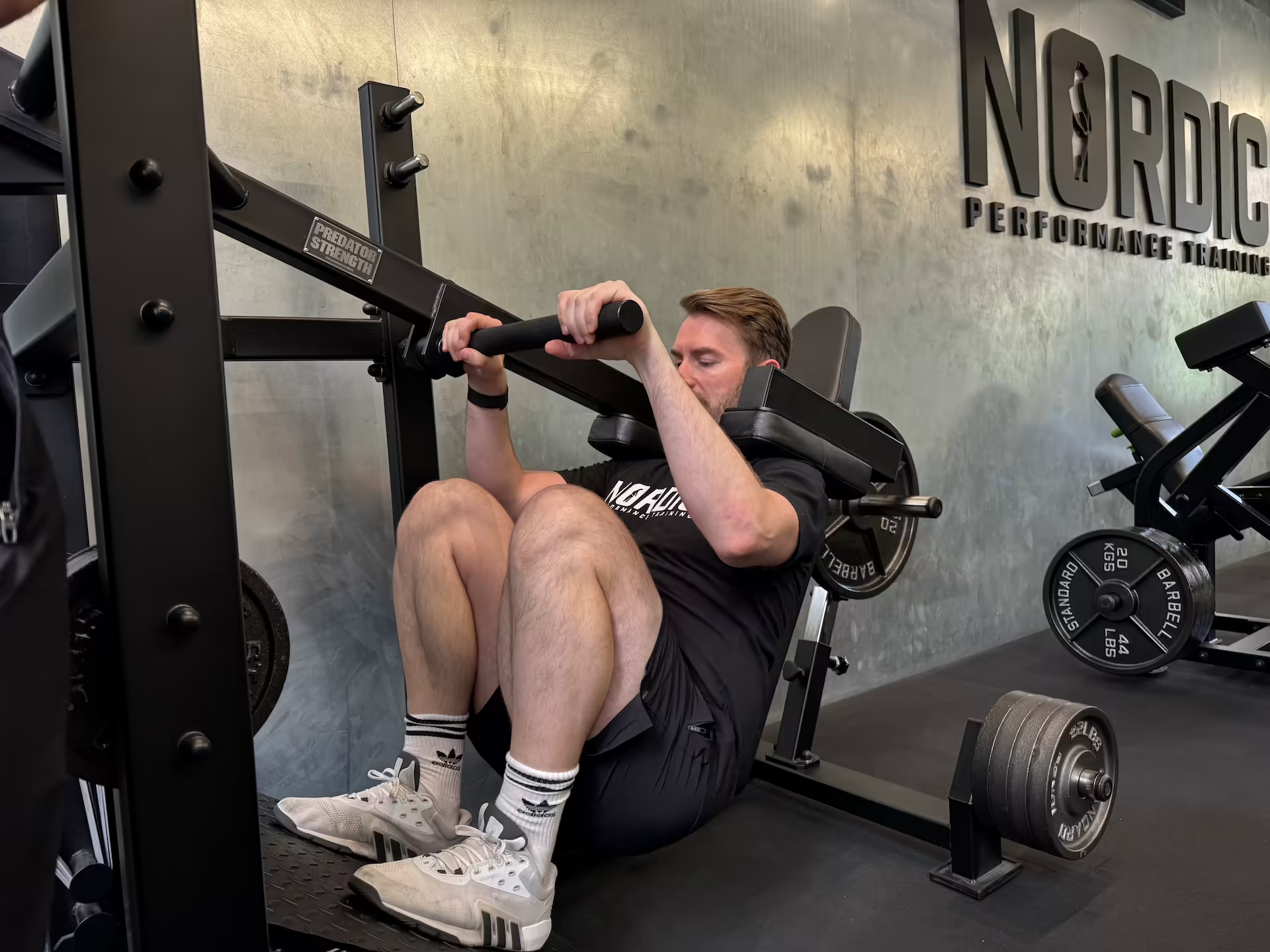
Setup: Adjust the seat so the knee joint is in line with the machine's axis of rotation. The upper pad is placed just above the kneecap against the thigh — it holds the leg down at the top of the movement and without it, it would be impossible to perform the exercise. The lower pad is placed on the lower part of the lower leg close to the ankle. Sit with the back flat against the back rest and press yourself actively back into the back rest throughout the entire movement — this stabilises the pelvis and prevents you from sliding forward when the weight pulls at the bottom.
Execution: Bend the knees in a controlled manner down toward the bottom. Avoid throwing the weight down with momentum. At the bottom: a short hold before you lower slowly and in a controlled manner back to the starting position. The weight must not tip uncontrollably back to the starting position by itself — you control it the entire way. That's a crucial point we focus a lot on in the beginning and which is difficult for most people who have never done leg curls before.
Tempo: Controlled down, 3 seconds up. The hamstrings should be under tension the entire way.
What's the difference — and when do you use which?
Lying leg curl is the starting point for most because it's practical and straightforward.
Seated leg curl is a good supplement that gives the hamstrings stimulus in the lengthened position and is particularly relevant for injury prevention. It's also used as the primary variant for clients who for various reasons can't lie on their stomach — pregnant women, older adults, or those with specific movement limitations. If you have access to both machines, you can benefit from alternating between them on an ongoing basis.
The most common mistakes
Too heavy weight and use of momentum. The most frequent mistake. The weight is "thrown" up instead of being lifted in a controlled manner. This reduces the muscle work markedly through large parts of the movement and makes it difficult to standardise and measure real progress. Reduce the weight and focus on control through the full range of motion.
The hip lifts (lying). The hips are lifted uncontrollably from the bench when the knees are extended at the bottom. This is almost always a sign that the weight is too heavy or that too much momentum is being used by lifting the hip and aggressively moving it back down to set the weight in motion with the entire body. Reduce the weight and focus on keeping the pelvis stable and approximately neutral throughout the entire movement.
You slide backward in the machine (lying). Happens when you don't pull sufficiently on the handles. Pull actively on the handles throughout the entire movement — but especially at the top, where the weight pulls you directly backward — to keep the body stable and prevent sliding backward.
You slide forward in the seat (seated). Happens when you don't press yourself actively back into the back rest. Press the back constantly back against the back rest throughout the entire movement — particularly at the bottom when the weight pulls the most.
Lack of eccentric control. The weight is released uncontrollably back to the starting position instead of being lowered in a controlled manner. This is primarily about standardisation — a weight that has built up speed and momentum in the extended position is harder to control and places sudden demands on the hamstrings they may not be used to. Always lower in a controlled manner.
Incomplete range of motion. The knee is not fully bent at the top or not sufficiently extended at the bottom. Full range of motion activates the hamstrings over their entire length and is a prerequisite for the best results and standardisation of the repetitions. A small nuance: in working sets, you don't need to extend the knees fully since the hamstrings are relatively weak in the fully extended position. But in warm-up sets, you can benefit from extending fully — it trains that part of the movement and gives the hamstrings experience working in all positions.
Variations and progression
Lying leg curl
Our primary variant. Simple and straightforward and is most often available in most gyms.
Seated leg curl
A good supplement to lying leg curl — or primary variant for those who can't lie on their stomach. Many machines are, however, not designed very well biomechanically, which can be a problem. But a well-designed machine makes it a really good exercise for effective hamstring training. Gives the hamstrings stimulus in the lengthened position and is particularly relevant for injury prevention.
Single-leg variants
Each leg works separately. Reveals and works on strength imbalances between the legs. Additionally, you overcome the bilateral strength deficit — the nervous system activates the muscle mass more effectively when only one leg works at a time. Relevant for those who are close to their maximal level or have a clear imbalance they want to work on. For the vast majority, bilateral leg curl is more than sufficient.
Standing leg curl
A variant where you stand on one leg in a machine while the other bends the knee against resistance. The stabilisation demand on the standing leg is high and uses a fair amount of energy — energy that doesn't go to the actual hamstring work. This reduces how much output you can get on the working leg. It's not a variant we use or generally recommend.
Nordic hamstring curl
A demanding bodyweight variant that trains the hamstrings eccentrically in a lengthened position. You kneel with the feet held down and slowly lower the upper body forward toward the floor by braking with the hamstrings. Very effective for building eccentric strength in the lengthened position — and well-documented for prevention of hamstring injuries in sport. Technically demanding and tough, but relevant for those who train in environments without access to machines or want to supplement their machine-based training. However, also very demanding from a recovery perspective, so get professional help with how to incorporate it into your routine.
Sliding leg curl and home variants
If you don't have access to a leg curl machine, sliding variants are the best alternative. You lie on your back with the heels on a sliding surface, a swiss ball, TRX, the seat of a rowing machine, or the legs elevated on a bench while you hang with straight arms under a bar — and bend the knees by pulling the heels toward the buttocks. These are not variants we use in our private gym in Copenhagen, but we continuously help clients find the one that suits their home training, holiday training, or CrossFit environment without machines.
Progression
Leg curl follows the same progression principle as all other exercises at Nordic Performance Training. Train within a fixed rep range — e.g. 6-8 repetitions. When you can complete all repetitions in all sets with good technique, you increase the weight next session. An exercise switch is not progression — stick with the variant that suits you and build systematically. Read more in our guide to double progression.
Leg curl and knee pain
The hamstrings play a central role in knee stability. They actively brake the knee's forward movement with every step, landing, and direction change — and research shows that reduced hamstring strength is associated with knee pain, particularly patellofemoral pain and knee osteoarthritis.
That's precisely what we saw with Mette. Not an acute injury, not a structural problem — but muscles that were never strong enough to do their job properly. The addition of leg curl as a fixed part of the programme was one of the most important changes we made.
Leg curl is also one of the most important exercises for prevention of hamstring injuries. Muscle tears in the hamstrings almost always happen in the eccentric phase — when the muscle is lengthened under load and has to brake a movement. Systematic training of eccentric control in leg curl builds precisely the capacity that makes the hamstrings robust enough to handle that load.
If you have knee pain or hamstring problems, read more in our guide to knee exercises and our Romanian deadlift guide.
Frequently Asked Questions About Leg Curl
What does leg curl train?
Leg curl primarily trains the hamstrings — biceps femoris, semitendinosus, and semimembranosus. It's the only exercise that isolates the hamstrings' knee flexion function directly, and which squats and deadlifts cannot replace. Gastrocnemius works as a synergist in the first part of the movement.
What is leg curl called in Danish?
Leg curl has no widespread Danish term. The exercise is referred to in Danish almost always as "leg curl." Some use "benbøjning," but it's rare. In practice, "leg curl" is the term used in all Danish gyms.
What's the difference between seated and lying leg curl?
Lying leg curl is performed lying on the stomach with the hip in a neutral position — it's our primary variant. Seated leg curl is performed sitting with the hip flexed, which lengthens the hamstrings over the hip joint and provides stimulus in the stretched position. Seated is particularly relevant for injury prevention. If you have access to both, you can benefit from alternating between them.
Is leg curl good for the knees?
Yes — strong hamstrings are an important factor for knee stability. Research shows that reduced hamstring strength is associated with knee pain, particularly patellofemoral pain and knee osteoarthritis. Leg curl strengthens precisely that capacity. If you have persistent knee pain, read our guide to knee exercises.
Can leg curl replace Romanian deadlift?
For most people, leg curl is more than sufficient as the primary hamstring exercise. Romanian deadlift trains the hamstrings in a lengthened position over the hip joint and is a good supplement — but is technically demanding with a steep learning curve. Leg curl gives you most of the benefit with far less complexity.
What's the difference between leg curl and leg extension?
Leg curl trains the hamstrings — the muscles on the back of the thigh. Leg extension trains the quads — the muscles on the front. The two exercises complement each other and should both be included in a complete leg programme.
How many sets and repetitions should you do in leg curl?
2-3 sets of 6-8 repetitions with a challenging weight is a good starting point. Use double progression: when you can complete all repetitions with good technique, you increase the weight next time. Read more in our guide to double progression.
Want to train with us?
Leg curl is one of our core exercises — and one of the exercises that most often makes the decisive difference for clients who have struggled with knee pain or never really got their hamstrings trained effectively.
Book a free start-up conversation and find out how personal training in Copenhagen could work for you — either in our private gym or as a call, if that suits you better.
References
Maeo, S., Huang, M., Wu, Y., Sakurai, H., Kusagawa, Y., Sugiyama, T., Kanehisa, H., & Isaka, T. (2021). Greater hamstrings muscle hypertrophy but similar damage protection after training at long versus short muscle lengths. Medicine & Science in Sports & Exercise, 53(4), 825–837. https://doi.org/10.1249/MSS.0000000000002523
Schoenfeld, B. J., Contreras, B., Tiryaki-Sonmez, G., Wilson, J. M., Kolber, M. J., & Peterson, M. D. (2015). Regional differences in muscle activation during hamstrings exercise. Journal of Strength and Conditioning Research, 29(1), 159–164. https://doi.org/10.1519/JSC.0000000000000598
Lopes, H. S., Waiteman, M. C., Priore, L. B., Glaviano, N. R., Bazett-Jones, D. M., Briani, R. V., & de Azevedo, F. M. (2023). There is more to the knee joint than just the quadriceps: A systematic review with meta-analysis and evidence gap map of hamstring strength, flexibility, and morphology in individuals with gradual-onset knee disorders. Journal of Sport and Health Science, 13(4), 521–536. https://doi.org/10.1016/j.jshs.2023.08.004
Table of Contents
Related Blog Posts


I’ve worked as a personal trainer for over 12 years and as a physiotherapist for over 10 years — and co-founded Nordic Performance Training with Lucas 8 years ago to give clients a professional and structured way to train. Since then, I’ve helped hundreds of people build strength, stay consistent, and feel better through evidence-based methods that actually work.
Along the way, I’ve completed advanced certifications and mentored under leading experts in various fields, and I’ve taught many trainers and physiotherapists internationally.
On this blog, I share the same practical tools, insights, and strategies we use every day at Nordic — so you can train smarter, stay consistent, and get real results.



Related Blog Posts
.svg)