






Romanian Deadlift (RDL): Complete Guide to Technique and Muscles
Romanian deadlift or RDL as the exercise is often referred to, is the deadlift variant that is both the most practical and easiest to learn technically. And that's precisely why we use it.
Jakob, 38, consultant from Østerbro, came to us after following an on-paper simple programme he had found on a personal trainer's website. Squat, bench press, and conventional deadlift from the floor — the three big lifts that everyone says you should have in your programme — as the primary exercises.
He trained three times per week and spent at least 15 minutes combined per session just on setting up the exercises, taking weight plates off and on, and warming up the joints for the technically demanding lifts.
The feeling of targeting it precisely where he wanted — in the hamstrings and glutes — was hard to reproduce. Conventional deadlift from the floor felt awkward and uncertain, and it ended up being the lower back that got fatigued rather than the muscles he was actually training for.
We started him on our 2x per week Full Body Program. Hack squat replaced back squat. Machine chest press replaced bench press. And Romanian deadlift replaced conventional deadlift from the floor. Now the bar is taken out from a rack instead of from the floor — and the weight plates are taken off and put on a bar that sits at mid-thigh in a rack — rather than on the floor, where the plates are pressed down by the bar's weight and have to be lifted and pulled off at the same time. It's a hassle, makes noise, and costs unnecessary time and energy. The time saving was significant. He wasn't as generally fatigued — but for the first time really felt the muscles he wanted to train: the quads in hack squat, the chest muscles in chest press, and the hamstrings and glutes in Romanian deadlift.
We try to look objectively at what we do. Not guided by what is traditionally considered the right exercises — but by what actually works best for the person sitting in front of us. Jakob is a good example of that.
This guide explains precisely what Romanian deadlift is, which muscles it trains — and why we at Nordic Performance Training choose it over conventional deadlift from the floor.
What is Romanian deadlift?
Romanian deadlift — or RDL as it's often abbreviated — is a hip joint-dominant deadlift variant. You take the bar out from a rack in a fully upright position and lead it in a controlled manner down along the body via a hip hinge — the hips move backward, the back remains neutral, and the knees bend slightly as the bar passes them.
The primary muscles are the glutes, the hamstrings, and the large inner thigh muscle — all three are loaded most heavily at the bottom of the movement, where the hip is most flexed. Because the knees bend slightly, the quads also work, but to a lesser degree. Upper back and shoulders work isometrically to hold the body stable under load, and the grip in the hands and forearms is challenged markedly.
What makes RDL hip joint-dominant is not that the knees don't work at all — it's that the hip initiates and drives the movement. You push the hips backward first on the way down, and it's the hip extension that drives you back to the top. The knees bend and extend as a natural consequence of the hip joint movement — not the other way around. The joint that bends first is loaded the most. It's the same logic as in a pressing exercise: if you start with the elbow, it's a triceps exercise. If you start with the shoulder, it's a shoulder exercise. In RDL, the hip starts — and therefore the glutes, hamstrings, and the large inner thigh muscle are the primary muscles.
This also makes the concentric phase — the way up — intuitive and easy to coordinate. Because you load the hip extension eccentrically on the way down, you simply reverse the movement on the way up. There's no new position to find and no new biomechanics to coordinate. That's one of the reasons RDL fits perfectly into our concept: the RDL exercise guides you down into a good position — and that means you can focus on lifting heavy and progressively from the first session, rather than spending energy on learning a complex movement.
Why we choose Romanian deadlift at Nordic Performance Training
It requires being willing to look objectively at the choices you make — even when they go against what many consider self-evident in strength training. Squat, bench press, and conventional deadlift are not bad exercises. But they're also not automatically the right exercises for everyone — and for most of our clients, there are better alternatives.
Jakob is a good example. He had the three big lifts in his programme because he thought it was the right thing — and spent a disproportionately large part of his limited training time on setup and warm-up. The switch to RDL changed everything: same movement pattern, markedly less hassle, and for the first time he felt the exercise where it was supposed to hit.
"We don't optimise for getting skilled at specific exercises. We optimise for giving our clients the results they're seeking — in the most practical and time-efficient way. RDL is the exercise that delivers that for the vast majority." — Lucas, physiotherapist at Nordic Performance Training
Easier to learn good technique. RDL starts from the top — you take the bar out from a rack and are naturally guided down into the correct position. It's far easier than starting from a bar lying "dead" on the floor, where you have to find the starting position yourself from the bottom and take the slack out of the bar before the lift even begins. And as we described in the previous section: because you load the hip extension eccentrically on the way down, you simply reverse the movement on the way up.
It suits our clients' training frequency and everyday life. Conventional deadlift requires frequent practice to get good at. Most of our clients train 1-2 times per week — that's not enough to build the coordination and technical feel that conventional deadlift requires. RDL is technically simpler and delivers results from the first session. And because the bar is taken out from a rack instead of from the floor, time is saved on setup and loading and unloading weight plates — time that's spent on the actual training instead. For clients with limited training time, that's a real difference.
It provides a better training experience. People feel it in the hamstrings and glutes already from the first session. This creates a positive association with the training and increases consistency — and thereby the results over time.
It doesn't make noise. We often work with clients who thrive best in a calm training environment. Romanian deadlift is never placed on the floor with a bang. It suits the training centre we want to run and the clients we work with.
Is conventional deadlift never relevant? Yes — for clients who want to get good at conventional deadlift, e.g. for powerlifting, it's obviously the exercise they should train. We've had clients who have combined RDL with us with conventional deadlift in a powerlifting gym — and found that the strength and technique foundation from RDL transferred directly. Read our complete deadlift guide for the full comparison.
RDL and hamstring injuries: Why the combination of RDL and leg curl is smart
One of the least discussed benefits of Romanian deadlift is its role in preventing hamstring injuries. The hamstrings are loaded most heavily at the bottom of RDL — where the hip is most flexed and the muscles are most lengthened. Training in a lengthened muscle position stimulates a particular form of muscle growth, where new sarcomeres — the muscle's smallest contractile units — are added in series. This makes the muscle longer and more robust under load.
But hamstring injuries don't only occur at the upper part of the hamstring, close to the hip's muscle-tendon junction. They also occur at the lower part — close to the knee. And that's precisely where leg curl complements RDL: leg curl loads the hamstrings over the knee joint rather than the hip joint. Seated leg curl — where you sit with the hip flexed and move the weight by bending and extending the knee — is particularly effective because the hip flexion places the hamstrings in a lengthened position already from the start, very similar to the bottom position in RDL. The combination of RDL and leg curl thereby covers the entire hamstring musculature from both joints — and is a professionally well-founded approach if the goal specifically is to minimise the risk of both proximal and distal hamstring injuries.
At Nordic Performance Training, we use leg curls — either seated or lying — as the primary hamstring exercise in our programmes. They're practical, reproducible, and easy to superset with our squat variant. That's deliberate: a squat and an RDL are both globally demanding exercises that load the entire body, and supersetting them would create a hard and logistically cumbersome combination set. Leg curl, on the other hand, is isolated and local — the body is resting while only the hamstrings work. This creates an effective superset that maximises return without increasing global fatigue unnecessarily. RDLs are added as a supplement when it makes sense for the specific person and the specific goal.
Technique: How to do Romanian deadlift correctly
Setup
Take the bar out from a rack in a shoulder-width grip with an overhand grip. Stand fully upright with the hips extended and the shoulders pulled slightly back. That's your starting position — and the position you return to after each repetition.
If you feel that the grip is what gives out before the hamstrings and glutes are trained effectively, you can benefit from using straps. This ensures that the grip is not the limiting factor — and that you actually train the muscles you came to train.
Execution
Push the hips backward and lower the bar in a controlled manner down along the body — the back remains neutral and the bar is kept close to the thighs and shin on the way down. The knees bend slightly as the bar passes them — they remain relatively stable and don't move markedly forward or backward.
Lower yourself until the bar is approximately at mid-shin level — or until you feel a good stretch in the glutes and possibly hamstrings without the back beginning to round. That's your individual depth. There's no fixed depth that applies to everyone — your body type and your flexibility determine how far you can go with good technique.
From here, you press the feet into the floor and drive the hips forward — and time it so you end back in the starting position with the hips and knees simultaneously reaching fully extended position.
Tempo and control
Control is more important than speed. Lower slowly and in a controlled manner on the way down. At the bottom of the movement: think of actively flexing at the hip rather than merely resisting. That's the cue that helps many understand what a proper hip hinge is — and prevents compensating by rounding the back or bending the knees to get further down.
Squeeze hard in the glutes and hamstrings from the moment you reverse the movement at the bottom — RDL is hardest precisely there, and that's where the greatest training effect lies. If the weight flies up, it's just a sign that you can handle more weight — and that's perfectly fine in the beginning while the movement is being learned.
Always stop with 2 repetitions in the tank. The nervous system remembers what you did most recently — if you stop a set with bad repetitions, those are the ones the brain carries forward. If you stop while the technique is still in place, you learn the good movement. It's also not necessary to go to failure to get a good training signal, as long as the weight is moderately heavy. See a demo-video here.
The most common mistakes
Rounded back. Not because it's dangerous — but because it's a clear sign that the weight is unnecessarily heavy. When the lower back rounds markedly, you change the exercise execution so much that you're essentially doing a different exercise than intended. You lose the neutral spine that gives the hips and legs access to full power — and it ends up being the lower back doing the work rather than the glutes and hamstrings. That's not the experience we want to give our clients — and it's not the experience they expect either. Reduce the weight and keep the back neutral. If you round markedly, the weight is too heavy. It's that simple.
Too bent knees — the exercise moves toward a squat. The knees bend slightly in RDL, but they should not move markedly forward. If that happens anyway, it's typically because you're trying to squat the weight down rather than hinge — often because you're unconsciously trying to unload the lower back by bending more at the knees. Paradoxically, it ends up loading the lower back more, not less, because the back's position relative to the weight changes. This is precisely where the active hip hinge cue from the technique section becomes crucial: think of actively flexing at the hip at the bottom — not of sitting down.
The bar pulls you forward. This is both a mistake and not a mistake — and it's worth understanding the difference. At low weight, it actually helps to let the bar move a little forward and away from the hip, so it can act as a counterweight and help you hinge backward without falling. If you try to keep it completely close to the body at low weight, you often end up arching the lower back to compensate. It's intuitive to let the bar slide forward — and at low weight, it's perfectly fine. The mistake occurs when the weight begins to pull you forward and you end up on the forefoot. That's the sign that the weight is controlling you — not the other way around. Maintain control over the bar throughout the entire movement and stay on a flat foot.
The neck extends upward. Not a major mistake in itself — but a neutral neck is a good cue for avoiding arching too much in the lower back. Gaze slightly forward and down.
Romanian deadlift vs. stiff-legged deadlift: What's the difference?
That's the most frequent confusion — many think RDL and stiff-legged deadlift are the same. They're not.
Stiff-legged deadlift is performed with almost fully extended knees throughout the entire movement and typically starts from the floor. Because the knees don't bend, the hamstrings' flexibility becomes the limiting factor for depth — and it's intuitively difficult to keep the knees straight at the bottom, as the body naturally wants to bend them to get further down.
Romanian deadlift is performed with slightly bent knees and starts from the top. The knees bend as a natural part of the movement, and the hamstrings are not a limiting factor in the same way. This makes RDL easier to standardise and easier to learn — and that's why we use it rather than stiff-legged deadlift.
Variations and progressions
Romanian deadlift can be done with different implements — and the choice depends primarily on what you have access to and what you're comfortable with.
Kettlebell RDL is a good introductory variant. The kettlebell is held with both hands in front of the body — and because there's no bar in the way, you don't need to time the knee bend on the way down. This makes the movement more intuitive and is a good way to learn the hip hinge pattern. Also works well for home training.
Barbell RDL is the standard variant we use at Nordic Performance Training. The bar is taken out from a rack and provides the best conditions for progressive loading over time — it's easy to add weight and easy to standardise the technique from session to session. Use double progression: train within a fixed range, e.g. 6–8 reps. When you can do 8 repetitions with good technique, you increase the weight next time. Read more in our guide to progress in strength training or our complete strength training guide.
Romanian deadlift with dumbbells, also called dumbbell Romanian deadlift, is practical and accessible, but becomes more challenging to handle as the weight increases, since the dumbbells are more unstable than a barbell and harder to control at the bottom of the movement. Works well as a supplement or for home training.
Single-leg RDL is used primarily in a sports context — e.g. by athletes who run or jump a lot — as an injury prevention measure for the hamstrings. It places markedly greater demands on balance and stability and is not a progression from the bilateral variant, but a specific choice with a specific purpose.
An exercise switch is not progression. Choose the variant that suits your body and your equipment — and stick with it. Increase the load systematically over time. That's progression.
Frequently Asked Questions About Romanian Deadlift
What does Romanian deadlift train?
Romanian deadlift primarily trains the glutes, the hamstrings, and the large inner thigh muscle — all three are loaded most heavily at the bottom of the movement, where the hip is most flexed. Secondarily, the upper back and shoulders work isometrically, and the grip in the hands and forearms is challenged markedly.
Should you feel RDL in the lower back?
A certain tension in the lower back is normal — the back muscles work stabilisingly throughout the entire lift. But marked soreness or pain in the lower back is typically a sign that the weight is too heavy or that the back is rounding. Read our guide to exercises for back pain for more.
How deep should you go in Romanian deadlift?
Until you feel a good stretch in the glutes and possibly hamstrings — or until the back begins to round, whichever comes first. There's no fixed depth that applies to everyone. Your body type and flexibility determine your individual depth.
Can you do RDL with dumbbells?
Yes — the movement pattern is identical to the barbell variant. Dumbbells are practical and accessible, but become harder to handle as the weight increases since they're more unstable than a barbell.
What's the difference between deadlift and Romanian deadlift?
Conventional deadlift starts from the floor and involves more knee flexion. Romanian deadlift starts from the top — the bar is taken out from a rack — and is primarily hip joint-dominant with slightly bent knees. RDL is technically simpler and provides a more focused load on the glutes and hamstrings.
Want to train with us?
Romanian deadlift is our preferred way to train the posterior chain — and as you've read, it's both a professional choice and a practical one. The two don't need to be in opposition to each other.
If you'd like help getting started as part of personal training in Copenhagen — or want to make sure you actually feel it where it's supposed to hit — then book a free start-up conversation. Either in our private gym in Copenhagen or as a call, if that suits you better. We'll go through what makes sense for you specifically.
References
Maeo, S., Huang, M., Wu, Y., Sakurai, H., Kusagawa, Y., Sugiyama, T., Kanehisa, H., & Isaka, T. (2021). Greater hamstrings muscle hypertrophy but similar damage protection after training at long versus short muscle lengths. Medicine & Science in Sports & Exercise, 53(4), 825–837. https://doi.org/10.1249/MSS.0000000000002523
Kassiano, W., et al. (2025). Hamstrings muscle architecture and morphology following 6 wk of an eccentrically biased Romanian deadlift or Nordic hamstring exercise intervention. Medicine & Science in Sports & Exercise. https://doi.org/10.1249/MSS.0000000000003697
McAllister, M. J., Hammond, K. G., Schilling, B. K., Ferreria, L. C., Reed, J. P., & Weiss, L. W. (2014). Muscle activation during various hamstring exercises. Journal of Strength and Conditioning Research, 28(6), 1573–1580. https://doi.org/10.1519/JSC.0000000000000354
Table of Contents
Related Blog Posts

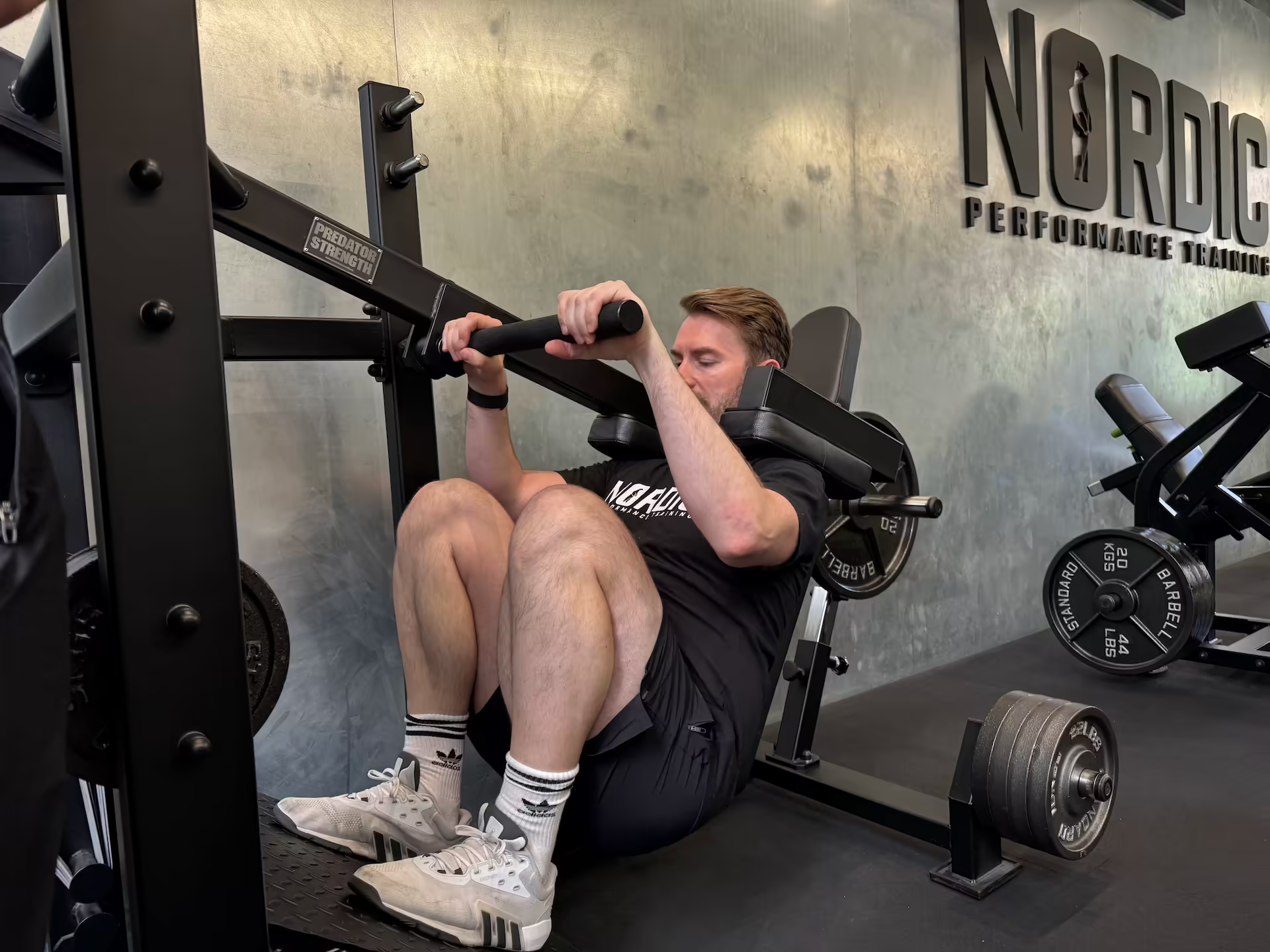

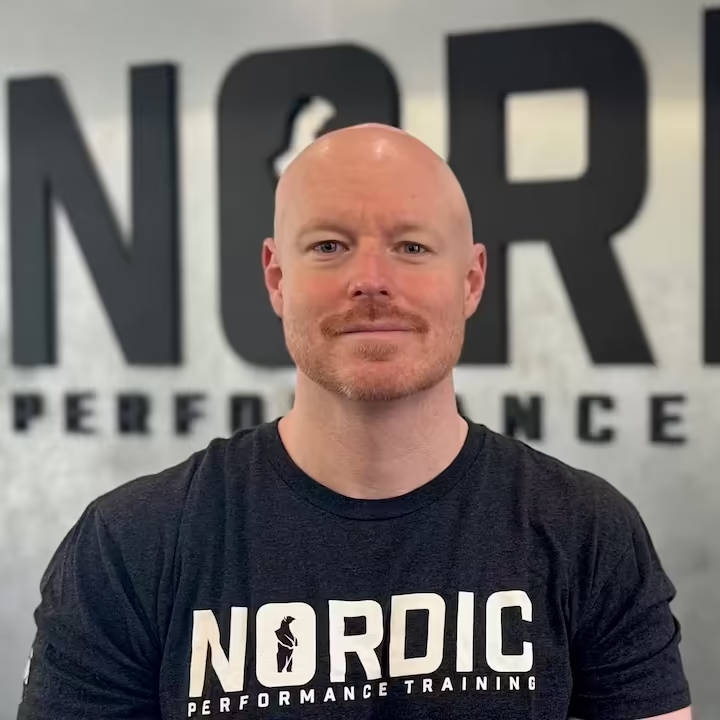
I’ve worked as a personal trainer for over 12 years and as a physiotherapist for over 10 years — and co-founded Nordic Performance Training with Lucas 8 years ago to give clients a professional and structured way to train. Since then, I’ve helped hundreds of people build strength, stay consistent, and feel better through evidence-based methods that actually work.
Along the way, I’ve completed advanced certifications and mentored under leading experts in various fields, and I’ve taught many trainers and physiotherapists internationally.
On this blog, I share the same practical tools, insights, and strategies we use every day at Nordic — so you can train smarter, stay consistent, and get real results.



Related Blog Posts
.svg)