







Strength Training: Guide to Results on 1-2 Sessions a Week
Most people optimise the wrong things.
They fine-tune their diet, buy expensive supplements, track steps on their phone, and consider whether they should swap the oatmeal for chia porridge at breakfast. All fine. But at the same time, they ignore the one intervention with the greatest documented effect on long-term health.
Strength training.
Not because they're lazy. But because they think it requires four to five days a week, a complicated training programme, and a lifestyle that revolves around their daily protein intake and new training exercises they need to learn on a weekly basis.
It doesn't have to be that way.
After 8+ years and thousands of clients in our training centre in Copenhagen, we see the same pattern: Those who get the best results with strength training are not the ones who train the most. They're the ones who train smart and simple. And keep going.
1–2 well-structured strength training sessions per week are enough to become markedly stronger, build muscle mass, and improve your health. Not as a compromise. But as the approach that actually works for people with an ordinary life.
This guide gives you everything you need: What strength training is, why it works, how to get started. And why you don't need to make it half as complicated as you think.
What is strength training?
Strength training is any form of training where you work against a resistance with the aim of increasing your strength. This can be with machines, dumbbells, or your own body weight.
The fundamental principle is simple: Give the body a challenge it's capable of, but that's beyond what it's used to. Give it time to adapt. And then increase the challenge slightly – so it matches the new level the body has reached.
This is called progressive overload. That you're gradually able to do a bit more over time, without it feeling harder. That's what tells us the training is working. That the muscles are growing – and that the brain is getting better at using them. Because that's actually what happens: Your brain learns to send stronger signals to the muscles, so more muscle fibres work together when you lift. That's why you can become markedly stronger long before the muscles look bigger.
Strength training. Training with the purpose of getting stronger. It's actually that simple.
What is strength training good for?
If you only know strength training from pictures of bodybuilders on Instagram, it's easy to think it's primarily about appearance. And strength training can radically change your appearance if you want a more toned, athletic, or muscular body. But it's also good for far more things.
Physical benefits
Your body is designed to adapt to what you expose it to. When you strength train regularly, a number of things happen that reach far beyond the size of the muscles.
Your muscles become stronger and more functional. You notice this in everyday life – when you carry the grocery bags up the narrow back stairs, play with your children, cycle across Dronning Louises Bro in a stiff headwind, or effortlessly lift the heavy pot and pour out the water.
Your bone density increases. This is especially important after 40, when the body naturally begins to lose bone mass. Strength training is one of the most effective and well-documented methods for counteracting this.
You build muscle mass – and that's more important than most people realise. Without strength training, adults lose 3–8% of muscle mass per decade after 30. It might not sound like much, but over 20–30 years, the consequences are enormous. Both for your quality of life and due to the fact that low muscle mass is associated with a 2–3 times higher risk of premature death – independent of other factors. It's a bigger risk factor than most people are aware of, and it underscores how important it is to build and maintain muscle mass throughout your entire life.
That's a number that surprises most people. We talk a lot about diet, supplements, and cardio – but muscle mass is the variable that research points to most unequivocally.
Structured strength training also reduces the risk of cardiovascular disease by 10–17%. Combined strength and cardio training reduces overall mortality by up to 51%.
And then there's pain relief. Many of our clients come to us with back pain, neck pain, or shoulder problems. Many have a fear that strength training could make it worse. But again and again, we see the opposite: A stronger body is a more resilient body. And research confirms it – strength training markedly reduces bodily pain in adults over 60. And those who train regularly recover far faster if pain occurs again.
Mental benefits
What surprises most people is not the physical changes. It's how they feel.
Strength training gives you surplus. Not the kind of surplus you get from a cup of coffee – but a fundamental feeling of having more to give in everyday life. More energy at work. More patience with the children. More desire to go out and do something on the weekend.
Research supports this: A large collection of studies found that strength training reduces depressive symptoms with a moderate-to-large effect. For every 4 people who begin strength training, 1 will experience a noticeable improvement of depressive symptoms. That's an effect comparable to – and in some cases better than – many medical interventions.
For older adults, the numbers are even stronger: Research shows large effect sizes for both reduction of depression and anxiety in persons over 60.
Many of our clients describe it as getting a new baseline of surplus. They sleep better, stress less, and feel more confident – not because their body necessarily looks different, but because they know what it can do – because they prove it to themselves on a weekly basis.
"I started training to lose weight," told Mette, 44, project manager from Valby. "But what has changed my life is that I no longer feel like someone who 'should get started.' I'm already going. It does something to your entire self-image."
And it doesn't stop at mood. Recent research shows that strength training is the form of training with the greatest effect on overall cognitive function in older adults – stronger than cardio and all other tested forms of training. It improves working memory, learning, and the type of controlled thinking we use to make good decisions.
Muscle strength is not just about the body. It's about the brain – and about feeling good.
Strength training and sport
If you run, play padel, cycle, or do another sport on the side, structured strength training is not a competing or disruptive element – it's a foundation for increased potential in all your physical endeavours outside the training centre.
All athletic movements require force production. And it's your maximal strength that sets the ceiling for how much you have to draw on. The stronger you are, the smaller a proportion of your capacity you use in your sport. This means it takes longer before you become exhausted, you maintain better technique for longer, and you have more reserves for the decisive moments when you need to perform.
Think of two runners who both weigh 75 kg. One can squat 60 kg, the other 120 kg. They run the same pace – but the first one uses a far larger proportion of their capacity with every single step. Gets tired faster, technique breaks down, therefore higher injury risk. The other has more in strength reserve.
And it doesn't stop at the muscles. Heavy strength training makes the tendons stiffer and the bones denser – the entire body can absorb more load before something gives. That's why research consistently shows that structured strength training markedly reduces sports-related injuries.
Strength training for beginners: How to get started
The most important thing when you start strength training is not to know everything. It's to know what you can expect – and what you can ignore. And a clear plan for which exercises to start with, how to perform them correctly, and how heavy you should lift.
What can you expect in the first weeks?
The first 4 weeks are not about big changes. They're about learning the exercises, finding a stable rhythm, and starting to feel comfortable in the training. Many also experience increased confidence and a sense of mastery from having made the decision to get started and feeling progress.
From week 4 to 12, the visible progress begins. You can lift more weight and do more repetitions in the exercises, you're more confident in the technique, and you start to notice that things in everyday life that used to feel difficult now feel easier.
After 3–6 months of consistent strength training, the difference is clear. Not only what you see in the mirror, but in how you move, how much you can manage physically, and how you feel mentally.
The rapid progress in the beginning is primarily due to adaptations in your nervous system. The brain learns to activate the muscles more efficiently – not because the muscles have necessarily grown that much bigger, but because the signals from brain to muscles become faster and more precise. That's why beginners often experience marked strength gains in the first months.
Søren, 52, IT manager from Østerbro, started without any training experience. "I thought it was too late for me," he said. "But after five months, I was lifting more than I had ever imagined. And the best part was that I only trained twice a week."
The most important exercises to start with
You don't need 20 different exercises. You need 6 exercise categories that together cover the entire body:
- A pressing exercise for the upper body. Chest press in a machine or with dumbbells. You push a weight away from you – this trains chest, shoulders, and triceps.
- A pulling exercise for the upper body. Pulldown or row. You pull a weight towards you – this trains back and biceps.
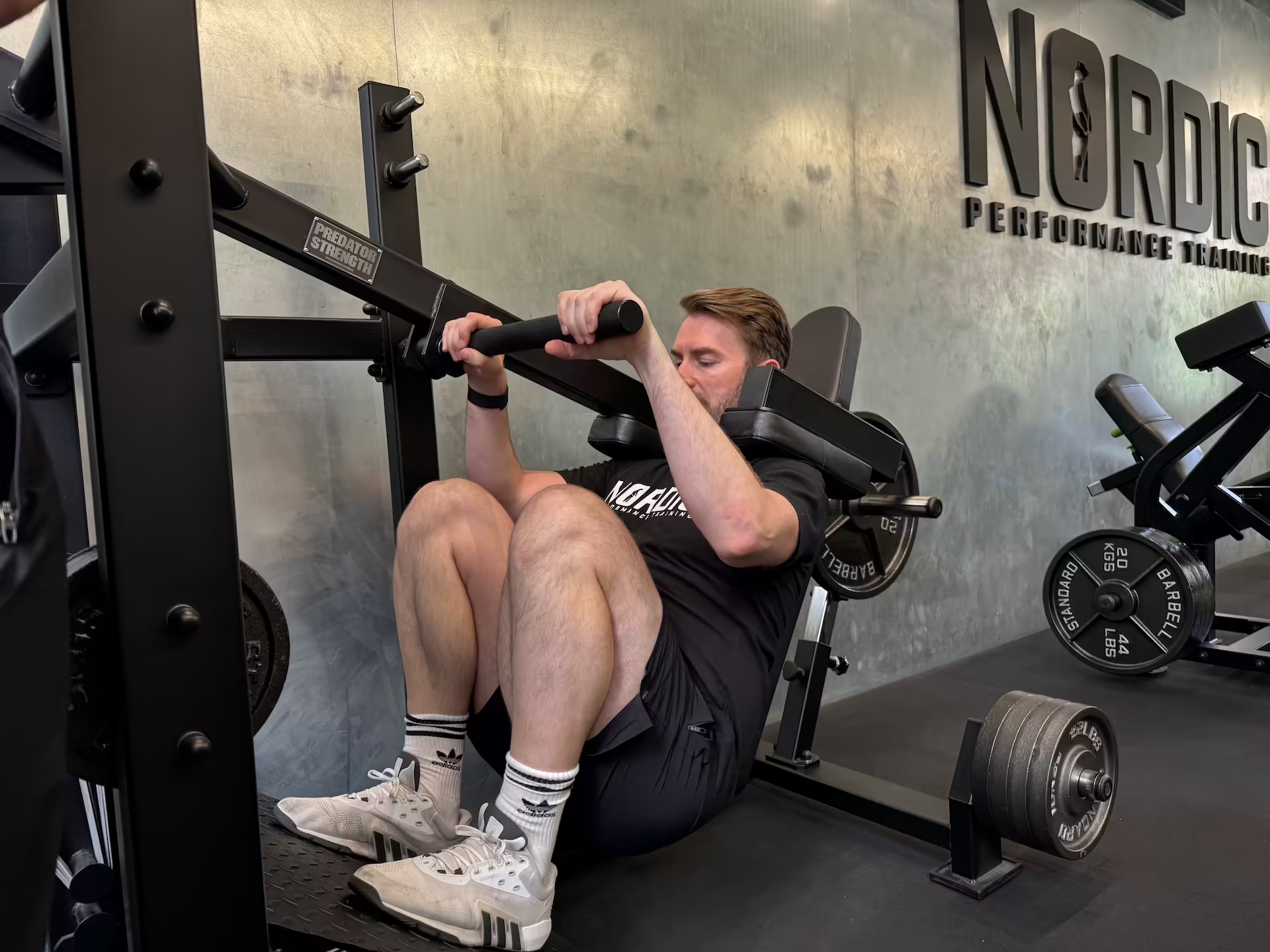
- A squat variant. Hack squat or split squat. You bend and extend the legs under controlled load – this trains quads, inner thighs, and glutes.
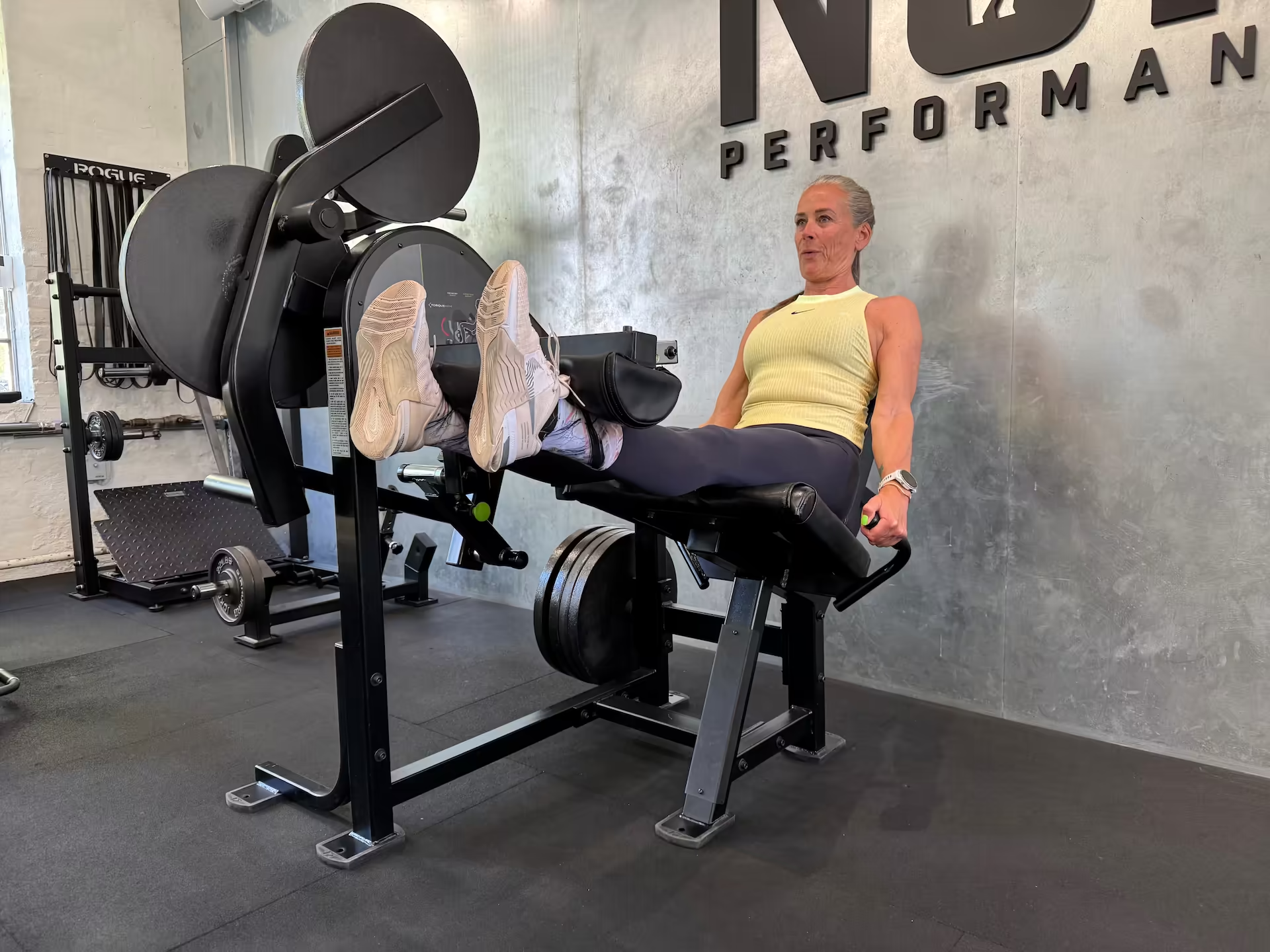
- A leg curl. Seated or lying leg curl. You bend the knee under load in a stable environment – this trains the hamstrings.
- A shoulder isolation. Lateral raises with dumbbells or on cable. You lift the arms away from the body – this trains the lateral deltoid muscle and all the stabilising muscles around the shoulder joint.
- A leg isolation. Leg extension or glute bridge machine. Trains the quads or the glutes in isolation.
That's the entire foundation. Six exercises built around these categories are enough for a complete strength training programme. The rest – biceps, triceps, and abs. Can become important over time, but not necessary when you're starting out. They're trained well enough in the other exercises on the programme.
Many beginners spend months researching the perfect exercise list so they train both upper and lower chest. Or they compare 4 different squat variations. Read up on "advanced" training methods like dropsets.
The truth is, all of that is irrelevant. Choose the exercise in each category that you have the opportunity to do regularly and that gives you the greatest return on investment, stick with that exercise, push yourself hard enough – and not as hard as possible – and increase weight and repetitions systematically.
How heavy and how many sets?
Here are the concepts you need – and no more:
Repetitions (reps) are the number of times you perform a movement in one set. 8 repetitions = you lift the weight 8 times.
Sets are a collection of repetitions. 3 sets × 8 reps = you lift the weight 8 times, rest, 8 times again, rest, 8 times again.
Working weight is the load that's heavy enough that the repetitions feel challenging. Not impossible – but challenging. If you could easily do 5 more repetitions, the working weight is too light. If you lose technique and push yourself to the absolute limit, it's too heavy.
For most beginners, 2–3 sets of 6–8 repetitions per exercise is a good starting point, as long as the working weight is challenging. This provides enough total repetitions for progress without making the training unmanageable or overwhelming.
The way you increase weight and repetitions over time is simple: When you can complete all repetitions with good technique, you increase the weight slightly next time. This is called double progression – and it's the most reliable method for ensuring you actually get stronger over time, without overloading yourself physically and mentally. Make sure to follow it systematically and note weight and repetitions after each training session.
Strength training for women: Myths and facts
Muscle mass and muscle building for women
Women build muscle at approximately the same relative rate as men – just from a lower starting point and with a lower absolute ceiling. The process and principles are exactly the same.
What women get out of strength training reaches far beyond looking a certain way. Yes, many start with a desire for a more toned physique – and strength training gives them that. But what really changes is something else: A feeling of robustness. Of being able to trust your body. Of belonging in a training centre – not as a guest, but as someone who belongs. Confidence, sense of mastery, and surplus in everyday life. These are the things our female clients most often highlight when they look back.
On top of that come the health-promoting effects. Women have a higher risk of osteoporosis, especially after menopause. Strength training with gradually increasing load is one of the most documented methods for building muscle mass and maintaining bone density in women. It's a health investment with decades of reach.
A training programme for women is built on exactly the same fundamental principles and exercise categories as for men. Because the physiology is the same.
Can you strength train when you're pregnant?
Many women stop training when they become pregnant. Often not because the body says stop – but because the surroundings do.
The truth is far more optimistic: Pregnant women are allowed to train – and it's healthy for both mother and child. Research shows that strength training during pregnancy reduces the risk of gestational diabetes, preeclampsia, and complicated deliveries. It improves sleep quality, reduces lower back pain, and provides better recovery after birth.
The rule of thumb is simple: You're allowed to do what you can. If you trained heavy before the pregnancy, you can in principle continue – with the adjustments the body naturally asks for along the way. The load is adapted, not the principle.
And after birth? This is where the investment pays off. Women who have strength trained throughout the pregnancy return to their baseline faster. Not because they push themselves – but because the foundation is still there.
Do women get big from strength training?
It's the most common question we get. And the answer is short: No. Women physiologically cannot build the same muscle mass as men – regardless of how heavy they lift. The women you see with very large muscle mass on Instagram are, in the vast majority of cases, using performance-enhancing substances. It's not something that happens by accident.
Emma, 31, graphic designer from Vesterbro, trained for years with light weights and many repetitions because she was afraid of "getting big." When she finally started lifting heavier, the opposite of what she feared happened: She got the toned physique she wanted, but most importantly she became stronger – and for the first time in her life got that feeling of physical competence she had always wished for.
Lift heavy. You won't get big. You'll get strong and healthy.
Strength training for older adults: Myths and facts
Let's establish this right away: It's never too late to begin strength training.
One of the most ambitious studies of strength training and ageing in Scandinavia followed 451 men and women between 62 and 70 years old. Approximately 80% had at least one chronic disease. They were not athletes. They were ordinary people.
The results were striking: The group that trained heavy with machines under the guidance of a physiotherapist every time maintained their leg strength for four years – even after they stopped training. The group that trained light at home with body weight and resistance bands lost strength over time – despite training just as often. The control group lost 7% leg strength. For a 70-year-old, that's the difference between standing up from a chair without help and not being able to.
Strength training for older adults is about preserving independence – being able to take the stairs, play with the grandchildren, react quickly enough when you stumble to take a quick step or brace with your hands in time. And if the worst happens, actually being able to get up after an unfortunate fall and – perhaps most importantly – being robust enough not to break anything.
The research is unequivocal: Strength training reduces fall risk by 21–50%, improves your ability to manage everyday tasks like standing up from a chair, walking on stairs, and carrying heavy things – and is the only non-pharmacological intervention that can counteract the loss of bone, muscle mass, and movement speed with age.
"My doctor told me to take it easy after I was diagnosed with osteoarthritis. Now I squat 60 kilos." – Erik, age 67
Age is not a barrier – it's a reason to start.
Want to know more? We've written a complete guide on the topic: Strength Training After 60. Or more specifically, how to improve your balance.
What a good strength training programme looks like
The best strength training programme is not the most complicated. It's the most sustainable.
It should contain exercises that cover the entire body – the exercise categories we reviewed above. It should have a clear system for when and how much you increase in weight and repetitions. And it should fit into your everyday life so you actually show up week after week.
That's the entire recipe. The rest is details that often end up making your training routine fragile.
We know thousands of different ways to make training programmes. Advanced periodisation models where you increase weight and decrease repetitions over time. 12-week blocks divided into 3-week periods where you alternate between many repetitions with lower weight and fewer repetitions with heavier weight. Advanced training splits where you divide your programme into 5+ different days to ensure that every conceivable muscle fibre in the body is hit.
We know how to do all of that. We just don't use it. Because it simply doesn't fit the way our clients live – and because we've seen again and again that it doesn't deliver better results in practice. Our approach is minimalist: Fewer moving parts, less that can go wrong, guaranteed progress.
And time after time, we see the same thing: The simplest programmes deliver the best results – because people actually manage to follow them. And once the routine is set, you can always try to optimise a few parameters at a time. But once you understand and experience how fragile it is, most people choose the simple solution – and fall in love with the quiet, steady progress.
Strength training exercises at home vs. in a centre
Strength training exercises at home
Can you train at home? Yes. Strength training at home can be push-ups against the kitchen counter, split squats with the back foot on the sofa, Romanian deadlift with dumbbells, rows with resistance bands around the door handle, and the plank on the living room floor. It requires almost no equipment and can be done in your living room.
But there's a limitation: It's difficult to increase the load precisely over time. You can make push-ups harder via changes in tempo and variations, but at some point, you run out of options. And without the ability to gradually increase the load, your progress plateaus.
The study with the many older adults from the previous section illustrated exactly this. The group that trained with resistance bands and body weight at home didn't get nearly as good results as those who trained with machines together with a physiotherapist – even though they trained just as often. The load was simply not high enough to create lasting adaptations. And honestly, it's often a bit of a hassle, unless you make a large investment in quality equipment.
Home training is a fantastic backup – for travel weeks, sick children, or those days when for various reasons you simply can't get to the training centre. But it's a backup, not a replacement.
Strength training exercises in the training centre
A training centre with machines and weights gives you what home training cannot: Unlimited ability to increase precisely – in smaller or larger increments – in load. You can always turn it up. This makes it possible to keep getting stronger – month after month, year after year.
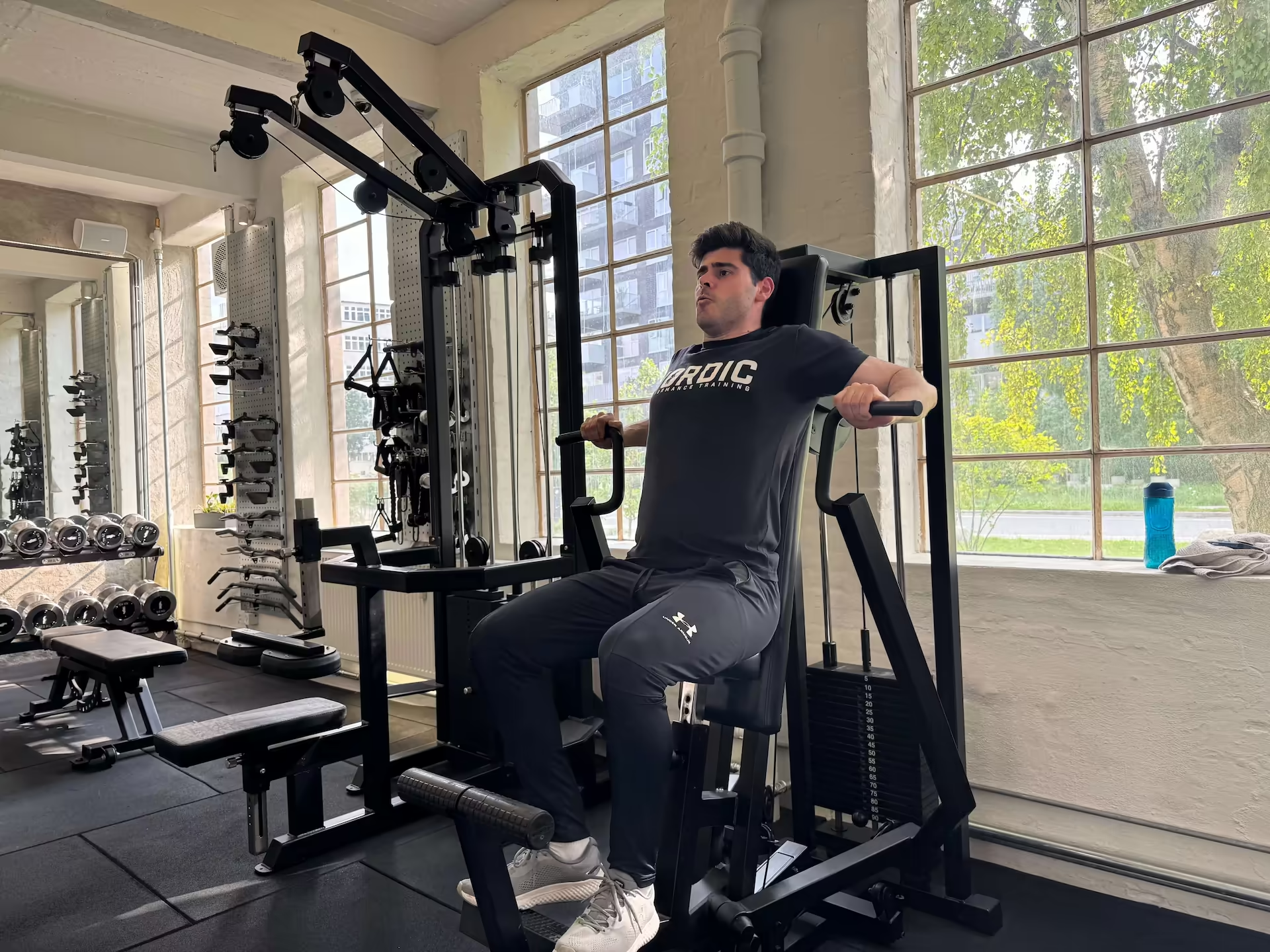
Machines have a particular advantage for most people: They provide stability and make it easier to focus on the movement itself. The study used exclusively machines and reported a very low injury rate. Machines are safe, effective, and remove the technique barrier.
Free weights provide more freedom and can feel more natural, but require more practice.
Our recommendation: 1–2 effective, heavy, and structured training sessions of 40–60 minutes' duration with machines. This delivers better results than short, daily home training sessions – at a fraction of the time investment. Start with machines so you actually get something out of your time in the training centre from the start. Once the foundation is in place, free weights can certainly come into the picture.
Want to see a concrete example of what a structured strength training programme looks like? Read our complete Full Body guide with free programs.
Warm-up for strength training
A good warm-up is about getting the body ready – not tired. You don't need 20 minutes of cardio or a 15-minute mobility routine. You just need to prepare the body for what it's going to go through during the training.
The simplest and most effective method is to use your first exercise as warm-up – just with lower weight.
If your working weight in chest press is 100 kg:
- Set 1: 50 kg (50%) × 6–8 reps. Light, controlled, focus on the end positions.
- Set 2: 75 kg (75%) × 6–8 reps. The body starts to wake up.
- Set 3: 100 kg (working weight) × 6–8 reps. That was your first working set.
It takes 3–4 minutes. Your muscles are warm, your joints are lubricated, and your nervous system is prepared for the load that's coming. This provides better performance in your working sets – which means greater stimuli, more results, and lower injury risk.
Can't you just cycle a bit first? Sure – and the body actually functions a bit better when it's generally warm, because the nervous system more easily sends signals out to the muscles. But for most people who rush into the training centre before or after work with max 60 minutes available, the time investment doesn't make sense. The warm-up sets do the same job – just more specifically and in less time.
The most important rule: Warm-up should make you ready, not exhausted.
How many times per week should you strength train?
The short answer: Most people get fantastic results with 1–2 times per week. Physiologically, it's easier to plan the training and fit in more exercises with 2 weekly sessions – but we can adapt the programme so that 1 time per week is surprisingly effective. You just can't fit as many different exercises per session. Let's take them one at a time.
1 time per week
One weekly strength training session is light years better than none. Research actually shows that once per week is surprisingly effective – across age groups and even persons who are already in good shape. The difference between 0 and 1 is the biggest difference you can make. The only adaptation is that you need more sets per exercise, because the body has more time to return toward baseline before the next training session. This means fewer exercises per session – but it works. If your everyday life only allows once per week, then train once per week. You will still get stronger.
2 times per week
This is where most people hit their sweet spot. With two weekly training sessions, you can do the same Full Body session both days and hit each exercise every 3rd–4th day. This keeps the muscles stimulated within the window where they still respond to the previous training, without you needing to perform more than 2–3 sets per exercise. You get technically better because you repeat the same exercises often enough to learn better movement patterns more frequently. And you still have 5 other days in the week that can be dedicated to running, sport, group training – or just living your life. Because we only need to do relatively few sets per exercise to see continuous progress, you also don't get as sore and can easily train purposefully towards multiple goals – e.g. cardio and strength simultaneously.
An effective training week can look like this: Full Body Monday, Full Body Thursday. Same exercises both days. Only change exercises every 6–12+ weeks if necessary. That's the entire system.
Our data shows that most clients who go from 1 to 2 weekly training sessions can easily maintain it over time. The jump from 0 to 2 is also often realistic and sustainable.
3 times per week
With three weekly training sessions, you can alternate between two different Full Body sessions – for example Full Body 1 Monday, Full Body 2 Wednesday, Full Body 1 Friday – and the opposite the following week. This provides more variation in exercises and hits more muscle fibres within the same muscle group, because different exercises load the muscle from different angles and positions. Each exercise is still trained every 4th–5th day.
But there's a price: It requires a fixed weekly schedule. The structure depends on you training every 2nd–3rd day. If your calendar changes from week to week, it quickly becomes fragile. Our data shows that clients who go from 2 to 3 weekly training sessions drop off on average after 3–4 weeks. Not because the body can't – but because everyday life doesn't allow it.
3 times per week is for you who has a consistent weekly schedule, recovers well, and genuinely enjoys spending time in the training centre. If that's not you, 2 times per week is the better choice.
4 times per week
Four weekly training sessions are in practice 2 times Full Body divided into upper body and lower body and spread across 4 days – a so-called upper/lower split. This allows room for more exercises per muscle group in each session, but it's not necessarily better results. It's more training, which is smart if you want to optimise your progress in more exercises and muscle groups. For the vast majority, however, it's far more than necessary.
The ground rule: More training sessions provide the opportunity for more variation – not necessarily better results. And the more training sessions you demand of yourself, the more fragile your routine becomes. The best programme is the one you actually complete – week after week, month after month.
The most important principle: Consistency beats everything
If you only remember one thing from this guide, let it be this: It's not the theoretically most optimal programme that delivers the best results. It's the programme you actually follow.
In a world full of 12-week transformations, new training concepts, and programmes that promise fast results, the boring truth is that progress in strength training is about showing up. Week after week. Month after month. Doing the same exercises a little bit better than last time – and then doing it again.
48 solid training weeks per year beats 6 weeks of max intensity followed by 46 weeks on the sofa, because the intensity wasn't sustainable.
"We see it time and again: Clients who train 1–2 times a week with structure and progression overtake those who train 4–5 times without a plan. It's not about volume – it's about direction." – Lucas Iversen, physiotherapist at Nordic Performance Training
One year with the right strength training can build such a large strength reserve that even if you take several years' break afterwards, much of your strength remains. The muscles get smaller, as the body doesn't want to hold on to the energy-demanding material it is, but the strength remains. The nervous system has learned to fire the muscle fibres more efficiently, and that ability doesn't just disappear. After that, you can easily maintain with e.g. 1 training session per week, possibly on and off, if life doesn't allow otherwise.
It's both an investment, and afterwards it can be a maintenance project.
Anders, 46, sales director from Hellerup, had been through three different training concepts in two years – CrossFit, a personal trainer with a 4-day split programme, and a period of bootcamp. Each time, he started with high energy and dropped it after 2–3 months.
"What changed it for me was to stop looking for the perfect programme – and just accept that the programme Nordic gave me was the one I could stick with," he told us. "Two training sessions per week, the same exercises, slow progress. It's not sexy. But after a year, I'm stronger than ever, and I've fallen in love with the process and am proud of actually having become good at this training thing."
That's the real secret of strength training. It's accessible to everyone who is willing to do something simple, long enough.
Frequently Asked Questions About Strength Training
Is strength training for me?
Yes – regardless of age, gender, or starting point. Research consistently shows that strength training delivers marked results for both healthy individuals and persons with chronic diseases.
You don't need to be in good shape to start. Start conservatively, focus on technique, and let the progress come with time. Most of our clients have never strength trained before they started with us – and most experience noticeable improvements within the first weeks.
Is strength training good for weight loss?
Strength training is not primarily a weight loss tool – but it changes your body composition. Research shows that heavy strength training increases muscle mass, lowers body fat percentage, and reduces visceral fat – the dangerous fat around the organs.
Many of our clients weigh the same after a year but look markedly different and feel markedly better. Focus on strength and health – not the scale. And if weight loss is important to you, use strength training to maintain or build your muscles alongside a calorie deficit.
How quickly can you see results from strength training?
Most people feel the first improvements within 2–4 weeks – better sleep, more energy, and increased strength. Visible body changes typically follow after 3–6 months of regular training.
The first weeks are primarily about the nervous system learning to send stronger signals to the muscles – you get stronger without the muscles necessarily growing yet. From week 4–12, visible strength gains begin. The changes you see in the mirror typically follow a couple of months after the changes you feel in strength and surplus.
How long should you strength train per session?
An effective strength training session takes 45–60 minutes including warm-up. You don't need to train for hours to get results – quality and intensity are more important than duration.
Many of our clients train 1–2 times per week for approximately 50 minutes and achieve marked results. The most important thing is that you focus on the exercise categories that cover the entire body, maintain a high enough intensity, and increase weight and repetitions systematically over time. Longer training sessions rarely deliver proportionally better results.
Can you strength train every day?
It's not necessary – and for most people not optimal either. Your muscles need 48–72 hours of recovery between training sessions to grow and get stronger.
Muscle growth doesn't happen during the training itself, but in the recovery period afterwards. If you train the same muscle group every day, you risk stagnation and increased injury risk. Research shows that the jump from 0 to 1 time per week provides the greatest improvement – and that 1–2 times per week is the sweet spot for most people. Up to 3–4 times can make sense if your everyday life allows it and you distribute the exercises wisely.
What does it cost to get started with strength training?
You can get started at a regular fitness centre for 350–800 kr. per month. Personal training with professional guidance costs more, but research is clear: supervised strength training delivers markedly better results than training alone.
The price for personal training varies depending on frequency and programme type. You can see our prices here.
Ready to get started?
Strength training doesn't need to take over your life to improve it.
1–2 training sessions per week. A simple programme with few, well-tested exercises. Gradual progress over time. That's enough to become stronger, healthier, and more resilient – without you having to restructure your entire everyday life.
If you want to see exactly what a structured strength training programme can look like – with free programmes for 1, 2, and 3 weekly training sessions – then read our complete Full Body guide.
And if you'd like help getting started with an approach that fits your life, then book a free start-up conversation here – either in our private training centre in Copenhagen or as a call, if that suits you better. We'll go through what makes sense for you specifically.
References
Wang, Y., Luo, D., Liu, J., Song, Y., Jiang, B., & Jiang, H. (2023). Low skeletal muscle mass index and all-cause mortality risk in adults: A systematic review and meta-analysis of prospective cohort studies. PLOS ONE, 18(6), e0286745. https://doi.org/10.1371/journal.pone.0286745
Saeidifard, F., Medina-Inojosa, J. R., West, C. P., Olson, T. P., Somers, V. K., Bonikowske, A. R., Prokop, L. J., Vinciguerra, M., & Lopez-Jimenez, F. (2019). The association of resistance training with mortality: A systematic review and meta-analysis. European Journal of Preventive Cardiology, 26(15), 1647–1665. https://doi.org/10.1177/2047487319850718
Gordon, B. R., McDowell, C. P., Hallgren, M., Meyer, J. D., Lyons, M., & Herring, M. P. (2018). Association of efficacy of resistance exercise training with depressive symptoms: Meta-analysis and meta-regression analysis of randomized clinical trials. JAMA Psychiatry, 75(6), 566–576. https://doi.org/10.1001/jamapsychiatry.2018.0572
Bloch-Ibenfeldt, M., Gram, B., Hesseldal, L., Christensen, R., & Dahlgaard, J. (2024). Heavy resistance training at retirement age induces 4-year lasting beneficial effects in muscle strength. BMJ Open Sport & Exercise Medicine, 10(2), e001899. https://doi.org/10.1136/bmjsem-2024-001899
Sherrington, C., Michaleff, Z. A., Fairhall, N., Paul, S. S., Tiedemann, A., Whitney, J., Cumming, R. G., Herbert, R. D., Close, J. C. T., & Lord, S. R. (2017). Exercise to prevent falls in older adults: An updated systematic review and meta-analysis. British Journal of Sports Medicine, 51(24), 1750–1758. https://doi.org/10.1136/bjsports-2016-096547
Table of Contents
Related Blog Posts

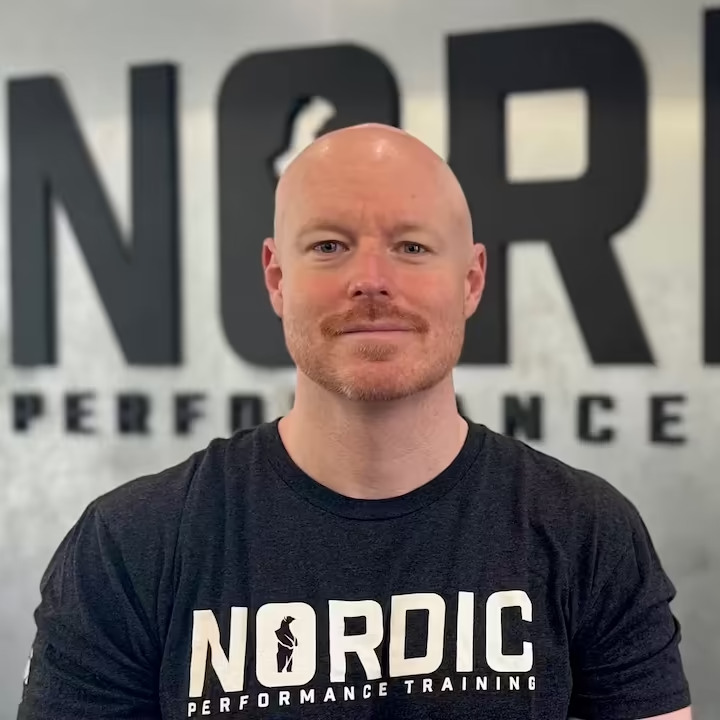
I’ve worked as a personal trainer for over 12 years and as a physiotherapist for over 10 years — and co-founded Nordic Performance Training with Lucas 8 years ago to give clients a professional and structured way to train. Since then, I’ve helped hundreds of people build strength, stay consistent, and feel better through evidence-based methods that actually work.
Along the way, I’ve completed advanced certifications and mentored under leading experts in various fields, and I’ve taught many trainers and physiotherapists internationally.
On this blog, I share the same practical tools, insights, and strategies we use every day at Nordic — so you can train smarter, stay consistent, and get real results.




Related Blog Posts
.svg)