






How to Train Balance: Effective Exercises & Tips
Most people think that balance is about standing on one leg. That it requires balance pads, unstable surfaces, and exercises that look like something from a circus act.
It sounds logical. Poor balance? Then train balance. Simple, right?
But that's just not how reality works. The people who improve their balance the most are not the ones standing on a wobble board, a balance pad, or a BOSU ball. They're the ones who get stronger.
And the difference is not small.
Research shows that moderate to heavy strength training provides comparable balance improvement to dedicated balance training. But on top of that, you get everything balance training cannot give you: more muscle mass, stronger bones, higher metabolism, better functional capacity, and – ironically – better fall prevention.
Balance training gives you better balance in the specific exercise you train. Strength training gives you a body that is better at everything, including balance.
Why is balance important?
Let's start with the obvious: Balance keeps you upright. It sounds trivial, but the consequences of poor balance are anything but trivial.
One in three over the age of 65 falls every year. And 10–15% of those falls lead to serious injuries – broken hips, concussions, hospitalisations. For many older adults, a fall is the beginning of a downward spiral that ends with loss of independence.
But balance is not only relevant for older adults.
Young athletes with poor balance have a markedly higher risk of ankle injuries. And perfectly ordinary adults who lose balance through decades of sedentary work experience it as a slow erosion of their physical confidence.
You don't notice it as "poor balance." You notice it as a growing insecurity. You hold on to the railing a bit more. You're a bit more cautious on slippery pavements in winter. You hesitate before lifting something heavy because you don't quite trust your stability.
That's not a balance problem. That's a strength problem.
Eva, a 66-year-old retired school principal from Frederiksberg, came to us after falling on a staircase. Not because the stairs were slippery – but because her legs simply weren't strong enough to catch her when she lost her footing for a moment.
"My doctor said I should do balance exercises," she told us. "So I stood on one leg every evening while brushing my teeth, for three months. But I fell again anyway – this time on the way down a staircase in the metro."
It wasn't Eva's balance that failed her. It was her leg strength. We can all lose our footing, but being able to catch yourself during a fall is the difference between getting away with a scare or getting seriously injured.
How balance works – from sensory input to muscle strength
To understand why strength is so crucial for balance, we need to look at what balance actually is.
Most people think that balance is one thing. An ability you either have or don't have. But balance is actually the result of two systems working together:
The sensory system – the one that detects the problem. And the motor system – the one that solves it.
Your sensory system is like a surveillance system with three cameras:
The vestibular system in your inner ear registers how your head moves in space – gravity, acceleration, and rotation. It tells your brain whether you're vertical or about to tip over.
Your vision provides context. It confirms what the vestibular system registers and helps the brain orient itself in relation to the surroundings.
Your proprioception – your joints' and muscles' ability to sense where they are – tells the brain what the body is doing. How much your ankles are bending. Whether your knees are extended. Whether your hip is stable.
These three systems constantly send information to the brain about what's happening. They are your alarm system.
But an alarm system is worthless if no one responds to it.
Think of it like a fire station. The sensors detect smoke. The alarm goes off. But if the firefighters don't have the strength to lift the hoses, kick the doors in, and carry people out – then the alarm is irrelevant.
The motor system – your muscle strength and ability to produce force quickly – is the firefighters.
When you trip over a kerb, your sensory system registers the imbalance in milliseconds. Your brain instantly sends a signal: "Take a step! Stabilise!" But whether you actually catch yourself depends on one thing: Do your legs have the strength to execute the compensatory step quickly enough?
This is where most balance programs fail. They train the alarm system – but ignore the firefighters.
Eva had fine sensory input. Her inner ear worked. Her vision was fine. She could feel that she was about to fall. But her legs simply didn't have the strength to react quickly enough.
And there is no wobble board in the world that can fix that.
How to test your balance
Before we go further, it can make sense to get a feel for where you stand yourself.
There are formal tests like the Timed Up and Go (TUG) and tandem gait that physiotherapists use to assess balance. The TUG test is simple: You stand up from a chair, walk three metres, turn around, and sit down again. Over 12 seconds indicates increased fall risk.
Tandem gait – walking with one foot directly in front of the other, as on a line – tests your dynamic balance and proprioception. If you can't take 10 steps without swaying, it's worth noting.
You can also try the single leg stand: Stand on one leg with open eyes. Can you hold it for 30 seconds? Then try with closed eyes. Here, most people over 50 reveal a surprising difference – because they've become dependent on vision to compensate for lacking strength and proprioception.
But here's an important nuance: These tests tell you whether you have a problem. They don't necessarily tell you what the solution is.
At our facility, we use a more pragmatic approach. We ask qualitative questions – do you feel more confident on stairs? Are you more comfortable on slippery surfaces? Can you get up from a low sofa without using your arms? – combined with objective data from training. If your hack squat has gone from 20 to 60 kg, and you simultaneously feel more stable in everyday life, we don't need a balance test to tell us it's working.
Numbers don't lie. And strength progress in your leg exercises is one of the most reliable indicators of functional balance we know.
Getting started with balance training (that actually works)
Here comes the truth most people are surprised by: The most effective way to improve your balance is not to train balance. It's to train strength.
Let's establish that.
The research is quite clear on this point. Strength training alone provides moderate to large improvements in balance in both younger and older adults. And when it comes to fall prevention, research shows that strength training has a comparable effect to programs that specifically include balance training.
And here's the really interesting part: Traditional balance training has a fundamental transfer problem. You get better at the specific exercise you train – but the improvement transfers poorly to other situations. If you train standing on a balance pad, you get better at standing on a balance pad. But it doesn't necessarily help you when you stumble on the pavement.
Strength training doesn't have that problem. Stronger legs are stronger legs – whether you're walking down stairs, cycling into a headwind, or tripping over a kerb.
So our recommendation is clear: Start with strength training. 1–2 times per week. Focus on heavy compound exercises that build leg strength and power in the ankle, knee, and hip – the three joints that determine whether you catch yourself when you lose your balance.
It's not just "equally good" as dedicated balance training. It is objectively more valuable per minute invested, because you get muscle strength, bone strength, metabolic health, functional capacity, and balance improvement – all in the same training session.
Eva started with our Full Body program twice a week. No balance pads. No tandem gait. Just structured strength training with a focus on gradually increasing the weight in the exercises.
After 6 months of personal training, her hack squat had gone from 10 kg to 35 kg. But the number that meant the most to her? She hadn't had a single fall – and she felt more confident in everyday life.
"I don't think about stairs anymore," she said. "I just walk down them. It might sound trivial to most people – but for me, it was a huge thing."
"I did planks and balance exercises for years and still felt insecure on stairs. Then I strength trained at Nordic for six months – and suddenly the problem was just gone." – Eva, 66 years old
Balance exercises with equipment
Here are the exercises we use in our training centre that give you the best balance improvements relative to time invested. All are machine-based or with free weights – and all build the strength your body needs to keep you upright and catch you when you lose your footing.
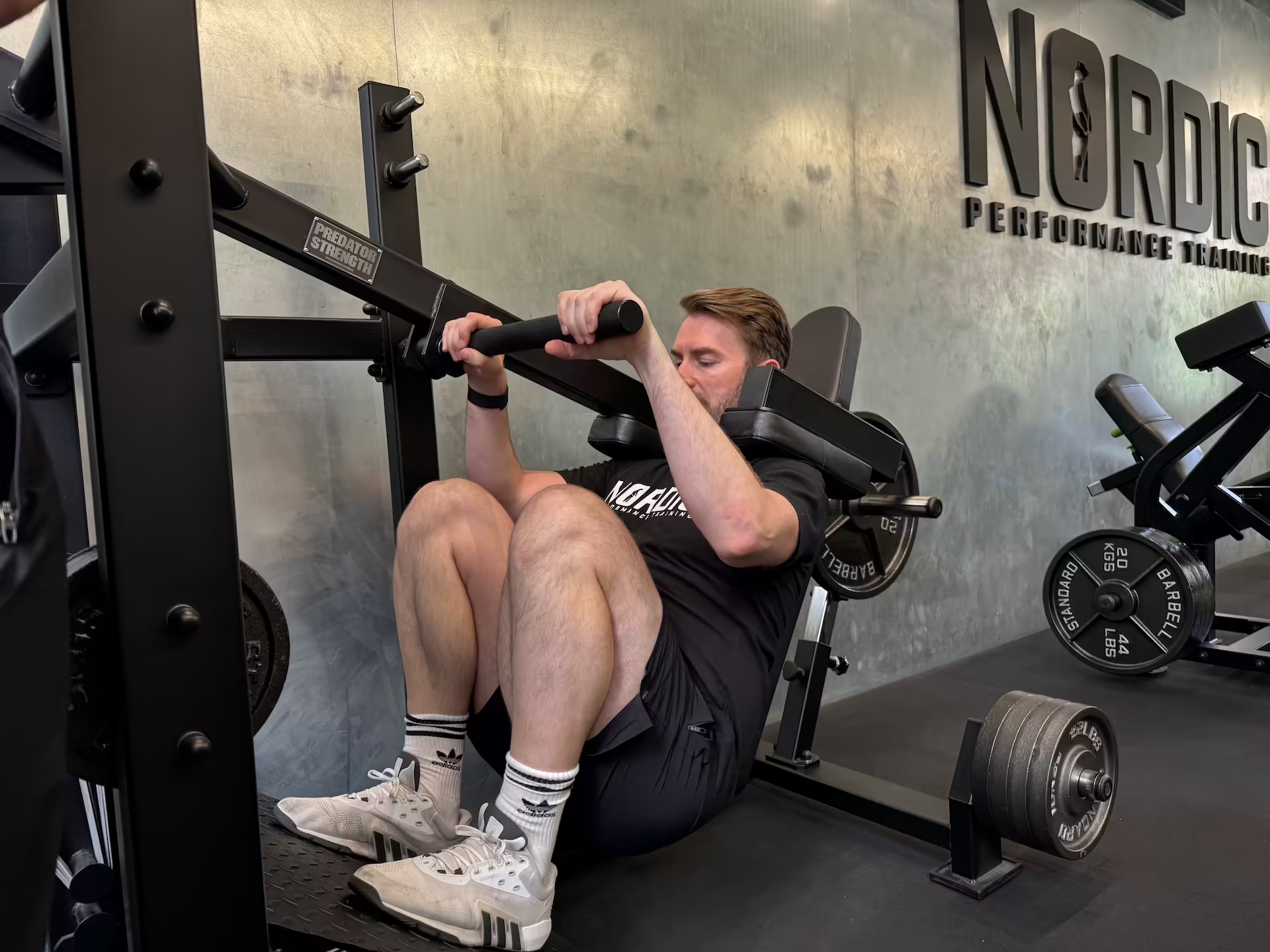
Hack Squat or Pendulum Squat
The heaviest compound exercise for legs. The machine provides external stability so you can focus on producing force without worrying about technique and balance during the exercise itself. It might sound paradoxical – training balance in a stable machine – but that's precisely the point. The machine lets you load your legs heavily enough to create real strength adaptation in the quads, inner thighs, glutes, and calves.
And it's that force that keeps you upright in real life.
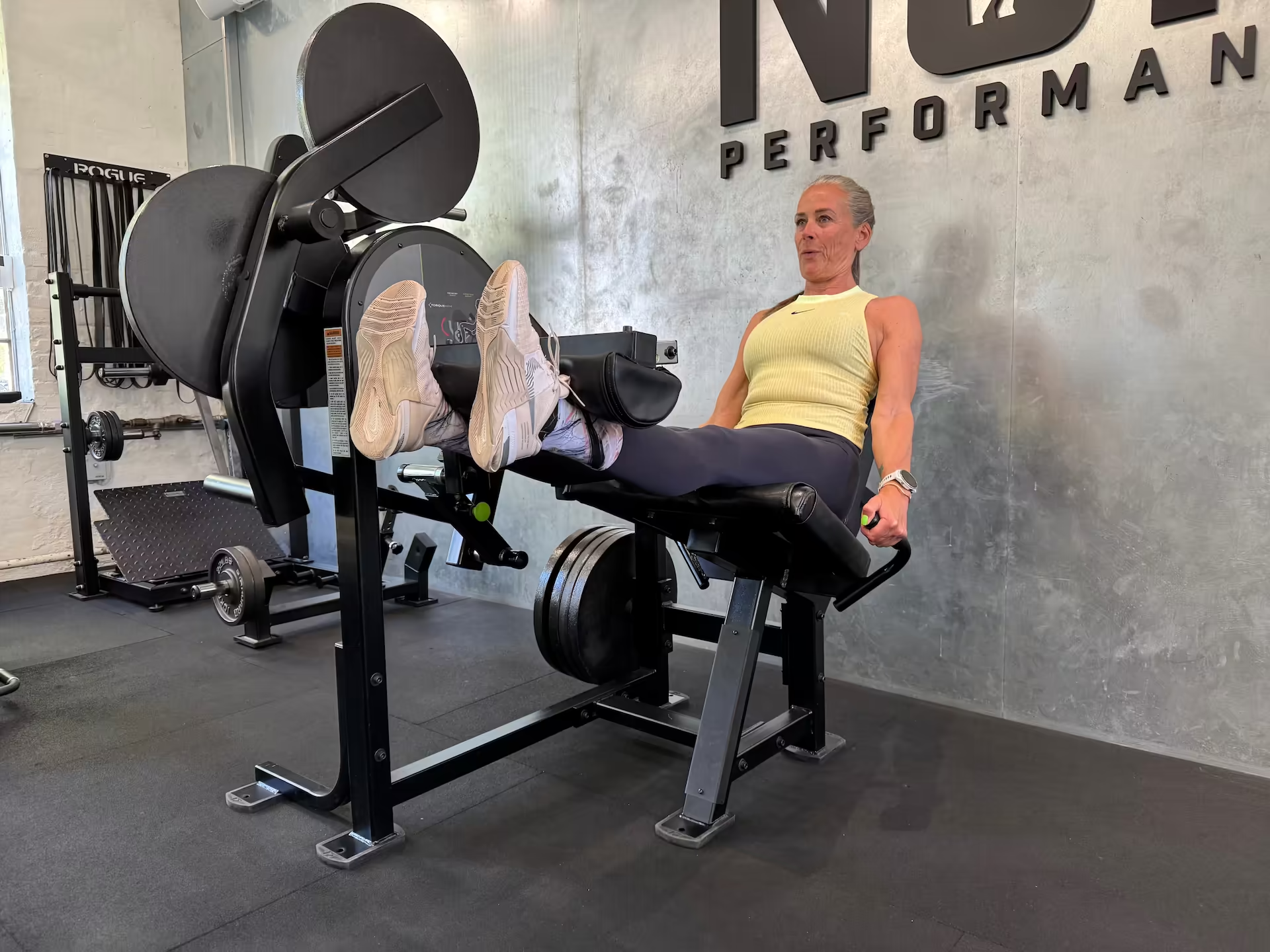
Seated Leg Curl or Lying Leg Curl
Eccentric knee control and force production in your posterior chain. The hamstrings play a crucial role in knee stability – and knee stability is one of the most underrated factors in balance control. Every time you land a step, your hamstrings brake the movement. The stronger they are, the more controlled and safely you land.
Leg Extension
Isolated strength in the quads – especially rectus femoris, which squats don't target particularly well. This muscle is crucial for the sit-to-stand movement: the ability to stand up from a chair without using your arms. If you've ever seen an older person struggle to get up from the sofa, this is often where the weakness sits.
Leg extension is not just a "bodybuilding exercise." It's functional training in its purest form.
Split Squat (with weight)
The most directly relevant exercise for balance. Why? Because it trains precisely the movement pattern your body uses when it catches you during balance loss: a quick, controlled step forward or to the side with one foot while you decelerate your body weight.
Split squat builds unilateral strength – strength in one leg at a time – and that's precisely what you need in the moment you stumble.
Machine Chest Press
This one surprises many. What does chest press have to do with balance?
Think about it: When you fall forward, what catches you? Your arms. You reach out, hit the floor or the wall, and push yourself away.
Machine Chest Press – or push-up variations – trains precisely the pressing ability you need to protect your head and upper body during a forward fall. It's one of the most overlooked components of fall prevention.
Balance exercises without equipment
Not everyone has access to a training centre. Here are exercises you can do at home, in a hotel room, or in the park that still build the strength your balance depends on.
Split Squat (with body weight)
The same unilateral pattern as the weighted version. Start here and build up. Focus on control: Lower yourself slowly, stay stable at the bottom, and press up with force. When you can do 15 clean repetitions per leg, it's time to add weight – a backpack with books, a water jug, whatever.
Single-Leg Glute Bridge
Hip stability and glute activation. The glutes are crucial for your ability to keep yourself upright, and keep yourself upright if you're about to fall. Strong glutes stabilise your entire lower body and give you a solid foundation to work from.
Push-Ups
Again: If you fall forward, it's the arms that protect you. Push-ups build the pressing ability you need. Can't do a full push-up? Start with your hands on an elevation – a table, a bench, a staircase – and work your way gradually lower.
Bodyweight Squat (or sit-to-stand)
Basic leg strength for those starting from the bottom. Don't have the strength for a full squat yet? Use a chair or stool: Sit down in a controlled manner, and stand back up without using your arms. It's a squat – just with a safety net. Start with a regular dining chair, and use a lower chair as you get stronger. When you can stand up from a low sitting height 15 times without pausing, you're ready for free squats.
Core, balance, and mobility – why heavy compound exercises beat isolated core training
"But what about core?" We hear that question constantly.
Many believe that a strong core requires the plank, crunches, and specific core stability exercises. That you need to isolate the abs to train them. And that core stability is the prerequisite for everything else.
But reality looks different.
Heavy squats activate your core just as much – or more – than the plank and crunches. And it makes good sense when you think about it: When you have several kg on your shoulders in a squat, your core has to stabilise the entire spine against a load that's heavier than your own body weight. That's a far higher demand than lying still on the floor and holding yourself horizontal.
You get core training for free every time you do heavy compound exercises.
But it doesn't stop there.
Strength training with full range of motion also improves your mobility just as well – or better – than static stretching. Because you build strength throughout the entire range of motion, not just passive flexibility you can't control.
Think about the difference: Static stretching gives you the ability to get into a position. Strength training with full range gives you the ability to control the position under load. Which is most relevant when you stumble and need to stabilise yourself?
Heavy strength training with full range of motion gives you core strength, mobility, and balance in one package – without extra time spent doing planks, stretching, or balance exercises.
It's the most effective use of your time.
Program structure and progression
You don't need a complicated program to improve your balance. You need the same thing everyone needs: A simple, structured Full Body program with gradual progression.
1 training session per week is enough for most people. 2–3 times if you have the time and energy for it.
We use our double progression method: Start with a weight you can lift 6 times with good technique. Increase the repetitions over the coming weeks until you hit 8 in all sets. Then increase the weight and start over at 6.
It's not complicated. You just have to keep going.
An example of a program that builds the balance you need:
- A-series: Machine Chest Press + Cable Pulldown – 3 sets × 6–8 repetitions
- B-series: Hack Squat or Pendulum Squat + Lying Leg Curl – 3 sets × 6–8 repetitions
- C-series: Leg Extension + Dumbbell Lateral Raise – 2–3 sets × 6–8 repetitions
Keep approximately 2 minutes of rest between sets. Use warm-up sets to get the body ready. And write down what you do – weight, sets, repetitions – so you can see that you're actually progressing.
For a complete walkthrough of exercise selection, set structure, and progression, read our Full Body Program guide.
The most important thing is not the specific program. It's that you show up, follow the plan, and get stronger over time. The balance follows along.
Eva at 66 used precisely this approach. No special balance exercises. No unstable surfaces. Just simple, structured strength training twice a week. And her balance improved more in six months than three years of balance pads and single-leg exercises had done.

Tips for effective balance in everyday life
Training is the foundation. But there are some practical things you can do alongside it that support your balance in everyday life.
Choose the right footwear for training
Your shoes affect your stability more than you think. Running shoes with thick, soft soles are designed to absorb impact – not to give you stability under heavy lifts. It's like standing on a mattress.
For strength training, we recommend shoes with flat, stable soles. Here are our top 5:
- Nike Metcon
- Reebok Nano
- Adidas Dropset
- Puma Fuse
- Under Armour TriBase
They give you a solid, firm contact with the floor – which improves your proprioception and stability during training. The result is more stability and more effective force development – which often leads to higher training intensity, faster strength progress, which gives you faster balance progress.
Get your vision checked
It might sound trivial, but your vision is one of the three pillars of your balance system. Many over 50 compensate for gradually declining vision without knowing it. A vision check at the optician can reveal problems you weren't aware of – and that affect your balance in everyday life.
Keep moving in everyday life
Cycling, walks, stairs instead of the elevator – all of it contributes to keeping your balance system active. The Danish lifestyle with daily cycling is actually one of the reasons why many older Danes have better balance than the average in other countries.
Think about safety at home
Loose rugs, poor lighting, and cluttered floors are the three biggest culprits in falls at home. Small adjustments – better lighting on the stairs, removal of loose rugs, tidy floors – can make a surprisingly big difference.
But remember: These tips are supplements, not replacements. The most important thing you can do for your balance is to get stronger. Everything else is fine-tuning.
Frequently Asked Questions
Can strength training improve my balance?
Yes — moderate to heavy strength training provides moderate to large balance improvements according to research. You build the muscle strength needed to correct balance loss, which is the real bottleneck for most people.
Is balance training better than strength training for preventing falls?
No. Strength training alone has a comparable effect on fall risk as programs that include balance training. Balance training only improves the specific exercise you train — the transfer to other situations is limited.
Do squats train your core more than the plank?
Yes. Research shows that heavy squats activate core just as much or more than the plank. Your core has to stabilise the spine against heavy external load — a far higher demand than holding your own body weight.
Can strength training replace stretching for mobility?
Yes — strength training with full range of motion improves mobility just as well or better than static stretching. You build strength throughout the entire range of motion, not just passive flexibility you can't control.
Which exercises are best for improving balance?
Heavy compound exercises like squats, leg press, and split squats. They build leg strength and power in the ankle, knee, and hip — the three joints that determine whether you catch yourself during balance loss.
It's all about strength
Let's tie the threads together.
Balance is not one thing. It's an interplay between your sensory system (the one that detects the problem) and your motor system (the one that solves it). For most people, the bottleneck is not the sensory part – it's the strength.
You can have the best alarm system in the world. But if the firefighters can't lift the hoses, the house burns down.
Strength training solves that problem. And it does so more effectively than dedicated balance training – because you simultaneously get all the other benefits: more muscle mass, stronger bones, better metabolism, higher functional capacity, increased confidence, and lower risk of falls.
You don't need a balance pad, a wobble board, or a BOSU ball. You don't need to stand on one leg with closed eyes. You don't need complicated stability exercises that look impressive but don't transfer to reality.
You need stronger legs. Stronger glutes. Stronger arms. A body that can react when it matters.
Eva understood that in the end. Not because she read a study – but because she felt it. The first time she took the metro without thinking about the stairs. The first time she walked on a slippery pavement without holding on to her husband's arm. The first time she stood up from the low sofa without hesitating.
"I thought I had a balance problem," she said. "It turned out I was just too weak. It sounds harsh – but it was actually the best news I got. Because weakness is something you can do something about."
And that's precisely what she did.
Ready to build the strength your balance depends on?
Eva spent three years on balance pads, single-leg exercises, and insecurity on stairs. Six months of structured strength training later, she takes the metro without thinking about it.
If you're tired of balance exercises that don't move the needle, or if you notice that your body is slowly becoming less stable – then let's have a talk.
Book a free startup conversation at our private training centre in Copenhagen, and experience how simple, structured strength training can give you the balance and confidence you're looking for — without balance pads, unstable surfaces, or complicated programs.
Because the best results don't come from training the most complicated way. They come from getting the strongest — and keeping at it.
References
Oliveira, A., Ribeiro, F., & Oliveira, N. L. (2021). Strength Training to Prevent Falls in Older Adults: A Systematic Review with Meta-Analysis of Randomized Controlled Trials. Journal of Clinical Medicine, 10(14), 3184. https://doi.org/10.3390/jcm10143184
Šarabon, N., Löfler, S., Jeranko, T., Burggraf, S., Kern, H., & Zorn, C. (2020). Effects of Resistance Exercise on Balance Ability: Systematic Review and Meta-Analysis of Randomized Controlled Trials. Life, 10(11), 284. https://doi.org/10.3390/life10110284
Šalaj, S., Štefan, A., & Grgurević, D. (2024). What are the hidden shortcomings of balance training research in older adults that prevent its transfer into practice? Scoping review. BMC Geriatrics, 24, 1035. https://pmc.ncbi.nlm.nih.gov/articles/PMC11695024/
Eckardt, N. (2016). Lower-extremity resistance training on unstable surfaces improves proxies of muscle strength, power and balance in healthy older adults: a randomised control trial. BMC Geriatrics, 16, 191. https://doi.org/10.1186/s12877-016-0366-3
Batson, C. D., Brady, R. A., & Keenan, K. G. (2021). Promoting Generalized Learning in Balance Recovery Interventions. Frontiers in Sports and Active Living, 3, 660438. https://pmc.ncbi.nlm.nih.gov/articles/PMC8004641/
Table of Contents
Related Blog Posts


I’ve worked as a personal trainer and physiotherapist for many years and I bring a calm, professional presence to every session, helping people feel comfortable and confident in the gym no matter their starting point.I help my clients build structure and consistency and the habits that drive real, lasting progress.
My approach is clear, effective, and sustainable, and I have extensive experience helping clients train safe and effectively with pain.
On this blog, I share the same practical methods we use at Nordic every day — so you can train with confidence and keep moving forward.




Related Blog Posts
.svg)