






Deadlift: Complete Guide to Technique, Muscles and Variations
Deadlift is one of those exercises that evokes the most respect — and the most concern. Many associate it with intimidatingly heavy weights and lower back pain. Others see it as the ultimate strength exercise.
Reality is more nuanced.
Morten, 44, from Frederiksberg, came to us for personal training because he wanted results from his strength training. He had a programme he had found online — and conventional deadlift was part of it. Many say it's one of the most important exercises. He wanted to have a deadlift movement in his programme — but he had never had a good feeling with the conventional variant. No matter how much he tried, he couldn't find a good starting position. It went in the lower back. He trained once a week and wanted progress — but conventional deadlift requires frequent practice and patience with the technique before you can train hard enough for it to have a real effect. It didn't fit his everyday life. We chose Romanian deadlift instead. And suddenly it worked. He felt it in the hamstrings and glutes — not in the lower back. After a few sessions, the technique was in place, and he could increase the weight gradually but safely.
Andrea, 26, came to us with a completely different background. She trained hard and loved strength training — but had developed back pain and had been told by several health professionals that she should stop training heavy and focus on light floor exercises. It frustrated her deeply, as she loved training and it was a big part of who she was. When she came to us, we gradually tested what she could tolerate here and now — and started with Romanian deadlift as a safe starting point. After five months, she was pain-free and set a personal record.
Two very different starting points. The same exercise. And the same lesson: it's not about choosing the exercise that looks the most impressive — it's about choosing the exercise that works for you.
This guide explains precisely what deadlift is, which muscles the exercise trains, and why we at Nordic Performance Training choose Romanian deadlift over conventional — with the concrete reasons behind that choice.
What is deadlift?
Deadlift is known for being one of the most fundamental movement patterns in strength training. In its classic form, you lift a weight from the floor to a standing position — and lower it more or less in a controlled manner back to the floor. It can be described that simply.
The exercise activates a large part of the body's musculature at once. That's one of the reasons it's a popular exercise in strength training worldwide.
The primary muscles are the posterior chain's large muscles: gluteus maximus, the large inner thigh muscle (adductor magnus), the hamstrings (biceps femoris, semimembranosus, semitendinosus), and erector spinae — the lower back's long spinal erectors. The core musculature works stabilisingly throughout the entire lift, the grip muscles in the hands and forearms are loaded markedly, and upper back and shoulder girdle — primarily trapezius and rhomboids — work isometrically to keep the shoulders pulled back and prevent the back from rounding under load. Variants with more knee flexion, like conventional deadlift, involve the quads more than variants with minimal knee flexion, like stiff-legged deadlift.
Deadlift has an undeserved bad reputation. Many believe the exercise is dangerous for the back — that it loads the spine unnecessarily and increases the risk of injuries. The opposite is the case. With correct technique and progressive loading, deadlift is one of the most effective exercises for strengthening the back.
But that's not the same as saying conventional deadlift is the right exercise for everyone — or that it's the variant we use at Nordic Performance Training. Conventional deadlift is technically demanding and requires frequent practice before you can train hard enough for it to have a real strength and muscle-building effect. For most of our clients, we believe there are better alternatives — that provide the same physical improvements, with far less hassle. More on that further down in the article.
Deadlift technique: How to lift correctly
Conventional deadlift
Conventional deadlift is the foundational movement — and one of the more technically demanding exercises in strength training. You need to find a good starting position with the bar lying still in front of you on each repetition, without the feedback and guidance that comes from starting from the top — as in Romanian deadlift. More on that further down.
Place the feet at hip-width distance with the toes pointing straight ahead or slightly outward — depending on what feels most comfortable. The bar is placed over the mid-foot, approximately where the laces are tied.
Grip the bar at shoulder-width distance. Before you lift, the hips should be lower than the shoulders, the back neutral, and the chest pointing slightly downward. Many end up either "sitting" too deep and making an awkward squat movement, or standing too upright and letting the lower back take over.
When you've found the position, you "take the slack out of the bar" — you push the hip up until you feel a stretch in the hamstrings, then lower the hip again while leaning slightly back and pulling lightly upward on the bar, until you feel the tension building in the body and the bar is about to lift from the floor. Think of it as becoming one with the bar before the actual lift starts. From there, you press the floor away from you — rather than "pulling" the bar up.
The bar is kept close to the body throughout the entire lift. Hips and shoulders rise at the same tempo — if the hips rise faster, you lose the legs' contribution and the lower back takes over.
At the top, you stand fully upright with the hips extended and the shoulders pulled back. Lower the bar in a controlled manner back to the floor.
Conventional deadlift is an effective exercise — but the technical complexity makes it difficult to train hard in unless you practise it often. That's one of the reasons we at Nordic Performance Training use Romanian deadlift rather than conventional deadlift.
Romanian deadlift
Romanian deadlift builds on the same fundamental movement pattern — but starts from the top, and that's precisely what makes it easier to learn. You take the bar out from a rack in a fully upright position with the hips extended.
From there, you lead the hips backward and lower the bar along the body in a controlled "hip hinge" movement — the back remains neutral and the bar is kept close to the thighs and shin on the way down. The knees bend slightly as the bar passes them. Lower yourself until the bar is approximately at mid-shin level — or until you feel a good stretch in the glutes and possibly hamstrings without the back beginning to round.
From here, you press the feet into the floor and as the bar passes the knees, you drive the hips forward — and time it so you end back in the starting position with the hips and knees simultaneously reaching fully extended position. The movement is simple and logical once you catch it.
And because you start from the top, you're naturally guided down into the correct position — rather than having to find it yourself from the bottom. Want the full walkthrough of Romanian deadlift? Read our complete guide.
Breathing and bracing
Regardless of variant: before you lift, take a deep breath down into the stomach and brace in the core — as if you're preparing for a punch in the stomach. Hold the tension throughout the entire lift and breathe out calmly at the top or on the way down. This stabilises the spine under load and is particularly important in free weight exercises like deadlift. See a demo-video here.
The most common mistakes
Too much back, too little hip and legs. One of the most frequent "mistakes" within our approach to training — not because rounding is necessarily dangerous or wrong in and of itself, but because it drains more than necessary of your energy and recovery. In our concept, the goal of deadlift is to train the legs, glutes, and posterior chain as effectively as possible — with as little unnecessary fatigue as possible.
With a neutral back, you can target the glutes and hamstrings effectively at a given weight. With a markedly rounded back, you need to use more weight to achieve the same signal in those muscles — because the nervous system now also has to use capacity on stabilising a spine that's under greater load than necessary — a sign that the weight is simply too heavy. You pay a higher price in fatigue for the same return. It's precisely the same logic that makes machines effective: the less energy that goes to stabilisation and coordination, the more goes to the actual muscle work.
It also makes it harder to standardise: if you round more and more from repetition to repetition, you don't know whether you've actually gotten stronger or merely changed the technique. We use neutral back as a deliberate technical requirement — in the same way as extended elbows in lateral raises or full repetitions in leg extension, where you obviously shouldn't use a weight so heavy that you can't fully extend the knee or lift from the seat on the last couple of repetitions. It's not wrong or dangerous. It's simply uncontrolled and compensatory — and goes against our fundamental principles.
It's not the end of the world to round. For strength sport athletes like powerlifters, it can even be a deliberate strategy — it shortens the lift's range of motion and some body types are stronger in that position. But at Nordic Performance Training, it's about giving our clients the greatest possible return with the least possible unnecessary loading.
It also makes it nicely concrete: if you round markedly, the weight is too heavy. If you can maintain a neutral back throughout the entire lift, the weight is appropriate. It's that simple.
The hips rise before the shoulders. When the hips rise faster than the shoulders in the starting phase, you lose the legs' contribution and the time and energy you've spent getting into the correct starting position is wasted. The lift becomes dominated by the lower back rather than the legs. Not inherently wrong — it's just a different exercise than intended.
The bar too far from the body. A bar that hangs in front of the body creates an unfavourable moment arm. Keep the bar close throughout the entire movement and lift in a straight line.
The neck hyperextended. Many look up during the lift in the belief that it helps the back. But most often it results in arching more in the lower back and back in general. Again, not wrong as such — but a different technique than the one we use. The neck should follow the back's neutral curve — gaze slightly forward and down, not up at the ceiling.
Jerking at the start. Many try to rip the bar from the floor with a quick jerk. Instead, take the slack out of the bar before you lift — pull lightly upward until you feel tension in the bar and the body — and then press evenly from the bottom.
Going too close to fatigue. Applies to all deadlift variants. When you approach failure, the technique begins to crumble. You thereby learn not the good movement, but rather the bad one. Always stop with 2 repetitions in the tank. It's also not necessary to go to failure to get a good training effect — and your technique and your recovery will thank you for it.
Deadlift variations: Which one suits you?
Conventional deadlift
The standard variant. Feet at hip-width distance, the bar is lifted from the floor to standing position. Requires good mobility in the hips and is the most technically demanding variant to learn. Provides the greatest range of motion and the highest total load on the body — and is the standard exercise in powerlifting that is competed in.
Romanian deadlift
The variant we use at Nordic Performance Training. The bar is taken out from a rack in an extended hip position and led in a controlled manner down along the body via a hip hinge — the hips move backward while the back remains neutral — until the bar is approximately at mid-shin or you reach full hip flexion, after which you drive the hips forward and back to the starting position. More about precisely why we choose this variant in the next section. Also read our complete guide to Romanian deadlift.
Sumo deadlift
Wide foot stance with the toes pointing outward and the hands gripping the bar inside the feet. The bar has a shorter range of motion than conventional deadlift, with greater involvement of quads and inner thighs. Preferred by many with long femurs or limited hip mobility and is also used in powerlifting competitions, as many individuals can lift more weight in this variation.
Trap bar / hex bar deadlift
The bar is hexagonal-shaped and you stand inside it. This allows for a more upright torso position, as you can push the knees further forward without them hitting the bar. An excellent beginner variant and good option for those who experience lower back pain during conventional deadlift. A significantly smaller learning curve — and is therefore often used in sports clubs where many need to train effectively in a short time. Trap bar deadlift can also be performed in B-stance — one foot carries the majority of the weight, the other is used primarily for balance — for more focus on one leg at a time without the full balance demands of single-leg.
Romanian deadlift with dumbbells
Same movement pattern as Romanian deadlift — hip hinge down along the body with neutral back — but with dumbbells instead of a barbell. Accessible and good for beginners and home training. The movement pattern is identical, but it's more demanding to stabilise the dumbbells compared to a barbell and it can be more of a hassle to lift them up to the starting position before the first repetition. Additionally limited by how heavy dumbbells you have available.
Deadlift with kettlebell
The kettlebell is placed between the feet. Like with the trap bar, this is easier to perform technically, as you can't push the knees forward into a bar — works well as an introductory exercise to the deadlift movement, but is most often limited by heavy enough weights.
Single-leg Romanian deadlift
Same hip hinge movement as Romanian deadlift — but on one leg. The other leg extends backward as a counterweight while you lower yourself. Places significantly greater demands on balance and stability and can be used to reveal and work on strength imbalances between the legs. It's not a progression from bilateral RDL — it's a specific choice with a specific purpose.
Regardless of which variant you choose: an exercise switch is not progression. Choose the variant that suits your body, your goals, and your everyday life — and stick with it. Increase the load systematically over time. That's progression. Use double progression: train within a fixed range, e.g. 6-8 reps. When you can do 8 with good technique, you increase the weight next time. Read more in our guide to progress in strength training.
One thing is worth mentioning: Most of our clients actually don't do a deadlift variant at all. They train the legs with hack squat, pendulum squat, or split squat in combination with leg curls — and complete the leg training with glute bridge and leg extensions. That covers the entire lower body effectively without requiring a deadlift movement at all. Romanian deadlift is added when it makes sense for the specific person — not because it's obligatory.
Why we choose Romanian deadlift at Nordic Performance Training
Conventional deadlift is not a bad exercise. But for most of our clients, Romanian deadlift is the better choice. And it's a professional choice based on four concrete reasons.
Morten is a good example. He wanted to have a deadlift movement in his programme — but conventional deadlift never gave him a good experience. Anatomically, he had difficulty finding a good bottom position. And with one weekly training session, there were simply not enough repetitions to build the coordination and technical feel that conventional deadlift requires. RDL solved it all at once.
"We don't help people get good at specific exercises just for the sake of being good at them. We help them get the results they want — in the most practical way that fits into our full body program." — Mathias, physiotherapist at Nordic Performance Training
Easier to learn good technique. Romanian deadlift starts from the top — you take the bar out from a rack in a fully upright position and are guided down to the bottom. It's far easier to find a good position than having to start from a bar lying "dead" on the floor. Just like it would be difficult to find a good bottom position in bench press if you didn't start from the top. RDL guides you down into the correct position — conventional deadlift requires you to find it yourself.
It matches our clients' training frequency. Conventional deadlift is a technically demanding exercise that requires frequent practice to get good at. Most of our clients train 1-2 times per week. That's not enough to build the coordination and technical feel that conventional deadlift requires. RDL is technically simpler and delivers results from the first session — regardless of whether you train once or twice per week.
It provides a better training experience. People feel it where they want to, already from the first session. This creates a positive association with the training and increases consistency. When the exercise feels good and gives the right signal in the right muscles from the start, there's a far greater probability that you show up and give it your all — also on the days when everyday life is pressed.
It doesn't make noise. As physiotherapists, we often work with clients who thrive best in a calm training environment — without sudden loud sounds and impacts. Romanian deadlift is never placed on the floor with a bang. It suits the training centre we want to run and the clients we work with.
Is conventional deadlift never relevant? Yes — for clients who specifically want to get good at conventional deadlift, e.g. for powerlifting, it's obviously the exercise they should train. We've had clients who have combined RDL with us with conventional deadlift in a powerlifting gym — and found that the strength and technique foundation from RDL transferred directly.
Read our complete guide to Romanian deadlift for the full walkthrough of technique, variations, and progression.
Deadlift and back pain
"Deadlift is bad for the back." That's one of the most widespread misconceptions in the training world — and one that keeps far too many people from one of the most effective exercises for strengthening the back.
Andrea is a good example of what can happen when that misconception is allowed to steer. She was active, strong, and happy to train — and was still told that she should stop training heavy and focus on light floor exercises. The result was frustration, decline in activity level, and an increasing fear of loading. When she came to us, we gradually tested what she could tolerate here and now — and started with Romanian deadlift as a safe starting point. An exercise that felt safe and controlled from the start. After five months, she was pain-free and set a personal record.
"Gradual loading is the key — but the exercise should feel safe and good from the start, so you begin to associate training with something positive rather than something threatening. That was precisely the experience RDL gave Andrea from the first session." — Simon, physiotherapist at Nordic Performance Training
The truth is the opposite of the myth: deadlift strengthens the back. A strong posterior chain and strong spinal erectors are the body's natural protection against back pain. Research shows that progressive strength training reduces pain intensity, improves quality of life, and reduces disability in people with chronic lower back pain.
It's not about avoiding loading — it's about dosing it correctly. Start light. Build up gradually. Learn the technique. And let the body adapt.
If you have back pain and are unsure how to get started — or worried about whether deadlift is safe for you — then read our guide to exercises for back pain. And feel free to book a consultation so we can assess what makes sense for you specifically.
Frequently Asked Questions About Deadlift
What is deadlift good for?
Deadlift strengthens the entire posterior chain — hamstrings, glutes, lower back, and core — in one cohesive movement pattern. It's one of the most effective exercises for building general strength, improving the back's robustness, and training the body's ability to produce force from the floor and up.
How much should you be able to deadlift?
There is no universal standard. Focus on technique and progressive overload — not on a specific number. Strength is individual and depends on experience, body weight, body type, and goals. The most important thing is that you lift more than last time — with the same good technique.
Is deadlift dangerous for the back?
No — with correct technique and progressive loading, deadlift is one of the best exercises for strengthening the back. Read our guide to exercises for back pain for more.
Should women deadlift?
Yes — deadlift trains the same muscles regardless of gender. Women also benefit particularly from heavy strength training, as it's one of the most effective methods for maintaining bone density — particularly important after menopause.
What's the difference between deadlift and Romanian deadlift?
Conventional deadlift starts from the floor with the bar in the bottom position and involves more knee flexion. Romanian deadlift starts from the top — the bar is taken out from a rack — and focuses on a hip hinge with minimal knee flexion. RDL is more hamstring and glute dominant and technically simpler to learn. Read our complete guide to Romanian deadlift for the full comparison.
Ready to get started with deadlift?
Deadlift is not for a special type of people. It's for everyone who wants a stronger body and a more robust back.
If you'd like help getting started — or want to make sure your technique is in place from the start — then book a free start-up conversation with us. Either in our private training centre in Copenhagen or as a call, if that suits you better. We'll go through what makes sense for you specifically.
References
Hayden, J. A., Ellis, J., Ogilvie, R., Malmivaara, A., & van Tulder, M. W. (2021). Exercise therapy for chronic low back pain. Cochrane Database of Systematic Reviews, 9, CD009790. https://pubmed.ncbi.nlm.nih.gov/34580864/
Calatayud, J., Guzmán-González, B., Andersen, L. L., Cruz-Montecinos, C., Morell, M. T., Roldán, R., Ezzatvar, Y., & Casaña, J. (2020). Effectiveness of a group-based progressive strength training in primary care to improve the recurrence of low back pain exacerbations and function: a randomised trial. International Journal of Environmental Research and Public Health, 17(22), 8326. https://pubmed.ncbi.nlm.nih.gov/33187076/
Farragher, T., et al. (2025). Does resistance training improve pain intensity, quality of life, and disability in people with chronic nonspecific low back pain? A systematic review and meta-analysis. Disability and Rehabilitation, 48(6). https://doi.org/10.1080/09638288.2025.2566275
Table of Contents
Related Blog Posts

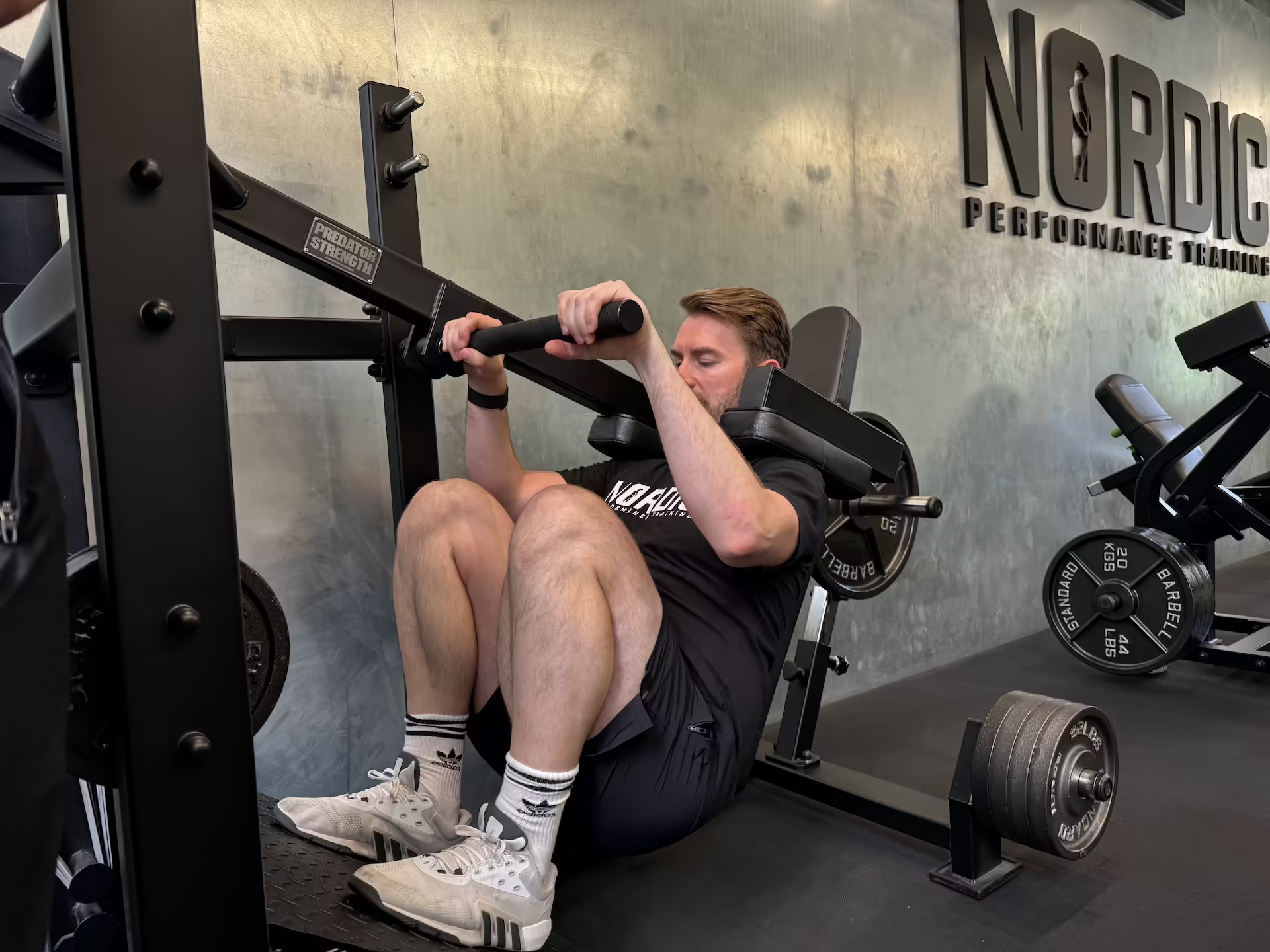

I’ve worked as a personal trainer for over 12 years and as a physiotherapist for over 10 years — and co-founded Nordic Performance Training with Lucas 8 years ago to give clients a professional and structured way to train. Since then, I’ve helped hundreds of people build strength, stay consistent, and feel better through evidence-based methods that actually work.
Along the way, I’ve completed advanced certifications and mentored under leading experts in various fields, and I’ve taught many trainers and physiotherapists internationally.
On this blog, I share the same practical tools, insights, and strategies we use every day at Nordic — so you can train smarter, stay consistent, and get real results.



Related Blog Posts
.svg)