





Bulgarian Split Squat: Complete Guide to Technique
Bulgarian split squat is one of the most effective tools for training your ability to accelerate, push your body forward and upward – and build strong glutes and legs. It's an exercise that demands everything from the entire lower body at once.
That's also why it's so hard. Your front leg carries 80–90% of your body weight and performs the majority of the work, while your back leg actively stabilises the pelvis and helps lift you up. Both legs work – but there's no strong side that can hide a weak one. No way to cheat your way through.
Mie, 29, hairdresser from Frederiksberg – on her feet all day and runs 2–3 times per week. She started to notice knee pain when running and thought she should stop loading her knees. She trained at a gym with few machines where there was always a queue, and came to us for help. We taught her during her personal training with us to perform Bulgarian split squats effectively with the equipment she had available – the knee pain disappeared within 3 months, and she still runs.
“I had been told my knees couldn’t handle it. After three months, I’m now running even better—and my knees have never felt better.” — Mie, hairdresser from Frederiksberg
This guide gives you everything you need: What the exercise is, why it works, how to perform it correctly – and the mistakes you need to avoid.
What is a Bulgarian split squat – and why is it so effective?
A Bulgarian split squat – also called bulgarsk split squat or rear-foot elevated split squat – is a unilateral leg exercise where you focus on training one leg at a time with the back foot elevated on a bench, stand, or angled weight plates behind you. It's fundamentally a split squat – related to lunges and walking lunges – but with the added challenge that your back foot is elevated, and therefore more of your weight shifts onto the front leg.
What makes the exercise so unique is what happens in the front leg. You simultaneously perform hip and knee extension under full load, which trains virtually all hip and knee extensors: quadriceps, gluteus maximus (also called glutes), and adductor magnus. The latter becomes particularly active at and below 90 degrees of knee flexion – precisely where the exercise is hardest. This stands in good contrast to an exercise like reverse banded hack squat, which is typically hardest around 90 degrees and primarily demands work from the quadriceps.
At the same time, you get a large stretch of the glute muscle at the bottom of the movement. The simultaneous hip flexion, internal rotation, and adduction is the easiest way to achieve a large stretch of gluteus maximus during training.
The stability is an advantage, not a disadvantage. When you stand on one leg, gluteus medius – the side glute – must work constantly to keep the pelvis stable. The back leg is not just passive: It actively "pushes" down into the support to create a counterforce that stabilises the pelvis, so the front leg can perform hip and knee extension in a stable environment. Think of each leg as placed on its own bathroom scale – 80–90% of your body weight should be on the front leg.
It matches bilateral exercises for strength and muscle growth. Research shows that unilateral exercises like Bulgarian split squat deliver comparable results to bilateral squats. You don't need to choose between one and the other – but if you have limited equipment, Bulgarian split squat can be enough to fill the role as your weekly squat variant.
Less load on the spine. Because you only load one leg at a time, you use markedly less total weight than with a back squat. This means far less axial loading of the spine. For you with lower back pain or back problems, where pain worsens from direct compression down through the spine, it can be the difference between an exercise that worsens and one that helps. We see it often: People who can't hack squat without pain can easily start with Bulgarian split squats pain-free – and get stronger from it. Read more in our guide to exercises for back pain.
Better for the knees than many think. Bulgarian split squat has an undeserved reputation as a "hard" exercise for the knees. In reality, it's one of the best exercises for people with knee pain – because you train full range of motion under control and can gradually increase the load. That's precisely the approach we as physiotherapists recommend: Controlled loading, not unloading. Read more in our guide to exercises for knee pain.
We use this exercise with almost all our clients – from 29-year-old runners with knee pain to 67-year-olds who want to preserve their independence. It requires no machines and almost no space. All you need is something to rest the back foot on and the willingness to work one leg at a time.
“Many people who come to us with knee pain have been told they should stop loading their knees. The opposite is most often what’s needed—and the Bulgarian split squat is a great exercise, not least because it requires very little equipment.” — Kasper, physiotherapist at Nordic Performance Training
Technique: How to do Bulgarian split squat correctly
Setup – height, distance, and foot placement
What you place the back foot on should be lower than most people think. Mid-shin is ideal – that's lower than a standard training bench, which is often too high. The problem with too high an elevation is that you compensate by tilting the pelvis forward to accommodate the high placement. The result: You can't fully flex the hip on the front leg, you don't get what you want out of the exercise, and it feels uncomfortable at the front of the hip.
Another advantage of a lower stand or angled weight plates is that your ankle can be in dorsiflexion instead of plantarflexion. When the ankle is flexed upward, the calf muscle can better stabilise the knee – and it feels markedly better for most people.
A good trick for the distance: Place your front foot in line with the rack you're standing at – not inside the rack, but just outside it. This gives you a fixed starting point from which you can adjust the distance to what the back foot rests on. It feels less awkward, and you have a consistent reference point from session to session.
The distance should be long enough that you can achieve full hip flexion and close to full knee flexion at the bottom. Check the back leg: The thigh should point straight down or slightly backward at the bottom of the movement. If it points forward, you're standing too close. If it points far backward, you're too far away and you experience a large stretch in the quad on the back leg.
Your front foot points straight ahead or slightly inward. Hip-width distance between the feet.
Execution – descent, depth, knee position, and upper body posture
Start in what we call athletic position: Upper body slightly tilted forward – think 10–15 degrees of hip flexion – and the hip pushed slightly back. This position should be maintained throughout the entire movement. It gives you two things at once: The hip extensors are pre-activated via the slight hip flexion, which creates a stable pelvis instead of a "floating" pelvis. And you can reach full hip flexion at the bottom, because you don't run out of range of motion too early on the way down.
Think of "pulling yourself down into the perfect position." Controlled, not just falling down. Your knee naturally tracks slightly inward on the way down – that's normal hip internal rotation, precisely as in sprinting, where the thigh rotates around the pelvis. You should not force the knee outward. The hip remains pointing straight ahead.
Go deep enough that you achieve full hip flexion on the front leg and close to full knee flexion. Your back knee approaches the floor or touches it lightly.
On the way up: Think "up and forward." This facilitates hip extension – which is the entire point. Avoid leaning backward and pulling yourself upward with the arm. A tip: Use a flat hand against the rack instead of gripping with the fingers. This forces you to use the leg, not the arm.
Tempo and control
Tempo: Controlled downward – 3 seconds – with a controlled transition at the bottom from the eccentric to the concentric phase. No bounce, no rapid deceleration. The controlled transition at the bottom is crucial: A too-fast stretch at the bottom signals a lack of control and only leads to unnecessarily high soreness. Once you've found the technique, you can push harder on the way up. See a demo-video here.
The 5 most common mistakes
Too high a support for the back leg. This is the mistake we see most often. A standard training bench is too high for most people. Use something at approximately mid-shin height – angled weight plates, a low box, or a split squat stand with roller. Too high an elevation forces the pelvis forward, limits hip flexion, and causes discomfort at the front of the hip.
Wrong distance between the legs. Check it at the bottom of the movement: There should be approximately one foot-width of distance between your front foot's heel and your back leg's knee when the knee is close to the floor. Too close: Intense stretch in the quad on the back leg. Too far: You lose depth and stability.
Too heavy weight. If you're leaning backward and pulling yourself up with the arm, the weight is too heavy. Performed correctly, 80–90% of your body weight is on the front leg – and that's heavy in itself. Start with body weight. Bulgarian split squat is one of the few exercises where the body alone is more than enough to create a training effect.
Too upright or too bent forward in the upper body. Too upright: The pelvis "floats," and you lose stability – the hip extensors are not pre-activated. Too bent forward: You run out of hip flexion before you reach the bottom. Think 10–15 degrees of hip flexion – athletic position – and maintain it throughout the entire movement.
Too fast descending phase. An uncontrolled fall down to the bottom creates an intense, rapid stretch in both the front and back leg. It feels uncomfortable and increases injury risk if you're not used to it. There should be a controlled transition from the eccentric to the concentric phase – think of pulling yourself down, not falling down.
These are precisely the mistakes we see in new clients. And they're all easy to correct with the right guidance.
Variations and progressions
Beginner: Start with the simple. Body weight alone is more than enough in the beginning – and for many for a long time. Hold on to a rack with a flat hand for balance while you learn the movement. Use a low support for the back foot – the higher the back support is, the more of your body weight shifts forward to the front leg. The most important thing is that you do the exercise with control and full range of motion – not that you add weight from day one.
Intermediate: Add weight. When you can do 3 sets of 8 repetitions with controlled technique and full depth, it's time to add load. Hold a dumbbell in the opposite hand of the leg that's in front. Start light – even 5 kg changes the exercise markedly.
Advanced: Optionally increase range of motion. If your back knee hits the floor before you achieve full hip flexion on the front leg, you can elevate the front foot on a low box for extra depth. But more range of motion is not always better – if you can already reach full hip flexion and close to full knee flexion, the extra depth is not necessarily an advantage, and many compensate to reach the floor.
An important point about progression: Walking lunges, reverse lunges, step-back lunges, and step-ups are not variations of Bulgarian split squat – they are other exercises. And an exercise switch is not a progression. Progression is about making the same exercise heavier, deeper, or more controlled over time – not about switching to something new. This is a principle we cover thoroughly in our strength training guide and Full Body guide: Variation is not good for progression. Consistency is.
If you want to supplement the Bulgarian split squat with an exercise that targets the gluteus maximus in its shortened position—rather than the lengthened position at the bottom as the split squat does—check out our glute bridge guide.
Progressive overload is the key. Start light, build up over weeks and months, and follow the principle of double progression: When you can complete all repetitions with good technique, you increase the weight next time.
Frequently Asked Questions About Bulgarian Split Squat
What's the difference between split squat and lunges?
Split squat is stationary — you move up and down in a fixed position. Lunges involve movement forward, backward, or to the side. Bulgarian split squat is a split squat with the back leg elevated on a bench, which places more weight on the front leg and provides a greater range of motion.
Is Bulgarian split squat good for the knees?
Yes – if performed correctly. Controlled loading through full range of motion strengthens the muscles around the knee and improves stability. Many of our clients with knee pain experience marked improvement with this exercise. The most important things are correct height of the back foot support, controlled tempo, and a weight you can handle technically.
How many sets and repetitions should you do?
3 sets of 6–8 repetitions per leg is a good starting point. The working weight should be challenging – not unmanageable. When you can complete all repetitions with good technique, you increase the weight next time.
Can you do Bulgarian split squat at home?
Yes — you only need a chair, sofa, or bed to rest the back foot on. Start with body weight, and add load with a backpack or dumbbells. Remember: if you can easily do 20+ repetitions with body weight, you need extra load — otherwise it becomes cardio, not strength training.
Ready to improve your technique?
Bulgarian split squat is one of the most effective leg exercises you can do – regardless of whether you're training for strength, knee health, or athletic performance. But as with all exercises, the results depend on correct technique and a plan for progression.
If you'd like help getting started – or want to make sure your technique is correct – then book a free start-up conversation. Either in our Private Gym in Copenhagen or as a call, if that suits you better. We'll go through what makes sense for you specifically.
References
Speirs, D. E., Bennett, M. A., Finn, C. V., & Turner, A. P. (2016). Unilateral vs. bilateral squat training for strength, sprints, and agility in academy rugby players. Journal of Strength and Conditioning Research, 30(2), 386–392. https://doi.org/10.1519/JSC.0000000000001096
McCurdy, K., O'Kelley, E., Kutz, M., Langford, G., Ernest, J., & Torres, M. (2010). Comparison of lower extremity EMG between the 2-leg squat and modified single-leg squat in female athletes. Journal of Sport Rehabilitation, 19(1), 57–70. https://doi.org/10.1123/jsr.19.1.57
Table of Contents
Related Blog Posts


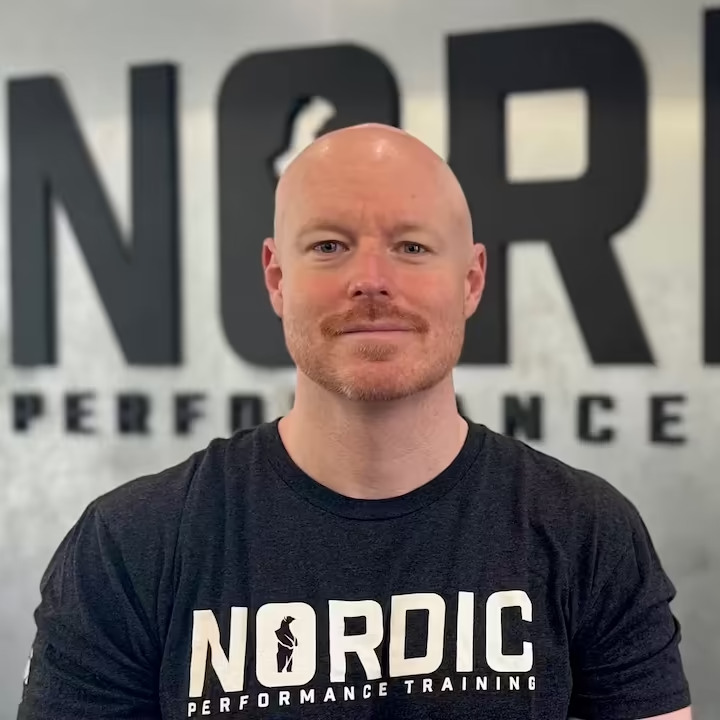
I’ve worked as a personal trainer for over 12 years and as a physiotherapist for over 10 years — and co-founded Nordic Performance Training with Lucas 8 years ago to give clients a professional and structured way to train. Since then, I’ve helped hundreds of people build strength, stay consistent, and feel better through evidence-based methods that actually work.
Along the way, I’ve completed advanced certifications and mentored under leading experts in various fields, and I’ve taught many trainers and physiotherapists internationally.
On this blog, I share the same practical tools, insights, and strategies we use every day at Nordic — so you can train smarter, stay consistent, and get real results.



Related Blog Posts
.svg)