







Every transformation here is real — written by the client’s own coach.
These stories show how structured, consistent strength training works across different goals, ages, and starting points.
Each story shows a real process — what the client struggled with, how we structured the training, and the results that followed.
Marie-Louise, 58: Found a Training Her Body Could Handle
Marie-Louise had always trained. For years she had strength trained with free weights 2-3 times a week. She was disciplined, knowledgeable, and motivated. Training was not something she needed to be persuaded into — it was part of her everyday life.
But something had changed.
"The last couple of years I've had difficulty maintaining continuity in my training, because I was often forced to take breaks due to injuries," Marie-Louise said. "I tried both adjusting the training myself and also had several courses with personal trainers, but my body reacted differently than before."
The pattern was the same every time: She started up. Trained well for a few weeks. Then came the pain — in joints, in tendons, in areas that hadn't bothered her before. Break. Loss of progress. Start over. Again and again.
As a 58-year-old nurse in a geriatric medicine ward, she sees daily what happens when people lose their physical abilities. And as a PhD student, she knows that training is what keeps you going — both physically and mentally. Stopping training was never an option. But she had run out of approaches that worked.
"Something new had to happen," she said. "It was clear to me that I needed a different approach. I wanted to find a way to train that suited my body now, and that would last over time."
After 3 months of structured strength training 2 times a week, Marie-Louise has only missed 1 training session out of 24. She is significantly stronger. And most importantly: She trains without the constant injury breaks that previously interrupted all progress.
Here is how a training-experienced woman discovered that the solution was not to train harder — but to slow down the pace and let the body keep up.

When the Body No Longer Plays Along
Marie-Louise's problem was not motivation. It was not a lack of experience. It was that the approach that had worked for years suddenly no longer worked.
"The body reacted differently than before," she explained. "It led to repeated minor injuries in the form of pain in joints and tendons, which meant breaks and having to start over again and again."
It is a frustration many experience — especially in their 50s: You train as you always have, but the body responds differently. Weights you used to handle without problems now cause discomfort. Movements that used to feel natural create irritation in joints and tendons. And the recovery that used to take one day now takes three.
Marie-Louise tried what most people would try. She adjusted herself. She trained with personal trainers. But the result was the same: Progress for a few weeks, then an injury, a break, and start over again.
"I had become uncertain about my own body," she said. "I no longer knew what worked, and I missed being able to train like before."
That uncertainty is perhaps the hardest part. Not the pain itself, but the feeling of having lost contact with your own body. That what you've always been able to do no longer works. And that you don't know what should replace it.
Slow Down the Pace. Increase the Quality.
When Marie-Louise started with us, the solution was not a more advanced program. It was the opposite: Less haste. More patience. And a fundamental change in how progression works.
The exercises Marie-Louise trained:
- Machine Chest Press
- Cable Pulldown
- Hack Squat
- Lying Leg Curl
- Leg Extension
- Dumbbell Lateral Raise
Same exercises every week. Machines that provided external stability and removed the coordination demand that free weights require — and which were often the source of her minor injuries.
But the most important change was not the exercises. It was the pace.
"My most important principle with Marie-Louise was the long-term perspective," explained Mathias, her trainer. "Strength gains happen as a byproduct of good, structured, and consistent training — it cannot be forced. And that was exactly what had happened before: she had pushed the weights up too quickly, and the body responded with pain."
Concretely, that meant: Good rest periods of 2 to 3 minutes between sets instead of 30 seconds. Slower pace in the training itself, but higher quality in each repetition. And a crucial rule — even if our progression model gave her "permission" to increase the weight, we stayed at the current weight if there was pain or discomfort. The body was allowed to adapt before we increased the load.
"It was the simplicity of the concept, the fixed times, and the fact that my job was really just to show up," Marie-Louise said. "I knew that someone else had made a plan and had the overview, and if problems arose, the exercises were adjusted immediately."
"I didn't think I would see such big progress in such a short time." — Marie-Louise
When Patience Beats Intensity
The breakthrough didn't come from one specific moment. It came from the absence of setbacks.
"It changed gradually, as I could feel that the training started to work," Marie-Louise said. "Now I can train continuously and feel that I'm making progress."
For the first time in years, she could train week after week, month after month, without being knocked back by pain. No forced breaks. No restarts. Just quiet, calm progress.
And that progress was far from small. In just 3 months, her Hack Squat went from 10 kg to 32.5 kg — an increase of 225%. Cable Pulldown went from 24 kg to 40 kg. Chest Press from 15 kg to 25 kg. Results that show that patient progress doesn't mean slow progress — it means lasting progression.
Marie-Louise started in the middle of a move — one of the most stressful periods most people experience. But she did it deliberately.
"I started in the middle of the move because I could feel that I would otherwise just keep postponing it," she said. "The fixed times made it easier to stick with it."
23 out of 24 sessions. 96% attendance. In the middle of a move, PhD studies, and full-time work. Because the structure carried her — not the willpower.
"I understand now what it takes to stick with my training, and how I can adjust it if problems arise." — Marie-Louise
Marie-Louise's Transformation
After 3 months of structured training — 2x Full Body per week:
Strength gains:
- Hack Squat: 10 kg → 32.5 kg (+225%)
- Lying Leg Curl: 5 kg → 12.5 kg (+150%)
- Machine Chest Press: 15 kg → 25 kg (+67%)
- Cable Pulldown: 24 kg → 40 kg (+67%)
Consistency:
- 96% attendance (23 of 24 sessions)
- No injury breaks in 3 months
- Trains continuously for the first time in years
Pain-free:
- No repeated minor injuries
- Can handle occasional pain without it stopping her
- Trusts her body again
Identity shift:
- From "someone who no longer knew how to train" to "someone who has it under control and feels safe"
- From uncertainty and restarts to continuity and progress
- From fearing pain to being able to handle it
Why It Worked This Time
Marie-Louise's story shows something many experienced training people overlook: The approach that worked in your 30s doesn't necessarily work in your 50s. Not because the body is broken, but because it has changed. Joints, tendons, and recovery require more respect. And it requires an approach that is patient enough to let the body adapt at its own pace.
The solution for Marie-Louise was not more training or harder training. It was smarter training: Machines that reduced injury risk. Proper rest periods that gave the body time to recover between sets. And a progression model that respected the body's signals instead of forcing them.
"Everyone can train heavy — regardless of starting point and age," Mathias explained. "But the road there must be adapted to the individual. For Marie-Louise, it was about slowing down the pace, increasing the quality, and having enough patience to let the progression come on its own."
Ready to Train Without Starting Over?
Marie-Louise spent years fighting with repeated minor injuries and forced breaks. 3 months of structured strength training gave her what she had been missing: continuity, progress, and confidence in her training.
If you are tired of starting over, if your body reacts differently than it used to, or if you want an approach that lasts over time — then let's have a talk.
Book a free start-up conversation at our private gym in Copenhagen, and experience how patient, structured strength training can give you the continuity that intensity alone cannot.
Because the best results don't come from training the hardest. They come from training the smartest — and keeping at it.
Table of Contents
Other Client Stories
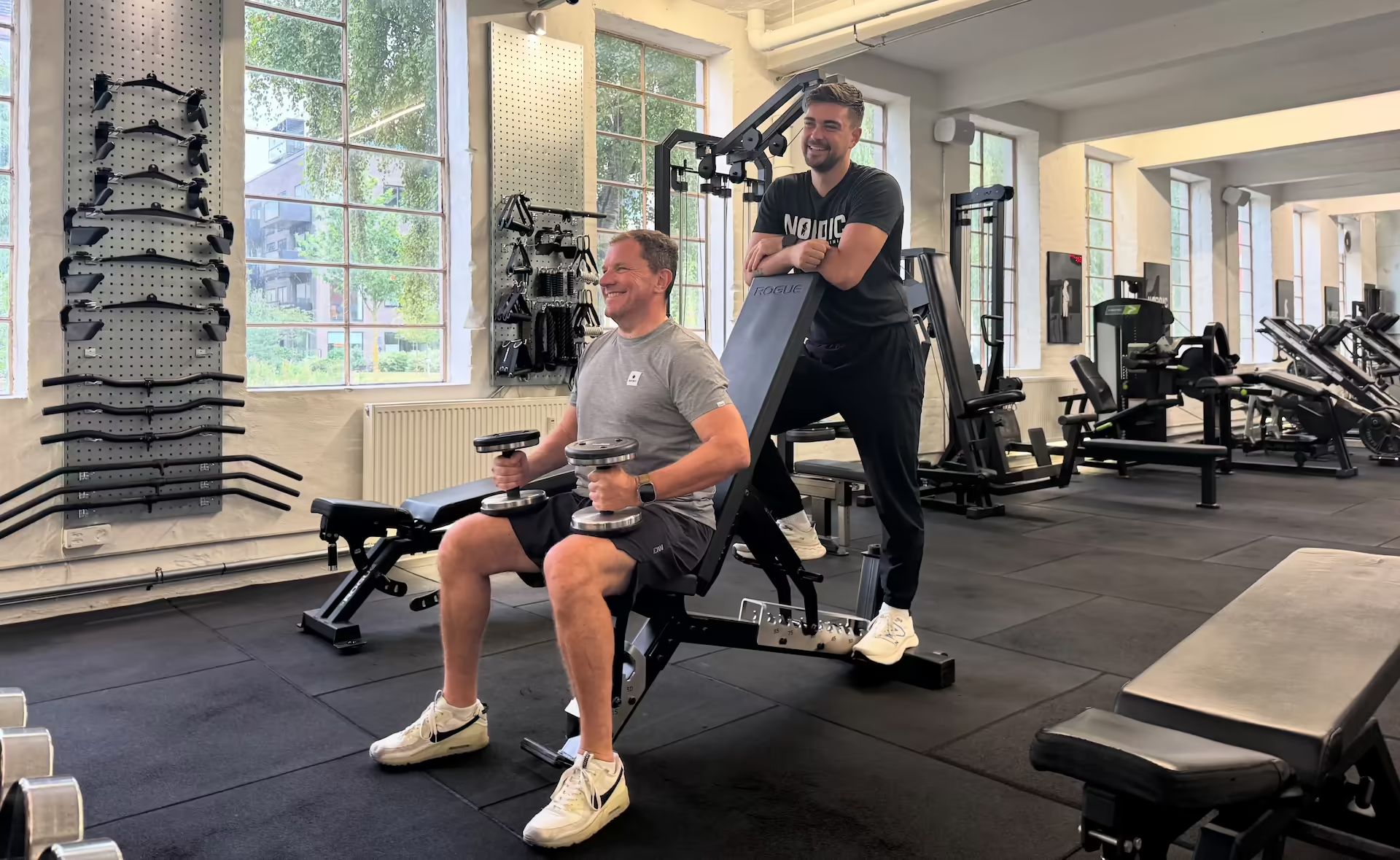


I have worked as a personal trainer and physiotherapist for many years, and I bring a calm and professional presence to every session — so my clients feel safe and confident, regardless of their starting point. I help them create structure, consistency, and the habits that lead to real and lasting results.
My approach is clear, effective, and sustainable, and I have extensive experience helping clients train safely and effectively — even with pain.
On this page, I share real client stories — so you can see how structured, patient training creates strength, confidence, and lasting results.


Other Client Stories


.svg)