








How to Learn Pull-Ups – Your Complete Guide to Your First Pull-Up
Most people try to learn pull-ups by doing bad pull-ups.
They jump up to the bar, struggle through half a rep with swinging legs and a rounded back — and wonder why it doesn't get better. Or they hang in a resistance band that makes the easiest part (the bottom) easier and the hardest part (the top) almost just as hard.
Jenny, mother of two from Amager, had tried that approach for years at her previous CrossFit gym. Negative chin-ups, resistance bands, kipping pull-ups. Nothing worked. The only thing she had achieved was a sore shoulder, and that was why she started with us. We did something that seems counterintuitive to many — we dropped pull-ups entirely.
Instead, we built general strength training via our full body program with extra focus on cable pulldowns and biceps exercises — and in periods we added single-arm pulldowns. When her pulldown strength approached her body weight, we added assisted pull-ups alongside to practise the actual technique.
12 months after she started with personal training with us, Jenny did her first pull-ups. 6 months later, she was doing 6 reps.
"I had tried so many fancy strategies to learn how to do a pull-up. The only thing that actually worked was just getting stronger." — Jenny
No resistance bands. No swinging. No cramped movements. Just systematic strength development in machines — and patience.
That's the core of our approach: You need to be strong enough to pull your own body weight before you actually attempt to pull your own body weight. You wouldn't try to bench press 100 kg if you can only lift 60 kg either. And the strength required is best built in machines, where you can adjust the load precisely.
What does a pull-up actually require?
Pull-ups — also called kropshævninger — are fundamentally a question of relative strength — the ratio between your pulling strength and your body weight.
Think of it like a company. Your brain is the director sending orders to the middle managers (your motor units), who activate the employees (your muscle fibres). Your body weight is the workload — the task the company needs to lift. The more employees you have, and the better the director is at recruiting them at the right time, the greater the workload the company can handle.
The muscles in a pull-up are primarily latissimus dorsi (the large back muscle), biceps, trapezius, and teres major. But something surprising also happens at the bottom of the movement — here, the lower part of the chest muscle helps initiate the shoulder extension from the hanging bottom position.
Three different adaptations need to work together before you can do a pull-up:
You can in other words not practise with pull-ups when you're not strong enough to do them. You need to build the strength somewhere else first — and practise technique with assisted pull-ups alongside.
Pull-ups vs. chin-ups — differences, grip, and what suits you
The short version: Pull-ups use an overhand grip (pronated), chin-ups use an underhand grip (supinated). The difference in muscle activation is smaller than most people think.
Research shows that latissimus dorsi — the primary mover — is activated at a comparable level regardless of grip variation. This means your choice of grip should be about comfort, not about which muscle you "target best."
Many of our clients find that a neutral or semi-supinated grip feels better in the shoulder, elbow, and wrist compared to a purely overhand or underhand grip. And that was precisely the grip Jenny trained with in her pulldowns.
Our recommendation: Choose the grip that feels best in your joints. You can always vary later.
How to build strength for pull-ups — step by step
Step 1: Cable pulldowns — your most important tool
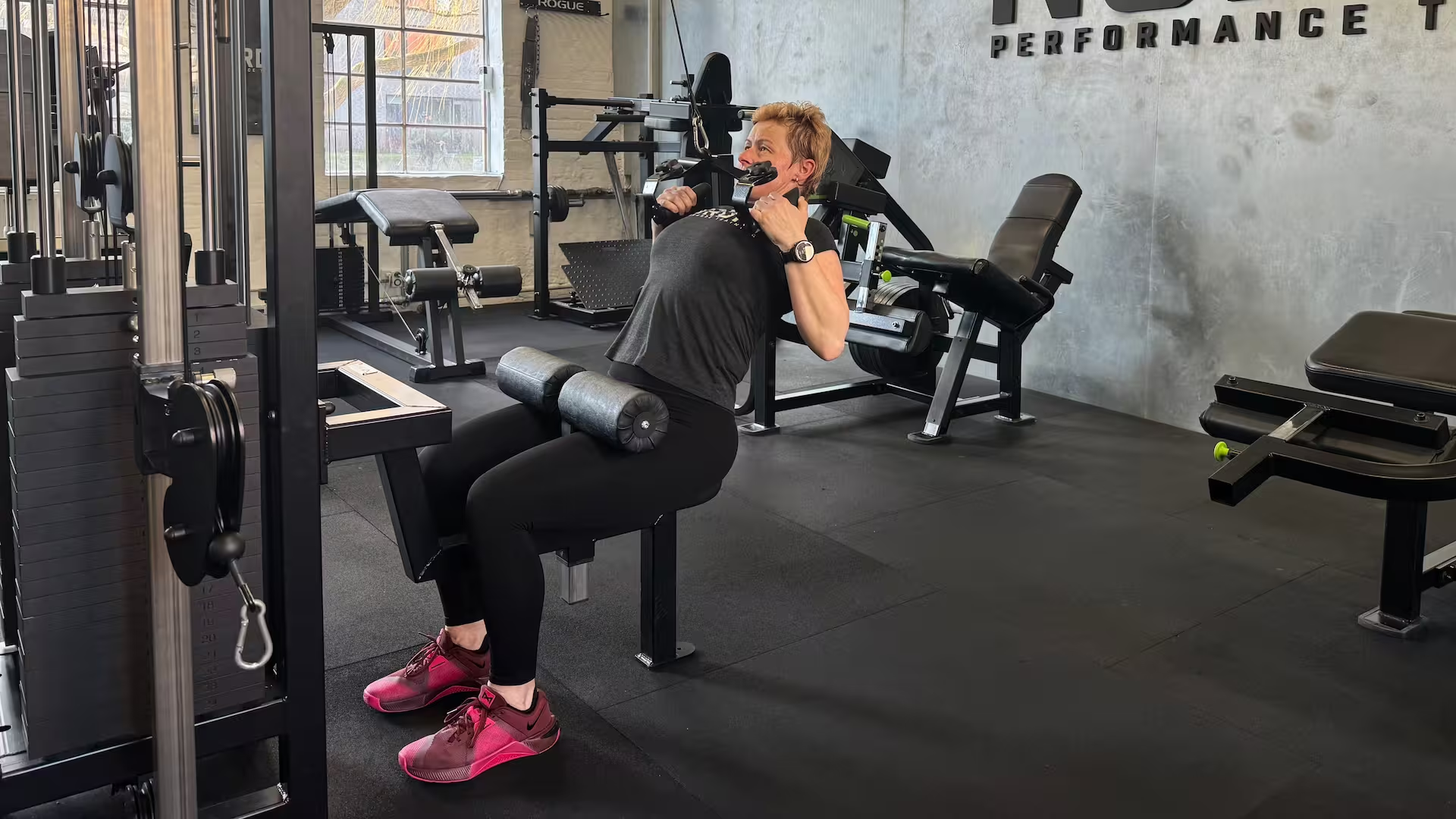
Cable pulldowns are the exercise that carries your entire pull-up progression.
Research confirms it directly: 8 weeks of pulldown training markedly improves pull-up performance. Pulldowns activate the same primary muscle groups as pull-ups — latissimus dorsi, biceps, and trapezius — with comparable activation levels.
But there's a bonus that most people overlook. The cable machine's friction makes the eccentric phase (the lowering) easier than the concentric phase (the pull). It might sound like a disadvantage — but it's actually an advantage. Easier eccentric loading means less fatigue per set, which means you can do more total volume over a week without running yourself into the ground.
Start with a weight where you can do 6-8 repetitions with approximately 2 reps in reserve on your first set. Use double progression: When you can do 8 reps in all sets, increase the weight. See our article on how to progress in strength training with double progression for further detail.
The goal? Work towards a pulldown strength that approaches your body weight.
Step 2: Single-arm cable pulldowns — activate more muscle mass
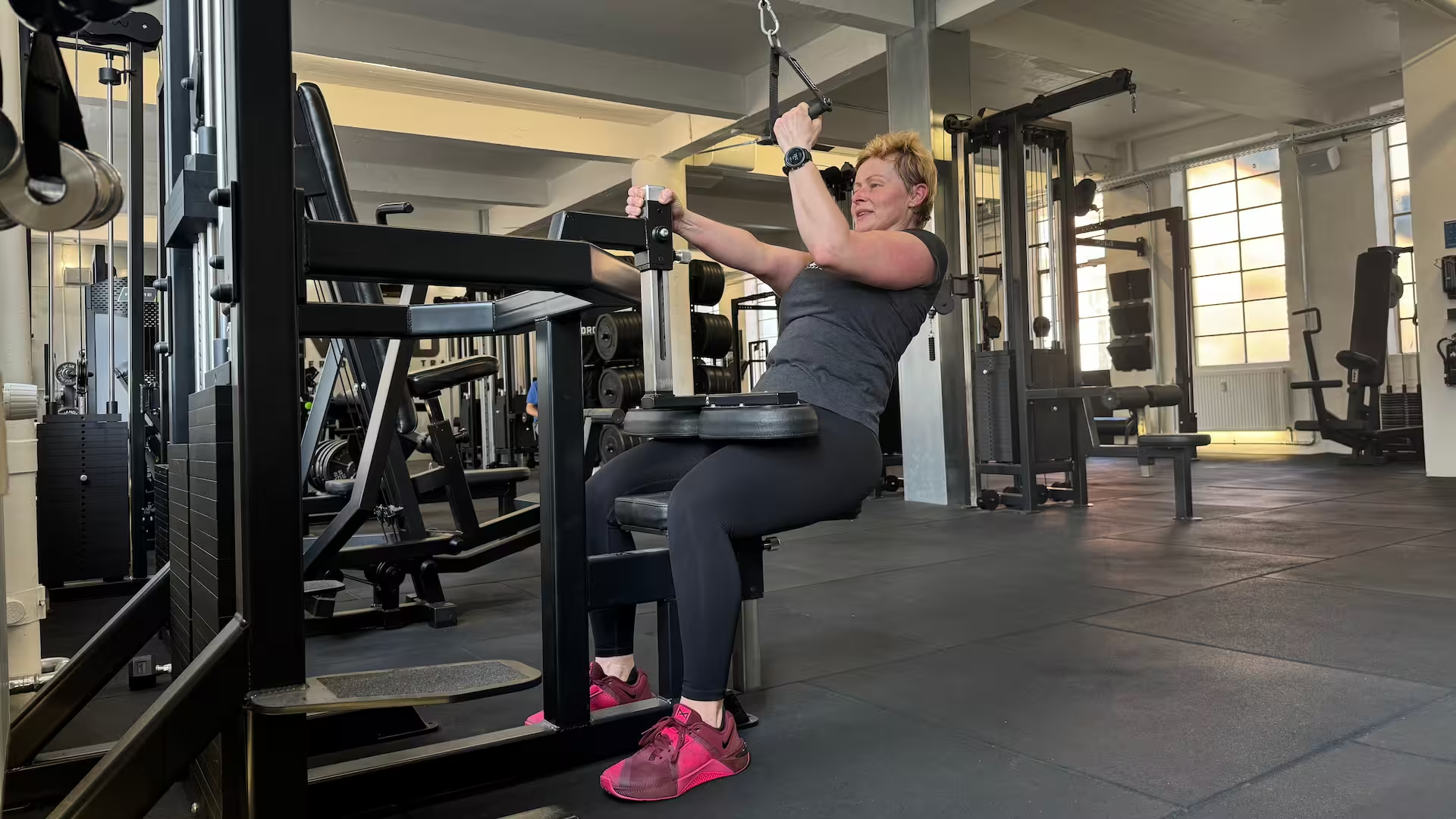
Here it gets a bit nerdy — but it's worth understanding.
When both arms work simultaneously, your nervous system has a harder time fully activating all available muscle fibres. This phenomenon is called bilateral strength deficit, and it's because the total motor signal has to be distributed to more muscle mass at a time.
By training one arm at a time, you reduce that effect. You get a greater activation adaptation and stimulate muscle fibres higher in the recruitment hierarchy — the fibres that are normally hardest to "fire up."
More activation = more muscle growth over time = more strength potential for your pull-up or chin-up.
Step 3: Assisted pull-ups — learn the specific movement
When your pulldown strength is well on its way, you add assisted pull-ups.
Important: The purpose is technique and coordination — not strength development. The strength is built in pulldowns. Here you practise the specific movement so your nervous system learns the precise pattern.
You can use an assisted pull-up machine, resistance band, help from a personal trainer or training partner. 2-3 sets of 3-5 reps during your training session as "skill practice" is plenty.
Step 4: Your first real pull-up
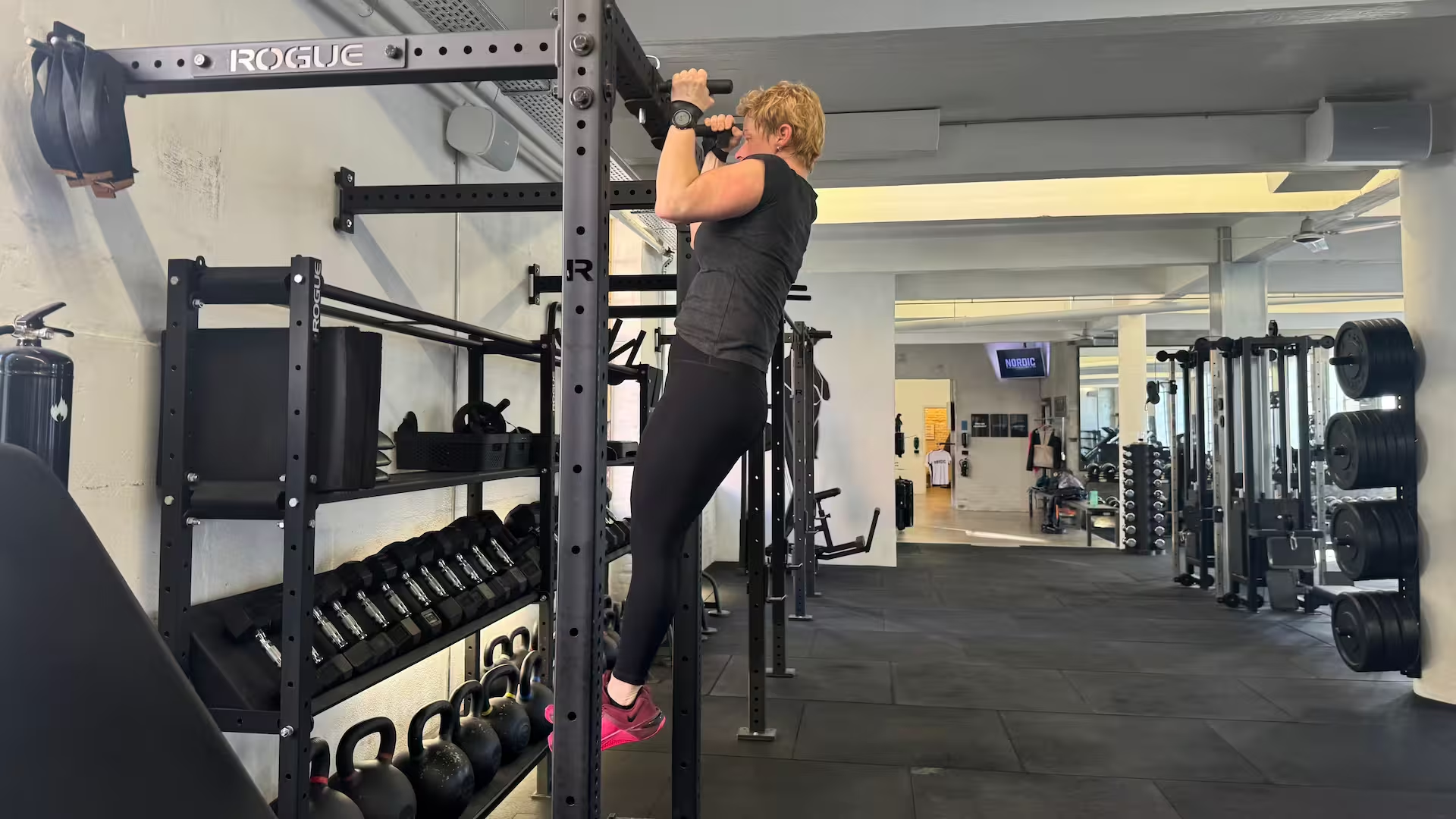
When your bilateral pulldown strength approaches your body weight, and you've practised the assisted movement for a couple of months — then it's time to test.
For Jenny, it took 12 months to get there. That's not unusual. But once the foundation was built, the progression went fast: From 1 rep to 6 reps in just 6 months.
That's the difference between building the strength properly versus banging your head against the wall with exercises you're not yet strong enough for.
What about negative pull-ups? (And other popular methods that disappoint)
"Do negative pull-ups — just jump up and lower yourself slowly." That's the standard advice. And it sounds reasonable.
The problem is that it's not as effective as it's made out to be.
Research shows that the nervous system activates fewer motor units during the eccentric (lowering) phase compared to the concentric (lifting) phase. To return to the company analogy: The director simply sends fewer orders out to the middle managers on the way down. It's in the concentric part that your strength potential actually increases — both because you hire more employees (muscle mass) and because the director learns to recruit them faster.
And if you try to overload the eccentric phase — that is, lower yourself with more weight than you can lift — you run into another problem. Overloaded eccentric contractions are markedly more fatiguing than concentric ones, partly due to increased calcium ion accumulation in the muscle cells. This means you can do fewer sets and reps over a week.
Compare that with cable pulldowns, where the friction actually makes the eccentric phase easier. This allows you to do more sets over the course of the week without accumulating unnecessary fatigue — and it's total volume over time that drives progress.
Does that mean negative pull-ups are totally useless? No. They have a place — particularly as technique practice and for trained individuals who already have the strength. But as the primary method for building pull-up strength? Pulldowns are superior.
And scapular pull-ups, which many recommend as a starting point? The shoulder blade movement happens naturally in conjunction with the upper arm bone. You don't need to isolate it. Train holistically with pulldowns instead.
Support exercises that accelerate your pull-up
Pulldowns are the foundation. But three areas deserve extra attention.
Elbow flexors. Biceps curls — hammer curls, preacher curls, or cable curls. Isolation exercises let you stimulate muscle fibres that are harder to reach in compound exercises.
Shoulder. Cable Y-raises strengthen overhead stability and keep the rotator cuff healthy. If you have problems with shoulder impingement, this exercise is particularly relevant. It's an investment in long-term pull-up training without shoulder pain.
Chest. It sounds counterintuitive, but the lower part of the chest muscle helps initiate the shoulder extension at the bottom of a full range pull-up. Stronger chest = better start from dead hang.
Common mistakes that hold you back
The biggest mistake is attempting pull-ups before the strength is there. This leads to compensation patterns — kipping, half reps, excessive momentum — which result in significantly lower muscle activation than controlled reps.
Other classics: Too much eccentric volume (negative pull-ups 5 times per week), too little systematics in the progression, and lack of patience.
The best program is the one you actually follow — consistently, week after week, month after month.
Why pull-up strength is best built in machines
We've worked with CrossFit athletes who wanted to improve their pull-up strength. You might think they should just do more pull-ups. But that was precisely what they were already doing — with diminishing returns.
"We see it again and again. Clients who have tried all sorts of magic exercises — resistance bands, eccentrics, kipping — but experience no progress. Or in the worst case end up with shoulder irritations. The solution is almost always the simplest: Build the strength in machines." — Kasper, authorised physiotherapist at Nordic Performance Training
When we added heavy cable pulldowns, single-arm pulldowns, and systematic biceps work to their program, their pull-up numbers exploded. Not because pull-ups are a bad exercise — but because the machines let us build strength with a precision and load management that pull-ups alone cannot deliver.
A complete pull-up program you can follow
The good news: You don't need a separate pull-up program. The exercises that build your pull-up fit naturally into a well-structured full body program.
Our recommendation is simple — follow a full body program where you train the entire body 2-3 times per week. Here are the exercises that are pull-up specific and already part of the program:
The progression looks like this:
The first 3-6 months: Follow your full body program and build your bilateral cable pulldown strength with double progression. Train the entire body — not just the "pull-up muscles."
When progress stagnates: Swap cable pulldown for single-arm cable pulldowns for 3-6 months. By overcoming the bilateral strength deficit, you get new stimulus and break the plateau.
After that: Switch back to bilateral cable pulldowns and continue the progression towards your body weight.
When pulldown approaches your body weight: Add 2 sets of assisted pull-ups after your pulldowns to practise the technique. When you can do them unassisted — then you're there.
That's the entire secret. No magic program. Just a good full body program, consistent progression in pulldowns, and patience.
Home training — when you don't have access to machines
If you don't have access to a pulldown machine, you're not completely out of luck. Inverted rows in a door, table edge, or gymnastic rings provide a good supplement. Banded pulldowns with a door anchor can work for lighter loads. And here, negative pull-ups actually make more sense — simply because the alternatives are more limited.
But let's be honest: Access to a pulldown machine accelerates the process markedly. It's an investment worth considering.
Frequently Asked Questions About Pull Ups
How do you build strength for pull-ups?
The most effective method is cable pulldowns with progressive overload. Start with 3×6-8 reps and increase the weight continuously. Supplement with single-arm pulldowns for higher muscle activation, biceps exercises for elbow flexor strength, and assisted pull-ups for technique learning. Build the strength in machines first — learn the movement alongside.
How long does it take to learn pull-ups?
For most beginners, it takes between 6-18 months with consistent training 2 times per week. The time horizon depends on your starting point, your body weight, and how systematically you train. Jenny, 43 years old, reached her first pull-up after 12 months — and did 6 reps after 18.
Should I use a resistance band or machine for pull-up training?
Machine is preferable. Pulldown machines give you precise load management that resistance bands cannot match — you can increase the weight in small increments week by week. Resistance bands can be used as a supplement for assisted pull-ups for technique practice, but they are not effective as a primary strength builder.
Can women learn to do pull-ups?
Yes. Pull-ups are about relative strength — the ratio between pulling strength and body weight — not about gender. Jenny, 43 years old, went from 0 to 6 pull-ups in 18 months with consistent strength training 2 times per week. The method is the same regardless of gender.
How many pull-ups should I be able to do?
For general fitness and health, 1-5 controlled pull-ups is a good starting point. For most of our clients, the goal is not a specific number — it's having the strength and capacity to be able to do it when they want to.
What's the difference between pull-ups and chin-ups?
Pull-ups use an overhand grip, chin-ups an underhand grip. The muscle activation is very comparable — latissimus dorsi is activated at almost the same level regardless of grip. Choose the grip that feels best in your joints. Many of our clients prefer a neutral grip.
Your pull-up is waiting
A pull-up is not an exercise you learn by practising pull-ups. It's an exercise you become strong enough to do.
Build the foundation in machines. Train the entire body. Have patience. And when the strength is there — the pull-up comes by itself.
Jenny spent 12 months. You might spend 6. Maybe 18. That's beside the point. What counts is that you follow a plan that actually works.
Want help reaching your first pull-up? Book a free start-up conversation, and let's make a plan together.
References
Duchateau, J., & Baudry, S. (2014). Insights into the neural control of eccentric contractions. Journal of Applied Physiology, 116(11), 1418–1425. https://doi.org/10.1152/japplphysiol.00002.2013
Duchateau, J., & Enoka, R. M. (2016). Neural control of lengthening contractions. Journal of Experimental Biology, 219(2), 197–204. https://doi.org/10.1242/jeb.123158
Hewit, J. K., Jaffe, D. A., & Crowder, T. (2018). A comparison of muscle activation during the pull-up and three alternative pulling exercises. Journal of Physical Fitness, Medicine & Treatment in Sports, 5(4), 555669. https://doi.org/10.19080/JPFMTS.2018.05.555669
Jakobi, J. M., & Chilibeck, P. D. (2001). Bilateral and unilateral contractions: Possible differences in maximal voluntary force. Canadian Journal of Applied Physiology, 26(1), 12–33. https://doi.org/10.1139/h01-002
Li, Z., Zhang, S., Chen, H., & Wang, X. (2024). Eight-week lat pull-down resistance training with joint instability leads to superior pull-up endurance performance. European Journal of Sport Science, 25(1), e12243. https://doi.org/10.1002/ejsc.12243
Oliveira, L. F., Pinto, R. S., Cadore, E. L., Lanferdini, F. J., & Loss, J. F. (2025). Electromyographic analysis of back muscle activation during lat pulldown exercise: Effects of grip variations and forearm orientation. Journal of Functional Morphology and Kinesiology, 10(3), 345. https://doi.org/10.3390/jfmk10030345
Table of Contents
Related Blog Posts



I’ve worked as a personal trainer for over 14 years and as a physiotherapist for over 8 years — and co-founded Nordic Performance Training with Kasper to give clients a professional, private, and structured training environment where results actually last. In that time, I’ve overseen more than 15,000 sessions and helped hundreds of clients rebuild after injuries, gain strength, improve their health, and stay consistent.
My approach combines practical experience with evidence from the latest research, making training both effective and realistic.
On this blog, I share the same methods we use every day at Nordic — so you can cut through the noise and focus on what truly works.



Related Blog Posts
.svg)