








Shoulder Press: Technique, Variations and Common Mistakes
Shoulder press is one of the exercises most often associated with shoulder pain. And for many, it's an exercise they either end up giving up on or never really get stronger in, because it ends up bothering the shoulder.
Morten, 38, works in finance and lives in Frederiksberg. When he came to us, he had had shoulder pain for a long time. Pressing exercises had become almost impossible to perform — and shoulder press was completely out of the question. He could barely lift his arms overhead anymore without it hurting.
Instead of testing and 'treating' his shoulder, we adapted his full body program to the exercises he could do pain-free and with high intensity. For the upper body, we chose machine chest press, cable pulldown, and cable y-raise — exercises that didn't provoke the shoulder but still gave a strong stimulus to the shoulder, back, and chest musculature. After six weeks, he was close to pain-free. After three months, he was stronger than ever in all three exercises.
At that point, Morten wanted to test something: could he now do shoulder press? He was curious whether the strength and robustness could transfer and whether he could now perform the exercise pain-free.
And he could. He did shoulder press pain-free and after a few weeks he was actually stronger than ever before in it. He ended up returning to chest press and lateral raises as his primary exercises — but with the knowledge that shoulder press is always available when he wants.
"It rarely makes sense to start with the exercise that hurts. If you can't perform it with high enough intensity, you won't get the adaptations you're after either. Start with what you can do pain-free, so you can train hard enough and build real strength and robustness that transfers broadly to all exercises. And over time, you'll be able to do the exercise that previously caused pain, both stronger and pain-free." — Simon, physiotherapist at Nordic Performance Training
Shoulder press is a good exercise. But it's not necessary for everyone. This guide explains what shoulder press is, which muscles it trains, and when it makes sense to have it in your program.
What is shoulder press?
Shoulder press — also called overhead press — is a compound exercise for the upper body where you press a weight directly up overhead. The shoulder and elbow both work actively in the movement, and the exercise places high demands on both strength, mobility, coordination, and stability in the shoulder joint.
Shoulder press belongs to the same category as chest press and dips — upper body pressing exercises — but unlike the two other exercises within the category, the weight is pressed vertically upward relative to the body. Where chest press and dips respectively press more forward or downward relative to the body and target both the chest, the front of the shoulder, and triceps, shoulder press is a vertical pressing exercise that primarily targets the front of the shoulder, the lateral shoulder, and triceps.
The exercise can typically be done with dumbbells or a barbell — seated or standing. But can also be done in a machine, with cables or resistance bands — as well as a bodyweight exercise if you're strong enough, such as handstand push-ups. All variants perform the same basic movement, but with different demands on especially mobility and technique.
Which muscles does shoulder press train?
The primary muscle is the anterior deltoid — the front of the shoulder musculature. It drives the movement from the bottom to the top and is the muscle that works the hardest in a correctly performed shoulder press.
Triceps is activated strongly in the upper part of the movement when the elbow is extended.
The medial deltoid — the lateral shoulder — is activated more than many think, particularly in the middle part of the movement. That's an important point: shoulder press is not only a front deltoid exercise.
The muscles around the shoulder blades work stabilisingly and guide the shoulder blade's movement during the press.
An important nuance: a traditional shoulder press with vertical torso and elbows out to the side does not train the chest. That's a central difference from chest press, which trains the chest musculature and the front of the shoulder muscle. A high incline press, where the elbows are relatively closer in toward the side of the torso, trains the upper part of the chest and is a good middle ground between shoulder press and chest press.
The vast majority of our clients have a chest press and lateral raise variation in their program as the only ones — and see far better results than they've achieved before, because they can actually train them in a structured manner, with good technique and sufficient intensity. Read more in our bench press guide and lateral raise guide.
Technique: How to do shoulder press correctly
Shoulder press with dumbbells
The variant we use at Nordic Performance Training when shoulder press is part of the program. The dumbbells provide a freer movement path — the shoulder can find its natural way rather than being locked in a fixed position, but at the expense of stability.
Setup: Sit with a dumbbell in each hand at or below shoulder height — what your mobility allows — with the elbows out to the side or just slightly in front of the body. The back is held upright and the feet solidly planted on the floor.
Execution: Press the dumbbells up and slightly inward in a natural path to almost fully extended arms. Lower in a controlled manner back to the starting position. No bounce at the bottom.
Tempo: Controlled up, 2-3 seconds down. You control the weight the entire way.
The increased freedom in the dumbbells places greater demands on stabilisation and it becomes more demanding practically when the weight increases — particularly when you have to lift the dumbbells up to the starting position. That's one of the reasons a good shoulder press machine, if you have access to one, is often the better choice.
Military press
Military press is the classic variant — standing with a barbell in front of the shoulders. It's often used in powerlifting, strongman, and CrossFit as well as, as the name suggests, in the military — and places very high demands on mobility in the shoulders, spine, and hips.
Standing press requires active stabilisation of the entire body — core, glutes, and legs all work to keep the body stable during the press. This makes the exercise technically demanding and energy-demanding. For general strength and health, dumbbells or machine is a more practical choice for most people.
We don't use military press in our programs. For those who compete in powerlifting or CrossFit, it's obviously an exercise they should practise alongside their training with us.
Shoulder press machine
If you have access to a dedicated shoulder press machine, it's often a solid choice. The machine guides the movement path, provides external stability, and makes it easier to standardise and achieve gradual and systematic progression. We don't have a dedicated shoulder press machine available and therefore use dumbbells when shoulder press is part of the program.
The most common mistakes
Too large an arch in the lower back. The most frequent mistake in standing and seated shoulder press. An excessive lower back arch is almost always a sign that the weight is too heavy or mobility is insufficient. Reduce the weight and focus on maintaining a more neutral spine that doesn't change position throughout the exercise.
Too limited range of motion. Many don't go down to or below shoulder height. Full range of motion activates the shoulder and triceps over their entire length and is a prerequisite for real progress and standardisation.
Too heavy and lack of control. The weight "bounces" up instead of being pressed in a controlled manner. This reduces the muscle work and makes it difficult to standardise and measure real progress. Reduce the weight markedly.
Variations and progression
Shoulder press with dumbbells (seated)
Our choice when shoulder press is part of the program. Free movement path so the exercise can be adapted to the shoulder's mobility.
Shoulder press machine
The best choice if you have access to a well-designed shoulder press machine. Easier to standardise and achieve controlled and systematic progress compared to dumbbells and barbell.
Military press / barbell overhead press
Standing with barbell. Technically demanding, energy-demanding, and requires good mobility. Relevant primarily for those who compete in powerlifting or CrossFit. Not an exercise we use, as it doesn't fit into our concept.
Do you need shoulder press?
For most people: no. A chest press and a lateral raise cover the shoulder's primary needs in a complete program — the front deltoid is activated to a high degree in chest press, and the lateral deltoid is isolated directly in lateral raise. Shoulder press primarily adds extra front deltoid, some lateral deltoid, and triceps stimulus and can be relevant in many specific contexts. But it's not a core exercise in our program. Read more about our Full Body program.
For all exercises, we use double progression — train within a fixed rep range and increase the weight systematically when you can complete all repetitions with good technique.
Shoulder press and shoulder pain
The overhead position is a position that places high demands on the shoulder joint — and a position that most often provokes existing shoulder issues. We therefore most often start clients with shoulder pain on other exercises.
The reason is simple: if you can't perform the exercise with sufficient intensity without experiencing pain, you won't get the adaptations you're after either. And then it makes far more sense to find alternatives where you can train harder from the start.
Morten's story illustrates the point. By starting with machine chest press, cable pulldown, and cable y-raise — exercises he could do pain-free and hard enough — he built strength and robustness that transferred directly to shoulder press. Three months without shoulder press. And then he could suddenly perform it pain-free and with heavier weight than ever before.
That's not a coincidence. Strength is general. Robustness is general. And a shoulder that is strong and robust will quickly be able to incorporate shoulder press, even without having practised it directly.
Pain doesn't mean stop. It means adaptation.
If you have persistent shoulder pain, read more in our guide to impingement in the shoulder or frozen shoulder.
Frequently Asked Questions About Shoulder Press
What is shoulder press?
Shoulder press is a compound exercise for the upper body where you press weight directly up overhead. The primary muscle is the front deltoid, but the lateral deltoid and triceps also work actively. Can be done with dumbbells, barbell, or machine — seated or standing.
What does shoulder press train?
Shoulder press primarily trains the front deltoid and triceps. The lateral deltoid is activated more than many think, particularly in the middle part of the movement. The chest is not activated — that's the central difference from bench press and chest press, which both train the chest musculature.
What's the difference between shoulder press and military press?
Military press is a specific variant of shoulder press — standing with barbell. Shoulder press is the overarching term for all overhead press variants. Military press places higher demands on technique, mobility, and stabilisation than seated dumbbell variants.
What is Arnold Press?
Arnold Press is a dumbbell variant named after Arnold Schwarzenegger. The movement starts with the palms facing the face and rotates to a facing-outward position at the top. It's not a variant we use at Nordic Performance Training.
Is shoulder press dangerous for the shoulder?
Not with correct technique and appropriate load. But the overhead position places high demands on the shoulder joint and is the position that most often provokes existing shoulder issues. For clients with shoulder pain, machine chest press and cable y-raise are almost always a better starting point.
Shoulder press seated or standing?
Seated is easier to standardise and places lower demands on stabilisation — a better starting point for most people. Standing requires active stabilisation of the entire body and is more technically demanding. For general strength and health, seated is the better choice.
Do you need shoulder press if you do chest press and lateral raise?
For most people: no. Chest press activates the front deltoid strongly. Lateral raise isolates the lateral deltoid directly. Together, they cover the shoulder's primary needs in most programs. Shoulder press can be added when needed, but is not necessary for everyone.
Want to train with us?
Shoulder press is a good exercise — but not for everyone at all times. And for most people, it's far from necessary. We help you find the shoulder exercises that suit your body, your goals, and your everyday life.
Book a free start-up conversation and hear how personal training in Copenhagen can look for you — either in our private gym or as a call, if that suits you better.
References
Coratella, G., Tornatore, G., Longo, S., Esposito, F., & Cè, E. (2022). Front vs back and barbell vs machine overhead press: An electromyographic analysis and implications for resistance training. Frontiers in Physiology, 13, 825880. https://doi.org/10.3389/fphys.2022.825880
Campos, Y. A. C., Vianna, J. M., Guimarães, M. P., Oliveira, J. L. D., Hernández-Mosqueira, C., da Silva, S. F., & Marchetti, P. H. (2020). Different shoulder exercises affect the activation of deltoid portions in resistance-trained individuals. Journal of Human Kinetics, 75, 5–14. https://doi.org/10.2478/hukin-2020-0033
Oliva-Lozano, J. M., & Muyor, J. M. (2022). Activation of the three deltoid muscle portions during common strengthening exercises: A systematic review. Journal of Bodywork and Movement Therapies. https://doi.org/10.1016/j.jbmt.2022.12.002
Table of Contents
Related Blog Posts

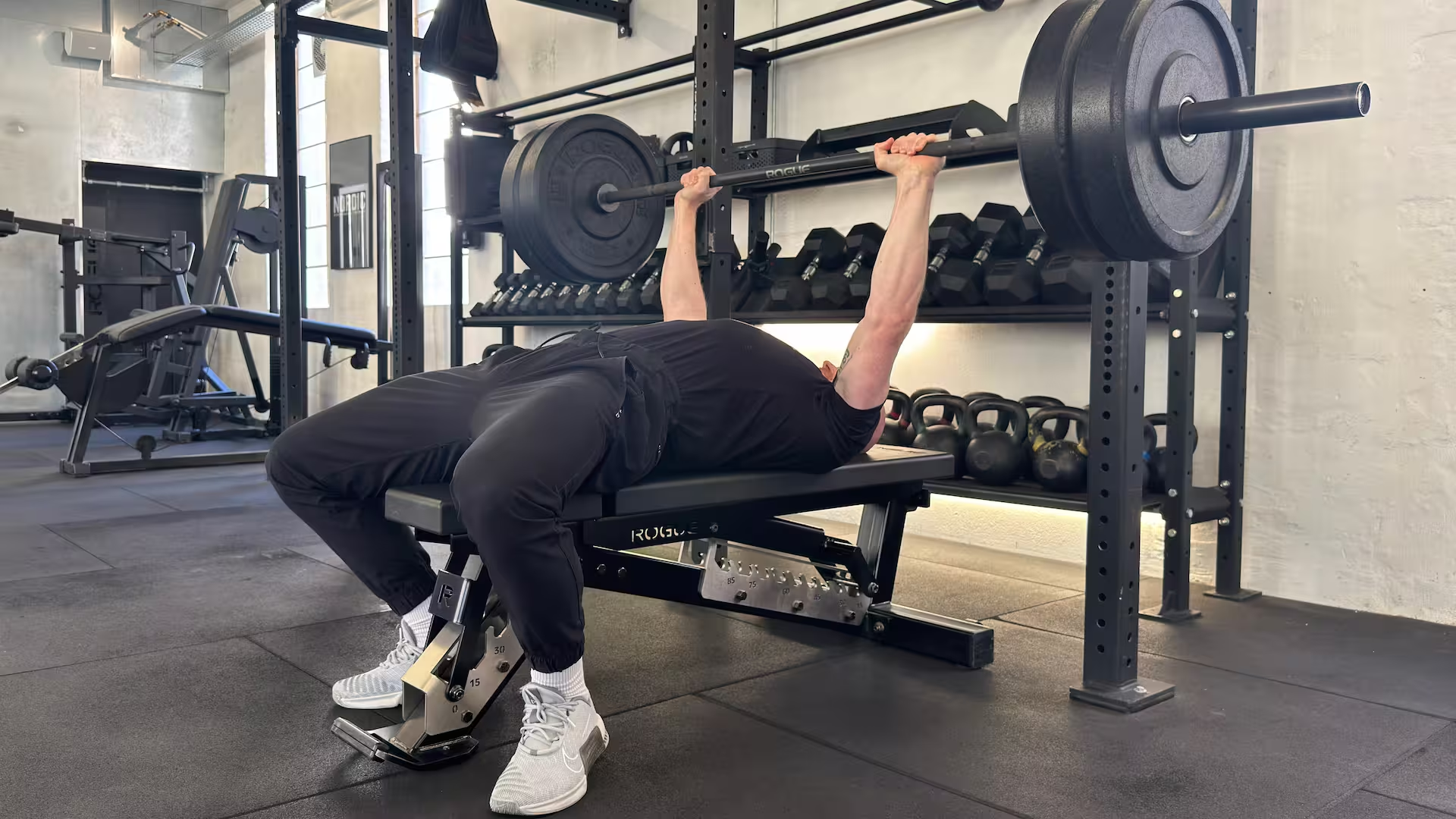

I’ve worked as a personal trainer for over 12 years and as a physiotherapist for over 10 years — and co-founded Nordic Performance Training with Lucas 8 years ago to give clients a professional and structured way to train. Since then, I’ve helped hundreds of people build strength, stay consistent, and feel better through evidence-based methods that actually work.
Along the way, I’ve completed advanced certifications and mentored under leading experts in various fields, and I’ve taught many trainers and physiotherapists internationally.
On this blog, I share the same practical tools, insights, and strategies we use every day at Nordic — so you can train smarter, stay consistent, and get real results.



Related Blog Posts
.svg)