









Bench Press: Complete Guide to Technique, Variations and Common Mistakes
Bench press is one of the most popular strength exercises in the world. But it's also one of the more technically demanding — and for many, it simply doesn't feel that great compared to the alternatives.
Peter, 52, director from Hellerup, has travelled his whole life with work and lived in many major cities around the world. That has meant many different personal trainers in many different countries — and a program that always had in common that they included barbell bench press as the primary chest exercise. On top of that, there were also typically 2-3 additional chest exercises, such as dumbbell flyes, incline chest press, and dips. All in one training session. The trainers also had in common that they switched exercises continuously and changed rep range approximately every four weeks to "shock the muscles."
It was always quite hard. But it also felt very random. As if the trainer came up with something new all the time, to entertain or impress him. It was actually fine exercise and nice to get trained, but when he reflects on it, he never actually got the results he wanted.
The shoulder also started to bother him frequently. The elbow as well. He thought it was just part of training — but also had a feeling that the exercises, especially barbell bench press, were a contributing factor. And he wasn't necessarily entirely wrong in his hunches. Many exercises, high volume, no systematics, and a setup in an exercise that didn't suit his body particularly well all contributed to the problem.
When he came to us 3 months ago, we changed the approach markedly. The only chest exercise — indeed the only pressing exercise — in his program became machine chest press: 3 sets of 6-8 repetitions, our simple progression system, twice per week. Nothing else. And the same concept for the rest of the body.
In 24 weeks, he achieved the best results of his life. The chest muscle grew. The shoulder and elbow stopped hurting. He gradually lifted more weight without it feeling harder. And because his strength training no longer exhausted him totally, he could more easily supplement with cardio — and had the surplus to make healthier choices in everyday life, which resulted in him losing fat continuously.
He did much less. But what he did was now just far better.
"I never thought about how silly it actually was that I had to do four chest exercises in one session. Now I do one — and I'm stronger than ever." — Peter, 52, CEO from Hellerup
That's not a coincidence. It's a professional choice based on what actually works — not what is traditionally considered the right way to train chest.
You don't need more exercises, more sets, or more repetitions. You need to choose the right thing, do it often enough, and follow a structured system. This guide explains precisely what bench press is, which muscles it trains — and why we at Nordic Performance Training always choose machine and dumbbells over barbell.
What is bench press?
Bench press is a compound exercise for the upper body — the shoulder and elbow work together in one movement pattern. This places it in the same category as other upper body pressing exercises like dumbbell chest press and machine chest press, which all solve the same movement task just with different conditions.
The bench press variant itself is one of the most popular and iconic strength exercises in the world. You lie on a bench, take the bar out from a rack, guide it down to the chest in a controlled path, and press it back up the same way to fully extended arms and place the bar back in the rack. That's the movement. Simple in its basic form, but with many different variations and countless nuances.
A primary reason for its popularity worldwide is that the exercise is competed in powerlifting and is one of the three lifts judged in powerlifting alongside squat and deadlift. It's also used as a standardised strength test in American football — at the NFL Scouting Combine, players must press 102 kg (225 lbs) as many times as possible, and the result is used as a direct measure of upper body strength. That says something about the exercise's status: bench press is not just a training exercise — it's a physical benchmark for athletes. And that's probably also the reason why "how much do you bench?" is still one of the first questions people ask each other in a gym.
Which muscles does bench press train?
Bench press is one of the most popular chest exercises — and the primary muscles are the chest muscles, the front deltoid, and the back of the upper arm (triceps). All three work together every time you press — but to different degrees depending on how you press, how the exercise is set up, and where it's heaviest in the movement.
The joint that bends first is loaded the most. It's the same principle we know from other exercises: if the movement starts primarily at the shoulder, the chest and front deltoid work the most. If the movement starts primarily at the elbow — and the weight is simultaneously heaviest when the arms are almost extended — triceps works the most.
Upper or lower chest — what determines it?
It's one of the most asked questions about bench press. And the answer surprises many: it's primarily the direction the arms move relative to the side of the body that determines whether the upper or middle part of the chest works the most — not the bench angle alone.
Grip width and grip orientation are the primary factors. A narrower grip forces the elbows closer to the body, which places the upper chest fibres in a more favourable position. A wider grip leads to more mid-chest. Research shows that a supinated grip — palms facing the face — increases upper chest activation by up to 30% compared to a standard pronated grip, even on a completely flat bench. It's the arm path that counts, not the angle alone.
An incline bench changes when in the movement the weight is heaviest and intuitively invites taking the elbows closer to the body — which again biases the upper chest. Research shows that 30 degrees is optimal for upper chest activation. If you set the bench steeper than 45 degrees, the front deltoid begins to take over and the chest's contribution decreases.
In other words, it's the angle of the arms relative to the body that determines whether we train the most of the upper or middle chest — and the angle of the bench can reinforce this by making the weight heaviest where the part of the chest you want to target is strongest.
Bench press technique: How to press correctly
There's a difference in technique depending on the goal and which variant you use. The principles below first cover conventional bench press with barbell — and then how we perform chest press at Nordic Performance Training, either in machine or with dumbbells.
Conventional bench press
In competition-style bench press, you pull the shoulder blades maximally together, down and back, create a large arch in the back, and hold that position throughout the entire lift — also while the bar is taken out of the rack. It's technically demanding and requires frequent practice to master.
In general training with barbell, the setup is the same, just less extreme. Lie on the bench with the eyes roughly under the bar. Lift the sternum up toward the ceiling and let the back follow naturally. Pull the shoulder blades slightly down and back — this provides a stable starting point. The hips should stay on the bench throughout the entire lift. The feet are placed flat on the floor, preferably slightly back under the knees.
Lower the bar in a controlled manner toward the lower part of the chest in a slight diagonal path — not straight down. At the bottom, the forearms should be roughly vertical. Keep the elbows at approximately 45-75 degrees from the body, depending on what feels natural in your joints. A short controlled pause against the chest — no bounce. Then press evenly up to fully extended arms.
A detail that illustrates how many nuances there are in competition-style bench press: in a maximal lift, many lifters use what's called "leg drive" — an active forward press with the feet against the floor. Because the feet can't slide forward due to friction, and because the upper back is anchored against the bench backward, the body bends slightly upward. This sets the bar in motion before the actual press — and a bar that's already slightly in motion is easier to press than one lying completely still on the chest. It requires timing, coordination, and experience to use effectively. Yet another example of how technically demanding the exercise is to optimise.
Machine chest press and dumbbell chest press
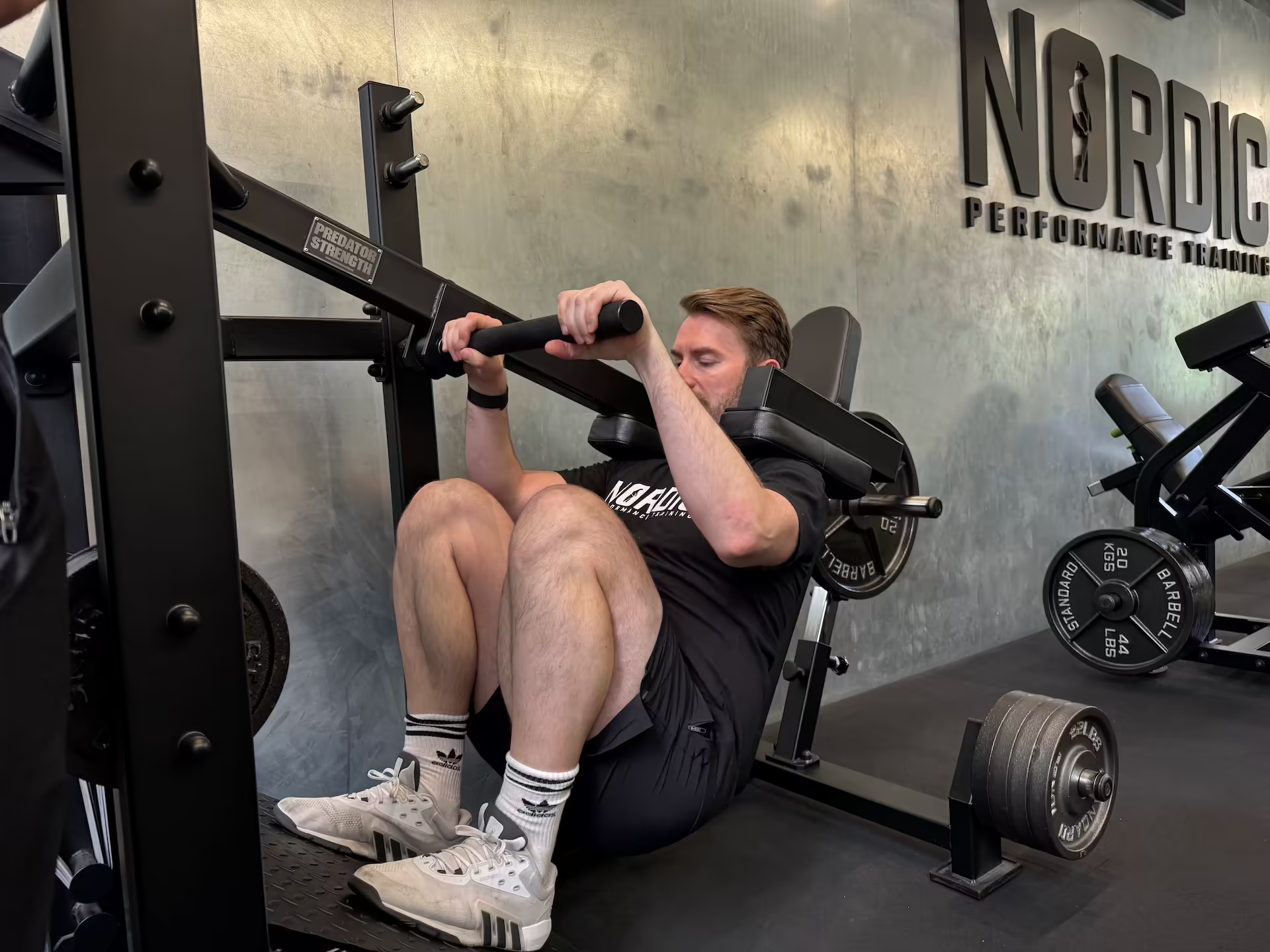
At our facility, we use machine chest press and dumbbell chest press — never barbell. The setup is simpler and more intuitive, because you don't need to spend energy on balancing and controlling the bar before the lift even begins.
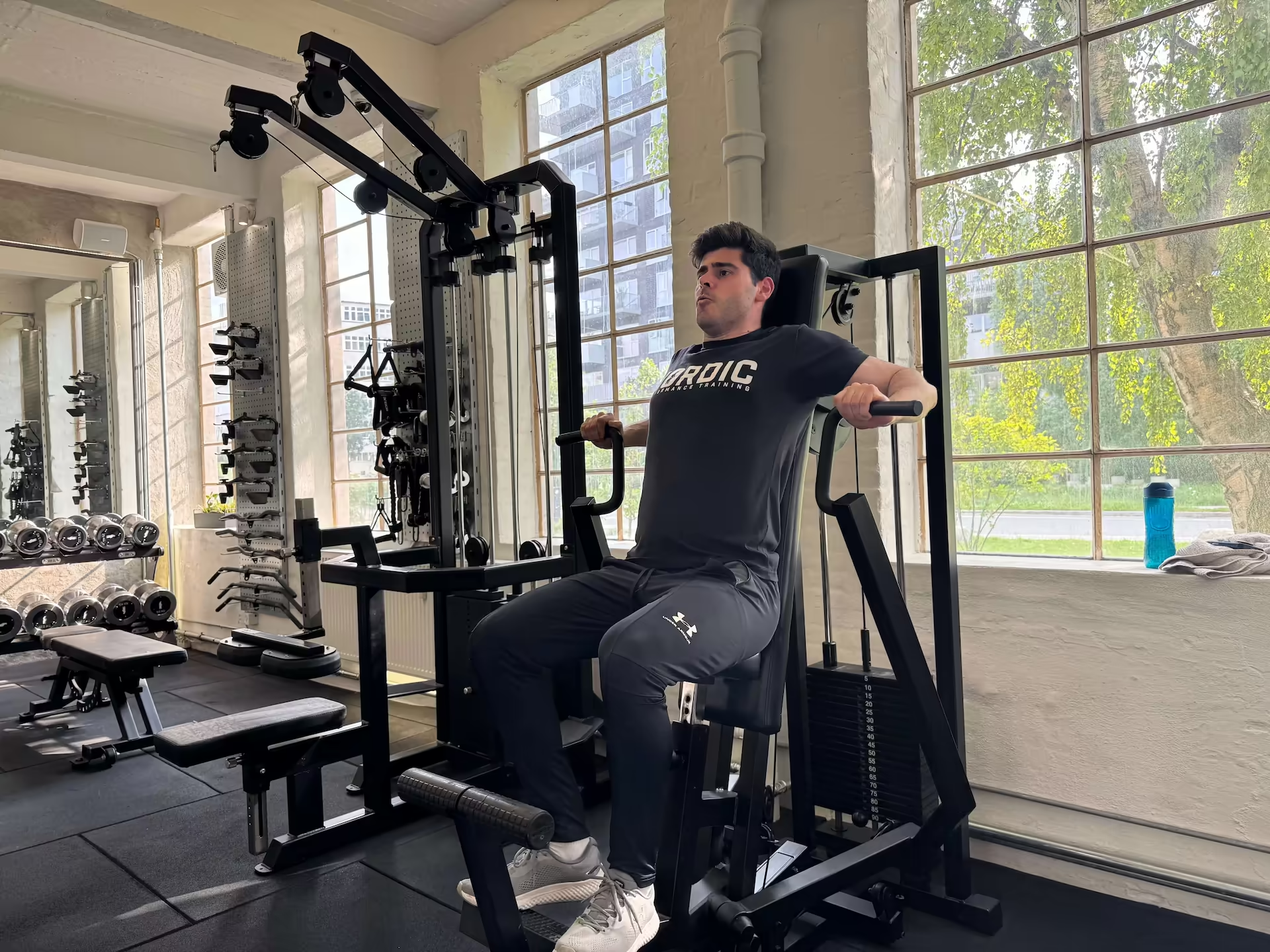
Machine: Adjust the seat so the handles are at chest height. Sit with the back flat against the back rest and the feet solidly on the foot plate. Lift the sternum slightly and pull the shoulder blades back before you begin. At our facility, we let the shoulder blades move freely with the arm movement rather than locking them in place — this provides more natural shoulder mechanics and better freedom of movement. Press the handles forward in an even movement to fully extended arms and lower in a controlled manner back. No bounce at the bottom.
Dumbbells: The dumbbells provide a free movement path — the shoulder can find its own natural path rather than being locked in a fixed position. That's an advantage. But the increased freedom also places greater demands on stabilisation, which means part of the energy goes to controlling the weight rather than the actual muscle work. This makes dumbbells more demanding than the machine — and particularly challenging when the weight increases, as you both have to lift the dumbbells up to the starting position and control them throughout the entire lift.
Lie on the bench with a dumbbell in each hand. Lift the sternum and pull the shoulder blades slightly back. Start with the dumbbells at chest height with the palms facing forward or toward each other — depending on what feels most natural in the shoulder and elbow. Press evenly up to fully extended arms and lower in a controlled manner back.
In both variants: breathe out calmly on the way forward and breathe in again at the starting position. Don't overthink it — the most important thing is that you remember to breathe.
Variations: Which bench press suits you?
Bench press can be seen as one specific exercise with different variations — we see it as one exercise within a category of pressing exercises that all solve the same movement task, but with different conditions and nuances. We choose a variation based on it fitting into our concept: giving our clients the physical adaptations they're seeking, in the most practical and sustainable way.
Machine chest press
Our primary choice within the category. The machine guides the movement path, provides a stable starting point, and makes it easy to learn, repeat, and increase weight gradually as the strength potential increases. You sit down, find your starting position — and get going. No need for a spotter, no steep learning curve, no time wasted on setup.
It's particularly valuable on days when you're tired, have slept poorly, or are mentally exhausted after a long workday. A coordination-demanding exercise like barbell bench press demands more of your brain. The machine demands far less. You see in your program what the weight should be — and get going. See a demo-video here.
Dumbbell bench press (dumbbell chest press)
Our other preferred variant. The dumbbells provide a free movement path — the shoulder can find its own natural path rather than being locked in a fixed position. The grip orientation can be adjusted freely, from palms facing forward to palms facing each other, depending on what feels best in the shoulder and elbow.
The increased freedom does, however, also place greater demands on stabilisation and balancing, and it becomes more demanding to handle as the weight increases.
A practical advantage: dumbbell chest press can be done in virtually all fitness centres. For clients who train with us once per week with a personal trainer and supplement with an independent session at another centre, dumbbells are the obvious choice — the machines are often either of varying quality or occupied, while there's almost always access to dumbbells.
That's why we always start by teaching the machine — and introduce dumbbells afterwards. When you know precisely where your arms should end up in the machine, it's far easier to transfer that feeling to the dumbbells. The other way around is harder. It's a detail — but it's the kind of detail that makes the difference for our clients. See a demo-video here.
Incline bench press
An incline bench changes when in the movement the weight is heaviest and can make the exercise a more upper chest-focused variation. Somewhere between 15-45 degrees is optimal for incline bench press if the chest is still what you want to train — if you set the bench steeper than 45 degrees, it begins to become more shoulder, as you're now pressing upward against gravity rather than forward and away from the chest. See a demo-video here.
Barbell bench press
The classic variant and the standard exercise in powerlifting. For general strength and health, the machine and dumbbells are often a better choice for most people — more on that in the next section. See a demo-video here.
Regardless of which variant you choose: progression is simple. Use double progression — train within a fixed range, e.g. 6-8 reps. When you can do 8 with good technique, you increase the weight next time. Read more in our guide to progress in strength training.
Why we choose machine and dumbbells over barbell
We never use barbell in bench press with our clients. It's both a professional and a practical choice, adapted to our concept and approach to training — not an opinion about the barbell as a tool.
Peter's story illustrates the point well. He had trained barbell bench press for years with different trainers. The shoulder and elbow caused problems continuously. They had all given him different technical cues and adjustments — often the opposite of each other. When we switched to our chest press machine, all those problems disappeared. There was now only one right way to do it. The exercise choice itself was not the only factor — too much volume, too many different pressing exercises, and lack of structure also played a central role in him not succeeding with the training. But an objectively somewhat cumbersome exercise also played a part. The machine and our simple approach to strength training solved it all.
"We don't choose exercises for the sake of the exercises. We choose what gives our clients the best results in the most practical way — and for most people, the machine is the answer." — Lucas Iversen, physiotherapist at Nordic Performance Training
Here are the concrete reasons for our choice:
The machine is faster to learn. Barbell bench press requires you to learn to take the bar out of the rack, balance it, find the right position on the bench, and control a straight movement path down to the chest and back up. It's coordination-demanding and takes time to learn properly. The machine requires none of those things. You sit down, your trainer guides you to the right position, and then you press. Most of your energy goes to the actual muscle work — from session one.
The machine is easier to standardise and increase gradually. You sit in the same position every time. Same movement path. Same starting point. This makes it easy to measure real progress — and easy to increase the weight systematically without the technique changing. On days when you're tired or mentally exhausted, a coordination-demanding exercise demands more of your brain. The machine removes all those demands. You see what the weight should be — and get going.
The barbell locks the movement path. The pronated grip and the fixed path provide fewer options for adapting the exercise to the individual client. The machine and dumbbells provide more flexibility — we can adjust seat height, grip orientation, and the angle of the upper arms to the specific client. Note it and easily and effortlessly repeat it the following week.
It doesn't require a spotter. Barbell bench press requires a spotter at heavy weights. Not only for safety, but to help the weight out of the rack without losing the tension you've spent time and energy building before you unrack. It's impractical for clients who train alone or with limited time.
It's also why we at Nordic Performance Training have chosen to invest in four identical chest press machines in our private training centre. We know it's the exercise that gives our clients the best result. Everyone can use it and no one waits for it to be free. We think it's unfortunate that personal training clients in larger training centres end up using free weights — not because it's the best choice, but because the machines are occupied by other members. They pay more and paradoxically get a harder and less optimal training experience.
We've invested in making sure that's not the case for our clients.
Is barbell bench press a bad exercise? No. It can be done in virtually all fitness centres worldwide — and that's actually a practical quality. If you can perform barbell bench press, you can train the chest almost regardless of where you are. That makes sense for people who travel a lot or change centres often. And for those who compete in powerlifting, it's obviously the exercise they should practise.
But the fact that an exercise is accessible and competed in doesn't automatically make it the best choice if the goal is to get stronger and build muscle mass in the most effortless way. We're not against the barbell. Before barbells existed, people built strength with e.g. heavy stones. When standardised barbells came along, they naturally became the preferred tool — not because the stones didn't work, but because they were much more effective. The same principle applies now with modern machines.
For most of our clients, the machine is clearly the best choice — easy to learn, easy to set up, and easy to track strength progress in. Dumbbells are a good alternative when the machine isn't available. The barbell is the most demanding of the three — and for most people, the extra complexity isn't worth it.
We don't optimise for difficulty. We optimise for results. And make sure every single exercise fits into our entire concept.
The most common mistakes
The elbows are lifted too high out to the side. Many press with the elbows pointing almost perpendicular out from the body. This can feel uncomfortable in the shoulder joint and reduces the chest's contribution to the lift. Keep the elbows at approximately 45-75 degrees from the body — depending on what feels natural in your joints.
The elbows are pulled too close to the body. The opposite problem is at least as prevalent — often as a result of the popular cue "tuck your elbows." When the elbows are pulled all the way in against the side of the body, the force production potential is reduced and the shoulder is rotated outward in a way that wastes unnecessary energy fighting against. The result is a weaker and more awkward press. The solution is the same: find the natural elbow angle that lies somewhere between the two extremes.
Uncontrolled lowering and bounce from the chest. When the weight falls down uncontrollably and bounces from the chest, it's the weight controlling you — not the other way around. It makes it harder to standardise: do you know whether you've gotten stronger, or just better at bouncing the weight? Additionally, it increases the risk of loading structures that aren't ready for it. Lower in a controlled manner all the way down and press evenly from the bottom.
Too heavy too early. The weight should increase systematically over time — not because you feel like lifting more, but because you've actually gotten stronger. The goal is to lift more weight with the same or better technique — and without it feeling harder. If it feels harder, you haven't necessarily gained more strength. You're just training heavier.
The hips lift from the bench. If the hips lift markedly, you're essentially doing a different exercise. Standardisation is the point — if you do the exercise differently from session to session, you can't measure real progress. The hips should stay on the bench throughout the entire lift.
Bench press and shoulder pain
We can never say with certainty why you experience shoulder pain in connection with strength training. It's rarely one thing or a specific exercise. It's usually the combination of exercise selection, technique, and loading over time. And sometimes just pure bad luck — part of being physically active.
Bench press with barbell is, however, the pressing exercise most often associated with shoulder pain. And for some individuals, it can very well be because it doesn't suit their body type and structure particularly well.
Without going too deep into this, we can simply say from experience that both a good machine and dumbbells, performed as part of a good program, almost always lead to being able to train without pain again. The grip angle in the machine or the freedom of movement of the dumbbells gives the shoulder the opportunity to find its natural movement path. Correct elbow angle reduces the load on the shoulder joint markedly. And the control that the machine offers ensures that the press starts from a stable foundation.
You don't need to stop training chest. You just need to press smarter — as part of a better program.
Do you have shoulder pain that doesn't go away with adjustment of technique and exercise selection? Read our guide to impingement in the shoulder or frozen shoulder — and book a consultation so we can assess what makes sense for you specifically.
Frequently Asked Questions About Bench Press
What is bench press good for?
Bench press primarily trains the chest muscles, the front deltoid, and triceps in one cohesive movement pattern. It's one of the most effective exercises for building upper body strength and muscle mass in the chest and shoulders — and a natural foundation in any strength training program.
How much should you be able to bench press?
There is no universal standard. Focus on technique and systematic progression — not on a specific number. Strength is individual and depends on experience, body weight, body type, and goals. The most important thing is that you lift more than last time with the same good technique — and that it doesn't feel harder.
Is 100 kg bench press a lot?
For most people, 100 kg barbell bench press is above average — but it's irrelevant for your training. Focus on lifting more than last time with good technique, regardless of starting point. Progression is relative, not absolute.
How do you get stronger in bench press?
Systematic progression, consistency, and correct technique. Use double progression: train within a fixed rep range, e.g. 6-8 repetitions. When you can do 8 with good technique — and without it feeling harder — you increase the weight next time. Don't change exercise or rep range too often. Consistency in exercise selection is a prerequisite for real progress.
Is bench press bad for the shoulders?
No — with the right variant and technique, bench press is an effective and gentle exercise. Most shoulder pain from bench press develops over time as a result of a combination of exercise selection, technique, and loading — not because bench press itself is dangerous. Bench press machine and dumbbells give the shoulder more freedom than the barbell.
What's the difference between bench press and chest press?
Chest press is the term for the machine variant of bench press — same movement pattern, but with a guided and stable movement path. Bench press is typically used for the barbell or dumbbell variant on a bench. At Nordic Performance Training, we use machine chest press and dumbbell chest press rather than barbell.
Want to train with us?
Bench press doesn't need to be complicated. One good exercise, systematic progression, one to two times per week — that's enough to see results that last.
Want to see how it fits into a complete program? Read our Full Body program guide.
Or if you'd like help finding the program that suits your everyday life as part of personal training in Copenhagen — then book a free start-up conversation. Either in our private gym in Copenhagen or as a call, if that suits you better. We'll go through what makes sense for you specifically.
References
Arseneault, K., Roy, X., & Sercia, P. (2021). The effect of 12 variations of the bench press exercise on the EMG activity of three heads of the pectoralis major. International Journal of Strength and Conditioning, 1(1). https://doi.org/10.47206/ijsc.v1i1.39
Lauver, J. D., Cayot, T. E., & Scheuermann, B. W. (2016). Influence of bench angle on upper extremity muscular activation during bench press exercise. European Journal of Sport Science, 16(3), 309–316. https://doi.org/10.1080/17461391.2015.1022605
Schwanbeck, S. R., Cornish, S. M., Barss, T., & Chilibeck, P. D. (2020). Effects of training with free weights versus machines on muscle mass, strength, free testosterone, and free cortisol levels. Journal of Strength and Conditioning Research, 34(7), 1851–1859. https://doi.org/10.1519/JSC.0000000000003349
Saeterbakken, A. H., Mo, D. A., Scott, S., & Andersen, V. (2017). The effects of bench press variations in competitive athletes on muscle activity and performance. Journal of Human Kinetics, 57, 61–71. https://doi.org/10.1515/hukin-2017-0047
Table of Contents
Related Blog Posts



I’ve worked as a personal trainer for over 12 years and as a physiotherapist for over 10 years — and co-founded Nordic Performance Training with Lucas 8 years ago to give clients a professional and structured way to train. Since then, I’ve helped hundreds of people build strength, stay consistent, and feel better through evidence-based methods that actually work.
Along the way, I’ve completed advanced certifications and mentored under leading experts in various fields, and I’ve taught many trainers and physiotherapists internationally.
On this blog, I share the same practical tools, insights, and strategies we use every day at Nordic — so you can train smarter, stay consistent, and get real results.



Related Blog Posts
.svg)