









Hip Pain: Causes, Exercises and Treatment
Susanne, 47, doctor from Valby, had been running since her mid-30s. 2-3 runs per week — not competition level, but a fixed part of everyday life and her most important breathing space from a busy family and work life. She had just started training for Copenhagen Half Marathon when the pain began.
It started gradually over a couple of months — first as a light irritation on the outside of the right hip after longer runs. She didn't think much of it. A couple of weeks later, she could feel it at work too — particularly late in the day, when she had been standing and walking for 8-12 hours at the hospital. A couple of months later, she could no longer sleep on her right side. She woke up several times at night from a pressing, diffuse, and persistent pain.
She went to the doctor, who felt the tender bone on the outside of the hip and made the diagnosis "trochanteric bursitis — inflammation of the bursa on the outside of the hip." She was advised to stop running for a period, apply ice, take painkillers as needed, and given a referral to physiotherapy via the public health insurance card.
She stopped running. It was hard — running had been her sanctuary for over 10 years. She used ice packs, took painkillers, did the home exercises she was given by her physiotherapist — clamshells with resistance band, hip abduction lying on the side, pelvic lifts on the floor — and received manual treatment every fortnight.
Three months later, the pain was still there. In fact, it had gotten worse. Now it hurt during work shifts, where before it had only been after running. As a doctor, she was professionally accustomed to reading research and understanding evidence — and the longer she was in the program without progress, the more she wondered whether there was another way. She began to fear two things simultaneously: that she could never get back to running, and that she couldn't continue in her job. She was 47, and over 20 years until retirement seemed like a long time to walk around with pain.
She was back at the doctor, who suggested a cortisone injection. She got it. The pain was markedly better for around 4-6 weeks, but then back to status quo.
It was a colleague on the ward who had been with us previously for knee pain who recommended us to her.
The first thing we did was give Susanne a more nuanced explanation of what her problem actually was. What she had been diagnosed with as "inflammation of the bursa" is in reality an entirely different condition than the name suggests. It's not primarily an inflammatory condition — it's a gluteal tendinopathy, an irritation in the glute's tendon musculature that occurs when loading and capacity don't match each other. And the cure is not rest and passive treatment. It's structured strength training of the entire lower body.
We put her on our regular full body program. No special "hip protocols." No isolated exercises with resistance bands. Just proper strength training with focus on glutes, thighs, and the entire lower body, adapted to what the hip could tolerate from the start.
After six weeks, she could sleep on her right side again. After three months, she had started running again — first short runs and then gradually longer. After 9 months, she completed Copenhagen Half Marathon — the goal she had dropped a year earlier.
Today, 14 months after she started with us, she still trains once per week. The hip pain is gone. She's stronger than ever, also during her work shifts, where she no longer feels the exhaustion she did before. She says herself that the strength training didn't just remove her hip pain — it gave her a physical strength she didn't know was possible at her age.
"We see it often. A woman in her 40s or 50s who has been told she has 'bursitis' and has been advised to rest, use ice packs, take painkillers, and do light home exercises. It sounds logical if you believe it's an inflammation or injury. But it's not. It's a tendon and a muscle that can't handle the load they're exposed to. And then there's only one thing that actually works: making them stronger. Not protecting them." — Kasper Vinther, personal trainer & physiotherapist
What is hip pain?
The hip is one of the body's most robust joints. It's a ball-and-socket joint where the femoral head sits deep down in a socket on the pelvis — a construction that allows both great mobility and carries the entire body's weight through everyday life. The joint is built for very large loads.
But the hip is also a complex area. Around the joint itself sit a long series of muscles, tendons, and bursae, and the joint is close to both the lower back, groin, and glute. This means that "pain in the hip" can have many different origins and causes — and that the first important question is: where precisely does it hurt?
The pain can roughly be divided into three areas:
The outside — the most common type. Pain around the bony prominence you can feel on the outside of the hip. The classic diagnosis is "bursitis" or "trochanteric bursitis."
The front and groin — pain in the hip joint itself or in the groin region. Frequent causes are hip osteoarthritis, hip impingement, and groin problems.
The back — pain in the glute or behind the hip. Often referred pain from the lower back or piriformis-related pain.
In most cases, hip pain has a good prognosis. The hip responds well to gradual loading and strength training, regardless of what the specific diagnosis is. That's the most important point to remember before we continue.
Causes — where does the hip pain come from?
The outside — bursa, gluteal tendinopathy, and trochanteric bursitis
This is the most frequent type of hip pain and the area that most often gets people to seek help. It's also the area where the diagnosis and explanation are most often misleading.
On the outside of the hip sits a bony prominence called the greater trochanter — it's the bone you can feel when you place your hand on the side of your hip. Around this bone sit several structures: a bursa (bursa trochantericae), the gluteus medius tendon, the gluteus minimus tendon, and various connective tissue structures.
When pain occurs in the area, the classic diagnosis for many years has been trochanteric bursitis or bursitis — a presumed inflammatory condition in the bursa. That's the explanation many still receive. But the modern understanding has changed markedly.
Today, the area is grouped under the term Greater Trochanteric Pain Syndrome (GTPS), and research shows that the primary cause of the pain in the vast majority of cases is not the bursa — it's the tendons. Specifically, it's gluteus medius and gluteus minimus — the muscles that stabilise the hip during walking and when standing on one leg — that have developed a gluteal tendinopathy. An irritation and change in the tendon itself, driven by a mismatch between the loading the body is exposed to and the capacity the tendons have to handle it.
It's the same principle we've described in our article about shin splints: what sounds like an inflammation is in reality a loading and capacity problem. It's not a disease you've "gotten." It's a condition that occurs when the capacity in a particular structure doesn't keep up with the demands you place on it.
Who is typically affected? Gluteal tendinopathy most frequently affects women over 40 — that's by far the largest group — but men and younger people can also get it. The risk increases with sudden activity increases (e.g. a new running plan), longer periods of standing or walking work, and — paradoxically — also with longer periods of inactivity, where tendon capacity gradually decreases.
Symptoms: Pain and tenderness on the outside of the hip, precisely at the bony prominence you can feel. Worse when lying on the affected side at night (classic). Pain when walking up stairs or standing up from a chair. The pain can radiate down along the outside of the thigh, but rarely further down than the knee.
Treatment: This is crucial. The classic approach — rest, icing, painkillers, light mobility exercises, and possibly a cortisone injection — is at its best temporary symptom dampening. It doesn't change the underlying capacity problem.
The latest research is clear. A large meta-study from 2024 compared exercise-based interventions with minimal intervention and found that exercise gave clearly better function both in the short and long term. A similar systematic review from 2025 concludes that cortisone injections don't give better long-term results than waiting for spontaneous improvement — and that cortisone injections potentially have negative long-term effects.
The treatment is therefore strength training. Gradually increased loading of glutes and hips that over time makes the tendons more resilient. That's the treatment the research points to as the first choice.
The front and groin — hip osteoarthritis, impingement, and groin pain
When the pain sits in the front of the hip or in the groin region, it typically points to the hip joint itself or the structures around it.
Hip osteoarthritis (osteoarthritis in the hip): Age-related changes in the joint cartilage that become more common with age. It typically produces stiffness in the morning, pain in the groin or front of the thigh, and pain with longer periods of activity. As we've described extensively in our article about osteoarthritis in the back, osteoarthritis is not "worn out" — it's age-related changes that correlate poorly with pain experience. Two 60-year-olds with precisely the same MRI findings can have vastly different experiences.
International guidelines are clear: strength training is the first-choice treatment for hip osteoarthritis. It's strongly recommended across the leading international guidelines for osteoarthritis — from OARSI (the world's leading research organisation for osteoarthritis) to the European and American clinical guidelines at NICE, ACR, and EULAR. Surgery (hip replacements) can be relevant for severe osteoarthritis that doesn't respond to conservative treatment — but it's rarely the first choice.
Hip impingement (FAIS): A condition where the bony structures in the hip joint don't fit optimally together, so pinching occurs during certain movements (particularly deep flexion and internal rotation). It typically affects younger, active people, and is a frequent diagnosis in people who do sports with deep hip movements — football, ice hockey, dance, martial arts.
The important thing to know about hip impingement is that the structural changes (cam and pincer morphology) that can be seen on MRI are extremely common also in people without pain. Many asymptomatic people have what on paper looks like hip impingement. It's the same principle as with supraspinatus in the shoulder and L4/L5 in the lower back: findings on scanning are not the same as cause of pain.
Conservative treatment with strength training is the first choice. The available evidence doesn't show that surgery (hip arthroscopy) is clearly superior to structured physiotherapy, and over half of patients with non-osteoarthritis-related hip pain respond well to conservative treatment.
Iliopsoas-related pain (the hip flexor): Pain deep in the groin, often when lifting the knee or standing up from a chair. Can be caused by irritation of the iliopsoas tendon or its bursa, typically after a period of increased loading.
Groin pain and groin injury: Acute or gradual development of pain in the groin itself. In athletes — particularly ball players, runners, and skiers — it's often an adductor-related injury or a small muscle tear in the groin region. Treatment is gradual rehabilitation with focus on adductor strength, not immobilisation.
The back — referred pain from the lower back and piriformis
Many "hip pains" that sit in the glute or behind the hip don't actually originate from the hip. They originate from the lower back.
The lower back's nerves supply large parts of the back of the body, and a lower back problem can produce pain experienced as hip pain. If you have pain in the glute, particularly if it radiates down into the leg or worsens in certain sitting positions, it's worth reading our article about lower back pain — much of what is experienced as hip pain has its origin there.
Piriformis-related pain — a deep pain in the glute, often with radiation down into the leg — is a frequent explanation, but also a debated diagnosis. We've written extensively about it in our article about the sciatic nerve pain.
Symptoms — when is it the hip?
The typical symptoms of hip pain:
- Pain when walking, particularly on stairs and hills
- Pain when standing up from a chair or getting out of the car
- Pain when lying on the affected side at night
- Stiffness in the morning or after longer periods of sitting
- Pain when bringing the leg out to the side or up toward the chest
- Swelling or tenderness when pressing on a specific spot
Where precisely is the pain? That's the most important diagnostic question:
- The outside — gluteal tendinopathy / trochanteric bursitis. Classically worst at night on the side.
- The front and groin — the hip joint itself. Osteoarthritis, impingement, iliopsoas-related.
- The back and glute — often referred pain from the lower back or piriformis.
Hip pain at night: Many with hip pain, particularly gluteal tendinopathy, wake at night from a dull pain when lying on the side. It's uncomfortable but not alarming — it's classic for the condition, and it typically subsides when the structures become stronger.
Pain that consistently wakes you without you lying on the affected side, or pain that doesn't subside with position change, is more concerning and should be assessed by your doctor.
Treatment of hip pain
The most important point first: The hip needs loading — not protection.
That's the opposite approach of what many are recommended. The classic approach for hip pain is rest, icing, painkillers, possibly a cortisone injection, and light exercises with resistance bands. It's an approach that dampens the symptoms short-term but doesn't change the underlying problem.
We work from the same principles as we do with all other loading-related conditions:
Understand what it is. The pain is not a sign that the hip is destroyed or fragile. It's a sign that there's a mismatch between loading and capacity. The solution we need to work toward is about increasing the capacity — not about permanently reducing the loading.
Keep moving. Rest worsens most hip problems. The tendons get poorer capacity, the muscles weaken, and you become less robust against everyday loading.
Build strength in glutes, thighs, and hip. That's where the long-term solution lies. A strong glute and hip stabilises the joint, distributes the load better in everyday life, and reduces the irritation that originally occurred.
Massage and stretching can relieve, but are not the solution
Massage and stretching can provide short-term relief and feel nice. It's not wrong to use those tools, but it's important to understand their role. They don't change the capacity in the structures that hurt. It's symptom dampening, but not a real solution.
Many with hip pain stretch the IT band, hip flexor, or piriformis in an attempt to "loosen up." It can provide a moment's relief. But the hip doesn't get stronger from it — and it's strength that ultimately determines whether the problem disappears.
Painkillers and cortisone
Painkillers can have a place in acute phases, but they're not the treatment. The Danish Health Authority's national recommendations from 2025 are clear that paracetamol, NSAIDs, and opioids should not be used routinely for chronic pain. Talk to your doctor about what's relevant for you.
Cortisone injection is a tool many are offered if physiotherapy hasn't produced progress. It typically provides 6-8 weeks of pain relief. But the latest research — including a large review from 2025 — shows that cortisone injections in the long term don't give better results than waiting for spontaneous improvement, and that they potentially can have negative long-term effects on the tendon itself. That's an honest point we believe clients deserve to hear.
Exercises for hip pain
We don't have a special "hip protocol." We have a full body program that we adapt to the individual client. For clients like Susanne, these are the exercises that do by far the most work:
Glute Bridge is one of the most central exercises for hip pain. It targets the glutes directly and builds the strength in gluteus medius and maximus that's crucial for hip stability. Strong glutes are the foundation in the vast majority of hip programs with us.
Bulgarian Split Squat trains one leg at a time and places large demands on hip stability — precisely the ability that's typically reduced in gluteal tendinopathy. It's one of the most functional exercises we do, because it mirrors everyday walking, stair climbing, and potential running.
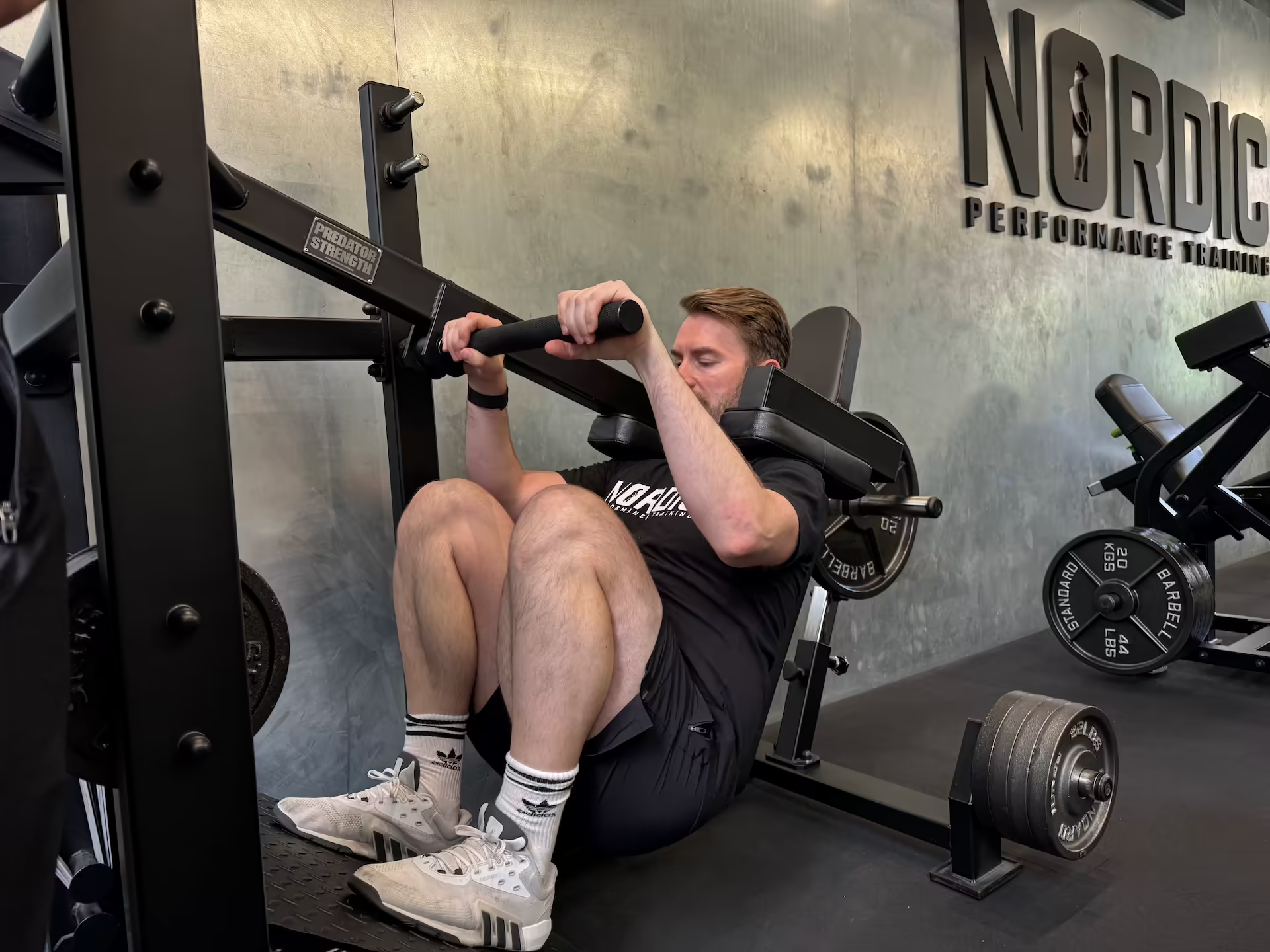
Hack Squat gives us the opportunity to train the entire lower body — including the hip — with high load in a controlled path. It's the exercise that builds the broad lower body strength.
Pendulum Squat is an alternative to Hack Squat for clients where we want lower loading on the lower back. It provides the same stimulus of the lower body, but in an even more controlled movement path.
Leg Extension and Leg Curl isolate the quads and hamstrings respectively. They're not directly hip-working exercises, but they contribute to the overall lower body strength, and hamstring strength is specifically important for hip and pelvic stability.
All these exercises are naturally included as part of our full body program, which we use with the vast majority of our clients — regardless of whether they come for hip, back, knee, or shoulder problems.
We use double progression: you work your way up in repetitions with the same weight, and when you hit the top of the repetition range in all sets, you increase the weight. It's the simplest and most sustainable way to ensure you actually get stronger over time.
When should you see a doctor?
Most hip pain responds well to structured strength training. But some situations require medical assessment:
- Hip pain after a fall or trauma — to rule out fracture
- Pain that doesn't improve after 6-8 weeks with an active approach
- Nighttime pain that consistently wakes you, regardless of your position
- Swelling, redness, or fever around the hip (can indicate infection)
- Progressive loss of range of motion in the hip
- Sudden loss of strength or numbness in the leg
- Weight loss, general malaise, or other alarm symptoms
If you're in doubt, contact your doctor.
FAQ About Hip Pain
Where do you have pain if you have hip pain?
Hip pain can sit in three different places. Pain on the outside of the hip — at the bone you can feel — is the most frequent type and is typically caused by gluteal tendinopathy (what's often called trochanteric bursitis). Pain in the groin or front points to the hip joint itself, typically osteoarthritis or impingement. Pain in the glute or back of the hip often originates from the lower back rather than the hip itself. The important thing to know is that treatment in most cases is the same regardless of location: gradual strength training of glutes, thighs, and hip.
How does inflammation in the hip feel?
It's worth starting with a clarification: what's often called "inflammation" in the hip — particularly bursitis — is in reality rarely a classic inflammatory condition. It's typically a gluteal tendinopathy, an irritation in the glute's tendon musculature. The symptoms are pain on the outside of the hip, particularly worse at night on the affected side, on stairs, and when lying on the side. The pain is typically diffuse and smouldering, not sharp.
Can hip pain be trained away?
For the vast majority: yes. The modern evidence is clear — gradual strength training of glutes, thighs, and hip is the first-choice treatment for nearly all types of hip pain, from gluteal tendinopathy to osteoarthritis to impingement. It takes time — typically 8-16 weeks before you feel a real difference — but the effect is long-lasting. It's a completely different approach than the classic "spare and rest" that many encounter, but it's the one with the best evidence.
What are symptoms of a bad hip?
"Bad hip" is not a professional term. The typical symptoms many describe with that expression are: pain when walking and on stairs, stiffness in the morning, reduced mobility, pain with longer periods of sitting, and nighttime pain. The important thing is that the specific diagnosis is rarely crucial for what you should do. Nearly all hip pain — regardless of whether it's caused by gluteal tendinopathy, osteoarthritis, impingement, or something else — responds well to the same approach: gradual strength training that builds capacity in glutes, thighs, and hip.
What is bursitis in the hip?
Bursitis is the classic diagnosis for pain on the outside of the hip. But the term is misleading. The modern understanding is that the pain in the vast majority of cases is not caused by the bursa itself, but by a gluteal tendinopathy — an irritation in the glute's tendon musculature. This also means the treatment shouldn't be about "dampening an inflammation" but about building capacity in the structures that can't handle the load. Strength training is the first choice.
What is trochanteric bursitis?
Trochanteric bursitis is another term for the same as bursitis in the hip. It refers to a presumed inflammation in the bursa trochantericae — the bursa at the bony prominence on the outside of the hip. Today, the broader term Greater Trochanteric Pain Syndrome (GTPS) is used professionally, because the real problem is most often a gluteal tendinopathy in the glute's tendon musculature, not the bursa itself. The treatment is the same: gradual strength training.
Can you train with hip pain?
Yes, and it's often precisely what solves the problem. The training should be adapted to what you can tolerate — but there's nothing dangerous about loading a hip that has a gluteal tendinopathy or osteoarthritis. On the contrary, it's the loading that makes the tendons and muscles stronger over time. Rest alone rarely solves hip problems.
Does stretching help against hip pain?
Stretching can provide short-term relief and feel nice, but it doesn't build capacity in the structures that hurt. Many stretch the IT band or hip flexor in an attempt to "loosen up" — it's not wrong to do, but it's not the solution. Stretching relieves. Strength solves.
What helps against bursitis in the hip?
What has the best evidence is gradual strength training of glutes and hip. A large meta-study from 2024 showed that exercise is clearly superior to minimal intervention, and that the effect holds at long-term follow-up. Cortisone injections can provide short-term relief but don't give better long-term results than waiting for spontaneous improvement — and they can have negative long-term effects on tendon quality. Rest, icing, and passive treatment dampen the symptoms but don't solve the underlying capacity problem.
Can hip pain come from the back?
Yes, and it's very common. The lower back's nerves supply large parts of the back and outside of the hip, and a lower back problem can produce pain experienced as hip pain — particularly in the glute and behind the hip. If you have hip pain accompanied by back pain, or if the pain radiates down into the leg, it may be worth reading our article about back strain.
Ready to get your hip back?
If you've been walking around for months with hip pain that isn't getting better — and if you've started to doubt whether there's even a way back — we understand. It's a fear we encounter every week.
It's also a fear that typically disappears when you experience that the hip actually responds to the right approach — and that it's not as fragile as the diagnosis has made it sound.
Book a free start-up conversation and hear how personal training in Copenhagen can look for you — either in our private gym or as a call, if that suits you better.
References
Bannuru, R. R., Osani, M. C., Vaysbrot, E. E., Arden, N. K., Bennell, K., Bierma-Zeinstra, S. M. A., et al. (2019). OARSI guidelines for the non-surgical management of knee, hip, and polyarticular osteoarthritis. Osteoarthritis and Cartilage, 27(11), 1578-1589. https://doi.org/10.1016/j.joca.2019.06.011
Bremer, T., Nicklen, P., Fearon, A., & Morrissey, D. (2025). The efficacy of gluteal tendinopathy treatments: A systematic review. Clinical Rehabilitation. https://doi.org/10.1177/02692155251327298
Cordeiro, T. T. P., Rocha, E. A. B., & Scattone Silva, R. (2024). Effects of exercise-based interventions on gluteal tendinopathy: A systematic review with meta-analysis. Scientific Reports, 14(1), 3343. https://doi.org/10.1038/s41598-024-53283-x
Holden, M. A., Metcalf, B., Lawford, B. J., et al. (2023). Recommendations for the delivery of therapeutic exercise for people with knee and/or hip osteoarthritis: An international consensus study from the OARSI Rehabilitation Discussion Group. Osteoarthritis and Cartilage, 31(3), 386-396. https://doi.org/10.1016/j.joca.2022.10.009
Mellor, R., Bennell, K. L., Grimaldi, A., Nicolson, P., Kasza, J., Hodges, P., et al. (2018). Education plus exercise versus corticosteroid injection use versus a wait and see approach on global outcome and pain from gluteal tendinopathy: Prospective, single blinded, randomised clinical trial. British Journal of Sports Medicine, 52(22), 1464-1472. https://doi.org/10.1136/bjsports-2018-099683
Sundhedsstyrelsen (2025). Nationale kliniske anbefalinger for brug af paracetamol, NSAID og opioider til behandling af akutte lænderygsmerter hos voksne. https://www.sst.dk/nyheder/2025/medicin-virker-ikke-mod-akutte-laenderygsmerter
Table of Contents
Related Blog Posts


I’ve worked as a personal trainer and physiotherapist for many years and I specialize in making complex training concepts simple, practical, and easy to apply — whether the goal is building muscle, improving performance, or training with more confidence.
My focus is on combining clear communication with evidence-based methods, so clients not only know what to do but also understand why it works.
On this blog, I share the same insights and strategies we use at Nordic every day — helping you train with purpose, clarity, and results.




Related Blog Posts
.svg)