









Sciatic Nerve: Pain, Exercises and Treatment
Thea, 34, dentist from Østerbro, came to us a good six months after she had given birth to her second child. She had always had "something" with her right hip — an old acquaintance she was a bit used to — but during the last part of the pregnancy, it began to spread. A shooting pain from the hip, down through the glute, into the thigh, and sometimes all the way down to the calf. She had hoped it would go away after the birth. But six months later, it was still there. The intensity varied from day to day. It was worst in the morning and after longer periods of sitting — and usually better during the day, when she got moving.
She had done what many do in her situation. Booked an appointment with her GP. Got referred for an MRI. Went to a physiotherapist and got stretching exercises. Tried an osteopath. Tried acupuncture. Each practitioner had their own explanation. One called it piriformis syndrome. Another was certain it came from the pelvis. The third pointed to the MRI, which showed a mild disc bulge in the lower back — which incidentally was also visible on an earlier scan she had had done five years ago, entirely without symptoms.
That was approximately where she had reached when she contacted us. Tired of receiving contradictory explanations. Tired of treatments that relieved briefly but never changed anything fundamental.
The first thing we said to her was something she hadn't heard before: That what she was experiencing was sciatica symptoms — and that sciatica is not a diagnosis in itself. It's a symptom. A collective term for pain that radiates from the lower back or glute down into the leg, because the sciatic nerve or one of its roots is suspected to be irritated. It can come from many things. And in many cases, there isn't one clear culprit — it's presumably a combination of different things.
We also said something else she hadn't heard before: That it didn't really matter exactly what was irritating the nerve. The treatment is largely the same regardless.
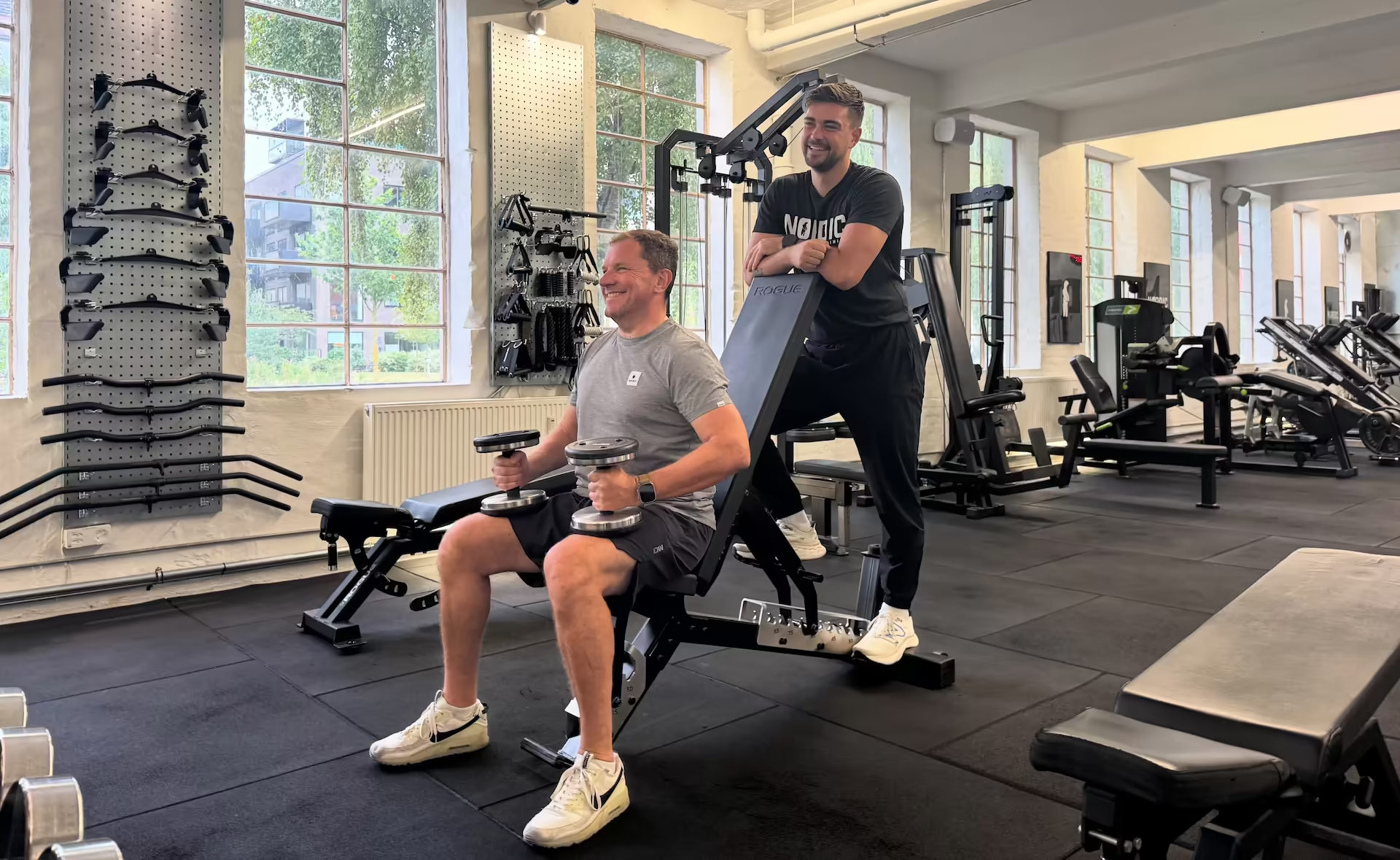
Thea started a 6-week program with two weekly sessions. We did what we always do — put her on our regular full body program and adjusted the load to what she could tolerate on the day. No special sciatica exercises. No extra focus on where it hurt. Just structured strength training where we gradually increased the weight over the weeks.
She became so happy with the approach — and particularly the absence of the constant attention to her problem that she had encountered everywhere else — that she continued with another 12-week program. And another. Today she's heading into her fourth program. She has one personal training session per week and has plans to continue for a long time yet. Not because the pain needs to be "treated" anymore, but because she has experienced how good she feels from training and the feeling of being strong.
Milder sciatica pain still shows up on rare occasions. But it doesn't take up space in her everyday life anymore. She has learned to see it a bit like a cold or the flu. Annoying, but not dangerous — and something that passes again. A pregnancy and birth are a major physical adjustment for the body, and it's not abnormal for the body to react with both infections and pain symptoms for some time after. The most important thing is to be kind to yourself along the way, and to have a plan that builds the body back up.
"Sciatica symptoms can mean all sorts of things. But it clearly hasn't helped Thea to go to different practitioners to find 'the cause' — doctor, scan, physiotherapist, osteopath. The treatment most often ends up being training and time anyway. So that's what we do from the start — just with a more optimistic focus and less focus on the 'disease.' We actually think piriformis syndrome is a bit of a wastebasket diagnosis, and we're honestly a bit indifferent, as long as there are no signs of something more serious. We just call it pain from the hip or glute with radiation — and then we don't focus on it anymore. We focus on what we can actually do something about." — Mathias Busk, physiotherapist & personal trainer
What is the sciatic nerve — and where is it located?
The sciatic nerve is the body's longest and thickest nerve. It's formed by nerve roots from the lowest vertebrae in the lower back and the upper sacral area (L4 to S3), runs out through the glute, down along the back of the thigh, and branches at the knee into two branches that run further down along the back of the calf and the front of the lower leg respectively — and all the way down to the foot.
It's the nerve that supplies virtually the entire back of the leg and lower leg both motorically and sensorily. And that's the reason why irritation of the nerve can produce symptoms in all the places it runs.
When we talk about "sciatica," we mean in everyday language pain that radiates from the lower back or glute down into the leg — typically in one leg, rarely in both. But it's worth remembering: Sciatica is a symptom, not a disease. It's not the nerve that's "sick." It's the nerve being irritated by something in the vicinity — typically a disc bulge, an age-related narrowing, or tight musculature around the glute.
But irritation can also come from something that isn't mechanical. Hormonal changes — particularly during pregnancy or in the hectic months after birth — can contribute. Stress, sleep deprivation, and chronically elevated activity in the nervous system can do the same. And in some people, the nervous system has over time become more generally sensitive — we call that phenomenon central sensitisation, and it means in short that the same mechanical influence can be experienced very differently from day to day.
That's one of the reasons the same "disc finding" on an MRI can produce severe symptoms in one person and none at all in another. And it's part of the explanation for why sciatica pain often fluctuates up and down, without anything necessarily changing mechanically in the back.
Symptoms of sciatica
The typical symptoms are:
- Pain that radiates from the lower back or glute down into the leg — can affect the thigh, calf, and foot
- A shooting, burning, or electric sensation, particularly in certain positions
- Tingling or numbness in the leg
- A sensation of weakness — the leg "not responding" as it normally does
- Worsening with prolonged sitting, coughing, sneezing, or certain movements
The intensity can range from a mild nuisance to severe pain that dominates everyday life. But here's the important thing: How severe it feels doesn't say much about how serious it is. Most cases improve over weeks and months, regardless of how intense it started.
The symptoms can also fluctuate from day to day — or from week to week — without anything necessarily changing mechanically in the back or hip. Stress, sleep, hormonal changes, and the general activity level all influence how sensitively the nervous system reacts to the underlying irritation. That's one of the reasons two people with the "same" finding on an MRI can experience the symptoms completely differently — and that the same person can have good and bad periods without a clear explanation.
Sciatic nerve pinched — what does it mean?
"Sciatic nerve pinched" is an expression many use, but it's a slightly misleading formulation. It gives a picture of the nerve being pinched by a muscle or bone, as if a hand is holding it in a firm grip. That's rarely the case.
You may also have heard the image of the garden hose that someone is stepping on, so the water can't get through. It's a popular metaphor among practitioners because it's easy to understand. But it's precisely that type of explanation we'd like to move away from. It plants an idea that something is physically pinched and needs to be "released" — and that often leads to a long series of treatments that don't build anything real. It's also a good example of a nocebo effect: words and images that can in themselves worsen the experience of pain because they suggest something serious is happening.
What typically happens is that the nerve or nerve roots at the lower back become irritated — by inflammation, by mechanical contact with a disc bulge, by narrowing in the spinal canal, or by a broader sensitivity in the nervous system that means lesser stimuli produce greater fluctuations in symptoms. It feels as though something is pinched. But in the vast majority of cases, there isn't a muscle that needs to be released or a compression that needs to be "pried loose" by a practitioner.
The same applies to the phrase "inflammation in the sciatic nerve." Many use it in everyday language, but it's typically not an infection or an actual inflammation. It's an irritation of the nerve — and that's an important linguistic difference because it changes what makes sense to do about it.
Causes — why does sciatica occur?
The most frequent causes:
Herniated disc the lower back. A bulge in one of the lowest intervertebral discs can irritate a nerve root, and the pain spreads down along the sciatic nerve's course. We've written extensively about disc prolapse — including why scan findings often look dramatic without saying much about the cause of the pain — in our article about disc prolapse.
Spinal stenosis. An age-related narrowing of the canal in the back where the nerves run. Most common in adults over 50.
Piriformis syndrome. The theory that the piriformis muscle (a small muscle in the glute) pinches the sciatic nerve where it passes through the glute. It's a debated diagnosis. Some practitioners use it a lot. We're more reserved. Our experience is that it's often used as a wastebasket diagnosis when nothing else can be found. And regardless of whether it's piriformis, a small hip irritation, or something entirely different behind it, the treatment is broadly the same: gradual loading and strength training of the entire hip and lower back area.
Pregnancy and the period after birth. Many women experience sciatica symptoms in the last trimester and in the months after birth — as Thea's story shows. It's a combination of several things: the hormone relaxin makes the pelvis and ligaments more flexible, the uterus increases pressure on the nerves, and posture changes markedly. After the birth, the body takes a long time to recover — pelvic floor, abdomen, posture, and hormone balance normalise over months and often one to two years. This doesn't mean something is wrong if the body still feels different long after the birth.
Centrally sensitised nervous system. A factor that's often overlooked. With prolonged pain — or with the combination of stress, sleep deprivation, and low physical capacity — the nervous system can become more generally sensitive. This means that the same mechanical irritation is experienced more intensely than it otherwise would be. It's not "imagining things." It's a real physiological change in how the body processes pain signals. And it's part of the reason why structured strength training combined with education in pain theory and optimistic guidance from an actively focused practitioner often works better than more "specific" treatments — it gradually dampens precisely this hypersensitivity over time, while also building you stronger and more robust.
Other causes. Inflammation, infection, trauma, or — very rarely — tumours can also irritate the nerve. That's part of the reason a medical assessment is worth getting if the symptoms don't follow the expected course.
For many, there isn't one clear culprit. It's a combination of old things that have built up over time and new things that have set it off. But here's the important thing: For almost all the people we see with sciatica, the treatment is broadly the same. It's rarely worth spending too long chasing the precise cause, as long as we can rule out serious underlying conditions.
Treatment of sciatica
The most important point first: Sciatica is for most people a condition the body manages over weeks or months — particularly if you keep yourself generally healthy and as active as possible during the course.
That's also why it's often a problem when you're met with a tendency to investigate and treat the problem very specifically and focused. And the classic reaction to sciatica is to "spare" the area, lie still, avoid loading, wait for it to pass. And that's also okay to do, particularly at the start of a course. But it's not what the evidence points to as best in the long run. On the contrary: education in what it actually is, what the prognosis says, introduction to structured training with gradual loading, and general movement should all instead be part of the "treatment."
With us, we work from three simple principles:
Understand what it is, and what you can expect. The first thing we do is not give you an exercise. It's to give you an explanation. What sciatica is, what it isn't, and how the typical course looks.
When you understand that you're dealing with something annoying but fundamentally harmless that will pass again, the experience of it changes. That's not a platitude. It's one of the most robustly documented tools in modern pain management: simple, honest information about the condition reduces the pain experience and accelerates the course. It's also the opposite of what many sciatica patients receive — namely vague and dramatic formulations about "something pinched" or "nerves being pressed" that can in themselves make the symptoms worse.
Keep moving. Walk, walk more, walk daily. Movement is not harmful to an irritated nerve — it's often the opposite. Walking is one of the best things you can do if you have sciatica. It reduces stiffness, keeps the circulation going, and gives the body the message that it's not "broken." Walking alone rarely solves the problem, but it's a low-threshold entry that everyone can start with and provides plenty of endorphins.
Build strength in the entire body. That's where the long-term gain lies. A strong body distributes the load better in everyday life, reduces the irritation in the area over time, and makes the body more robust against relapse.
For Thea, this was the central shift. In the months after the birth, she had primarily done stretching, small home exercises, and received manual treatment. It had relieved briefly but never changed anything fundamental. When she started with structured strength training with us, she gradually experienced that the pain took up less space — not because we did something special for the nerve, but because her entire hip, glute, and back musculature became stronger and better equipped for everyday loading. At the same time, the training also affected the nervous system's sensitivity itself: when the body repeatedly experiences that loading is safe and manageable, the hypersensitivity that can otherwise maintain the symptoms subsides.
The factors that make the nervous system more sensitive
It's worth knowing that sciatica symptoms are not only about what's happening in the back or hip. They're also markedly influenced by some things that are rarely mentioned when you seek help:
Sleep. Poor sleep turns up pain sensitivity. It's one of the most robustly documented associations in modern pain research. If you sleep poorly, you experience more pain — also from precisely the same mechanical irritation.
Stress. Chronic stress keeps the nervous system on alert and amplifies both inflammation and pain signals.
Worry about the symptoms themselves. Fear and catastrophising is one of the strongest predictors of prolonged pain. When you walk around waiting for the next pain attack, the nervous system achieves precisely the sensitivity that makes the attack more intense.
General health and activity level. Low physical capacity, poor diet, smoking, low energy level, social isolation — all contribute to how sensitively the body reacts to the underlying irritation.
We don't necessarily go into depth with all these areas at every session. But we mention them, we acknowledge them, and we talk about them where it makes sense. Because it's often the combination of a stronger body, better sleep, less fear, and more general activity that is what actually moves the symptoms — not a single exercise or a specific treatment.
Massage — short-term relief, not treatment
Massage can feel nice. It can dampen the symptoms for hours or days. It's worth knowing that massage primarily works by modulating the pain through the nervous system and providing an experience of a less tense muscle — it's not a mechanical "loosening" phenomenon, even though it feels that way. But it doesn't change the underlying problem and should not replace the primary approach. We're not saying it's forbidden — we're saying it's a short gain, not an investment.
Stretching — can relieve, but is not the solution
Stretching exercises for sciatica are one of the most widespread approaches. Piriformis stretch, hamstring stretch, knee-to-chest, the "pigeon pose" from yoga. They can provide short-term relief, and there's nothing wrong with that.
But here's the nuance: Stretching doesn't solve the problem. People who have done stretching for months often come to us with precisely the same symptoms they had when they started. If stretching were the solution, the problem would be gone by that point.
There's also a less tangible point. When you stretch to "relieve your sciatica," you remind yourself that you have sciatica. Every time. It keeps the focus on the symptom and can paradoxically make it more prominent in your everyday life than it needed to be. It's not because stretching is forbidden — it's because we'd like to shift the focus away from "fixing the sore region" and toward "building a stronger body."
Our recommendation: If you're already doing stretching and find it nice, then by all means continue. But it should not be the backbone of your rehabilitation, and the exercises you start with should be ones you'll continue with for the rest of your life, precisely like those in our Full Body program.
Exercises for sciatica
As with all the other conditions we've written about, we don't have a special "sciatica protocol." We have a full body program that we adapt to the individual person.
For clients like Thea, these exercises are particularly central:
Hack Squat is the core. It loads close to all the muscles in the lower body, and because you're guided in a fixed path, there aren't large demands on technique, and we can therefore start completely light and build up gradually.
Bulgarian Split Squat trains one leg at a time and places higher demands on balance and hip control in the loaded leg. For sciatica clients, it's a particularly useful exercise because it challenges the entire glute and hip area.
Glute Bridge targets the glutes directly. Strong glutes stabilise the entire lower back-pelvis-hip region and are one of the most central muscle groups to build up when you've had sciatica symptoms.
Leg Curl isolates the hamstrings. A strong hamstring musculature balances the quad's pull on the knee and contributes to a well-functioning hip and lower back region.
Leg Extension isolates the quad. Strong quadriceps distribute the load better up through the leg and are a well-known buffer against a wide range of knee and hip problems.
We use double progression: you work your way up in repetitions with the same weight, and when you hit the top of the repetition range in all sets, you increase the weight. It's the simplest and most sustainable way to ensure you actually get stronger over time.
And as always, the principle applies: loading you can tolerate is not your enemy. It's part of the treatment.
When should you see a doctor?
Most cases of sciatica improve over weeks and months with an active approach. But some situations require medical assessment:
Acute — call immediately or go to A&E:
- Sudden loss of strength in both legs
- Changes in control of bladder or bowel
- Numbness around the genitals, anal opening, and inside of the thighs (saddle anaesthesia)
These symptoms can indicate cauda equina syndrome, where the nerve bundle at the bottom of the spine becomes compressed. It's rare but requires acute assessment.
Get an assessment within days:
- Progressive neurological deficits — growing weakness or increasing numbness
- Sudden loss of strength in one leg
Get a planned assessment if:
- Symptoms don't subside after 6-8 weeks with an active approach
- Symptoms after trauma (fall, accident)
- Symptoms accompanied by fever, unexplained weight loss, or general malaise
If you're in doubt, contact your doctor.
FAQ About Sciatica
What do you do about sciatic nerve pain?
The most effective approach is to keep moving and gradually build strength in the lower body and back through structured strength training. That's the opposite approach of "spare and rest" that many encounter — but it's the one with the best evidence. Massage, stretching, and painkillers can dampen the symptoms short-term but don't address the cause.
Are walks good for sciatica?
Yes, walks are one of the best things you can do. Movement keeps the circulation going, reduces stiffness, and gives the body the message that it's not "broken." It doesn't harm an irritated nerve to walk — it's typically the opposite. Walking alone rarely solves the problem, but it's an excellent low-threshold entry that everyone can start with.
How do you stretch out the sciatic nerve?
The short answer: You can't really, and that's not what solves the problem either. The typical "sciatica stretches" — piriformis stretch, hamstring stretch, knee-to-chest — stretch surrounding muscles, not the nerve itself. They can provide short-term relief but don't address the cause. If you want to supplement with stretching, then do so, but don't make it the primary part of your rehabilitation.
Which exercises are good for the sciatic nerve?
Structured strength exercises for the entire lower body are the best investment. Hack squat, Bulgarian split squat, glute bridge, leg curl, and leg extension are exercises that build strength in the muscle groups that have the greatest significance for the lower back-glute-hip region. They're not "sciatica exercises" in the narrow sense — they're exercises that make the entire body more robust, which is precisely what an irritated nerve needs.
Can sciatica go away on its own?
Yes, often. Most cases improve over weeks to months, particularly if you keep moving and avoid getting locked in fear of loading. But "goes away on its own" happens faster and more stably if you actively build strength along the way. Pure passivity — waiting and hoping — is not the fastest way back.
How long does sciatica last?
Milder cases typically improve within a few weeks. More pronounced cases can take 3-6 months or longer, particularly if there's an underlying disc prolapse or spinal stenosis. How long it takes depends more on how systematically you build strength and movement than on how intense the symptoms were at the start.
Sciatic nerve and pregnancy — what do you do?
Sciatica symptoms are common in the last trimester. This is due to a combination of pressure from the uterus on the nerve, hormonal changes (relaxin makes the pelvis and ligaments more flexible), and changes in posture and weight distribution. It's usually self-limiting after the birth, but it's worth remembering that a body takes a long time to recover after a pregnancy — markedly longer than the traditional maternity period of 6-8 weeks. Hormonal changes, pelvic floor, abdomen, posture, and weight distribution normalise over months and often one to two years. This doesn't mean something is wrong if the body still feels different long after the birth.
Does massage help against sciatica?
Massage can provide short-term relief and feel nice, but it doesn't change the underlying problem and should not replace the primary approach: gradual movement and strength training. Use it as a supplement if it feels good — not as treatment.
Less focus on the symptom, more focus on you
What typically works best for sciatica is not yet another specific treatment. It's a plan that builds the entire body up — and a practitioner who doesn't circle around what hurts. That's the approach Thea found with us after having tried everything else. And it's the one we offer you.
Book a free start-up conversation and hear how personal training in Copenhagen can look for you — either in our private gym or as a call, if that suits you better.
References
Foster, N. E., Anema, J. R., Cherkin, D., Chou, R., Cohen, S. P., Gross, D. P., et al. (2018). Prevention and treatment of low back pain: evidence, challenges, and promising directions. The Lancet, 391(10137), 2368–2383. https://doi.org/10.1016/S0140-6736(18)30489-6
Hayden, J. A., Ellis, J., Ogilvie, R., Malmivaara, A., & van Tulder, M. W. (2021). Exercise therapy for chronic low back pain. Cochrane Database of Systematic Reviews, 9, CD009790. https://doi.org/10.1002/14651858.CD009790.pub2
Jensen, R. K., Kongsted, A., Kjaer, P., & Koes, B. (2019). Diagnosis and treatment of sciatica. BMJ, 367, l6273. https://doi.org/10.1136/bmj.l6273
Stochkendahl, M. J., Kjaer, P., Hartvigsen, J., Kongsted, A., Aaboe, J., Andersen, M., et al. (2018). National Clinical Guidelines for non-surgical treatment of patients with recent onset low back pain or lumbar radiculopathy. European Spine Journal, 27(1), 60–75. https://doi.org/10.1007/s00586-017-5099-2
Hopayian, K., & Heathcote, J. (2019). Deep gluteal syndrome: an overlooked cause of sciatica. British Journal of General Practice, 69(687), 485. https://doi.org/10.3399/bjgp19X705653
Sundhedsstyrelsen (2025). Nationale kliniske anbefalinger for brug af paracetamol, NSAID og opioider til behandling af akutte lænderygsmerter hos voksne. https://www.sst.dk/nyheder/2025/medicin-virker-ikke-mod-akutte-laenderygsmerter
Table of Contents
Related Blog Posts


I’ve worked as a personal trainer and physiotherapist for many years and I bring a calm, professional presence to every session, helping people feel comfortable and confident in the gym no matter their starting point.I help my clients build structure and consistency and the habits that drive real, lasting progress.
My approach is clear, effective, and sustainable, and I have extensive experience helping clients train safe and effectively with pain.
On this blog, I share the same practical methods we use at Nordic every day — so you can train with confidence and keep moving forward.




Related Blog Posts
.svg)