








Shin Splints: Causes, Exercises and Treatment
Louise, 31, from Frederiksberg couldn't remember precisely when it started. Just that she had a long history of pain after running, and that she couldn't go out for a run without feeling it in the shin for days afterwards.
So she stopped. And tried again. And the pain came back. And she stopped again.
Frustrating, right?
That's the classic cycle with shin splints. You get pain, you take a break, you try again, the pain returns, you're forced to take a longer break. And every time you start over, your starting point has gotten a bit worse and your fitness a bit lower.
With a 3-month program with us, Louise broke the cycle. We combined strength training with very conservative, short runs. In the beginning, the pain lasted several days after each run. But over weeks and months, the pattern began to change — the pain came later in the runs, lasted shorter, and gradually became less intense. She learned that the pain wasn't a signal to stop completely — it was part of the adaptation process in a structured program.
The body adapts to the load it's exposed to — but only if the dose is appropriate. Too little stimulus, and capacity drops. Too much, and the overload returns. Both are frustrating. The secret lies in training hard enough — not as hard as possible — and in respecting the body's adaptation time. Do your best, neither more nor less. And that was precisely what we helped Louise with.
Today, Louise runs half marathons.
"I had almost accepted that running just wasn't for me. The best thing I was told was that it wasn't about stopping — but about finding the right dose." — Louise
Her case illustrates something important: With shin splints, running is both the cause and part of the cure. It's not about removing the activity — it's about adjusting the dose.
What is shin splints?
Shin splints — technically called medial tibial stress syndrome (MTSS) or on Danish skinnebensbetændelse — is pain along the inside of the shin that typically occurs during or after loading. It's one of the most common running injuries and also affects soldiers, dancers, and others with high repetitive loading.
The name is a bit misleading. "Betændelse" (inflammation) suggests an infection or acute inflammation, but that's not what's happening. Recent research shows that it's primarily a loading problem on the bone tissue itself: the shin is exposed to more stress than it can adapt to in time.
Bone is living tissue. It constantly remodels — cells break down micro-damage, and new cells build up again. That process is normally in balance. But if the load suddenly increases — more runs, longer distances, harder surfaces, new activity — the breakdown can exceed the build-up. That's where the pain arises.
You're not alone. Shin splints account for 6-16% of all running injuries and can make up to 50% of all lower leg injuries in certain populations. It often affects beginners who increase training volume too quickly — but also experienced runners who make sudden changes to their routine.
The most important thing to understand: Your shin is not broken. It's overloaded. And it responds really well to the right approach.
Symptoms of shin splints
The typical shin splints symptoms are:
Pain along the inner, lower part of the shin — typically in the lower two-thirds of the bone. The pain is diffuse and spreads over an area of at least 5 cm — not a precise single point.
The pain occurs during or after running and other loading. In the beginning, it's often only after training, but if the condition worsens, the pain can come earlier in the run — and later in the course even in everyday life.
How does shin splints feel? Most people describe it as a dull, gnawing pain along the shin — sometimes with slight swelling or tenderness when pressed. It's not a sharp, localised pain (that could indicate a stress fracture — more on that later).
The pain typically subsides with rest but returns as soon as loading is resumed. That's precisely the pattern that makes the condition so frustrating — and precisely the pattern Louise experienced.
Causes — why do you get shin splints?
The short version: Too much, too fast, too one-sided.
The long version is about loading and adaptation. The bone adapts to the load you expose it to — but it takes time. If you increase the load faster than the bone can adapt, micro-damage occurs that doesn't heal sufficiently before it's loaded again.
The typical causes:
Sudden increase in load: The classic scenario. You've been running 10 km per week and decide to train for a half marathon and add two extra running days per week. Or you haven't run in half a year and start with 20 km in the first week. In both cases, the result is the same: the bone can't adapt in time. If you take a longer break, the bone becomes deconditioned — it gradually loses the capacity it had built up. And when you then suddenly expose it to more than it's used to, you get an acute spike in load. But it doesn't have to be a single jump. It can also come from repeatedly running again and again before the body has had time to recover from the last run.
One-sidedness: Only running, no strength training, no variation in the type of cardio, same shoes, same surface, same routes. When you load the same structures again and again without giving the body alternatives, the risk increases.
This is where many overlook something important: You don't need to run to improve your fitness. Cycling is, for example, an effective way to get the heart rate up without the repeated impact loading that characterises running. It doesn't need to be specific to be effective. Of course, you need to run to get better at running — but if running alone leads to overload, it's smarter to distribute the load across different activities. Additionally, strength training increases your tissue capacity, so the bone and muscles can tolerate more next time.
New activity: Not only running. People who suddenly start walking much more — e.g. a new walking routine, job change to a job with a lot of walking or standing work, or a holiday with 20,000 steps per day — can also get shin splints.
Hard surfaces and footwear: Can contribute to the total load, particularly if combined with increased volume. Many can feel a big difference from one running shoe to another — and although the evidence for specific running shoe tests is limited, it makes empirically good sense to have several pairs of shoes to alternate between. It also makes sense to vary surfaces — alternate between gravel, asphalt, treadmill, flat and hilly terrain, so the load doesn't hit the precisely same structures in exactly the same way every time.
Weak lower body: If calf musculature, thighs, glutes, and hips are weak, the bone has to take a larger part of the impact. Strong muscles absorb force and protect the bone.
It's not about finding one culprit. It's about the total load and the body's capacity to handle it.
Treatment of shin splints
Here's the important principle we build all treatment on: The load is both the cause and the cure. You shouldn't remove it — you should adjust the dose.
This goes against the classic "rest and wait" approach. But rest alone only removes the symptoms, not the cause. When you then start up again — after two weeks of rest without using the body — the pain returns. The cycle continues.
That's also why training programs exist in the first place. You don't train the same muscle with heavy weight and many sets two days in a row. You also don't run two hard, long runs two days in a row. It's intuitive for most when they think about it — but without structure, many do it anyway. A program ensures that you load enough to create positive adaptations, but not so much that you exceed the body's ability to recover.
Instead of rest, we use a graded approach:
Reduce the load to a tolerable level. This doesn't necessarily mean stop. It can mean shorter runs, greater spacing between runs, slower pace, more variation in surface and/or incline. The goal is loading without severe pain — typically under 4 on a 0-10 pain scale.
Supplement with cross-training. Cycling, swimming, rowing machine — activities that maintain or increase your fitness and strength without loading the shin. This is crucial so you don't lose physical capacity during the process.
Gradual progression based on tolerance. The pain should come later, last shorter, and become less intense over time — precisely like Louise's course. That's how the bone adapts: through controlled loading, not through absence of loading.
Strength training of the lower body. This is the missing piece for most. Stronger muscles around the lower leg (and the entire body in general) absorb more impact and reduce the load on the bone. Our Full Body program builds precisely this capacity in 1-2 training sessions per week.
Massage and stretching exercises
Massage and foam rolling on calves and the shin region are popular measures. They can provide temporary relief and feel nice, but there's no convincing evidence that they change the course of the condition. The same applies to isolated stretching exercises.
Use it if it feels good — but it's not a solution in itself.
Voltaren and other painkillers
Here's an important nuance you should know.
Voltaren and other NSAIDs (ibuprofen, naproxen) can dampen the pain short-term. But here's what most people aren't told: Research suggests that NSAIDs can inhibit the bone's ability to adapt to load and potentially increase the risk of stress fracture with prolonged use.
Studies on military personnel have shown higher risk of stress fracture in those who use NSAIDs regularly. It makes sense: NSAIDs work by inhibiting inflammatory processes, and part of the bone's remodelling process is dependent on precisely these signals.
We don't give medical recommendations — that's a conversation you should have with your doctor. But we believe it's important you know the potential side effect so you can make an informed choice. If you choose to use Voltaren to get through e.g. a planned race you've trained up to, we'd like to know so we can adjust the training accordingly.
Generally, we don't recommend using it, but if you do, use it with caution, not as a first choice, and not for long periods.
Tape and compression stockings
Tape and compression stockings can feel supportive, but there's no clear evidence that they accelerate healing of shin splints. They can have a placebo effect or provide a small mechanical support, but they should not replace the primary approach: adapted loading and strength training.
Exercises for shin splints
Shin splints exercises are not about "treating" the shin with isolated exercises. It's about making the entire lower body stronger, so the load is distributed better next time you run.
Here are the exercises we use with our clients:
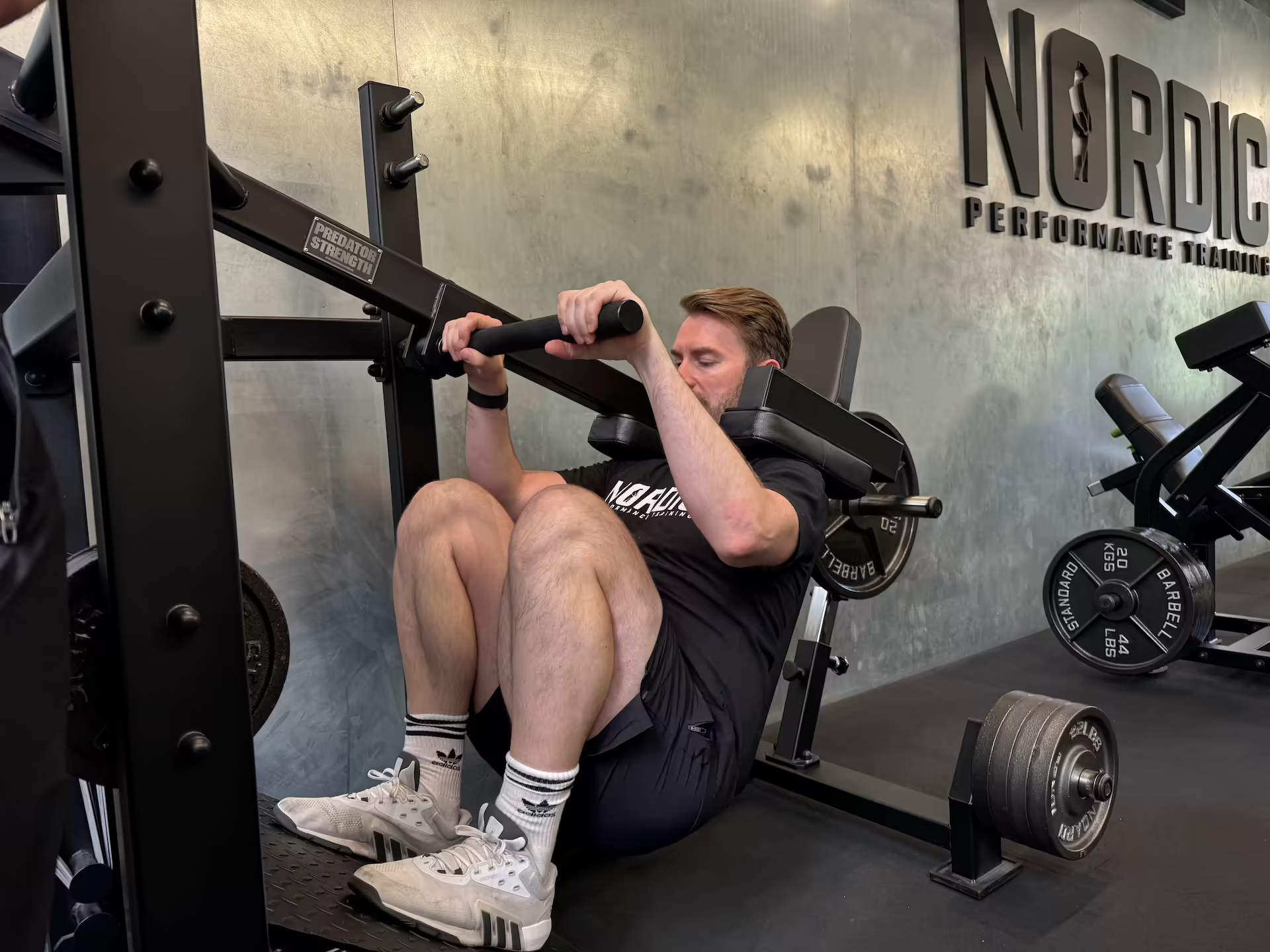
Squat variations (Hack squat, Split squat, Pendulum Squat): When you squat, you perform isometric plantarflexion in a bent knee position — precisely the position you're in when you run. You therefore train the calf musculature, quadriceps, glutes, and inner thighs simultaneously, in a functional position. During a squat, the calf constantly presses against the surface to keep you stable, without the ankle moving. The static muscle work this creates is particularly relevant for runners. The inner thigh muscles (adductors) are incidentally a muscle group most people don't think about in connection with running — until they get pain in them or their attachment either in the groin or close to the inside of the knee.
Leg curls: Strong hamstrings are crucial for running — they brake the leg in the swing phase and drive you forward at push-off. Weak hamstring musculature increases the load on other structures, including the shin.
Leg extension: Isolated quadriceps training. Quadriceps plays a central role in absorbing impact at foot strike.
Glute bridge: Strong glutes stabilise the entire lower extremity and reduce the load down through the kinetic chain to the shin.
You might notice that we don't include isolated calf raises or tibialis anterior exercises. These are popular exercises that you can certainly supplement with if you want. But our experience is that they're rarely necessary when the squat variations already train the calf isometrically in the relevant position. Our concept is simplicity, done consistently over time.
The point is not that you should do all these specific exercises every time. The point is that structured strength training of the entire body like our Full Body program — typically 1-2 times per week — builds the capacity that makes you resistant to shin splints, and all other overuse injuries, in the future.
The progression follows our double progression method: you work your way up in repetitions with the same weight, and when you reach the top of the repetition zone in all sets, you increase the weight. That's how the bone and muscles adapt over time.
"The best thing you can do as a runner is to combine a structured cardio program with strength training 1-2 times per week. It's the combination we see gives the best results — both for preventing and treating shin splints." — Lucas Iversen, physiotherapist
How to prevent shin splints
Prevention is about respecting the body's adaptation time and building sufficient capacity:
Gradual increase of running volume: You may have heard about the "10% rule" — that you shouldn't increase your weekly running volume by more than 10%. The truth is that despite being a good rule of thumb, it's more myth than evidence. Studies show that the risk of injuries isn't significantly different between groups that follow the 10% rule and groups that increase faster — as long as the progression is gradual.
What is better documented, however, is to avoid sudden jumps in the distance of your runs. A large study with over 5,000 runners showed that the risk of overuse injuries increased markedly when a single run was more than 10% longer than the longest run in the preceding 30 days. In other words: Spread the volume out over the week rather than putting all the extra kilometres in one long Sunday run. And have a fixed structure where you increase steadily.
Strength training 1-2 times per week as a supplement to running. As personal trainers in Copenhagen, we've seen it again and again: runners who include strength training in their weekly routine come through training blocks both stronger and experience fewer overuse injuries — not only shin splints, but also things like knee pain and back pain.
"I strength train 1x per week with my personal trainer at Nordic Performance Training. No fancy exercises, just structured strength training with good machines. That's what keeps me injury-free, so I can train what really matters to me." — Kristoffer Buus Langkilde, IRONMAN 70.3 Oceanside, 4:23:24

Variation in loading: Alternate between hard and soft surfaces and vary the pace you run at. Not all runs should be as fast as possible.
Sensible footwear: Shoes that fit your feet and your running style. This doesn't mean you need to buy the most expensive or most advanced pair — it means the shoes should be comfortable and feel good for you.
Listen to the signals early. Mild soreness after running is not a catastrophe signal. But if it comes back multiple times, it's worth adjusting the load — before it develops.
If you follow a structured running program, you naturally build a gradual progression into your training.
When should you see a doctor?
Most cases of shin splints respond well to adapted loading and strength training. But there are some situations where you should get a medical assessment:
Suspicion of stress fracture. The difference between shin splints and a stress fracture is important to know. With shin splints, the pain is diffuse over an area of at least 5 cm. With a stress fracture, the pain is typically localised to one very specific point — under 5 cm — and can wake you at night or hurt even at rest. If you experience precisely localised pain that doesn't subside with rest, or if you have pain when standing on one leg and hopping, you should get it examined.
The pain doesn't subside. If you've given an adapted approach 2-4 weeks and don't see any improvement — or if it worsens — it's worth having a professional assess it.
You have risk factors for reduced bone density. Low energy intake, menstrual disturbances, previous stress fractures, or low vitamin D/calcium can increase the risk of stress fracture and require special attention.
Chronic shin splints. If you've had the problem for months despite an adapted approach, a thorough assessment can help identify contributing factors.
FAQ About Shin Splints
What should you do about shin splints?
Reduce the load to a tolerable level, supplement with cross-training like cycling or swimming, and introduce strength training of the lower body 1-2 times per week. Rest alone rarely solves the problem — it removes the symptom but not the cause. Gradual progression based on how the body responds is the key. The load is both the cause and the cure — it's about adjusting the dose, not stopping.
How long does it take for shin splints to go away?
With an active, adapted approach, most experience marked improvement within 4-8 weeks. Milder cases can be gone in 2-4 weeks, while more pronounced cases can take 3-6 months. The duration depends more on how systematically you adjust your load and include strength training than on how long you rest.
Can you massage shin splints away?
No. Massage can feel nice and provide short-term relief, but it doesn't change the course of the condition. The problem sits in the bone itself and its adaptation capacity — not in the muscles. Use it as a supplement if it feels good, but it should not replace adapted loading and strength training.
Is Voltaren good for shin splints?
Not as a first choice. Voltaren and other NSAIDs can dampen the pain short-term, but research suggests they can inhibit the bone's ability to adapt to load and potentially increase the risk of stress fracture with prolonged use. Talk to your doctor — but know the side effect so you can make an informed choice.
Can you run with shin splints?
Yes, often — and it's actually part of the solution. Short, slow runs within a tolerable pain interval are often fine and even beneficial. The body adapts to load, but only if it's exposed to it. If the pain worsens during running or lasts long after, the dose should be reduced — not removed.
Is shin splints dangerous?
No, not in itself. But if you ignore it and continue to load at the same level, it can develop into a stress fracture — a more serious condition that requires longer rehabilitation. Adjust the load early, and you'll get through faster.
Can a rolling pin help against shin splints?
Not as treatment. A rolling pin on calves and the arch of the foot can feel nice and provide short-term relief, but it doesn't change the actual condition. Use it as a supplement — the primary approach is adapted loading and strength training.
Ready to get through your shin splints?
If your shin hurts and you're tired of the cycle — run, pain, break, run, pain, break — we understand it well. It's frustrating.
But you don't need to wait for it to disappear on its own. And you don't need to guess your way forward.
Book a free start-up conversation and find out how personal training in Copenhagen could work for you — either in our private gym or as a call, if that suits you better.
References
Moen, M. H., Tol, J. L., Weir, A., Steunebrink, M., & De Winter, T. C. (2009). Medial tibial stress syndrome: a critical review. Sports Medicine, 39(7), 523-546. https://doi.org/10.2165/00007256-200939070-00002
Winters, M., Eskes, M., Weir, A., Moen, M. H., Backx, F. J. G., & Bakker, E. W. P. (2013). Treatment of medial tibial stress syndrome: a systematic review. Sports Medicine, 43(12), 1315-1333. https://doi.org/10.1007/s40279-013-0087-0
Winters, M., Burr, D. B., van der Hoeven, H., Condon, K. W., Bellemans, J., & Moen, M. H. (2019). Microcrack-associated bone remodeling is rarely observed in biopsies from athletes with medial tibial stress syndrome. Journal of Bone and Mineral Metabolism, 37(3), 496-502. https://doi.org/10.1007/s00774-018-0945-9
Staab, J. S., Kolb, A. L., Tomlinson, R. E., Pajevic, P. D., Matheny, R. W., & Hughes, J. M. (2021). Emerging evidence that adaptive bone formation inhibition by non-steroidal anti-inflammatory drugs increases stress fracture risk in physically active populations. Experimental Biology and Medicine, 246(9), 1104-1111. https://pmc.ncbi.nlm.nih.gov/articles/PMC8113733/
Nielsen, R. Ø., Bertelsen, M. L., Ramskov, D., et al. (2025). How much running is too much? Identifying high-risk running sessions in a 5200-person cohort study. British Journal of Sports Medicine. https://pubmed.ncbi.nlm.nih.gov/40623829/
Table of Contents
Related Blog Posts


I’ve worked as a personal trainer for over 14 years and as a physiotherapist for over 8 years — and co-founded Nordic Performance Training with Kasper to give clients a professional, private, and structured training environment where results actually last. In that time, I’ve overseen more than 15,000 sessions and helped hundreds of clients rebuild after injuries, gain strength, improve their health, and stay consistent.
My approach combines practical experience with evidence from the latest research, making training both effective and realistic.
On this blog, I share the same methods we use every day at Nordic — so you can cut through the noise and focus on what truly works.



Related Blog Posts
.svg)