









Whiplash: Symptoms, Treatment and Exercises
Christina, 48, nurse from Amager, was sitting in queuing traffic in the inner city when it happened. She was standing still. The car behind her came toward her at 30-40 km/h and hit right into the back of her car. The collision itself wasn't violent. But the shock was enormous — and it was the classic whiplash the body reacts with when the neck is suddenly thrown rapidly back and forth.
At the scene of the accident, she didn't really feel the pain. The adrenaline compensated. It was the next morning she woke up with severe neck pain, stiffness, and headache. She went to A&E, where she got X-rays and later an MRI. Both looked normal. She was told it "was a classic whiplash" and that it should go away on its own. She was advised to take it easy, avoid loading the neck, and use painkillers as needed.
The following weeks were hard. Headache, dizziness when she lay down, concentration difficulties. Sleep was disrupted because the neck couldn't find a comfortable position. She went on sick leave from work — as a nurse, the job was too physically demanding for her to continue. And without fully realising it, she gradually began to avoid more and more. She didn't turn her head quickly. She didn't lift anything heavy. She was afraid that the next wrong movement would "start it over."
She was referred to a private physiotherapist via the public health insurance card. There she started a program with resistance band exercises, gentle mobilisation, home exercises, and manual treatment. It helped. A little. The first months she noticed gradual improvements, and she returned to work on reduced hours. But after 3-4 months, it stalled. She was still plagued by recurring headaches — particularly late in the day — and a baseline tension in the neck and shoulders that wouldn't let go.
When nine months had passed, she was losing faith. She was afraid this was her new normal. She especially missed the feeling of being strong — as a nurse, she was used to having a physically robust body that could handle long shifts, lifting patients, and managing the pressure. That was the body she wanted back. She also missed playing tennis, which she hadn't dared since the accident.
That was approximately where she found her way to us.
The first thing we said to Christina was something she hadn't been told anywhere else: That her problem at this point — nine months after the accident — was no longer primarily the whiplash itself. It was what typically comes after a whiplash: a neck and upper body that had been protected for too long, a nervous system that had learned to be on guard, and reduced physical capacity and belief in her own abilities. It's not unusual. And it's something that can be changed — but not with more resistance band exercises and manual treatment. It needs to be changed with loading that gradually builds the strength and confidence that have been missing.
Christina could find time in her calendar for one weekly session. Which is also enough, if it's the right kind of training. We put her on our regular full body program and adapted the load to what she could tolerate. No special "whiplash exercises." No hyperfocus on the neck. Just structured strength training that trained her entire body — including the muscles around the neck, shoulders, and upper back that had been too little used in the months after the accident.
After six months with one weekly session, Christina was completely pain-free. No headache. No neck tension. No fear of relapse. And most importantly of all: she had begun planning her return to tennis.
"What we see again and again with clients like Christina is that what started as a perfectly ordinary whiplash becomes something else if the body is considered fragile over a long period. The whiplash itself, the vast majority recover from — but it's the prolonged caution that's often the real problem, which leads to chronic pain and weakness. Most people don't need more protection. They need to feel strong again. And you only get that by loading the body — gradually, systematically, and in a way where you can feel progress from week to week." — Mathias Busk, personal trainer & physiotherapist
What is whiplash?
Whiplash — or in professional terminology Whiplash-Associated Disorder (WAD) — is a collective term for the symptoms that arise when the neck is suddenly thrown rapidly back and forth. It's not a specific injury to one particular structure. It's a mechanism that can irritate muscles, tendons, ligaments, and nerves throughout the neck and upper body region.
The classic scenario is a car accident where you're hit from behind. But whiplash can also occur from falls, contact sports, combat and martial arts, mountain bike accidents, horse riding, or even a sudden head movement. It's the mechanics that make the difference — not the context.
The medical system grades whiplash into four categories (WAD I-IV):
WAD I: Pain and stiffness in the neck without objective findings. By far the most common.
WAD II: Neck pain with tenderness and limited range of motion.
WAD III: Neck pain with neurological deficits (weakness, numbness, reflex changes).
WAD IV: Fracture or dislocation in the neck — requires acute medical assessment.
The vast majority of cases are WAD I-II, and the prognosis is good. The Danish Medical Handbook's own assessment is that the course is benign for the vast majority, and that symptoms typically subside gradually and disappear within a few months.
Symptoms of whiplash
The typical symptoms are:
- Neck pain and stiffness
- Headache — often from the neck and upward
- Dizziness, particularly with head movements
- Pain in the shoulders and upper back
- Reduced range of motion in the neck
- Fatigue and concentration difficulties
- Sleep disturbances
One of the most characteristic features is that the symptoms often come delayed. It's not unusual to not feel anything particular on the day of the accident itself, and then wake up with severe symptoms 24-72 hours later. This is due to a combination of adrenaline at the time of the accident and inflammation that builds up in the hours after. It's not a sign that the injury has worsened — it's how the body typically reacts.
Long-term symptoms and late effects
This is the part that often frightens people the most. We'll go through it completely honestly and transparently.
For the vast majority — around 90 percent — whiplash is a self-limiting condition where symptoms subside gradually over weeks and months. The Danish Health Authority estimates that around 10 percent experience persistent symptoms more than six months after the accident.
But here's the important nuance: The strongest predictors of long-term symptoms are not how violent the accident itself was or the physical findings on the MRI scan. It's the psychosocial factors — fear of movement, catastrophising, prolonged immobilisation, and an experience of not getting help to move forward. The Danish Medical Handbook mentions it itself: heavy manual work, fear of serious injury, and expectation of functional loss are moderating factors that affect the course.
This doesn't mean that long-term symptoms are imagined. The pain is completely real. It means that the factors we can actually change — movement, strength, trust in the body, and the understanding of what's happening — are some of the strongest tools we have to turn the course around.
Christina is a good example. Nine months after the accident, what was keeping her stuck in the symptoms was not the original trauma. It was everything that had come after.
Can whiplash be seen on scanning?
No, most often not. MRI and X-ray are typically normal after a whiplash. That's a source of frustration for many — particularly when you're feeling bad, and the scan can't "confirm" it.
But here it's important to understand: The absence of findings on an MRI doesn't mean the pain isn't real. It means it can't be seen as a structural injury on the scanning methods we have available. It's the same point we know from osteoarthritis, disc prolapse, and a wide range of other conditions: structural findings and pain experience are two different things.
It also means that scanning rarely changes the treatment. If you have symptoms that follow the typical whiplash pattern, and the neurological tests don't raise suspicion of anything serious, then the answer is the same regardless of what the scan shows: gradual movement, gradual loading, and over time strength training. An MRI is primarily relevant for ruling out serious injuries — not for "confirming" whiplash.
Treatment of whiplash
The most important point first: Early mobilisation and gradual return to normal activity is the foundation of the treatment. It's not rest, recovery, and caution.
That's precisely what both the Danish Medical Handbook and international guidelines point to. A neck collar and rest are advised against — there is no documented effect, and use of a neck collar can in most cases prolong the symptoms. The classic message of "spare the neck" has now been replaced with "stay active within what you can tolerate."
For clients like Christina — who come to us after months or years with persistent symptoms — the point is slightly different. The acute phase is long since over, and the primary problem is no longer the whiplash itself. It's the reduced capacity, the fear of movement, and the nervous system that has learned to be on guard. The treatment that works here is the same fundamental approach — just with emphasis on systematic strength building.
With us, we work from the same principles as we do with other prolonged problems:
Understand what it is, and what you can expect. The first thing we do is give an honest explanation. Whiplash is for most a self-limiting condition. Symptoms subside over weeks and months. And the few percent who develop prolonged symptoms still have a good chance of returning to a completely normal everyday life — with the right approach.
Keep moving. Movement is not harmful to a neck that has been subjected to a whiplash. On the contrary, it's part of what makes the course go faster. Walk, train, turn your head, and generally live as normally as possible — even if it feels uncomfortable at first.
Build strength in the entire body, but especially the upper body and neck. That's where the long-term gain lies. A strong upper body and neck distributes the load better in everyday life, reduces the persistent tension, and makes you more robust against relapse.
Why it needs to be strength training — not just mobilisation
This is the point we'd like to hold on to, because it's what separated Christina's course with us from what she had been through before.
Mobilisation, resistance band exercises, and manual treatment can be fine for some. They keep the neck moving, perhaps dampen the symptoms, and provide short-term relief. But they don't build capacity and confidence. And your physical capacity and belief in your own abilities is what ultimately determines whether your body can handle everyday demands.
When you've spent nine months with periodic symptoms, light exercises, and manual treatment — and you still feel bad — it's not because you've received the wrong pain relief. It's because the body has lacked a stimulus that makes you stronger. That's what structured strength training solves.
Massage and passive treatments
Massage can feel nice and provide short-term relief in the neck and shoulders. It doesn't do any harm, and if it feels good, use it. But it doesn't change the underlying problem and should not replace the primary approach — gradual movement and strength training.
Exercises for whiplash
As with all the other conditions, we don't have a special "whiplash protocol." We have a full body program that we adapt to the individual client. For clients like Christina, these exercises are particularly central:
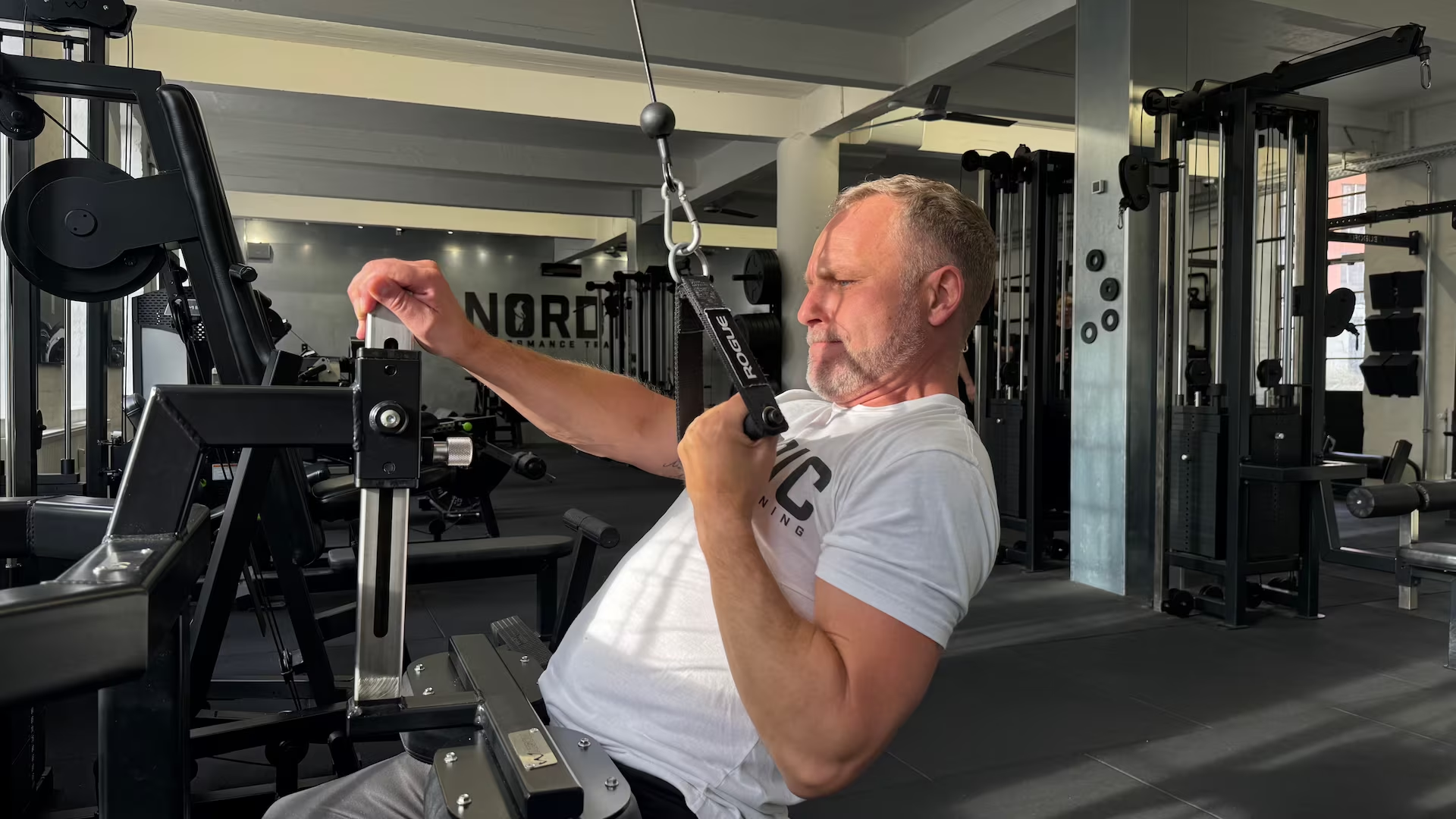
Cable Pulldown is one of the most fundamental exercises in our program. It trains the entire back's musculature effectively in a controlled path with high stability and easily adjustable weight.
Chest Press builds strength in the chest, shoulders, and triceps in a very stable position. For whiplash clients, it's a very relevant exercise because it demands that the chest, neck, and shoulder girdle work together to complete the movement.
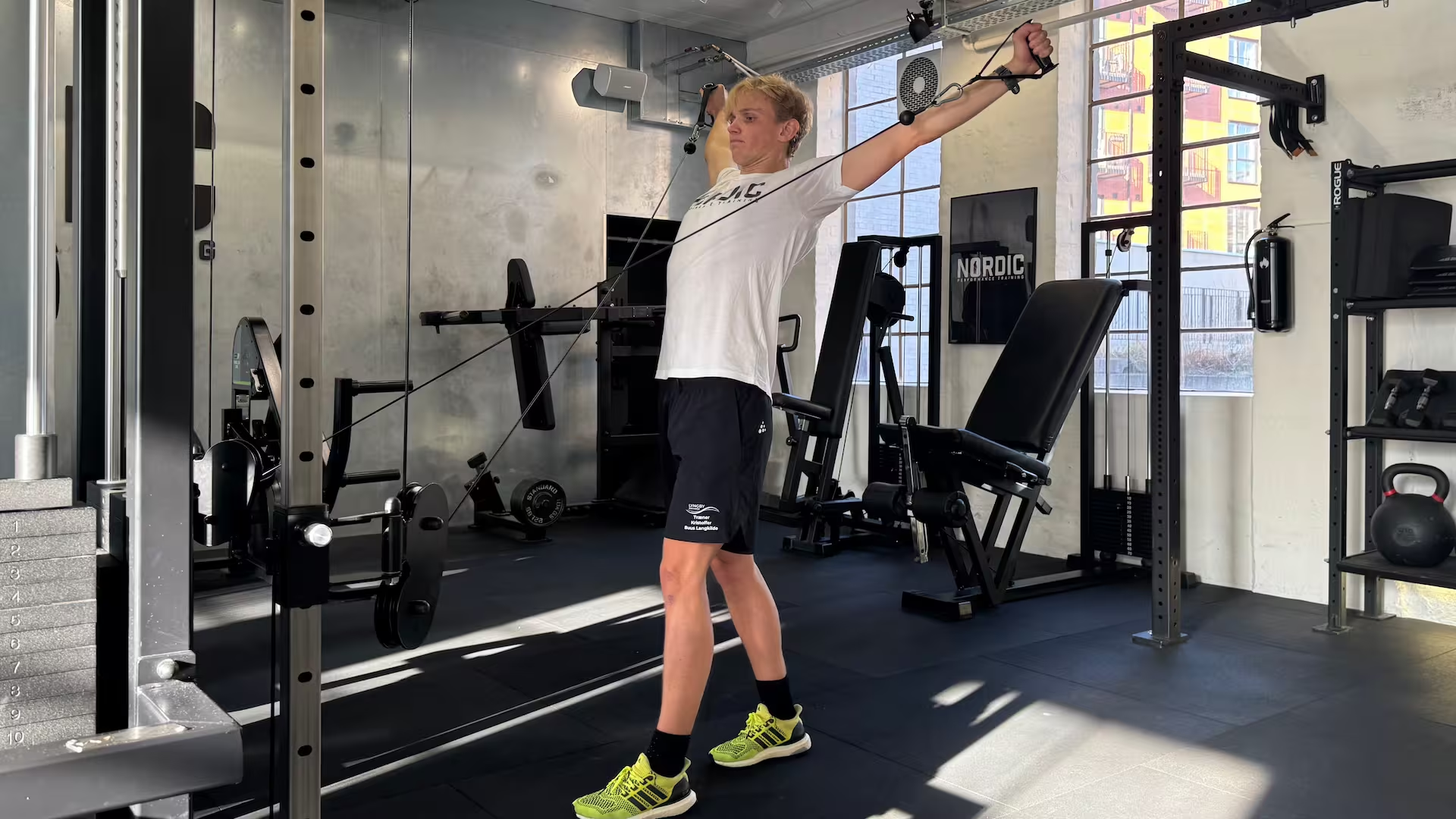
Dumbbell Lateral Raise builds strength in the shoulders' lateral heads and trapezius. For whiplash clients, it's a really important exercise because it strengthens precisely the muscles around the shoulder blade and neck that are typically weakened after longer periods of cautious behaviour.
Hack Squat, Pendulum Squat, or Split Squat is the core of the lower body part of the program — we choose the variant that suits the individual client best.
Lying Leg Curl or Seated Leg Curl isolates the hamstrings and is an important complementary exercise to the squat variants.
These two lower body exercises have nothing directly to do with whiplash. But they're an important part of getting the entire body to feel strong again — and a strong body is a body that's less on guard.
There's also a more concrete physiological reason we prioritise lower body training, even with upper body problems like whiplash: strength training is analgesic — also when it's performed in a completely different part of the body than where it hurts. That phenomenon is called exercise-induced hypoalgesia, and it's well-documented in modern pain research. A session of strength training reduces pain sensitivity for up to 30 minutes after — both in the trained muscle and in the rest of the body. This means that if you with your whiplash symptoms can perhaps only manage 3-4 sets of cable pulldown, chest press, and lateral raise in terms of what the neck and shoulders can tolerate, you can easily add another 3-4 sets of leg exercises on top. This gives you both extra capacity in a part of the body that doesn't hurt — and an additional analgesic effect in the part that does.
In some cases, we add an extra exercise for the upper back — typically Cable Row or a cable Y-raise — if there's a need for extra focus on the upper back musculature. But for the vast majority of clients with whiplash, our classic full body program is sufficient.
We use double progression: you work your way up in repetitions with the same weight, and when you hit the top of the repetition range in all sets, you increase the weight. It's the simplest and most sustainable way to ensure you actually get stronger over time.
When should you see a doctor?
Most cases of whiplash improve over weeks and months with an active approach. But some situations require medical assessment — particularly in the acute phase after the accident:
Acute — seek a doctor or A&E immediately for:
- Severe headache, nausea, or vomiting after the accident
- Visual disturbances or double vision
- Changes in consciousness, memory loss, or confusion
- Severe radiating pain, numbness, or weakness in the arms or legs
- Loss of control of bladder or bowel
These symptoms can indicate a more serious injury — head injury, nerve involvement, or in rare cases fracture — and should be assessed immediately.
Get a planned assessment if:
- Symptoms don't subside after 4-6 weeks
- Symptoms worsen instead of subsiding
- New neurological symptoms appear (weakness, numbness, radiation)
- Persistent severe headache or dizziness
If you're in doubt, contact your doctor.
FAQ About Whiplash
What are the symptoms of whiplash?
The typical symptoms are neck pain, stiffness, headache, dizziness, and pain in the shoulders and upper back. The symptoms often come delayed — it's not unusual for them to only become apparent 24-72 hours after the accident. Fatigue, concentration difficulties, and sleep disturbances are also common. How severe it feels doesn't say much about how serious it is.
How long does it take to recover from a whiplash?
For the vast majority — around 90 percent — the symptoms subside gradually over weeks and months and are gone within six months. Milder cases typically improve within a few weeks. The factors that have the greatest significance for how long it takes are not the violence of the accident, but how you act in the time after — how active you stay, how much you dare to move, and how well you understand what's happening.
What can you do about whiplash?
The most effective approach is to stay active within what you can tolerate and gradually build strength in the neck, shoulders, and upper body. That's the opposite of "spare and rest" that many encounter — but it's the one with the best evidence. A neck collar and rest are advised against, as there is no documented effect. Massage and manual treatment can dampen the symptoms short-term but don't address the capacity in the body.
Can whiplash be seen on scanning?
No, most often not. MRI and X-ray are typically normal after a whiplash. This doesn't mean the pain isn't real — it means it can't be seen as a structural injury on the scanning methods we have. Scanning is primarily relevant for ruling out serious injuries like fracture or nerve involvement, not for "confirming" whiplash.
Can you train with whiplash?
Yes, and it's often precisely what solves the problem. The training should be adapted to what you can tolerate, but there's nothing dangerous about loading a neck after whiplash. On the contrary — it's part of what makes the course go faster. If you've had prolonged symptoms, structured strength training is often what actually makes a difference — after months of gentle mobilisation that hasn't.
Does massage help against whiplash?
Massage can provide short-term relief and feel nice, but it doesn't change the underlying problem and should not replace the primary approach: gradual movement and strength training. Use it as a supplement if it feels good — not as treatment.
What are late effects after whiplash?
Around 10 percent experience symptoms lasting longer than six months — that's what's often referred to as late effects. The most common are persistent neck pain, headache, fatigue, and concentration difficulties. The risk of prolonged symptoms is closely connected to how worried and inactive you are in the time after — not to the violence of the accident itself. Structured strength training and an active approach reduces the risk markedly.
Ready to move forward?
If you're struggling with prolonged symptoms after a whiplash and are losing faith that it can get better — then we understand. We see it often, and we have good experience helping clients like Christina get a body that's strong enough that the whiplash no longer takes up space in everyday life.
Book a free start-up conversation and hear how personal training in Copenhagen can look for you — either in our private gym or as a call, if that suits you better.
References
Lægehåndbogen / sundhed.dk. Piskesmældslæsion — whiplash injury. https://www.sundhed.dk/sundhedsfaglig/laegehaandbogen/fysmed-og-rehab/tilstande-og-sygdomme/ryg-nakke-og-bryst/piskesmaeldslaesion-whiplash-injury/
Sterling, M. (2014). Physiotherapy management of whiplash-associated disorders (WAD). Journal of Physiotherapy, 60(1), 5-12. https://doi.org/10.1016/j.jphys.2013.12.004
Carroll, L. J., Holm, L. W., Hogg-Johnson, S., Côté, P., Cassidy, J. D., Haldeman, S., et al. (2008). Course and prognostic factors for neck pain in whiplash-associated disorders (WAD). Spine, 33(4S), S83-S92. https://doi.org/10.1097/BRS.0b013e3181643eb8
Michaleff, Z. A., Maher, C. G., Lin, C. W., Rebbeck, T., Jull, G., Latimer, J., Connelly, L., & Sterling, M. (2014). Comprehensive physiotherapy exercise programme or advice for chronic whiplash (PROMISE): a pragmatic randomised controlled trial. The Lancet, 384(9938), 133-141. https://doi.org/10.1016/S0140-6736(14)60457-8
Table of Contents
Related Blog Posts


I’ve worked as a personal trainer and physiotherapist for many years and I bring a calm, professional presence to every session, helping people feel comfortable and confident in the gym no matter their starting point.I help my clients build structure and consistency and the habits that drive real, lasting progress.
My approach is clear, effective, and sustainable, and I have extensive experience helping clients train safe and effectively with pain.
On this blog, I share the same practical methods we use at Nordic every day — so you can train with confidence and keep moving forward.




Related Blog Posts
.svg)