








Runner's Knee: Symptoms, Exercises and Treatment
Sabrina, 31, project manager from Amager, had started training toward her first half marathon. She had always run a bit, around 10 km per week, but when she signed up for her first half marathon, she increased to 30 km per week over four weeks.
The pain set in during a run around km 7. A sharp, precisely localised pain on the outside of the right knee. She limped home. A couple of days later, when she attempted an easy run, the pain returned already at km 5.
She did what most people do. She foam rolled the IT band every evening. She stretched hips and thighs. She bought new running shoes recommended by a sports shop. She took 14 days off. And when she started running again, the pain returned exactly as before.
She began to google. She read our client stories and Google reviews from others with similar experiences. That's how she found us.
The first thing we explained to Sabrina was that her IT band can't be stretched out. It's a piece of connective tissue, not a muscle. Foam rolling and stretching can feel nice, but it doesn't address the actual problem. Her runner's knee was not a "tight IT band" — it was a capacity problem. Her hips and glutes weren't strong enough for the load she was suddenly demanding of them.
We built hip and glute strength gradually. She trained 1x weekly full body with us. We reduced her running volume briefly while the strength training got underway, and then increased it gradually again in combination with the weekly strength training.
After 8 weeks, she ran 10 km pain-free. After 14 weeks, she completed her half marathon in 1:54.
"We see this story often. A runner who is training toward a half marathon, the pain comes on the outside of the knee, and suddenly the entire training plan is in jeopardy. They've foam rolled and stretched for months without it making any difference. And it's not because stretching is wrong — it's just not what solves the underlying problem. What they need to do instead is build strength in the hip and glute area, and within 6-12 weeks most are back to full running volume — without pain. And not only pain-free, you now also have a stronger body to perform better." — Kasper Vinther, personal trainer & physiotherapist
What is runner's knee?
Runner's knee is pain on the outside of the knee, typically caused by irritation or overloading of the iliotibial band — a strong connective tissue structure that runs from the hip down along the outside of the thigh and attaches just below the knee.
It most often affects runners, but also occurs frequently in other physically active people with repeated knee flexions, e.g. cyclists and weightlifters. It's one of the most frequent overuse injuries in runners, and research indicates that up to 14% of running injuries are runner's knee.
It's worth knowing that "løberknæ" in Danish and "runner's knee" in English are not the same thing. In English, "runner's knee" covers patellofemoral pain syndrome (PFPS) — pain in front of or behind the kneecap. In Danish, "løberknæ" is typically used for IT band syndrome (ITBS) — pain on the outside of the knee. The Danish terminology is messy, and it's worth knowing if you've searched around on the internet and ended up with contradictory information.
In practice, "runner's knee" functions as a somewhat loose collective term for lateral knee pain in runners. The important thing is not the specific label — the important thing is the treatment, and it's the same regardless of whether the diagnosis is called ITBS, lateral pain syndrome, or something else.
Symptoms of runner's knee
The classic symptoms are quite recognisable:
- Sharp, precisely localised pain on the outside of the knee
- The pain typically sets in after some time into the run — not from the first step. Often around km 5-10
- Worse when running downhill
- Worse when going down stairs
- The pain often disappears with rest but returns on the next run
- No swelling, no redness, no warmth
The last point is characteristic and important. Runner's knee is not an inflammatory or traumatic condition. It's overloading. If you have swelling, redness, or warmth in the knee, it's probably something else, and it should be assessed by your doctor.
Why do you get runner's knee?
The short explanation is the same as with nearly all overuse injuries: the demand you place on your body exceeds its physical capacity. The mismatch creates the problem.
The longer explanation is that the IT band doesn't work in isolation. It's controlled and tensioned by the muscles around the hip — particularly gluteus medius and minimus, which stabilise the pelvis every time you plant your foot on the ground during running. If these muscles aren't strong enough for the load you expose them to, the IT band becomes overloaded by compensating. The research is clear here: weakness in hip abductors and glutes is the most documented risk factor for runner's knee.
The classic triggers are very recognisable:
- Rapid increase in weekly kilometre volume (precisely what Sabrina did)
- Sudden addition of intervals or hill running
- New shoes or terrain
- Marathon training with longer runs than the body is used to
It's not a biomechanical fault. It's not because you "run incorrectly" or have "crooked feet." It's a completely normal overloading reaction that occurs when the training load increases faster than the body's capacity to handle it.
Treatment of runner's knee
The most important point first: You don't need to stop running. You just need to adjust the training volume and simultaneously build your strength capacity.
This is precisely the opposite of what many are recommended. The classic approach is: "Take 14 days off and see if it gets better." And of course it gets better — you're not using the body, and you're not doing anything that can provoke the pain. But as soon as you resume your running, the pain returns. You haven't changed anything. You've just pressed the pause button.
The solution is to increase your physical capacity — and simultaneously manage the load wisely along the way.
What works
Strength training of hips and glutes is the single intervention with the best evidence. We gradually build strength in the muscles that stabilise the hip during running — particularly gluteus medius and maximus. That's what reduces the load on the IT band over time.
Load management instead of total rest. We reduce running volume briefly — typically the first 2-4 weeks — so the tissue gets rest while the strength training gets underway. Then we gradually increase running volume again while the strength training continues. If the pain sets in at km 7, then run 5 km. Not 0.
Patience with progression. Most people improve markedly within 6-12 weeks with structured strength training. Often faster than most expect, because they've been doing "treatment" that hasn't worked even after several months.
What doesn't work
Foam rolling and stretching of the IT band. This is the most important point in the entire article. The IT band is very strong connective tissue and not a muscle. Research shows that it's too stiff to be stretched meaningfully — no matter how much you foam roll. It's like trying to "stretch" a rope.
Tape, kinesiotape, and knee supports. Passive interventions. Can provide a slight placebo effect and short-term relief, but they don't build capacity. They're at their best temporary comfort, and not a real solution.
Massage. Same principle. Can provide short-term relief but doesn't make the hip and glute muscles stronger.
Complete rest. As described above — the pause button doesn't solve the underlying problem.
It's not because these things are wrong to use. It's because they're symptom relief, not treatment. The actual problem is capacity, and capacity is built via structured strength training and smart progression — not with your foam roller.
Exercises for runner's knee
We don't have a special "ITBS protocol." We have a structured full body program that builds hip and glute strength as prevention and treatment. For clients like Sabrina, these are the exercises that do by far the most work:
Split Squat trains one leg at a time and places large demands on hip stability — precisely the ability that's typically reduced in runner's knee. It's one of the most functional exercises for runners, because it replicates the single-leg stance that's repeated thousands of times during every run.
Hack Squat or Pendulum Squat are good alternatives to Split Squat — particularly early in the program if the knee pain is pronounced. Both are bilateral exercises, so the stability demand is lower, and they can most often be dosed very precisely in terms of intensity. They provide an easier entry point than Split Squat for clients who can't tolerate full single-leg loading from the start. They target glutes, quads, adductor magnus, and soleus in a controlled movement, and they build the broad lower body strength that makes the rest of the body more robust.
Glute Bridge is the most direct glute exercise in the program. Where the other squat variants target the glutes as part of a broader lower body movement, Glute Bridge is dedicated hip extension with focus on gluteus maximus. It's also one of the most gentle exercises in terms of loading, which makes it ideal early in the program.
Leg Curl trains the hamstrings and contributes to both knee and hip stability. Strong hamstrings help stabilise the pelvis during every landing in running — together with the glute musculature — and are an important part of the overall posterior chain strength that reduces the load on the IT band over time.
Leg Extension isolates the quad musculature and contributes to knee stability during the landing phase in running. It's not directly linked to the IT band problem, but is valuable as part of the overall program to ensure balanced strength in the entire lower body.
These exercises fit easily into our standard full body program. You therefore don't need a separate "Runner's Knee program" — all you need is structured strength training of the entire lower body, with particular focus on hips and glutes.
We use double progression: you work your way up in repetitions with the same weight, and when you hit the top of the repetition range in all sets, you increase the weight. It's the simplest and most sustainable way to ensure you actually get stronger over time. We go more in depth with the method in our article about double progression.
Should you stop running?
Rarely. For most, it's about load management, not total rest.
If the pain sets in at km 7, then run 5 km. If the pain sets in at km 5, then run 3 km. Reduce the volume temporarily and build gradually back up as the hip and glute strength falls into place. But remember: reduced running volume only works if you simultaneously strength train. Otherwise, it's just a smaller pause button, and the pain returns as soon as you increase again.
The only situation where total rest is necessary is with very acute and intense pain — and even then typically only for a couple of days. Prolonged rest is rarely the way forward and is often precisely what has kept runners trapped in a pattern where the pain returns every time they try to run again.
Similar but different conditions
Knee pain in runners can have several different causes. It's worth distinguishing them, because they're treated differently:
If you have general knee pain — pain on the inside, swelling, osteoarthritis, or other symptoms that don't match runner's knee — then read our article about knee pain and knee exercises instead.
When should you see a doctor?
Most cases of runner's knee respond well to structured strength training. But some situations require medical assessment:
- Acute trauma with sudden loss of strength
- Swelling, redness, or warmth around the knee (atypical for runner's knee — can indicate something else)
- Pain that doesn't improve after 8-12 weeks with an active, strength-based approach
- Pain also at rest (atypical for runner's knee)
- Sudden lack of stability in the knee or locking
If you're in doubt, contact your doctor.
FAQ About Runner's Knee
What is runner's knee?
Runner's knee is pain on the outside of the knee in runners, most often caused by overloading of the IT band — a connective tissue structure that runs from the hip down along the outside of the thigh and attaches just below the knee. The pain is typically sharp and precisely localised, and sets in after some time into the run — not from the first step.
How long does it take to recover from runner's knee?
Most people improve markedly within 6-12 weeks with structured strength training of hip and glutes combined with smart load management. Many are surprised at how quickly it goes — because they've previously tried foam rolling, stretching, and rest for months without progress. It's not because the condition is hard to treat. It's because the right treatment is different from the classic one.
Does foam rolling help against runner's knee?
No, not as primary treatment. The IT band is structurally too stiff to be stretched or "loosened" meaningfully with foam rolling. It's connective tissue, not a muscle. Foam rolling can provide short-term comfort, but it doesn't address the actual problem — lack of strength in hips and glutes to handle the load you're placing on the body.
Does it help to stretch the IT band?
No. Research shows that the IT band is too stiff to be stretched meaningfully. It's not like a muscle that can become "tight" and be "loosened." Stretching of hips and thighs can feel good and be nice, but it doesn't address the capacity problem underlying runner's knee.
Does a knee support help against runner's knee?
A knee support or knee strap can provide short-term compression and comfort but doesn't solve the underlying problem. It can be okay as temporary support during running, but it's not a treatment. The long-term solution is to make the hips and glutes strong enough to handle the load.
Does tape or kinesiotape help against runner's knee?
No, not as treatment. Tape can provide a placebo effect and light compression, but there's no evidence that it addresses the underlying cause of runner's knee. As with knee supports, it's passive treatment — the long-term solution requires strength training.
Does massage help against runner's knee?
Massage can provide short-term pain relief but doesn't address the actual problem. It's the same principle as foam rolling — it may feel good in the moment, but it doesn't make the hip and glute muscles stronger, and that's what's needed.
Should I stop running when I have runner's knee?
Rarely completely. Most can continue running in an adapted extent — typically reduced volume for a period while the strength training gets underway. If the pain sets in at km 7, then run 5 km. Complete rest is rarely necessary and doesn't help in itself — the pain typically returns as soon as you resume running if the capacity hasn't been built up.
What's the difference between runner's knee and patellofemoral pain syndrome?
Runner's knee (in Danish) produces pain on the outside of the knee and is caused by overloading of the IT band. Patellofemoral pain syndrome (PFPS) produces pain in front of or behind the kneecap. In English, "runner's knee" is actually PFPS, not ITBS — the Danish terminology is messy. The treatment is partly different, but both conditions respond to structured strength training of hips and glutes.
Which exercises are best for runner's knee?
Compound exercises that build strength in hips and glutes — particularly Split Squat, Hack Squat, Pendulum Squat, Glute Bridge, Leg Curl, and Leg Extension. These fit directly into a standard full body strength training program. You don't need a specific "ITBS protocol" — you need progressive strength training of the entire lower body.
Ready to run pain-free again?
If you've tried foam rolling, stretching, knee supports, new shoes, and rest without luck — and if you've started to fear that your running is in jeopardy — we understand. It's a frustration we've encountered countless times.
It's also a frustration that typically disappears when you experience how quickly it can improve once the right approach is in place. Most of our runners are back to full running volume within 6-12 weeks.
The most important thing is two things. The first: That it's the right, structured strength training — not foam rolling, tape, or knee supports. The second: That it's something you can actually stick with for the rest of your life — so it doesn't come back the next time you increase your running volume.
Book a free start-up conversation and hear how personal training in Copenhagen can look for you — either in our private gym or as a call, if that suits you better.
References
Aderem, J., & Louw, Q. A. (2015). Biomechanical risk factors associated with iliotibial band syndrome in runners: A systematic review. BMC Musculoskeletal Disorders, 16, 356. https://doi.org/10.1186/s12891-015-0808-7
Mucha, M. D., Caldwell, W., Schlueter, E. L., Walters, C., & Hassen, A. (2017). Hip abductor strength and lower extremity running related injury in distance runners: A systematic review. Journal of Science and Medicine in Sport, 20(4), 349-355. https://doi.org/10.1016/j.jsams.2016.09.002
Pavlova, A. V., Shim, J. S. C., Moss, R., Maclean, C., Brandie, D., Mitchell, L., Greig, L., Parkinson, E., Alexander, L., Brown, V. T., Morrissey, D., Cooper, K., & Swinton, P. A. (2023). Effect of resistance exercise dose components for tendinopathy management: A systematic review with meta-analysis. British Journal of Sports Medicine, 57(20), 1327-1334. https://doi.org/10.1136/bjsports-2022-105754
Taunton, J. E., Ryan, M. B., Clement, D. B., McKenzie, D. C., Lloyd-Smith, D. R., & Zumbo, B. D. (2002). A retrospective case-control analysis of 2002 running injuries. British Journal of Sports Medicine, 36(2), 95-101. https://doi.org/10.1136/bjsm.36.2.95
Wilhelm, M., Matthijs, O., Browne, K., Seeber, G., Matthijs, A., Sizer, P. S., Brismée, J. M., James, C. R., & Gilbert, K. K. (2017). Deformation response of the iliotibial band-tensor fascia lata complex to clinical-grade longitudinal tension loading in-vitro. International Journal of Sports Physical Therapy, 12(1), 16-24. https://www.ncbi.nlm.nih.gov/pmc/articles/PMC5294945/
Table of Contents
Related Blog Posts
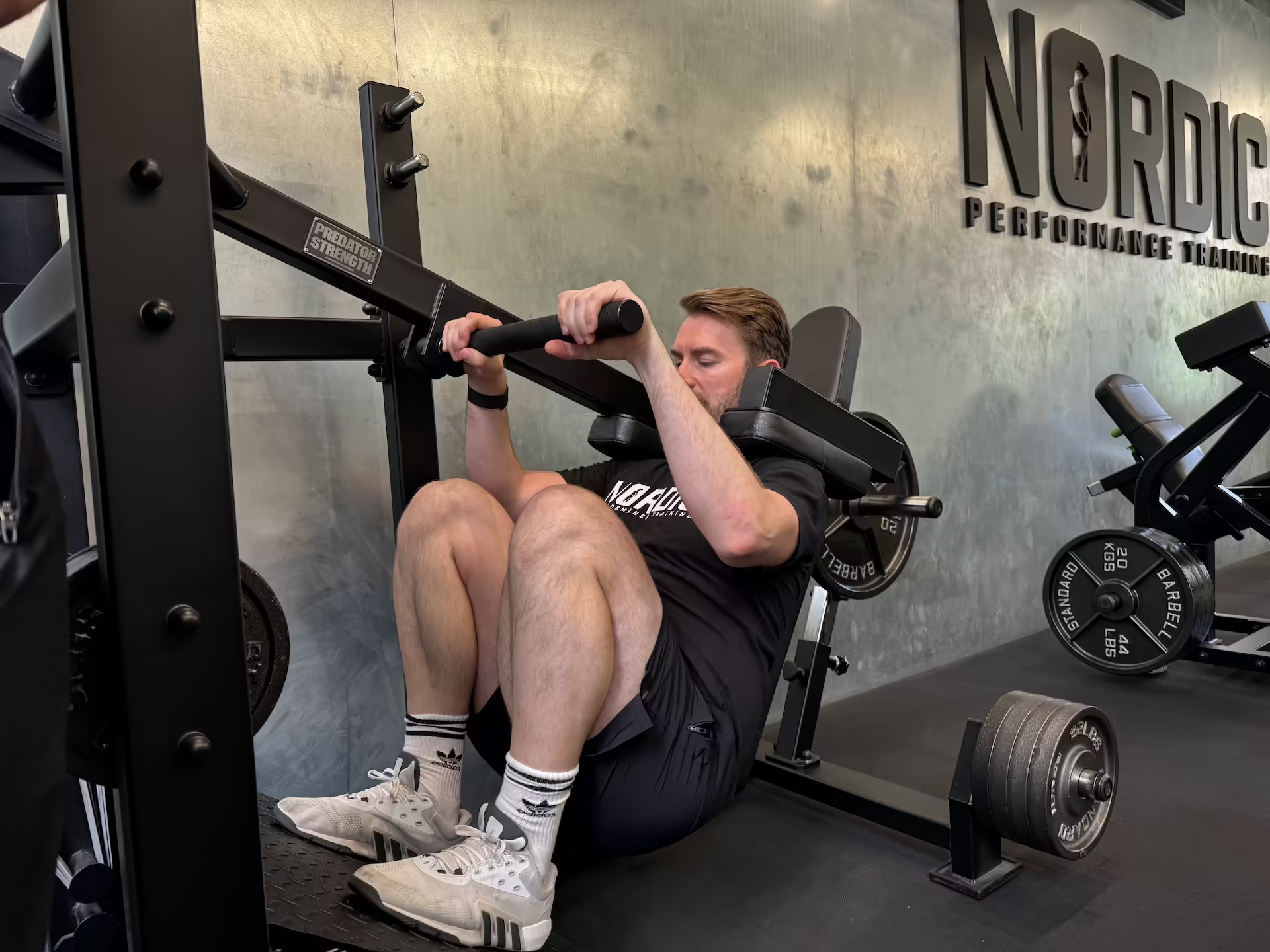


I’ve worked as a personal trainer and physiotherapist for many years and I bring a calm, professional presence to every session, helping people feel comfortable and confident in the gym no matter their starting point.I help my clients build structure and consistency and the habits that drive real, lasting progress.
My approach is clear, effective, and sustainable, and I have extensive experience helping clients train safe and effectively with pain.
On this blog, I share the same practical methods we use at Nordic every day — so you can train with confidence and keep moving forward.



Related Blog Posts
.svg)