








Muscle Strain: Symptoms, Treatment and Exercises
Michael, 36, IT consultant from Amager, had always played football. As a boy and teenager 3-5 times per week. First youth club, later youth elite. In his early 20s, he stopped playing competitively and switched to casual games with friends, 1-2 times per week. In his 30s, it had become even more sporadic and more just a way to stay in touch with the lads than a regular sport. 0-1 sessions per week, mostly if the weather was good and if enough people could participate.
But in his head, he was still 22. Still the fast, explosive player. Still the one who could sprint free and deliver a cross. Everyday life had just shifted — office job of 8-10 hours daily, a few extra kilos on the side, no regular exercise beyond the sporadic matches.
It happened on a Friday evening during a football match. The opponent sent a long ball up the pitch. Michael accelerated to reach the ball first. Explosive push-off on the right leg. And then a "crack" in the calf, so loud the other players could hear it. He lay in the grass and couldn't bear weight on the leg.
At A&E, ultrasound and MRI were performed. The Achilles tendon was fortunately intact, which was their first concern. But there was a serious grade 3 muscle strain in the right gastrocnemius, the outer calf muscle — a complete rupture of a large part of the muscle tissue. He got crutches and a protective boot, was put on sick leave, and given a referral for rehabilitation.
The following week, something happened he hadn't anticipated. He got pain and swelling in the entire lower leg, and he found it harder to breathe. He called the doctor, who sent him straight in. Ultrasound showed a deep vein thrombosis — a blood clot in the leg, probably triggered by the combination of immobilisation, overweight, and the original injury. He was admitted and started on blood-thinning treatment.
That was the moment everything changed for Michael. It wasn't just the calf he needed to get back. Suddenly he was left with an experience of how fragile it all actually was, and how little he had taken his health seriously in the last 10 years.
When the boot came off, he started rehabilitation with a physiotherapist via the public health insurance card after a referral from the doctor. He got exercises with resistance bands, bodyweight heel raises, manual treatment, and gradual return to normal walking. For 3-4 months. He got better, but he didn't trust his body. He didn't dare sprint. He didn't dare jump. He didn't dare play football again. He was afraid it would happen again and that he wasn't strong enough to withstand it.
He began searching for help via Google and various AI search engines. He was looking for someone who could help him get stronger, not just pain-free. That's how he found us.
The first thing we said to Michael was that what he needed wasn't to train his calves in isolation. It was about building the entire body up — lower body and upper body. He needed to make the body he actually had now strong enough for the demands he wanted to place on it. Not just until the next football match, but for many years ahead.
He trained 2 times per week with us for 9 months. A full body program with a clear plan for how he would get stronger, and a concrete progression method that ensured structured progress over time. He knew precisely what was going to happen at every single session. And along the way, we had small conversations about diet and everyday habits — without it in any way becoming a diet plan.
Today, approximately a year after he started, Michael has lost 13 kilos. He's stronger than he has ever been — also as a teenager. He plays football with the lads again 0-1 times per week, just as sporadic and unstructured as before. But that's completely okay, because he has also added something new: 2 weekly runs of 5 km. Not because he loves running. On the contrary. He actually doesn't find it particularly appealing. He does it because he has understood that his body needs to be reminded of how it feels to run. So when Sunday's football match suddenly turns up and sprinting and direction changes are a necessity to participate, the calf and hamstring don't experience it as a shock.
"We see it often. A man in his 30s or 40s who has played football his whole life, and who mentally is still 20 — but who physically has a completely different body now. When the body is then asked to sprint and accelerate, it's not a question of if it goes wrong. It's a question of when. This isn't a problem you solve by stretching or foam rolling. It's a problem you solve by making the body so strong that it can actually handle what you ask of it. And that's a lifelong task — not an 8-week rehabilitation plan." — Lucas Iversen, personal trainer & physiotherapist
What is a muscle strain?
A muscle strain is an acute injury where muscle fibres rupture — partially or completely — typically in connection with a sudden, explosive movement. It's one of the most common sports injuries, and it can happen in all muscles in the body. The most frequent locations are the calf, hamstring, and groin.
It's worth knowing that "strain" and "tear" are often used as different things in everyday language, but they're really degrees of the same thing. Injuries are normally classified into three grades:
Grade 1 — mild: Few muscle fibres are damaged. Local pain and slight tenderness, but the muscle functions largely normally. This is what many call a "strain."
Grade 2 — moderate: A significant portion of the muscle's fibres are damaged. Clear pain, swelling, often a bruise, and clearly reduced function. This is the classic "muscle tear."
Grade 3 — complete rupture: The entire muscle or a very large part of it has ruptured across. Marked loss of function, often an audible "crack," significant swelling and bleeding, and requires medical assessment.
In practice, the treatment is the same for grade 1 and 2: gradual loading, structured strength training, and return to activity as the muscle can tolerate it. Grade 3 requires medical assessment to determine whether surgery is needed.
The typical mechanism is a sudden acceleration, a direction change, a jump, or a kick — movements where the muscle suddenly has to produce a lot of force in a stretched position. That's why muscle strains are so frequent in sports like football, handball, sprint, tennis, and squash.
Muscle strain in the calf
The calf is the most frequent location for muscle strains. The calf consists primarily of these 2 muscles: gastrocnemius (the outer and largest) and soleus (the deep one that sits under gastrocnemius). Most muscle strains in the calf affect gastrocnemius — particularly the inner part, called the medial gastrocnemius.
This is due to anatomy and function. Gastrocnemius crosses both the knee and ankle joint, and it's the explosive calf muscle that contributes most to fast movements like sprinting, jumping, and kicking. When a sudden acceleration is combined with an extended knee and ankle in dorsiflexion (the foot pulled up toward the shin), gastrocnemius is stretched the most — and it's precisely in that position the muscle strain typically occurs.
"Old man's calf"
A popular Danish expression for this injury is "gammelmands læg" (old man's calf), because it often affects men over 40 who suddenly accelerate during sport. It's by no means a disrespectful term — it's a clinically recognisable profile. It's precisely the pattern that hit Michael: a body that's no longer used to explosive movements being asked to do precisely that.
Symptoms of muscle strain in the calf
- Sudden "crack" or "pop" in the calf (classic for gastrocnemius muscle strain)
- Sharp pain in the middle or inside of the calf
- Swelling and possibly bruising, which often seeps downward toward the ankle in the days after
- Difficulty walking on tiptoes or pushing off
- Tenderness when pressing on the injured spot
- In severe cases: a visible indentation in the muscle tissue
Treatment and healing time
The first days we follow the PEACE & LOVE principle, which is the modern successor to the outdated RICE principle. We've written extensively about PEACE & LOVE in our article about sprained ankle, but it's fundamentally about giving the tissue rest the first days, avoiding unnecessary anti-inflammatory medication, and then gradually resuming loading through structured strength training with progressively increased load over weeks and months.
It's the last part that's often missing in classic rehabilitation. We've seen it again and again: a client comes to us after 3-4 months of conservative rehabilitation, where the focus was on rest, icing, light mobility exercises, manual treatment, and bodyweight exercises. The tissue has healed, the pain is gone — but the muscles' capacity is still markedly reduced. The client feels insecure. Doesn't dare sprint, jump, do sport. That's precisely the state Michael found himself in.
Our experience aligns with the research: for grade 1-2 muscle strains, early, gradual loading is better than prolonged immobilisation. In fact, we typically start strength training already a few days after the injury — we just adjust the weight down so the movement stays within a reasonable pain threshold. The important thing is that the muscle gets the signal: you need to work again.
Healing times — readers should have realistic expectations:
- Grade 1: 2-3 weeks to functional return
- Grade 2: 4-8 weeks
- Grade 3: 8-12+ weeks, may require surgical assessment
But here's the most important point: pain-free is not the same as recovered. We'll return to that in the prevention section.
Muscle strain in the hamstring
The hamstring is the second most frequent location for muscle strains. The hamstring musculature consists of three muscles: biceps femoris (the outer hamstring muscle — the most frequently injured), semitendinosus, and semimembranosus (the inner hamstring muscles). Around 84% of all hamstring injuries affect biceps femoris.
The typical mechanism is sprinting, explosive acceleration, or kicking — movements where the hamstring has to produce great force in a stretched position. That's why hamstring injuries are the most documented injury in professional football — in UEFA's large cohort study, the risk has increased by 4% annually since 2001, driven by the elite game becoming faster and more intense.
With us, we see a similar pattern, just in a completely different way. Our clients are not elite athletes. They're completely normal people who often have an office job and aren't particularly physical in everyday life — under 2,000 steps on a work-from-home day is not unusual — but who often play padel, football, tennis, or similar 1-2 times per week. The body lives a generally sedentary life, but when the week's match suddenly turns up, the hamstring is asked to produce maximal force in a split second — precisely what it's least prepared for. It's that mismatch that makes injuries like Michael's so typical.
Martin's profile — the one we see often
Martin, 41, salesman from Frederiksberg, played division football as a young man, stopped competitively at 25, and today plays casual football 1-2 times per week plus a regular veterans' match on Sundays. When he came to us, he had had four grade 1-2 hamstring injuries in five years. Every time the same pattern: 4-6 weeks out → home exercises → back on the pitch → new injury within six months. "I just accepted it as part of getting older," he said at our first conversation. It was his wife who had had enough of seeing him limping around — she was already a client with us and suggested he try us. One year after he started his program with us at 1x weekly full body, he hasn't had a single hamstring injury. He still plays veterans' every Sunday and says himself that he's had a new career as a player.
The re-injury rate — the real problem
This is an area where the research is really clear, and where classic rehabilitation often falls short. Studies of professional football show that hamstring injuries have a re-injury rate of 12-63% — depending on the population. The highest risk is in the first week after return to sport, where 13% of players get a new injury. Cumulatively, 31% of players get a new hamstring injury through an entire season.
And here's the important thing: re-injuries are typically worse than the original injury. They keep people out longer, and they create a pattern where the client becomes more and more afraid of pushing themselves. For an elite athlete, it can mean the end of a career. For our clients, it can mean the end of the sport that gave them energy, social connections, and a feeling of being good in their body — and thereby a loss that reaches far beyond the injury itself.
This pattern — where a mild muscle strain becomes a chronic injury problem — is precisely what we see with clients like Martin. It's not "just how it is when you get older." It's a muscle that doesn't have the strength capacity needed to handle the load it's asked to produce.
We go deeper into why in the following section about the professional trap in mainstream physiotherapy — because this isn't just a hamstring problem. It's a systemic problem in how muscle strains are treated in general.
"We see it often. A guy in his 30s or 40s who has had three, four, five hamstring injuries, and who has started to believe that it's just how it is when you get older. It's not. It's a muscle that doesn't have the strength capacity needed to withstand the explosive loading he still exposes it to. The research is very clear here: heavy strength training of the hamstring is the single intervention with the greatest effect on reducing re-injuries. Not stretching. Not massage. Not resistance band exercises. But heavy strength training." — Kasper Vinther, personal trainer & physiotherapist
Muscle strain in the groin
The groin region is the third most frequent location for muscle strains. The majority of groin injuries involve the adductor musculature — particularly adductor longus — which sits on the inner thigh. The mechanism is typically a sudden sideways movement, a direction change, or a kick where the leg swings out to the side.
Groin injuries are frequent in ball players (football, handball) — but also in runners who suddenly increase the volume or intensity of their training.
Camilla's profile — the one we see often
Camilla, 33, psychologist from Vesterbro, is a keen recreational runner. 3-4 runs per week, primarily at easy zone 2 pace. She began to train more structurally toward a specific time — sub-2 hours on the half marathon — and increased both volume and the amount of tempo and interval training markedly over a short time. She gradually developed increasing groin irritation, thought it was a hip flexor that was a bit tight, and continued running but started stretching extra. Until during an interval session she experienced a "pop" in the groin and had to limp home. She tried rest for two weeks, foam roller, stretching, and light hip exercises from YouTube. It just didn't get better. She googled her way to finding that she should strength train, but she didn't know how. Six months after she started with 1x full body with us, she was pain-free and completed her half marathon at the desired time. She has continued with us because she feels that strength training has made her a better runner — and given her more energy in everyday life.
"This pattern we see often in runners — particularly in women who suddenly increase volume or add a lot of anaerobic work to their running training. The body is used to zone 2 jogs, and suddenly it's asked to do intervals, tempo training, and generally harder runs. It's not a question of running incorrectly. It's a question of having a body that isn't built up for the load it's suddenly asked to handle. And the only way to build it up is through structured strength training alongside the running — not by stretching more or resting a bit." — Mikkel Krause, personal trainer & physiotherapist
We've written more extensively about groin and hip-related problems in our article about hip pain, including the connection between groin and hip.
Why "the magic exercise" is a trap
Before we get to treatment and exercises, it's worth addressing a fundamental trap in mainstream physiotherapy. It's a trap we often see clients fall into — regardless of whether their injury is in the calf, hamstring, or groin.
The classic approach often looks like this:
"Do 3 sets of Nordic Hamstring Exercise to prevent hamstring injuries." "Do 3 sets of Copenhagen Adduction to prevent groin injuries." "Do 3 sets of isometric heel raises to prevent Achilles problems." "Do 3 sets of clam shells to prevent hip problems."
It's a symptom-driven, reductionist approach that ignores a larger and more important truth: a strong body is a robust body. If your hamstrings, glutes, calves, adductors, and entire lower body as a whole are just strong, then you're protected against injuries — regardless of whether it's Nordic Hamstring Exercise, Lying Leg Curl, Romanian Deadlift, or Seated Leg Curl that made them strong. It's the general strength capacity that protects you, not the specific exercise.
The approach with the "magic exercise" is problematic for several reasons:
It disconnects the exercise from the rest of the body. When a client is given three prevention exercises as homework, it signals that the problem is isolated to the specific muscle. But the body doesn't work that way. A hamstring injury is not only a hamstring problem — it's often a symptom that the entire posterior chain (glutes, hamstrings, calves, lower back) doesn't have the capacity needed. A groin injury is rarely only an adductor problem — it's a sign that the entire pelvis-hip system can't handle the load.
It typically underdoses markedly. Three sets of an isolated exercise, done with bodyweight at home without guidance or a clear plan for progression, rarely provides enough stimulus to create adaptations that counteract the risk of re-injury. The client who does 3x10 Nordic Hamstring Exercise as a home exercise for 8 weeks and then returns to football undoubtedly has a better starting point than the person who did nothing — but he hasn't gotten a markedly stronger body that minimises the risk of re-injury significantly. So you could almost say he's been given a false sense of security.
It ignores the most important factor: consistency over time. An exercise done perfectly for 8 weeks and then stopped doesn't work as prevention. It's something that needs to be part of life — as long as you want to do your sport.
What newer research actually says
The classic physiotherapy recommendation has long been the Nordic Hamstring Exercise (NHE). It was validated in a large Scandinavian study in 2011 that showed it can halve the risk of hamstring injuries in amateur players. It's an effective exercise, and the research around it is solid.
But there's a context the mainstream narrative often lacks: NHE became so popular because it doesn't require equipment. It can be implemented broadly in amateur clubs with two players on the grass, where one holds the other's ankles. Most large studies therefore compare NHE with no strength training — not with controlled, heavy, and challenging leg curls or other evidence-based alternatives.
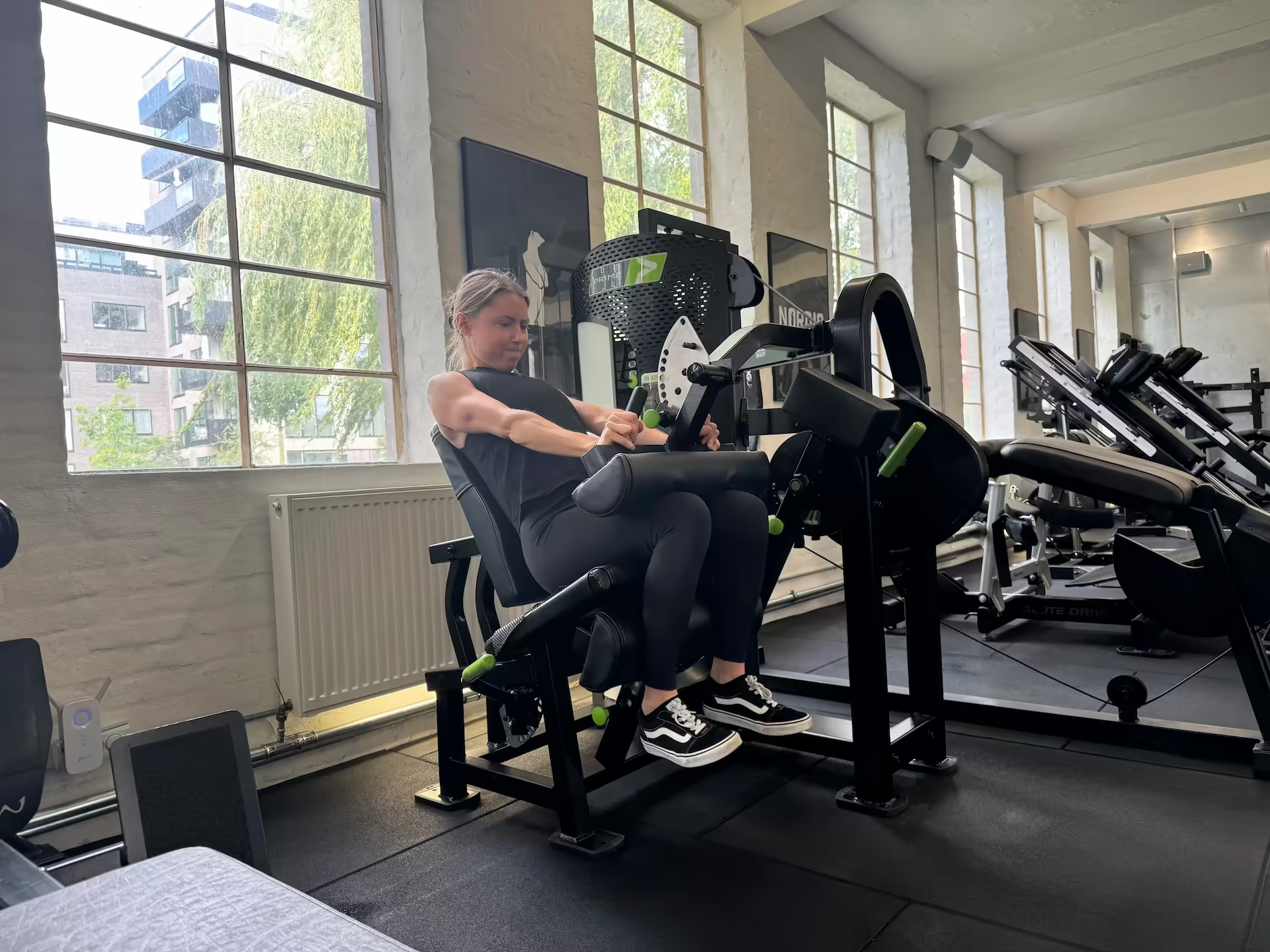
Newer research indicates that challenging working sets of Leg Curl — particularly performed with the hip flexed, e.g. Seated Leg Curl where the hamstrings work in a lengthened position — produces greater adaptations in muscle volume and strength than NHE. A study from 2024 compared Seated Leg Curl with NHE over 12 weeks and found:
- Seated Leg Curl: +18% in total hamstring volume
- NHE: +11% in total hamstring volume
- Seated Leg Curl: +19% in biceps femoris long head — the muscle most frequently injured
- NHE: +5% in biceps femoris long head
That's a significant difference. Seated Leg Curl produced almost four times better growth in precisely the muscle that's typically the main location for hamstring injuries.
It's not the individual exercise — it's the system
The bigger point is this: There is no single "magic exercise" that prevents muscle strains — neither in the hamstring, calf, nor groin. What works is structured strength training performed continuously over time, where the entire body gradually gets stronger year after year.
With us, we see it again and again with clients like Michael, Martin, and Camilla: they've done "proper" exercises during their rehabilitation — Nordic Hamstring Exercise, Copenhagen Adduction, clam shells, bodyweight calf raises. Perhaps even performed correctly. But they've done them in isolation, without a plan for progression, without sufficient intensity, and without the rest of the body getting stronger at the same time. The result is a tendon and a muscle that's perhaps marginally stronger than before — but a body that overall doesn't have the capacity needed to handle the load their sport demands.
Our approach is different. We build the entire lower body up as one coherent unit through a structured full body program. We prioritise heavy, compound exercises performed with 3 sets of 6-8 reps close to muscle failure, and we ensure the client can progress systematically over months and years. Seeing the body in a bigger picture, having a clear plan for progress, and being able to maintain your strength training in the long run. That's what reduces the risk of re-injuries — not a specific exercise done in isolation at home.
Treatment of muscle strain
We work from a basic principle: gradual loading from day one — not prolonged rest and recovery.
The classic approach for muscle strains is PRICE (Protection, Rest, Ice, Compression, Elevation) in the first days, then gradual return to activity over weeks and months. The modern approach is the PEACE & LOVE principle, which we cover thoroughly in our article about sprained ankle. The most important difference is that PEACE & LOVE highlights early optimistic loading and movement over prolonged rest.
For grade 1-2 muscle strains, we have good experience starting strength training a few days after the injury. We adjust the load so the movement stays within a reasonable pain threshold — a light irritation is okay, sharp pain is not. The early loading sends the right signal to the tissue: you need to be strong again.
For grade 3 (complete rupture), the course is different. It's the client type we actually see most often — people who have been through hospital, possibly surgery, immobilisation with boot or cast, and 3-6 months of rehabilitation at a clinic or municipal rehabilitation centre, and who then google their way to specialised help because they feel insecure and afraid of relapse. That was Michael's story, among others, and it's a story we've encountered countless times.
Painkillers and passive treatment
Painkillers can have a place in acute phases, but they're not the treatment. The same applies to massage, stretching, and manual treatment. They're often sold as treatment, but they don't treat anything. They dampen the pain symptoms. But symptom dampening is not the same as healing. And it's not the strength building needed to prevent re-injury either.
It's not because these things are wrong to use. It's because they're not the solution. The solution is to make the tissue stronger.
Exercises for muscle strain
We don't have a special "muscle strain protocol." We use our structured full body training program, which we adapt to the individual client and the specific injury. For clients like Michael, Martin, and Camilla, these are the exercises that do by far the most work:
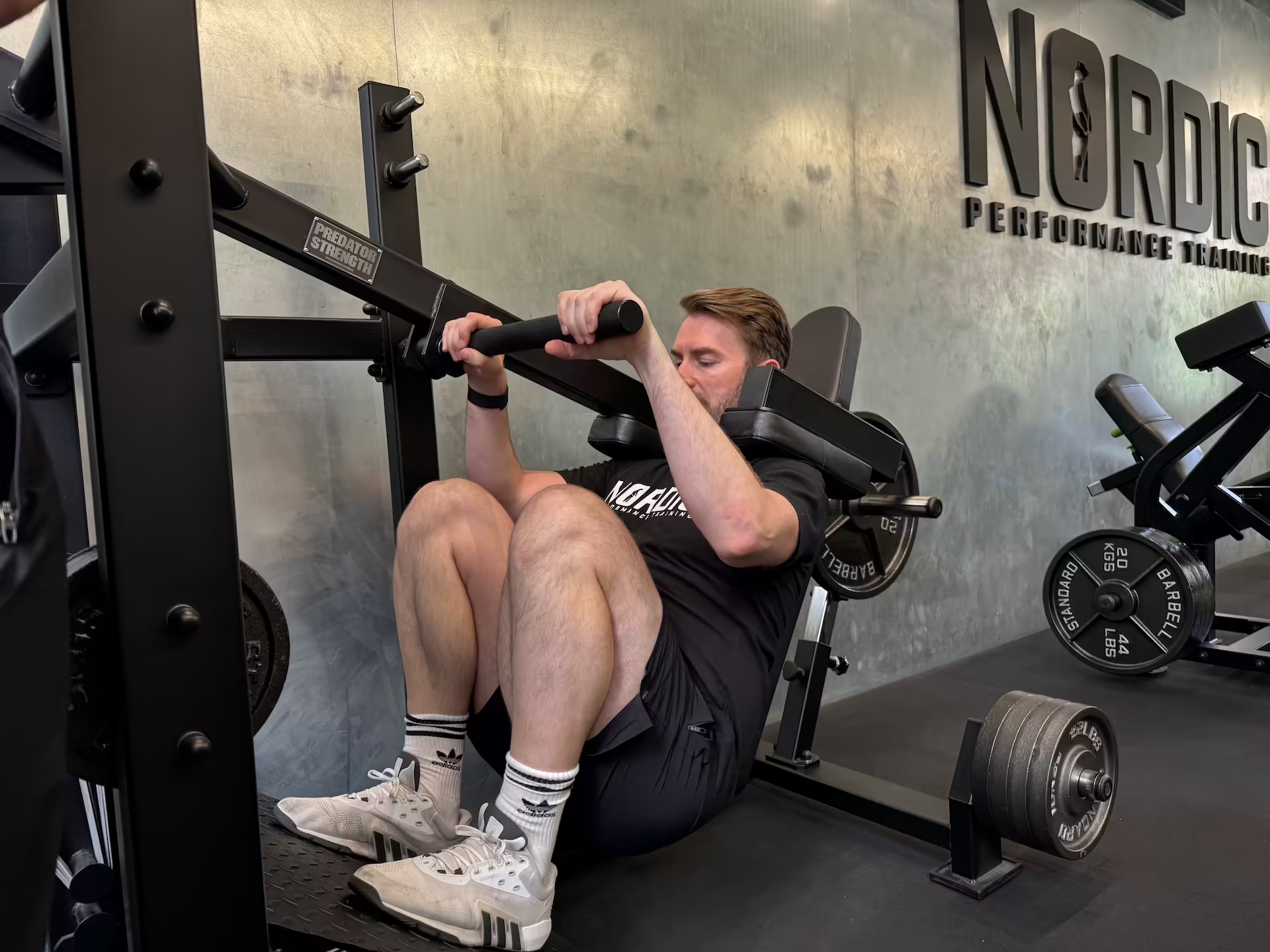
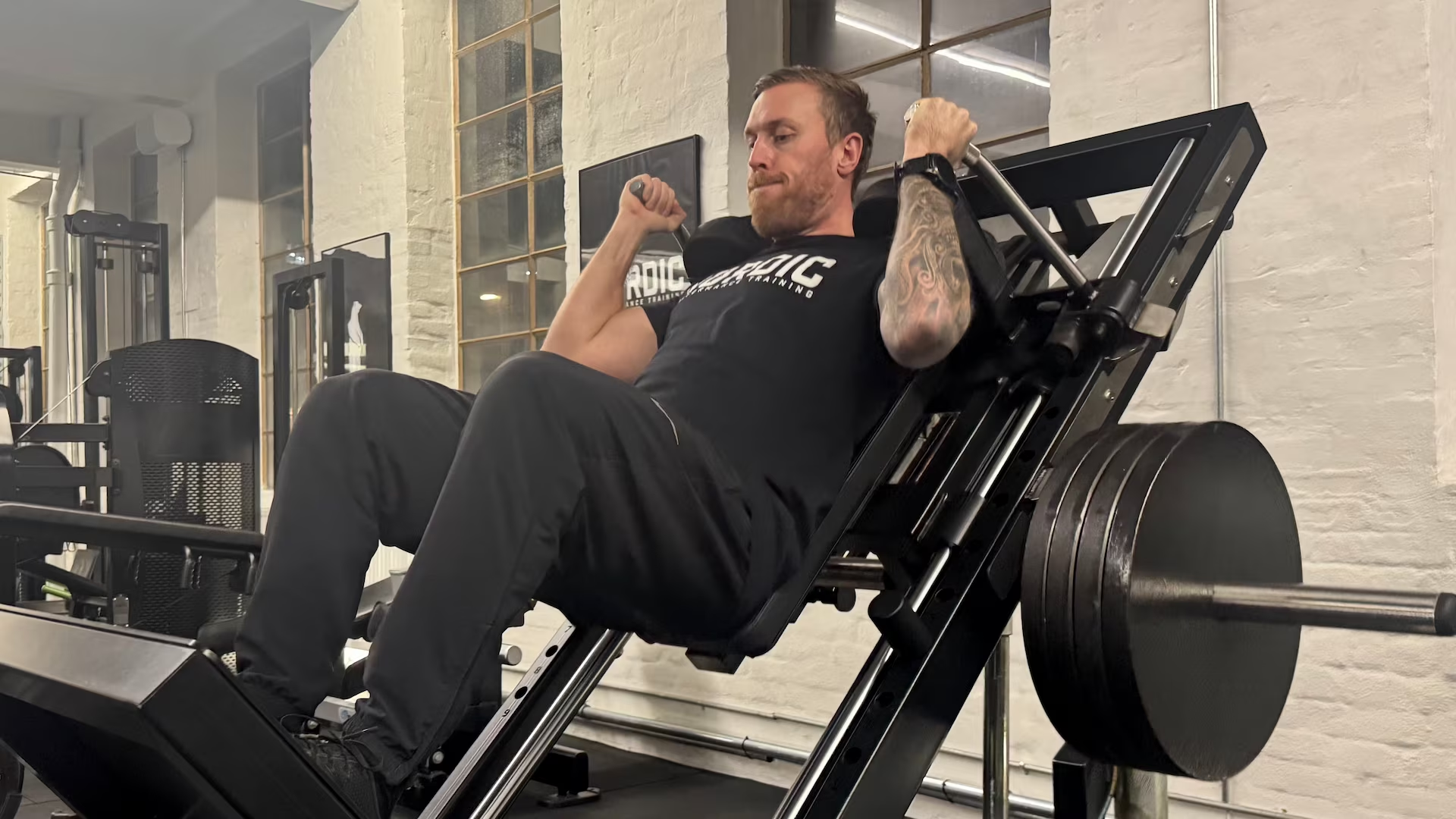
Hack Squat, Pendulum Squat, or Split Squat is one of the primary exercises for the lower body. They all target glutes, quads, adductor magnus (important for groin), and soleus (the deep calf muscle) in a controlled movement with adjustable weight — with small differences between them in how much they prioritise each muscle group. For clients with groin problems, the adductor magnus activation is particularly relevant.
Lying or Seated Leg Curl are the most important individual exercises for the hamstring and the outer calf muscle. They train both the hamstrings and gastrocnemius simultaneously, because gastrocnemius crosses the knee joint and contributes to knee flexion. For clients with both hamstring and calf injuries, leg curl is the exercise that provides the most value per minute.
Glute Bridge targets glutes, hamstrings, and adductor magnus in a gentler version that's ideal early in the program. It builds the glute strength that's crucial for hip stability and thereby reduced loading on the groin and hamstring.
Leg Extension isolates the quad and provides supplementary knee and lower leg stability. It's less directly relevant for muscle strain rehabilitation, but valuable for overall lower body strength.
A typical lower body program with us looks like this:
- 3 sets of 6-8 reps Hack Squat or Pendulum Squat
- 3 sets of 6-8 reps Leg Curl
Then we add upper body exercises — typically Machine Chest Press, Cable Pulldown, and Dumbbell Lateral Raise — so it becomes a complete whole-body session. It's deliberate: we don't want to fall into the reductionist trap we addressed earlier. We're not treating an isolated muscle — we're building a stronger body as a whole.
If deemed relevant, we can add 2-3 sets of Leg Extension and/or Glute Bridge for extra focus on quads or glutes respectively.
A basic program typically takes 50-60 minutes. With Leg Extension and/or Glute Bridge on top, the session becomes 10-20 minutes longer.
We use double progression with all our clients: you work your way up in repetitions with the same weight, and when you hit the top of the repetition range in all sets, you increase the weight. It's the simplest and most sustainable way to ensure you actually get stronger over time.
Prevention — the most important work
This is the section we really want to focus on.
The single biggest factor for prevention of muscle strains — regardless of whether it's calf, hamstring, or groin — is regular structured strength training. The research in the area is consistent: strong muscles are more resilient against sudden overloading, and structured strength training is the most effective single intervention for reducing re-injuries.
The most important point to understand is this: being pain-free is not the same as being sufficiently rehabilitated. You can be pain-free without having achieved the strength capacity needed for your body to handle what you want to ask of it. That's precisely the trap many statistically fall into: 4-8 weeks of rehabilitation, the pain is gone, back to sport — and then a new injury within six months.
Our approach is that strength training is not something you should do until the pain is gone. It's something you should do as long as you want to do your sport. That may sound daunting, but it's actually the most liberating description for most of our clients. It means you can keep playing football, running marathons, climbing, dancing, or whatever you want — as long as you maintain the body.
That's precisely what Michael has understood. His 2 weekly runs are not about becoming a runner. They're about keeping the calf and hamstring accustomed to the loading Sunday's football match suddenly demands. His 1 weekly strength training session is not about becoming a powerlifter. It's about having a body that can handle the life he wants to live for 20 more years.
When should you see a doctor?
Most muscle strains heal well with structured strength training. But some situations require medical assessment:
- Complete rupture (grade 3): You can't use the muscle at all, marked swelling, possibly a visible indentation in the muscle tissue
- Swelling that progressively worsens in the hours or days after the injury
- Pain that doesn't improve after 2-3 weeks despite appropriate unloading
- Bruising that is disproportionately large or spreads rapidly
- Suspicion of deep vein thrombosis (DVT) — particularly important to be aware of with calf injuries and immobilisation. Symptoms: swelling, warmth, and redness in the leg without a clear trauma cause, often with deep tenderness in the calf. This is potentially life-threatening and requires acute medical assessment.
DVT is not a common complication, but it happens. We've had clients ourselves who experienced it, and the consequences can be catastrophic if it's overlooked. If there's the slightest doubt — contact your doctor or A&E.
FAQ About Muscle Strain
What is a muscle strain?
A muscle strain is an acute injury where muscle fibres rupture — partially or completely — typically during a sudden explosive movement like sprinting, jumping, or kicking. It's classified into three grades: grade 1 (mild, few fibres), grade 2 (moderate, significant portion of the fibres), and grade 3 (complete rupture, rare). The most frequent locations are the calf, hamstring, and groin.
How does a muscle strain feel?
A muscle strain typically feels like a sudden, sharp pain in the middle of an explosive movement. Many describe it as a "crack" in the muscle, and some hear or feel it clearly. Afterwards comes swelling, possibly bruising, and reduced function in the affected muscle. It's clearly different from the gradual irritation typically associated with tendinopathy or overuse injuries.
How long does it take to recover from a muscle strain?
It depends on the grade. A grade 1 (mild strain) typically heals in 2-3 weeks. A grade 2 (classic muscle tear) typically takes 4-8 weeks. A grade 3 (complete rupture) takes 8-12 weeks or more and may require surgical assessment. But here's the important thing: being pain-free is not the same as being recovered. The full strength capacity must be rebuilt over months, particularly if you want to return to sport — otherwise the risk of relapse is high.
Can you walk with a muscle strain?
It depends on the grade and location. With a mild grade 1 injury, you can typically walk, perhaps with a slight limp. With a grade 2 in the calf or hamstring, it can be very difficult to walk normally the first days, and crutches may be necessary. With a grade 3, you typically can't bear weight on the leg at all. Generally: if you suspect a larger muscle strain, unload the leg in the first days and seek medical assessment — particularly if there's marked swelling or loss of function.
What's the difference between a strain and a tear?
They're really degrees of the same thing. "Strain" is typically used for the mild cases where few muscle fibres are damaged (grade 1). "Tear" is typically used for the moderate to severe cases (grade 2-3), where a larger part of the muscle is damaged. In practice, the treatment is the same: gradual loading and strength training. The classification is more relevant for setting realistic expectations for healing time.
Can you train with a muscle strain?
Yes, and it's often precisely what gets you back faster. The research is clear: early, gradual loading produces better results than prolonged immobilisation for grade 1-2 muscle strains. We typically start strength training a few days after the injury — we just adjust the load so the movement stays within a reasonable pain threshold. The important thing is that the muscle gets the signal that it needs to become strong again, not that it needs to be protected.
What is "old man's calf"?
"Old man's calf" is a popular Danish expression for an acute calf muscle strain that typically affects men over 40 during sport — particularly during sudden acceleration or explosive movements. It's not a disrespectful term, but a clinically recognisable profile: a body that's no longer used to explosive movements that's suddenly asked to do precisely that. The treatment is the same as for any other calf muscle strain: gradual loading and strength training.
Can you get a muscle strain in the arm?
Yes, muscle strains can occur in all muscles. In the arm, it's most often seen in biceps or triceps during heavy lifts or sudden movements. The principle for treatment is the same as for lower body muscle strains: gradual loading and structured strength training. If there are signs of complete rupture, it should always be assessed medically.
Can you get a muscle strain in the knee?
No. The knee is a joint, so you can't get a muscle strain "in" the knee. But you can get muscle strains in muscles close to the knee joint — in the quadriceps near the kneecap, in the lower part of the hamstring, or in gastrocnemius just behind the knee. These injuries often feel like knee pain and are easily confused with joint injuries. If you have acute knee pain after a trauma with swelling or lack of stability, it should be assessed medically to rule out meniscus or ligament injuries (e.g. ACL or PCL).
Ready to get your body back — and keep it strong?
If you've had a muscle strain and are afraid it's going to come back — or if you have a pattern of repeated injuries you've started to accept as "that's just how it is" — or if you want to make sure it never happens to you — we understand. It's a fear and a frustration we encounter every single week.
It's also a fear that typically disappears when you experience how strong the body can actually become — and how strength training is not just something that helps you back, but something that keeps you going for the rest of your life.
The most important thing is two things. That it's the right, structured strength training — not isolated symptom-relieving exercises. And that it's something you can actually stick with for the rest of your life.
Book a free start-up conversation and hear how personal training in Copenhagen can look for you — either in our private gym or as a call, if that suits you better.
References
Dubois, B., & Esculier, J. F. (2020). Soft-tissue injuries simply need PEACE and LOVE. British Journal of Sports Medicine, 54(2), 72-73. https://doi.org/10.1136/bjsports-2019-101253
Ekstrand, J., Bengtsson, H., Waldén, M., Davison, M., Khan, K. M., & Hägglund, M. (2023). Hamstring injury rates have increased during recent seasons and now constitute 24% of all injuries in men's professional football: The UEFA Elite Club Injury Study from 2001/02 to 2021/22. British Journal of Sports Medicine, 57(5), 292-298. https://doi.org/10.1136/bjsports-2021-105407
Ekstrand, J., Hägglund, M., & Waldén, M. (2011). Epidemiology of muscle injuries in professional football (soccer). American Journal of Sports Medicine, 39(6), 1226-1232. https://doi.org/10.1177/0363546510395879
Green, B., & Pizzari, T. (2017). Calf muscle strain injuries in sport: A systematic review of risk factors for injury. British Journal of Sports Medicine, 51(16), 1189-1194. https://doi.org/10.1136/bjsports-2016-097177
Heiderscheit, B. C., Sherry, M. A., Silder, A., Chumanov, E. S., & Thelen, D. G. (2010). Hamstring strain injuries: Recommendations for diagnosis, rehabilitation, and injury prevention. Journal of Orthopaedic & Sports Physical Therapy, 40(2), 67-81. https://doi.org/10.2519/jospt.2010.3047
Petersen, J., Thorborg, K., Nielsen, M. B., Budtz-Jørgensen, E., & Hölmich, P. (2011). Preventive effect of eccentric training on acute hamstring injuries in men's soccer: A cluster-randomized controlled trial. American Journal of Sports Medicine, 39(11), 2296-2303. https://doi.org/10.1177/0363546511419277
Pincheira, P. A., Boswell, M. A., Franchi, M. V., Delp, S. L., & Lichtwark, G. A. (2024). Hamstrings hypertrophy is specific to the training exercise: Nordic hamstring versus lengthened state eccentric training. Medicine & Science in Sports & Exercise, 56(10), 1893-1902. https://doi.org/10.1249/MSS.0000000000003497
Table of Contents
Related Blog Posts

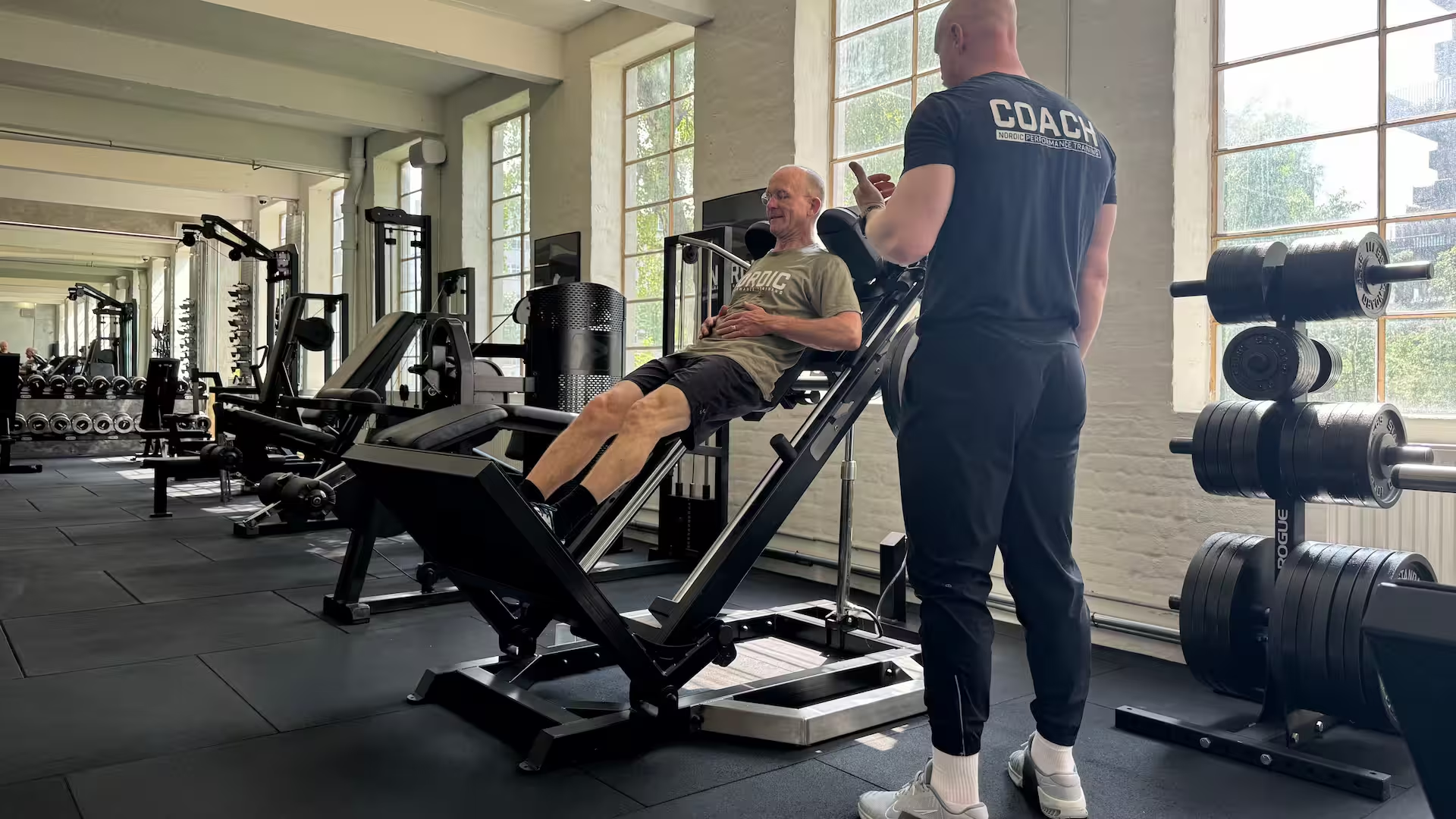
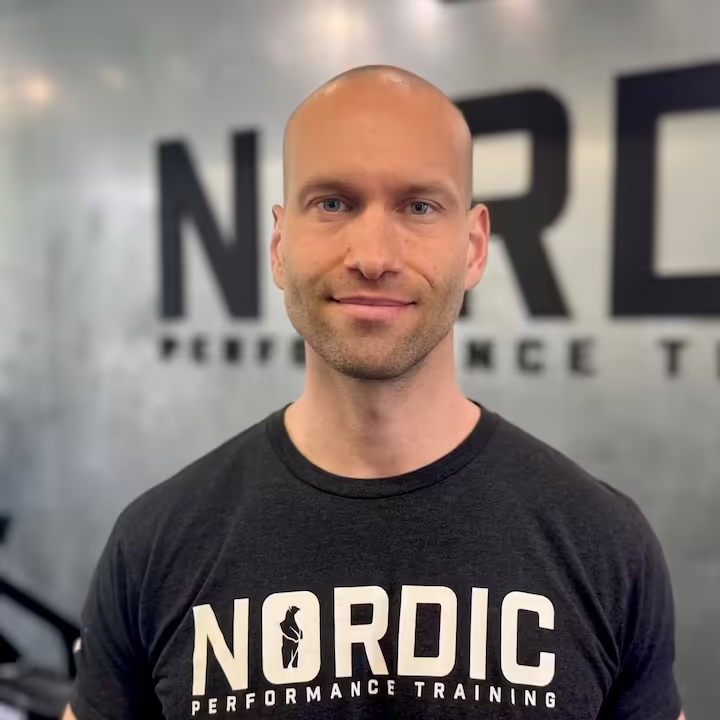
I’ve worked as a personal trainer for over 14 years and as a physiotherapist for over 8 years — and co-founded Nordic Performance Training with Kasper to give clients a professional, private, and structured training environment where results actually last. In that time, I’ve overseen more than 15,000 sessions and helped hundreds of clients rebuild after injuries, gain strength, improve their health, and stay consistent.
My approach combines practical experience with evidence from the latest research, making training both effective and realistic.
On this blog, I share the same methods we use every day at Nordic — so you can cut through the noise and focus on what truly works.




Related Blog Posts
.svg)