








Sprained Ankle: Treatment, Rehabilitation and Exercises
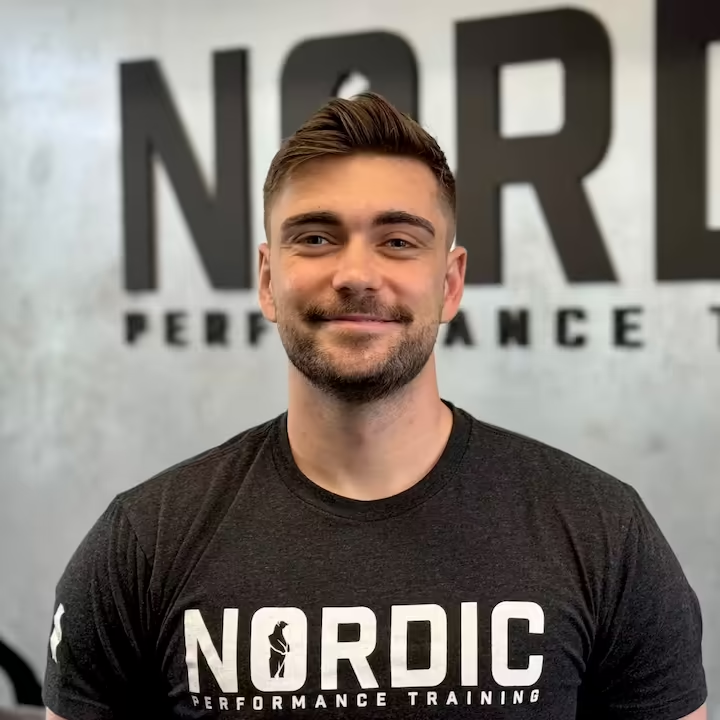
Jimmy, 36, bank adviser from Tårnby, came to us after his fifth ankle sprain. The first time it happened during a tackle playing football. The following four times he twisted it on various hikes around the world — a part of his life he doesn't want to do without.
Each time he sought rehabilitation from different practitioners. He got resistance bands, bodyweight exercises at home, ultrasound, laser, and kinesiotape. But every time he got back on the football pitch or on the hiking trail, he was hit by the same feeling of insecurity. Lack of strength in the legs and a sensation that the ankle could decide to fail him again.
He felt that he needed to become markedly stronger and more resilient if he was to be physically and mentally capable of the things he wanted to do in his life. And that all the "small" exercises, which were fine enough in the early stages, weren't enough.
That's why he googled his way to how to get stronger in the most effective and practical way, and came across our Full Body article. It dawned on him that he should strength train the entire body heavily and systematically — not just do small balance exercises on a pad or heel raises on the stair step. He booked a start-up conversation, and the week after his most recent sprain he was training twice per week.
Together with his personal physiotherapist Mikkel Krause, he simply followed our regular full body program. No special focus on the ankle, other than that he was welcome to continue with his heel raises at home during the first 12 weeks. After three months, he was completely pain-free and felt at home in strength training. After six months, he was stronger in his entire body than ever — and the persistent insecurity around his physical capability had been replaced by a growing motivation to get back on the football pitch and out on the next hikes.
"I just wish I had done this after my first sprain. I've wasted so much money on treatments that didn't do anything for me in the long run. It's absurdly simple — I got stronger, and then it stopped being a problem." — Jimmy
This illustrates a point worth repeating: Getting stronger is not complicated. It requires a simple program, followed systematically over time with a skilled trainer by your side. It's not the sprain itself that's the biggest problem — it's what happens, or doesn't happen, in the months after.
What is a sprained ankle?
A sprained ankle is an overstretching or partial tear of one or more of the ligaments that hold the ankle together. In the vast majority of cases — around 80 percent — it happens on the outside of the ankle, when the foot turns inward. It typically affects the anterior talofibular ligament (ATFL).
Sprains are traditionally classified into three grades:
Grade 1: Mild overstretching. A little swelling and pain, but you can still bear weight on the foot. Course typically 1-2 weeks.
Grade 2: Partial tear. More marked swelling, bruising, harder to bear weight on the foot. Course 3-6 weeks.
Grade 3: Complete tear. Significant swelling, and you typically can't bear weight on the foot at all. Course 6 weeks to several months, and should always be assessed medically.
The classification is useful, but it doesn't tell the whole story. Two people with the "same" grade 2 sprain can have very different courses — depending on how strong a body they had beforehand, and how systematically they build back up.
Sprained or broken — when is it serious?
The first question many ask themselves: "Should I go to A&E?" Fortunately, there's an evidence-based answer.
The Ottawa Ankle Rules are a set of simple criteria used in emergency departments worldwide. They have a sensitivity of around 97-100 percent — meaning very good at catching fractures if there is one.
You should get a medical assessment if one or more of the following apply:
- You can't bear weight on the foot immediately after the injury, and you can't take four steps
- There is point tenderness directly on the bone in the lowest 6 cm of either the outer or inner ankle bone (malleolus)
- There is point tenderness on the base of the fifth metatarsal bone (the bone midway down toward the little toe)
- There is point tenderness on the navicular bone (on the inside of the foot)
If none of them apply — you can limp around, and it hurts in the muscles and ligaments but not directly on the bone — the probability of a fracture is very small. Then you're probably better served by avoiding A&E and instead getting started with a training plan adapted to your daily life.
Symptoms of a sprained ankle
The typical symptoms are swelling around the ankle, pain with pressure and movement, bruising (often only after a couple of days), and a sensation that the ankle doesn't "want to" as normal.
The swelling typically subsides as the tissue heals:
- Grade 1: marked improvement within 1-2 weeks
- Grade 2: 2-4 weeks with visible swelling, some swelling after activity for longer
- Grade 3: visible swelling for several months
Many also experience nighttime pain the first nights, particularly with grade 2-3. This is because the inflammatory response peaks in the first 24-72 hours — not because something is wrong. The pain typically subsides as the swelling decreases.
Important to know: The swelling and pain are not the "injury" itself. It's the body's reaction to the injury — part of the healing process. That's one reason we no longer focus as much on "stopping" the swelling with ice, painkillers, and elevation as we did twenty years ago.
Once you've used the Ottawa criteria above to rule out a fracture, the most important thing we can do in the first days is to explain what's happening: The repair phase is underway. It can be very uncomfortable, and that shouldn't be trivialised — but it's not dangerous, and it will pass. A bit like the flu: the body reacts violently to something that in itself is not a catastrophe for an otherwise healthy person, and the uncertainty makes the entire experience worse than necessary. When you know what it is, and that it's progressing as it should, a large part of what can otherwise develop into fear of movement and long-term problems falls away.
Treatment of a sprained ankle
For decades, the standard advice was RICE — Rest, Ice, Compression, Elevation. That's still what many encounter. But the evidence for both rest and ice as treatment methods is weak, and the doctor who originally invented the acronym in 1978 has since retracted his own recommendation for ice, arguing that it can delay healing.
In 2019, Dubois and Esculier published a more modern framework in the British Journal of Sports Medicine: PEACE & LOVE. The acronym covers two phases:
PEACE (the first days): Protection, Elevation, Avoid anti-inflammatories, Compression, Education. That is: protect the tissue, keep the foot elevated, avoid unnecessary medical dampening of inflammation, optionally use compression, and — the most important — get a proper explanation of what's happening.
LOVE (after the first days): Load, Optimism, Vascularisation, Exercise. That is: gradual loading, optimism about the process, blood circulation through movement, and targeted training.
It's a more realistic framework than RICE, which was built on the assumption that rest and dampening of inflammation was the most important thing. Today we know it's the opposite: inflammation is part of the healing, and movement is part of the cure.
Painkillers like ibuprofen can dampen the process and are no longer the first choice. The Danish Health Authority's recommendations from 2025 generally support that painkillers should not be the backbone of treatment for pain in muscles and joints.
The research is quite clear: Early mobilisation gives better results than immobilisation. One of the classic studies (Eiff et al., 1994) directly compared the two approaches and found that the early mobilised group had less pain after three weeks and returned to work faster.
With Jimmy, we started one week after his sprain. When I say "started," I don't mean small cautious circular movements with the foot in the air — I mean our regular full body program, with hack squat adapted to his tolerance at that time. Loading you can tolerate is not your enemy after a sprain. It's part of the way back to a stronger body than the one you had before you sprained it.
"Most of the people I see with recurring ankle sprains have done everything that works fine in the early, more acute phase — resistance bands, balance pads, and kinesiotape. But they've never made a targeted effort to get strong. The most important thing you do for your ankle is what you do in the six to twelve months after the sprain — not what you do in the first three days." — Mikkel Krause, physiotherapist
Tape, support bandages, and ice
Tape and support bandages can dampen the symptoms and provide light protection against new sprains in the short term. It's fine to use for a period, particularly if you need to return to sport before you feel completely ready. But they don't build capacity. Used over years as a "solution" for an unstable ankle, they actually risk doing the opposite: the ankle becomes dependent on the external support because it never gets the chance to become strong enough to manage on its own.
Ice often feels nice and can dampen the pain briefly, but the evidence that ice accelerates healing is weak. Use it if it feels good, but you don't have to.
Rehabilitation and exercises
Here's what really matters. It's the rehabilitation period after your sprain that determines whether you end up with a stronger ankle than before, or one that's ready to fail you the next time you challenge it.
The research is quite clear on one point: Rehabilitation beats no rehabilitation. The largest and most recent meta-analysis in the area (Tassignon et al., 2022) concluded that exercise therapy reduces the risk of a new sprain by around 40 percent compared to "usual care" — which in practice often means rest and a leaflet with exercises.
But here's the nuance that rarely comes along: Most of the studies that exist in the area compare active rehabilitation with passivity — not two serious rehabilitation strategies against each other. We have plenty of evidence that something is better than nothing. We have virtually no evidence for what is optimal. The authors of the review write it themselves plainly: "There is insufficient data to establish the optimal content of rehabilitation interventions."
This means that the typical ankle rehab protocols — wobble boards, resistance band exercises, and heel raises (calf raises) — don't have a particularly strong evidence base as the best approach. They have evidence for being better than nothing. That's not the same thing.
Our position is that progressive heavy strength training of the entire lower body is probably a better long-term strategy than the light specific ankle exercises that dominate practice. We can't prove that, because the comparison has never been made in a randomised study. But it's a position that rests on what we know from other overuse injuries, where heavy strength training consistently beats light protocols. And it's the approach we've seen work for eight years for clients like Jimmy and everyone else.
The five exercises that are central to our approach
We put clients with ankle sprains on our regular full body program. What we adapt is the load, number of repetitions, and the way it's performed, for the individual person.
Hack Squat is the core. You can start completely light — Jimmy started with no weight on the machine. During a deep hack squat, soleus (the calf's deep muscle) works intensely isometrically, and so do the foot's and the rest of the lower leg's muscles.
Bulgarian Split Squat trains one leg at a time and places higher demands on balance and coordination in the loaded leg. It's the single-leg exercise that gives you "balance and strength training in one movement." And here the demand is even greater on the feet and lower leg muscles.
Leg Curl isolates the hamstrings. A point many don't know: Gastrocnemius (the calf's superficial muscle) also crosses the knee joint and contributes to knee flexion. This means a leg curl trains gastrocnemius effectively — particularly if the foot is held in slight dorsiflexion. It's a smart way to strengthen the calf in the beginning, when the ankle can't be loaded as heavily.
Leg Extension isolates the quad. Strong quadriceps are crucial for shock absorption — and thereby for distributing the load up through the leg instead of concentrating it down at the ankle.
Glute Bridge targets the glutes directly. Strong glutes stabilise the entire lower body. When the hips function well, the knee moves better, and when the knee moves better, the ankle also functions better.
On top of that, we run a pressing exercise for the upper body, a pulling exercise, and a shoulder exercise. Yes, we train the upper body in a man with an ankle sprain — we train a person who needs to be robust and ready for everything life throws his way in the future. And we teach him a way to train that he can continue with forever.
We use double progression: you work your way up in repetitions with the same weight, and when you hit the top of the repetition range in all sets, you increase the weight. It's the simplest and most sustainable way to ensure you actually get stronger over time and keep training hard enough.
What about calf raises and balance exercises?
Calf raises (heel raises): We don't use calf raises in our Full Body program. Our squat variants and leg curl already train the calves quite effectively, and we don't set our clients to perform exercises they won't continue with in the long run anyway. But with that said, they're not forbidden either. If you want to supplement with heavy, slow calf raises three times per week at home — as many rehabilitation protocols prescribe — the research indicates that it has a beneficial effect on reducing the risk of new sprains.
Balance exercises and proprioception training: As we touched on above, this type of training has evidence for working better than doing nothing — but it has never been compared with heavy structured strength training. Much of proprioception training's effect is achieved naturally through single-leg exercises like split squat, where you're already standing and balancing on one leg under load. If you want to supplement at home, that's fine. But keep it as a supplement — not as the primary training that should build a robust and resilient body.
A simple program you stick with — rather than a complicated one you give up on
One more thing about our approach. We have one core product: the Full Body program. It's not because we lack the imagination to create something more complex. It's because through eight years we've learned that structure protects progress.
That's also why we don't just throw in all sorts of rehabilitation exercises into the program every time a client comes in with a new sprain, an old knee injury, or a back strain.
We could easily do that — there are thousands of specific exercises for every single condition. But every time we add an exercise, what primarily happens is that it becomes harder to keep going over time.
That's the classic trap in rehabilitation: you add exercise after exercise because each of them "is also good for something" — until the entire program becomes so unmanageable that no one can stick with it. Variation must earn its place. If an exercise doesn't add something that isn't already covered, it's contributing to dulling the program, not strengthening it.
It's precisely that simplification that enables us to help our clients in a way where they never lose overview. They know what they should do, why they should do it, and how it's progressing. It's the long-term success we set them up for — not an impressive rehabilitation program that looks complicated on paper but that no one will continue with in a year.
But a good program isn't enough in itself. It also needs to be delivered well. That's why our clients always train one-on-one with a personal physiotherapist who ensures the exercises are performed correctly and adjusted to you. A relationship that is safe, where you're encouraged and validated. And a professional who helps you understand why we do what we do — in a way that makes sense for you and your life.
It's the framework and the operating system that makes the training not just a series of exercises. It becomes a process you get through well — and that you can continue with, because it makes sense physically, mentally, and on a human level.
Prevention of a new sprain
The probability that you'll sprain your ankle again is actually quite high. Studies estimate that up to 70 percent of people who sprain their ankle for the first time experience one or more recurrences.
Up to 40 percent develop chronic ankle instability — the persistent sensation that "the ankle could give way." That was precisely the starting point Jimmy had before he started with us.
Those are the consequences of what typically applies after a sprain — that most people either do too little to build the ankle back up or receive treatment that doesn't build real capacity.
The most important thing is that you get started with structured strength training 1-2 times per week. A strong lower body distributes load better, reacts faster, and makes the ankle less dependent on passive structures like ligaments. Our Full Body program and training system achieves precisely this.
If you do team sports like football, basketball, or handball, where direction changes and landings are a normal part of the activity, this isn't just "nice to have" either. It's what builds the base for you to feel safe performing those movements again — and it determines whether the following years will be filled with recurring sprains or not.
When should you see a doctor?
Go to A&E if:
- You meet the Ottawa criteria above
- You have severe pain or swelling that seems disproportional to the injury
- The foot sits "crooked" or the ankle's contour looks abnormal
- You have numbness or lack of blood supply to the foot
Get a planned medical assessment if:
- Symptoms don't subside after 4-6 weeks, or worsen
- You have recurring episodes of "giving way" — the ankle suddenly failing
If you're in doubt, contact your doctor.
FAQ About Sprained Ankle
Can you walk on a sprained ankle?
Yes, often, and it's actually recommended. Early mobilisation — getting started with loading the foot as quickly as you can tolerate it — gives better results than keeping the foot at rest. If you can take four steps immediately after the injury, there's very little risk of fracture, and you may walk within what you can tolerate. Optionally use tape or support bandages for a period if it gives you reassurance.
How long does a sprained ankle take?
It depends on the grade. A grade 1 is typically significantly better within 1-2 weeks. A grade 2 takes 3-6 weeks. A grade 3 can take several months. But here's the important thing: Being "pain-free" is not the same as being "recovered." Up to 70 percent experience a new sprain if they don't build the underlying capacity through strength training.
How long does the swelling last with a sprained ankle?
The swelling typically subsides markedly within 1-2 weeks for grade 1, 2-4 weeks for grade 2, and can last several months for grade 3. Mild swelling after activity can be normal for several months after a more pronounced sprain. It's part of the healing process, not a fault.
How do I know if my ankle is sprained or broken?
Use the Ottawa Ankle Rules as a guideline: If you can bear weight on the foot and take four steps, and if you don't have point tenderness directly on the bone points described above, the probability of a fracture is very small. With a sprain, the pain is primarily in the muscles and ligaments around the ankle. With a fracture, it's typically localised to one specific point on the bone itself. If you're in doubt, get it assessed.
Do tape and support bandages help against a sprained ankle?
Tape and support bandages can dampen the symptoms and provide a light protective effect against new sprains in the short term. It's fine to use for a period. But they don't build capacity and don't make the ankle stronger in the long run. Use them as a tool for a period — not as a long-term solution.
Ready to move forward?
If you've sprained your ankle and are tired of the frustrating cycle — sprain, rest, light exercises, back on the pitch, new sprain — then we understand. We see it often in our personal training in Copenhagen, and we have good experience helping people like Jimmy build an ankle they can trust again.
Book a free start-up conversation and hear how personal training in Copenhagen can look for you — either in our private gym or as a call, if that suits you better.
Referencer
Dubois, B., & Esculier, J.-F. (2020). Soft-tissue injuries simply need PEACE and LOVE. British Journal of Sports Medicine, 54(2), 72–73. https://doi.org/10.1136/bjsports-2019-101253
Doherty, C., Bleakley, C., Delahunt, E., & Holden, S. (2017). Treatment and prevention of acute and recurrent ankle sprain: an overview of systematic reviews with meta-analysis. British Journal of Sports Medicine, 51(2), 113–125. https://doi.org/10.1136/bjsports-2016-096178
Tassignon, B., Verschueren, J., Delahunt, E., Smith, M., Vicenzino, B., Verhagen, E., & Meeusen, R. (2022). Exercise-based rehabilitation reduces reinjury following acute lateral ankle sprain: A systematic review update with meta-analysis. PLoS ONE, 17(2), e0262023. https://doi.org/10.1371/journal.pone.0262023
Bachmann, L. M., Kolb, E., Koller, M. T., Steurer, J., & ter Riet, G. (2003). Accuracy of Ottawa ankle rules to exclude fractures of the ankle and mid-foot: systematic review. BMJ, 326(7386), 417. https://doi.org/10.1136/bmj.326.7386.417
Eiff, M. P., Smith, A. T., & Smith, G. E. (1994). Early mobilization versus immobilization in the treatment of lateral ankle sprains. American Journal of Sports Medicine, 22(1), 83–88. https://doi.org/10.1177/036354659402200115
Sundhedsstyrelsen (2025). Nationale kliniske anbefalinger for brug af paracetamol, NSAID og opioider til behandling af akutte lænderygsmerter hos voksne. https://www.sst.dk/nyheder/2025/medicin-virker-ikke-mod-akutte-laenderygsmerter
Table of Contents
Related Blog Posts
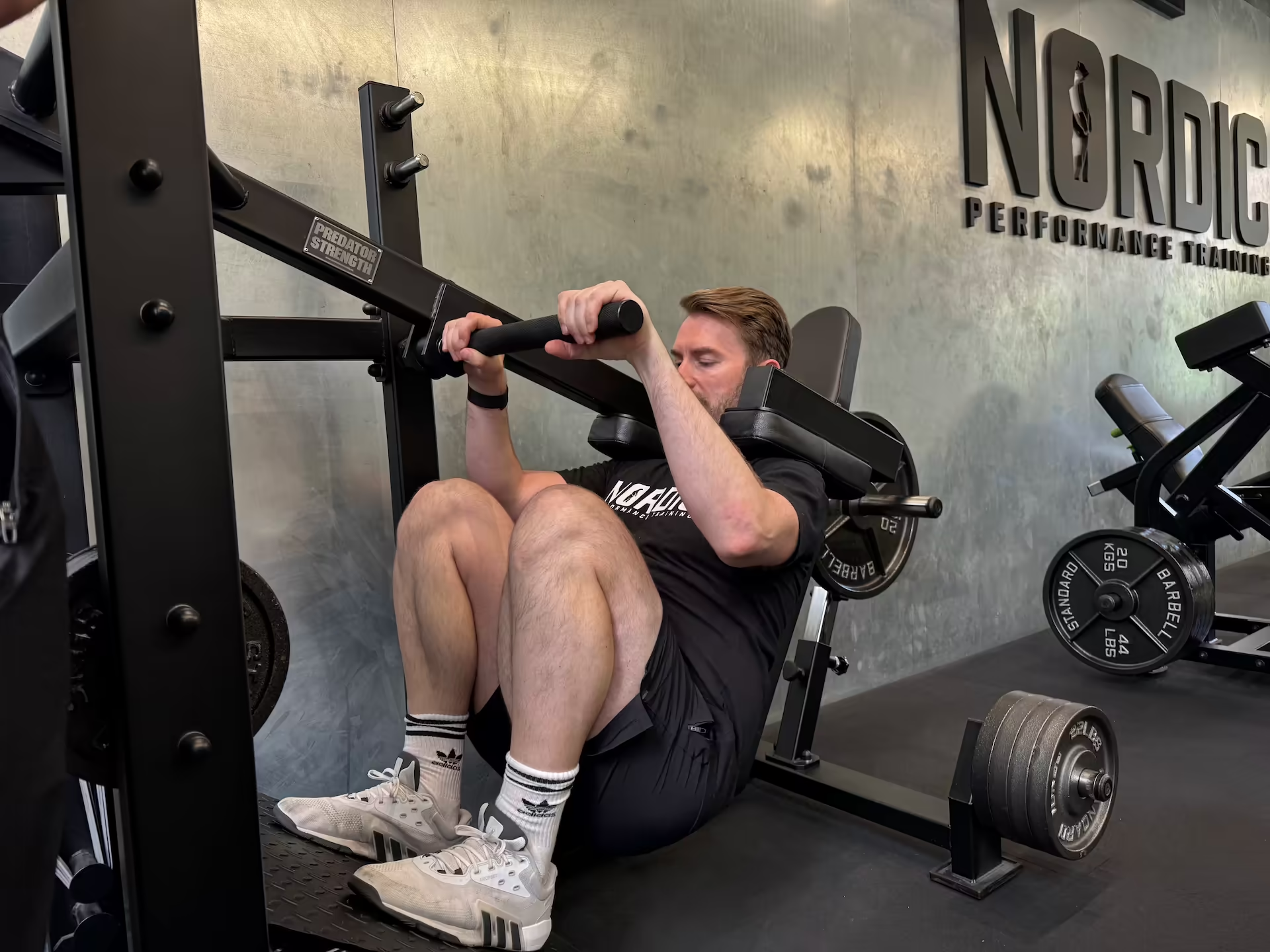


I have worked as a personal trainer and physiotherapist for many years, and I bring a calm, attentive approach to every session — taking the time to listen and understand the person I'm working with. I believe the best results come when training fits your life and your body, not the other way around.
My background in clinical practice gives me a solid foundation for working with people at any starting point — and I'm always mindful of when to push and when to hold back.
On this blog, I share the same methods and insights we use every day at Nordic — so you can train smarter, stay consistent, and achieve results that last.



Related Blog Posts
.svg)