







Heel Spur: Treatment, Exercises and Causes
Louise, 42, self-employed hairdresser from Frederiksberg, came to us after half a year of battling heel pain. Every morning was the same: The first steps from the bed to the bathroom caused severe pain under the left heel. It got better when she had walked around a bit — but after a typical working day of seven to eight hours in the salon, the pain returned at full force in the evening.
She had had an X-ray taken. There was a small bony growth on the heel — a heel spur. She had bought insoles at the pharmacy. She had bought new shoes. She had had acupuncture and massage. She had also tried to rest the foot as much as possible, but as a self-employed person she couldn't exactly call in sick from her own calendar.
The first thing we did was explain to Louise something that she had not heard from any of the practitioners she had been to: The heel spur itself was in all likelihood not the cause of the pain. The bony growth on the X-ray was just an incidental finding.
What it was that had triggered her pain, we cannot know with certainty. This is a condition with many potential contributors — everything from the daily load on the foot, to general health, sleep, stress and periods of inactivity. But in Louise's case, it made good sense to look at her job. Eight hours of standing work daily on a hard salon floor is very repetitive loading on the same tissue, day after day. Her symptom pattern — worst in the morning, improvement after warming up, back again in the evening — pointed to tissue that had become more irritated than it could recover from between days.
What we needed to work on was therefore the foot's and the body's overall capacity to tolerate the loading her daily life demanded.
The next thing we did was give her a plan. Not a complicated one — but a simple one. As always, we followed our full-body program with chest press, pulldowns, hack squat, leg curls, lateral raise and leg extension. Two times per week, 60 minutes per session. We talked about how she could structure her working days with micro-breaks, and about why it made sense to have two to three pairs of shoes to alternate between in the salon. In the beginning, she still used her insoles. That was perfectly fine.
Three months later, the morning pain was almost gone. Six months later, she could stand and cut hair an entire Saturday without waking up with pain and stiffness on Sunday. She had not had the heel spur itself removed — it was presumably still there on the X-ray. But it no longer filled anything in her life.
"The biggest thing for me was actually not that the pain went away. It was that I got an explanation that made sense, and a plan I could follow. At all the other places it was either 'rest more' or a new treatment that could 'fix' a specific problem. This was the first time my situation was explained to me in an honest way. And I got a long-term plan." — Louise
What is a heel spur?
First, the most important thing: When people talk about "heel spur," they usually mean two different things that get mixed together.
One thing is a bony growth — a small calcification on the heel bone where the plantar fascia attaches. That is the one that can be seen on an X-ray.
The other thing is the pain under the heel — a condition that medically is called plantar fasciitis. The plantar fascia is the broad tendon band that runs from the heel to the toes, and the pain is probably connected to some form of irritation or loading of that area — although we can't always see precisely what is happening, even on a thorough scan.
The two things sometimes go together. But they are not the same. And that is an absolutely crucial distinction.
The research is quite clear: The bony growth itself most often does not cause pain. Many people have a heel spur on X-ray without having any pain whatsoever. And many people have classic heel pain without having any visible bone spur. That is why the Danish Medical Handbook also clearly states that "the mere presence of a heel spur on X-ray has no diagnostic or treatment-related significance."
Based on this, many people conclude: "Well, then it's not the bone, it's the tendon band — that's the problem." But here is a point worth dwelling on: It's not quite that simple either.
The same pattern we see with the heel spur also applies to the plantar fascia. Studies where the foot is scanned in people without heel pain often find thickened or "inflamed" plantar fascia — without the person having any complaints whatsoever. And when the foot is scanned in people who have recovered after a good training program, you often see no visible change in the fascia. The pain has disappeared. The person has become markedly stronger. But the structure looks the way it did before.
That is the interesting point. If the pain came from a specific structural damage in the fascia, the structure should change when the pain does. But it doesn't necessarily.
This does not mean that the fascia is irrelevant. It is probably the tendon's and the foot's overall loading tolerance that is central. But it means we should be careful about moving the explanation from "the bone is the problem" to "the fascia is the problem" — because then we end up with the same fundamental error: assuming that the pain is caused by a specific structural damage that we can point to.
The more honest and evidence-based explanation is simpler: The pain is strongly connected to loading. Too much loading, too quickly, compared to the tissue's current capacity. And that capacity can be built up through training. The structure doesn't need to change for the pain to do so.
It is the capacity — not the structure — that we address. But what do we actually mean by "capacity" or "loading tolerance"? It is not just one thing. The research points to it being about at least three things happening simultaneously:
The tissue becomes physically stronger. Tendons, muscles and surrounding structures gradually adapt to the loading they are subjected to. That is the most obvious layer — but it is not the only one.
The nervous system turns down the pain signals. Training has a direct pain-dampening effect on the nervous system. It turns down the sensitivity, not just locally in the foot, but broadly throughout the body.
The mindset and the experience change. Fear of movement subsides. Self-confidence grows. You go from thinking "my foot is fragile" to "I can handle this." It sounds banal, but it is one of the most robust findings in pain research: how you think about your body directly affects how much it hurts.
It is the combination of the three that works. Not just one or the other. That is why strength training — performed within a plan you can stick with, together with someone who helps and cheers you on — is so effective: it hits all three layers at once.
It is also worth knowing that "capacity" is not only about training. It is about the entire body's general health. Diabetes and prediabetes, chronic stress, poor sleep, smoking, obesity, long periods of inactivity — all of it is connected to poorer tendon quality and higher risk of developing plantar fasciitis. Many hope for a specific and concrete explanation of precisely what is wrong — but it often doesn't exist. The only concrete thing we can say is that training and help from an optimistic physiotherapist who helps you navigate the entire picture usually seems to work.
This means that good treatment also involves looking at the rest of life: How good is your sleep? How stressed are you? How is your general health?
The so-called "false heel spur"
You may have encountered the term "the false heel spur" — it is used quite a bit on Danish health websites about plantar fasciitis where there is no visible bone spur on X-ray.
But honestly, the term is a bit misleading. There is nothing "false" about the pain. And the distinction itself — between a "true" and a "false" heel spur — is logically problematic. Because if the heel spur were the problem, people without a heel spur wouldn't have pain. And people with a heel spur but without plantar fasciitis would have pain. Neither fits with reality.
In other words, there are not two different conditions based on whether there happens to be a bone spur on the image or not. There is one experience — pain under the heel — that is strongly connected to the loading tolerance in the area. The X-ray finding, if there even is one, is irrelevant to the pain and to the treatment.
This also means that regardless of what the X-ray shows, the approach is the same: We address the capacity. The bone spur we can safely leave alone.
Symptoms of heel spur
The typical symptoms of heel spur are:
Pain under the heel, particularly in the morning, with the first steps out of bed. That is the classic picture. Pain after extended periods of rest — for example when getting up after having been seated for a long time. Pain that subsides when you have walked yourself warm — many describe it like this: "It's worst before I get going." Pain that returns later in the day, particularly after extended periods of standing or walking. Tenderness under the heel, often just in front of the heel bone itself, where the plantar fascia attaches.
The pain is often described as sharp and stabbing at onset, while later in the day it can be more dull and tiring. It is rarely a constant pain — it is typically one that comes and goes depending on loading.
Why do you get a heel spur?
The short version: Too much loading, too quickly — compared to the tissue's current capacity. The plantar fascia is accustomed to a certain amount of loading. If that loading suddenly increases — or if the capacity has been reduced for various reasons — the tendon cannot adapt in time, and an irritation develops.
The typical causes:
Standing or walking work — particularly on hard floors. Hairdressers, nurses, chefs, retail workers, teachers. Sudden increase in training volume in runners or other active people. Obesity — more kilos means more loading per step. Stiff or poorly fitting shoes can contribute, particularly if you switch suddenly. Generally weaker lower body — strong legs and feet distribute the loading better. Long periods of inactivity that are suddenly broken — the capacity drops, and ordinary everyday loading can then exceed what the tissue can tolerate. It is not always "too much loading" — sometimes it is "too little capacity." Diabetes, prediabetes and general metabolic health. Research shows that metabolic conditions are connected to higher risk of plantar fasciitis, poorer tendon quality and longer healing time. Sleep, stress and general lifestyle, which affect both the body's ability to heal and its sensitivity to pain.
It is not about finding one culprit. It is about the total loading, and about how much capacity the body has to handle it. And capacity is broader than many think — it is not only about how strong your lower body is, but also about how good your general health is. It is the same fundamental dynamic we have written about in our article about shin splints.
Treatment of heel spur
The good news first: Most cases of heel spur get better. Studies show that approximately 90 percent of people with plantar fasciitis recover with conservative treatment — meaning without surgery, without injections, without anything dramatic.
The bad news: It can take time. Typically three to six months, sometimes longer. And some people experience it returning if they haven't built the underlying capacity up.
That is why good treatment is not just about getting the pain away right now. It is about building a more robust foot — and a more robust body around it — so it doesn't come back. That is the long-term investment. And that is what we prioritize when we work with clients with heel pain.
We work from the same three principles that we use with all overuse injuries: calm the symptoms, stay active within what you can tolerate, build up again.
This happens in a collaboration between you and your personal physiotherapist — one with technical expertise to plan the training correctly, whom you feel comfortable being with, and who acknowledges and cheers you on along the way. Equally important: one who can explain what we do, why we do it — and why we don't do what others might suggest — in a way that makes sense for you and your life.
"I have helped quite a few people with heel pain who have tried all kinds of passive treatments, insoles, heel pads and special shoes that haven't worked for them. It is not because those things and treatments are wrong in themselves — they can dampen the symptoms for a period. But they don't build capacity in the foot or in the body. And they don't increase the understanding of your issue and prognosis either. Strength training does. Together with an optimistic partner and a structured plan you can stick with over months, not weeks." — Mikkel Krause, personal trainer & physiotherapist
Insoles, heel pads and special shoes
Insoles can dampen the symptoms. If you are very pressure-sensitive, then it obviously helps to have a bit more shock absorption under the heel, particularly in a period where the foot is extra irritated. And for clients like Louise, who cannot avoid standing a large part of the day, insoles can be what makes it possible to get through the day while the underlying capacity is being built up. We shouldn't provoke the pain unnecessarily during the course.
But insoles are not the treatment itself. They don't remove the cause. They temporarily offload the symptom — and that is fine, as long as it is part of the plan and not the entire plan.
An often overlooked detail: For runners and other active people, having several pairs of shoes to alternate between can actually reduce injury risk. A large study from 2015 followed 264 recreational runners over 22 weeks and found that those who alternated between several pairs of shoes had 39 percent lower risk of running injury than those who used the same pair every time. The mechanism is probably that different shoes distribute the loading slightly differently on the tissue — which gives the body a bit of variety. For a hairdresser with standing work, the same principle applies: Have several different pairs to alternate between during the week — or even during the day.
Stretching and massage
Stretching of the plantar fascia and calf can be pain-dampening in the short term. The same applies to massage and foam rolling. It is perfectly fine to do — particularly if it helps you "get going" in the morning when the pain is typically worst. We never tell our clients that they shouldn't do it. We have occasionally had clients who benefited from having a small massage ball next to the bed that they can use to massage under the foot before taking their first steps in the morning.
So it can help — but you also need to be careful about becoming too hyperfocused on the pain. These kinds of daily measures can in themselves become a constant reminder that you are in pain, and thereby amplify the experience more than relieve it.
And honestly: It is not necessary. Strength training has the same pain-dampening effect — and simultaneously builds the capacity that makes the foot more robust in the long term. If you already have a busy daily life, you don't need to fill it with stretching, massage, foot baths, exercises with towels and a whole lot of other things that easily end up feeling like a chore — or just an irrelevant addition without real effect. Our advice is the opposite: Follow a simple full-body program. Stick to the basics. It is the consistency over months that works — not the complexity of the individual intervention.
Pain medication
For most people with plantar fasciitis, pain medication is rarely necessary. The research shows only a weak effect of NSAIDs such as ibuprofen, and the effect is for the most part marginal compared to placebo. The Danish Health Authority's new national recommendations from 2025 furthermore state that paracetamol, NSAIDs and opioids should not be routinely used for musculoskeletal pain — we review this more thoroughly in our article about shin splints.
Pain medication can for a short period be a tool to get started with movement if the pain is very intense. But it is not the treatment itself, and for most people it is not necessary. Talk to your doctor if you are considering using it.
Shockwave and other passive treatments
The research on shockwave therapy for chronic plantar fasciitis shows a moderate effect on pain and function in the short term. We don't use shockwave ourselves at NPT, and there are two reasons for that.
First: The effect in the long term levels out. When you follow up after 12 months, there is often no meaningful difference between those who received shockwave and those who didn't. We see the same pattern again and again in pain research.
Second — and more importantly: Shockwave doesn't build capacity. It doesn't give you a skill to take with you through life. Strength training does. When you get through a training program, you learn something — you become a person who trains, who understands their own body and can handle it when new problems arise. It is that kind of independence and robustness that makes the real difference in the long term. Not the dependence on yet another treatment that needs to be repeated.
Other passive treatments such as ultrasound, laser, kinesio tape and acupuncture generally have weaker or non-existent evidence. They don't address the fundamental: the capacity in the foot, the body — and in the mind.
Exercises for heel spur
Yes, there are "specific heel spur exercises." Heavy, slow calf raises with a towel under the toes (known from Rathleff's research) are the most cited example, and we will return to them further down. But our approach is different: We don't focus on a single isolated exercise for the foot — we focus on the entire body.
The reason is simple. Strength training of the entire body doesn't just build the physical capacity — it also builds your mental robustness, your understanding of your own body and your independence in the long run. You learn something you can take with you going forward. A calf raise on a step rarely teaches you that you are a strong and trained person who can handle the physical challenges you encounter through life. A well-structured full-body program, followed over months, together with someone who can guide and challenge you along the way, does.
And that is precisely what we do with our clients with heel pain: we put them on our Full Body program, which we use with all our clients, regardless of diagnosis. What we adapt is the load, the repetitions and the technique for the individual person.
The program is built around the following structure: a press and a pull exercise for the upper body (chest press or dumbbell press, combined with cable pulldown), a squat variation and a hamstring exercise for the legs (hack squat, pendulum squat or split squat, combined with leg curl), a shoulder exercise (dumbbell lateral raise or cable y-raise), and depending on time and need, possibly leg extension or glute bridge — and a bit of arms at the end.
Why a general approach beats a specific one
It may seem counterintuitive that the best treatment for a specific condition like heel spur is not a specific exercise. But that is precisely what the research points to, not only for plantar fasciitis but also for a wide range of other tendinopathies — e.g. in the Achilles tendon, the knees and the shoulders. When you compare different training modalities against each other, the results are by and large comparable. The specific exercise is not what matters. The sustained, progressive loading is.
That is one of the reasons we build the training around a complete program that you actually want to continue with — regardless of whether you have heel pain now, or you at some point get pain somewhere else. A strong and capable person is better equipped for all the future physical challenges they may encounter.
For the lower body, these exercises are particularly relevant for heel pain:
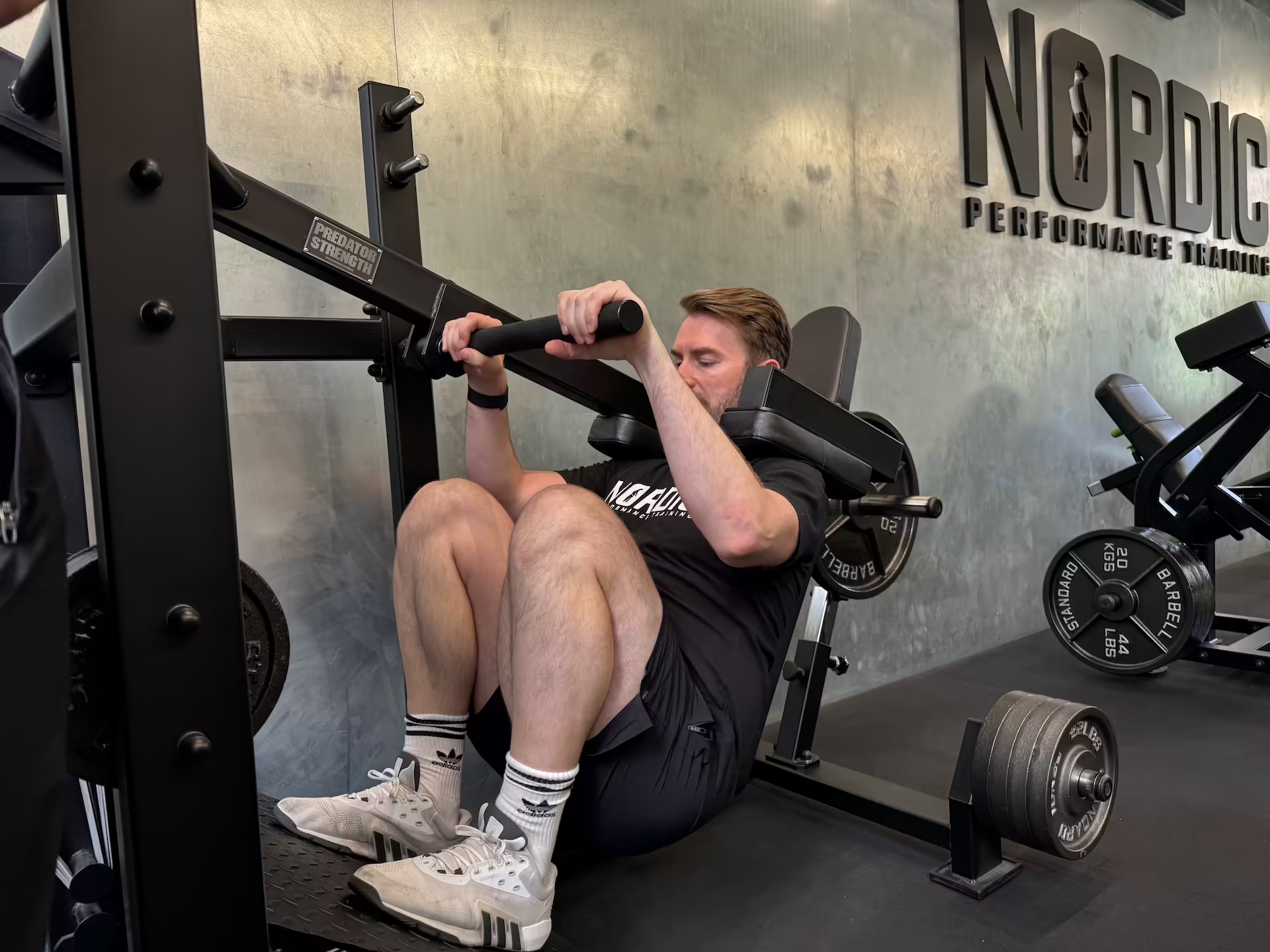
Hack Squat — trains the quadriceps, glutes and adductors, and the calf muscles work statically. Louise started with 5 kg and moderate pain on the machine. Six months later she was at 45 kg, without pain.
Bulgarian Split Squat — trains one leg at a time and requires more coordination and activation of all the small muscles in the foot and lower leg.
Pendulum Squat — even lower load on the back and upper body than hack squat, while the legs still get good stimulus. A fine alternative for clients who for a period need less total loading.
Glute Bridge — trains the glutes directly and is a good supplement to the heavy squat variations.
Leg Curl and Leg Extension — isolate the hamstrings and quadriceps. Both build the general capacity in the legs and can be dosed very precisely.
We use double progression: you work your way up in repetitions with the same weight, and when you reach the top of the repetition range, you increase the weight. We start at a point that feels manageable and adjust reactively — not by avoiding movements in advance.
What about calf raises?
That is a professionally good question, and it is worth going into a bit of depth with.
The most cited research on heel spur training — Rathleff's study from 2014 — specifically examined heavy, slow calf raises (with a towel under the toes, so the fascia was stretched during the exercise). The study showed that the participants who did strength training had markedly less pain after 3 months compared to those who only did stretching exercises.
But: After 12 months, there was no meaningful difference between the two groups.
That is the exact same pattern we see in other parts of pain research — e.g. with herniated disc, where surgery can provide faster pain relief in the first months, but after one to two years we no longer see a difference between those who were operated on and those who weren't. It doesn't mean that the quick solution doesn't work. But it means that if you take the long perspective — which we always do — then the most robust path is often to build general capacity through a structured program you actually stick with over months and years.
That is precisely our philosophy: Less is often better. We don't add extra exercises that you won't continue with going forward anyway. A well-structured full-body program gives you the necessary stimulus for the foot — and simultaneously a sustainable habit you can take with you.
If you want to supplement with calf raises at home — for example three times per week — we can show you how, and the evidence from Rathleff supports that it can help you through the acute phase faster. But it is not necessary. We have helped many clients away from heel pain without a single calf raise. Our experience aligns with what the research shows in the long term: It is not about finding the perfect, single exercise — it is about sticking with a good, simple structure that builds capacity over time.
When should you see a doctor?
Most cases of heel spur do fine with an active, adapted approach. But there are situations where you should get it examined:
Pain that does not improve after 8-12 weeks of adapted loading and strength training. Heel spur is typically a slower process, but if after 2-3 months you are not seeing progress in the right direction, it is worth getting a professional evaluation.
Local, sharp pain at a very specific point on the heel that does not improve with rest. In rare cases, this can be a stress fracture in the heel bone — particularly if you have made a sudden increase in running or jumping load, if you are young and active (e.g. soldier, dancer, track and field athlete), if you are a woman with irregular menstruation, or if you have had low energy intake for a period. Stress fractures are important to get diagnosed because they typically heal well with approximately six weeks of targeted offloading — but only if you know what you are working with.
Pain that wakes you at night or is present even at rest. Heel spur is typically load-dependent. Pain that does not subside with rest deserves a medical evaluation.
Sudden onset pain after a fall, a twist or a trauma.
Accompanying symptoms such as fever, swelling, warmth in the area or general malaise. In rare cases, this can indicate joint inflammation, rheumatic disease or infection, and an overall medical evaluation is worth getting.
If you are in doubt, contact your doctor.
FAQ about heel spur
How do you get rid of a heel spur?
The most effective approach is gradual loading and strength training of the entire lower body combined with sensible management of your total daily loading. Rest alone is rarely the solution — it removes the symptom temporarily but doesn't address the capacity in the tissue. Insoles and pain medication can dampen the symptoms for a period, but they should be followed up with active rehabilitation. Most people get better over the course of months if the approach is right.
What are signs of a heel spur?
The classic signs are pain under the heel, particularly in the morning with the first steps or after extended periods of rest. The pain typically subsides after a few minutes of movement but can return later in the day after extended periods of standing or walking. Tenderness under the heel, where the plantar fascia attaches, is also typical.
Can a heel spur go away on its own?
Yes, often. Studies show that approximately 90 percent of people with plantar fasciitis (the medical name for heel spur pain) get better with conservative treatment — even without active rehabilitation. But you can accelerate the process and reduce the risk of relapse by actively building capacity through strength training and movement, rather than simply waiting for it to resolve on its own.
How long does it take to get over a heel spur?
Textbooks typically state 6-12 months as the normal course. But it is very individual — it depends on your general health, your activity level, your work, your baseline capacity and a wide range of lifestyle and genetic factors. We have seen clients get over it considerably faster than the textbook predicts, particularly when they build strength up systematically. How long it takes depends more on how systematically you adjust your loading and build strength than on what the X-ray looks like. The bone spur itself — if there is one — typically doesn't disappear. But that is also not necessary to become pain-free.
Do insoles or orthotics help with heel spur?
Insoles and orthotics can dampen the symptoms, particularly for people with standing work who cannot avoid daily loading. But they don't address the cause. They are a fine tool for a period while the underlying capacity is being built up through strength training. At the pharmacy, you can get basic insoles that are often good enough — you rarely need custom-made insoles from a podiatrist unless there are specific foot positioning problems.
Which shoes are good for heel spur?
Comfortable shoes that fit you. There is no one pair of "perfect heel spur shoes." Generally, shoes with good shock absorption, a slightly elevated heel and sufficient room in the forefoot are recommended. For people with standing work or runners, it is worth having several pairs to alternate between — a large study showed 39 percent lower injury risk in runners who alternated between several pairs of shoes compared to those who used the same pair every time. The principle also applies to everyday shoes.
Does massage help with heel spur?
Massage and foam rolling can provide short-term pain relief. Many experience it as pleasant and helpful in the acute phase. But it doesn't significantly change the underlying condition or build capacity in the foot. Use it as a supplement if it feels good — but it should not replace strength training and sensible load management as the primary approach.
Does ibuprofen help with heel spur?
Ibuprofen and other NSAIDs can dampen the pain briefly, but the research shows only a weak effect compared to placebo. The Danish Health Authority's new recommendations from 2025 state that NSAIDs should not be routinely used for musculoskeletal pain. Talk to your doctor if you are considering using it. Our point is that pain medication is not the treatment — it is at most a tool to get started with what actually works: movement and gradual loading.
Get a plan, not yet another treatment
If you have been battling heel spur and are tired of every new treatment only working for a week or so — we understand. We see it often in our personal training in Copenhagen, and we have good experience helping people with heel pain through a well-structured plan that helps them come out stronger on the other side of the pain.
Book a free start-up conversation and hear how personal training in Copenhagen can look for you — either at our private training center or as a call, if that suits you better.
References
Rathleff, M. S., Mølgaard, C. M., Fredberg, U., Kaalund, S., Andersen, K. B., Jensen, T. T., Aaskov, S., & Olesen, J. L. (2015). High-load strength training improves outcome in patients with plantar fasciitis: a randomized controlled trial with 12-month follow-up. Scandinavian Journal of Medicine & Science in Sports, 25(3), e292–e300. https://doi.org/10.1111/sms.12313
Malisoux, L., Ramesh, J., Mann, R., Seil, R., Urhausen, A., & Theisen, D. (2015). Can parallel use of different running shoes decrease running-related injury risk? Scandinavian Journal of Medicine & Science in Sports, 25(1), 110–115. https://doi.org/10.1111/sms.12154
Sun, J., Gao, F., Wang, Y., Sun, W., Jiang, B., & Li, Z. (2017). Extracorporeal shock wave therapy is effective in treating chronic plantar fasciitis: a meta-analysis of RCTs. Medicine, 96(15), e6621. https://doi.org/10.1097/MD.0000000000006621
Sundhedsstyrelsen (2025). Nationale kliniske anbefalinger for brug af paracetamol, NSAID og opioider til behandling af akutte lænderygsmerter hos voksne. https://www.sst.dk/nyheder/2025/medicin-virker-ikke-mod-akutte-laenderygsmerter
Sundhed.dk. Plantar fasciitis og hælspore — Patienthåndbogen. https://www.sundhed.dk/borger/patienthaandbogen/knogler-muskler-og-led/sygdomme/laeg-ankel-fod/plantar-fasciitis-og-haelspore/
Sundhed.dk. Plantar fasciitis og hælspore — Lægehåndbogen. https://www.sundhed.dk/sundhedsfaglig/laegehaandbogen/LHB-Plantar-fasciitis-og-haelspore/
Martin, R. L., Davenport, T. E., Reischl, S. F., McPoil, T. G., Matheson, J. W., Wukich, D. K., & McDonough, C. M. (2014). Heel pain — plantar fasciitis: revision 2014. Journal of Orthopaedic & Sports Physical Therapy, 44(11), A1–A33. https://doi.org/10.2519/jospt.2014.0303
Table of Contents
Related Blog Posts


I have worked as a personal trainer and physiotherapist for many years, and I bring a calm, attentive approach to every session — taking the time to listen and understand the person I'm working with. I believe the best results come when training fits your life and your body, not the other way around.
My background in clinical practice gives me a solid foundation for working with people at any starting point — and I'm always mindful of when to push and when to hold back.
On this blog, I share the same methods and insights we use every day at Nordic — so you can train smarter, stay consistent, and achieve results that last.




Related Blog Posts
.svg)