









Baker's Cyst: Symptoms, Exercises and Treatment
Lennart, 58, director from Dragør, has struggled with knee pain for over ten years. It started gradually, worsened over the years, and five years ago he had to go through a meniscus operation. Afterwards, he was diagnosed with osteoarthritis in the same knee. He had been to traditional physiotherapy several times along the way. There he went to knee classes, got home exercises, and various leaflets with general knowledge about osteoarthritis in the knee. All things he was happy about and that helped, but the problems never fully went away, and now he was experiencing an actual swelling behind the knee that he hadn't experienced before.
When it appeared, he got nervous. A soft, round swelling in the back of the knee that felt worse the longer he had been walking. The cyst wasn't something that appeared overnight — it had developed quietly. His doctor sent him for an MRI, which confirmed the suspicion: a Baker's cyst. The explanation he got was that the cyst "belonged to" his osteoarthritis — but there wasn't much more to do than live with it, take painkillers as needed, and a referral back to group training and massage at the physiotherapist.
That was approximately where he began to investigate on his own on Google and read his way to the conclusion that "proper strength training" was probably what he needed. He therefore booked a start-up conversation with us.
The first thing we did was explain to him what a Baker's cyst actually is — and what it isn't. It's not a separate disease. It's a bodily reaction to irritation in the knee joint itself. In other words: the cyst is a symptom, not the cause. If we want to remove it or reduce it, we need to do something about the knee behind it. And what has the best evidence is to make the knee stronger — via systematic and controlled strength training 1, 2, or 3 times per week.
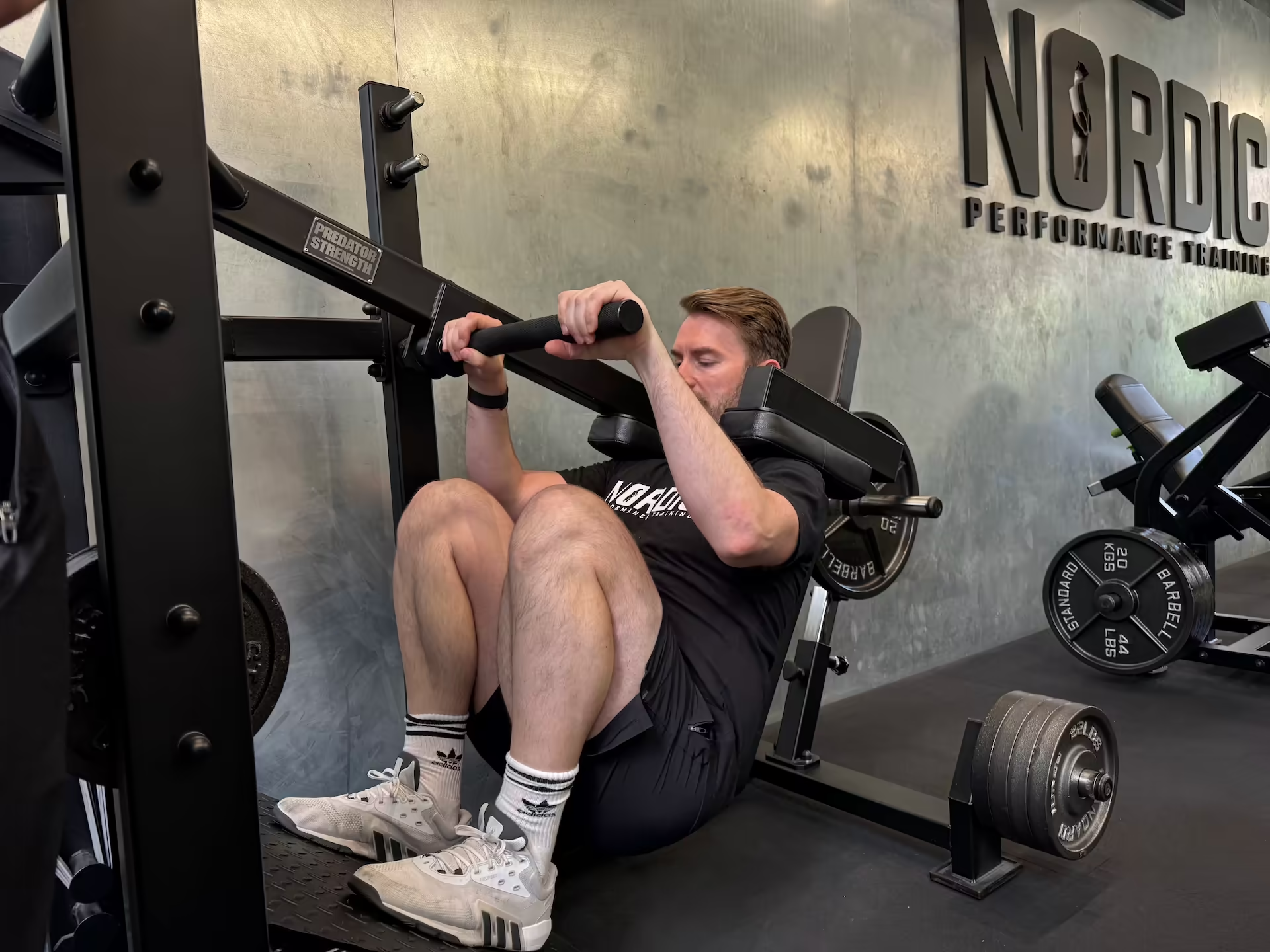
Lennart started with our 6-week program, with two weekly sessions. He didn't dare go deep in hack squat the first many times, and we used the machine's lowest weight setting in the beginning. He was worried about pushing the knee, so first he needed to experience that you can easily find a level where it feels good and build systematically from there. It doesn't matter if you start "too light," as long as you just increase systematically from there. Over the weeks, both his trust in the knee and his strength grew. He therefore continued with his 2 fixed weekly sessions for the following year and a half, and today he hack squats 70 kg and loads the knee directly with leg extension and leg curl. Both the cyst and the pain no longer take up space in his everyday life.
It came back a little twice along the way. But each time we just adjusted the program — took the load down a bit, adjusted a single exercise — and each time it disappeared again as we built the load back up.
Lennart has learned that a mild swelling behind the knee is not a catastrophe. It's feedback that the training needs to be adapted for a period. And that's easy when you follow a fixed structure and have good data.
"Many believe that if you have a Baker's cyst, you should stop loading the knee. That's the opposite of what I myself have done, and the opposite of what we recommend to our clients. I've had a meniscus injury and subsequent Baker's cyst myself. Yet I've managed to run both half marathon and full marathon, and I hack squat 170 kg without problems. Knowing the physiology behind it and the research in the area — and at the same time having been through a rehabilitation process myself — has made it much easier for me to help others in the same position. The most important thing is to set all that fear and uncertainty aside first, and then build up gradually with an optimistic mindset." — Simon Petersen, physiotherapist
What is a Baker's cyst?
A Baker's cyst — also called a popliteal cyst — is a fluid-filled protrusion behind the knee, in the area called the fossa poplitea (the back of the knee). It's named after the English surgeon William Baker, who described the phenomenon in 1877.
The mechanism is quite simple: The knee joint normally produces a small amount of synovial fluid that lubricates the joint. If there is irritation inside the joint itself — over a longer period — the joint increases the production of synovial fluid as a reaction. Between two of the calf's tendons behind the knee (gastrocnemius and semimembranosus) sits a small connection to the joint that functions as a sort of one-way valve.
When the pressure in the joint increases, the fluid is pushed through this connection and collects in a cyst behind the knee.
The cyst can be small and barely noticeable, or it can grow to the size of a plum. It typically develops gradually over months or years — not overnight. That's one of the reasons many discover the cyst by coincidence, or because it has over time become large enough to produce a visible swelling or a feeling of tension.
Here's the most important thing to understand: The cyst is not the actual problem. It's a symptom that something is happening inside the knee joint itself — typically osteoarthritis, an old meniscus injury, or other persistent irritation. The knee joint produces extra synovial fluid as a reaction to the irritation, and some of that fluid pushes backward and forms the cyst.
This means that if you want the cyst to become smaller or disappear, it's not the cyst itself you should work on. It's what's irritating the knee behind it. And that's precisely what our approach focuses on.
A word about "osteoarthritis"
We'd like to pause here, because this is one of those places where the language does more harm than good.
"Slidgigt" (the Danish term, literally "wear arthritis") sounds like a disease where the joint is worn out from use — like a car engine that has driven too many kilometres. It's a widespread notion, and it's the one that makes many people "spare" the joint when they get the diagnosis. Stop going on stairs. Stop training heavy. Unload wherever they can.
But that's precisely the opposite approach of what the evidence points to. Osteoarthritis is fundamentally not an overuse injury that occurs due to heavy use. It's a gradual change in the joint where the balance between breakdown and build-up of cartilage is shifted — and it's primarily inactivity and lack of loading that causes the balance to shift in the negative direction. Systematic and gradually increased loading does the opposite.
That's one of the reasons we'd like to move away from the term "slidgigt" — it plants an idea that the joint is damaged from use and that it should be protected and unloaded. A more precise term is "degenerative changes," which doesn't say anything about why the changes occurred. And the research is quite clear on that point: They haven't occurred because you've used the knee too much. They've occurred because the knee over time has lacked the loading that keeps the structures strong and well-nourished. The good news is that the development can be reversed — we'll return to that further down in the article.
Symptoms of Baker's cyst
The typical symptoms are:
- A soft, round swelling behind the knee, often most visible when the leg is extended
- A feeling of tightness or tension behind the knee, particularly during bending or after longer periods of activity
- Mild discomfort or pain, particularly when the cyst is large
- Stiffness in the knee, particularly in the morning or after inactivity
Many first discover the cyst by coincidence — or because they notice a swelling they haven't felt before. The pain is often more related to the underlying knee problem (e.g. osteoarthritis or meniscus irritation) than to the cyst itself.
An important nuance: The experience itself of having a visible lump behind the knee can in itself amplify the pain. When the brain registers a visible swelling on a part of the body that already hurts, it often interprets the signal as a threat — and turns up the sensitivity in the area. That phenomenon is well-documented in pain research, and it's one of the reasons the same cyst can feel like "a painful lump" in one person and "a bit of tension" in another.
This also means that part of getting the cyst to take up less space in your consciousness and pain is about what you know about it. When you understand that it's benign, that it's not dangerous, why it occurs, and that in many cases it gradually becomes smaller with the right approach, a large part of what otherwise made the symptoms worse than they needed to be subsides. Lennart experienced precisely this during his program. He didn't just get a stronger knee — he also quickly got a cyst that took up less space in his consciousness, because he understood what it was.
When should you see a doctor?
In rare cases, a Baker's cyst can rupture — then the fluid seeps down into the calf and can cause sudden pain, swelling, redness, and warmth in the calf. It can be difficult to distinguish from deep vein thrombosis (a blood clot), and therefore it should always be assessed medically.
Seek medical attention immediately if you experience:
- Sudden severe pain in the calf, often accompanied by swelling, redness, and warmth
- Breathing difficulties, chest pain, or palpitations (can indicate that a possible blood clot has moved)
- Discolouration or "marbled" skin on the calf
Also get a planned assessment if the cyst grows quickly, becomes markedly painful, or if you haven't had it definitively diagnosed. An MRI can confirm that it's a Baker's cyst and rule out other — rarer — types of cysts and protrusions behind the knee.
Causes — why do you get a Baker's cyst?
The short version: The cyst is a consequence of persistent irritation in the knee joint. The research is quite clear on what typically lies behind it.
A large MRI study of Baker's cysts found that around 83 percent of all Baker's cysts are associated with a meniscus injury — typically in the posterior part of the medial (inner) meniscus. Other studies show a strong association with osteoarthritis and with general joint irritation. In adults over 40 years, it's practically always a combination of these factors that lies behind it.
The most common underlying causes:
Osteoarthritis (arthrosis) in the knee. The clearly most frequent cause in adults over 40 years. As we touched on above, osteoarthritis is not a final diagnosis — it's a gradual change in the joint that responds really well to structured strength training and movement.
Old or current meniscus injuries. A meniscus injury can irritate the knee joint for a long time — also long after a possible operation. It's often the posterior part of the medial meniscus that's involved. Lennart had had a meniscus operation five years before he came to us, and his knee had subsequently developed osteoarthritis. That combination — old meniscus history plus osteoarthritis — is one of the most typical backgrounds in people who develop a Baker's cyst.
Other joint irritation or inflammation. Rheumatoid arthritis, gout diseases, or periods of overload can also contribute. More rarely, a cyst can occur as a primary finding without a clear cause.
For a large proportion of the people we see with a Baker's cyst, there isn't one clear culprit. And fundamentally, it's not always that important either, as long as we can rule out serious underlying causes — because the treatment is most often structured strength training. The cyst then appears as a signal that the knee joint is irritated — not as a new injury, but as a consequence of what has built up over time.
Treatment of Baker's cyst
The most important point first: You don't treat a Baker's cyst — you treat the knee joint that's producing more synovial fluid, which therefore seeps out to the back and thereby becomes a cyst.
That's precisely why our approach isn't much different from clients with osteoarthritis, meniscus injuries, or "ordinary" knee pain. The purpose is the same: to use structured strength training to build the joint stronger. We use our simple full body program and simply adjust the weight to the individual, and build gradually and systematically from there.
Wear should be worn away
This is the point we'd like to dwell on, because it goes against what many have been told. Osteoarthritis — which is the most frequent underlying cause of a Baker's cyst — is not a constant, irreversible "diagnosis." Strength training, when done correctly, doesn't "wear" further on the joint. It actually ends up doing the opposite.
The cartilage in the knee doesn't get nutrition from blood vessels, the way muscles and other tissue do. It gets nutrition from synovial fluid that's pushed in and out of the cartilage every time you load and unload the joint.
It's movement and loading that literally feeds the cartilage. Inactivity and unloading do the opposite: the synovial fluid circulates less, the cartilage gets less nutrition, and over time it becomes thinner and more fragile.
Research on MRI scans has shown the same pattern again and again. Cartilage in joints that are loaded regularly is thicker and more robust than cartilage in joints that aren't used and challenged. Studies on people with osteoarthritis show that progressive strength training activates the cartilage's own repair processes — the joint remodels itself as a reaction to the loading. It's the same basic mechanism we know from all other tissue in the body: muscles become stronger from being loaded, bones become denser, tendons become more resilient. The cartilage in your knees is not an exception.
That's why international clinical guidelines for osteoarthritis — including OARSI 2019 — recommend strength training as the first choice. Not as a supplement. Not as a last resort. As the first thing we should do. And that's why it's important that our clients actually understand why — since it sounds counterintuitive to load something that's "worn." It doesn't make much sense until you understand that the body is a biological organism that adapts to the demands it's exposed to, and how we can control and guide these processes through structured (not random) training.
Why it needs to be long-term — and why it's more important than most think
There's a point worth understanding before you get started. Not all tissue in the body adapts at the same speed.
The muscles around the knee react quite quickly to training. They grow larger, and the brain becomes better at coordinating their interplay during movement, as a reaction to the mechanical and technical challenge they're exposed to, and you therefore often feel progress already after a few weeks. This is due to a process called supercompensation in exercise physiology: the body repairs and builds the loaded muscle tissue slightly stronger than before, in preparation for the same load in the future.
That's why structured strength training feels motivating — you see the numbers go up week by week. But it's also why we use a system that holds you back a little and doesn't just increase weight as fast as possible.
You see, the cartilage works a bit differently. It also adapts to loading, but it happens much more slowly — over weeks and months — through a process called turnover. The cartilage's own cells become more active in both breaking down old cartilage tissue and building new. The result is a better balance and over time a more robust joint. It's not something you feel from day to day — but over months and years it builds up to a real and measurable change in the joint itself. A bit like how your hair grows: you don't register it hour by hour, but the result is there.
This means that a treatment of a knee with osteoarthritis and a Baker's cyst is not a 6-week project. It's at minimum a 6-month project that should ideally continue for many years after. The first improvements come quickly — you get stronger, the pain subsides, you dare to move more — but the deep, long-term gain on the joint itself only comes when you've put months and years into it.
That's precisely why it's so important to have a plan you can actually keep up week after week. A short, intense program of six weeks gives you some of the quick gains. It feels like you've done something good for yourself because it felt hard and intense. But it doesn't give you the slow remodelling of the cartilage, which is what actually changes the prognosis for your knee. That only comes through consistency over a long time. That's one of the reasons we prioritise simplicity and structure over complexity — because a program you want to and logistically can continue with is worth much more than a program that looks impressive on paper but that you can't stick with for the rest of your life.
For people with a Baker's cyst, this means that the best investment you can make is not getting the cyst aspirated, or getting another round of cortisone. It's making the knee stronger over time. When the irritation in the joint subsides — because the muscles around it are stronger, the cartilage is better nourished, and the joint can handle more — the need to produce extra synovial fluid also subsides. And thereby the cyst often subsides with it.
Aspiration and corticosteroid injections
Many clients are offered aspiration (where the cyst is punctured with a needle and the fluid is drawn out) or corticosteroid injections in the knee joint. We're not doctors, so we don't give medical recommendations about these procedures — that's a conversation you should have with your own doctor or specialist.
But we can say this: regardless of whether you choose a medical procedure or not, making the knee stronger is what reduces the underlying irritation. Aspiration without subsequent strength training is often a temporary solution — the cyst typically comes back because the cause hasn't been addressed.
Massage and passive treatments
Massage and foam rolling can feel nice and provide short-term relief in the area behind the knee. It doesn't do any harm, and if it feels good, use it. But it doesn't change the underlying problem and should not replace the primary approach: strength training and gradual loading.
Knee support and compression
A knee support can dampen the symptoms and provide a sense of reassurance. It's fine to use for a period, particularly if you need to get through longer periods of standing work, a long walk, or other activity where you'd like a bit of extra support. But it doesn't build capacity, and it shouldn't be a permanent solution. The goal is a knee joint that's strong enough to manage without external support on a daily basis.
Exercises for Baker's cyst
As you might guess, we don't have a special "Baker's cyst protocol." We have a full body program designed to make the entire body stronger and healthier, not just the knees. The physiotherapy aspect lies in adapting it to the individual person.
For clients like Lennart, these exercises are particularly central:
Hack Squat is the core. You can start completely light — Lennart began with the machine's lowest weight setting. Here the knee is loaded through its entire range of motion and strengthens close to all the muscles in the lower body, and we can increase weight gradually over weeks and months, which makes it one of the most effective ways to make the knee stronger, at a pace where the body (and the mind) can keep up.
Leg Curl isolates the hamstrings and trains what you don't get via a squat: a strong hamstring musculature. This way we get balance in the strength on both sides of the knee and hamstrings that actively contribute to a well-functioning knee joint.
Bulgarian Split Squat trains one leg at a time. It places higher demands on balance and coordination — and gives you "balance and strength training in one movement," without us needing to spend time on isolated balance exercises.
Leg Extension isolates the quad. Quadriceps is crucial for the knee's stability and function, and leg extension trains the quad precisely where it can't be trained effectively in squat variations (the top — the fully extended knee). It's one of the most robustly documented interventions for knee pain in general.
Glute Bridge targets the glutes directly. Strong glutes stabilise the entire lower body, so the knee moves better and the load is distributed more appropriately.
We use double progression: you work your way up in repetitions with the same weight, and when you hit the top of the repetition range in all sets, you increase the weight. It's the simplest and most sustainable way to ensure you actually get stronger over time.
The same principle applies here as with all other overload conditions: loading you can tolerate is not your enemy. It's part of the cure. And if the cyst comes back a little now and then — as with Lennart — it's not a sign that something is wrong. It's simply feedback that we adjust and adapt to everyday life, and continue from there.
FAQ About Baker's Cyst
What do you do about a Baker's cyst?
The most effective approach is to address the underlying knee problem — typically osteoarthritis, a meniscus injury, or overload. This means gradual strength training of the entire lower body, not isolated treatment of the cyst itself. Massage, knee supports, and painkillers can dampen the symptoms short-term but don't address the cause.
Can a Baker's cyst disappear on its own?
Yes, that often happens. If the underlying knee problem subsides — for example because you've strengthened the leg markedly — the cyst can gradually become smaller or disappear entirely. But if the irritation in the knee joint continues, the cyst often returns. That's one of the reasons we focus on the cause, not the symptom.
Is a Baker's cyst dangerous?
No, it's not dangerous in itself. The only complication that can require acute medical help is if the cyst ruptures and produces symptoms in the calf that can resemble a blood clot. In those cases, you should see a doctor immediately to rule out deep vein thrombosis. Beyond that, a Baker's cyst is neither dangerous nor something that develops into something serious.
Can a Baker's cyst develop into cancer?
No. A Baker's cyst is not cancer, and it doesn't develop into cancer. It's a completely benign condition. In rare cases, other types of cysts or protrusions behind the knee can resemble a Baker's cyst on the surface, and therefore the doctor often recommends an MRI to confirm the diagnosis. But if the MRI confirms that it's a Baker's cyst, it's something completely benign.
Can I cycle with a Baker's cyst?
As a rule yes, and often beneficially. Our general position is: be as active as you can, as long as the activity doesn't provoke or worsen the symptoms. Cycling loads the knee in a controlled movement without impact loading and is often well tolerated. If the cyst becomes more uncomfortable during or after cycling, turn down the duration or resistance a bit — and build gradually back up.
Can you train a Baker's cyst away?
You can't "train" the cyst directly away. But you can train the knee joint it comes from — and that's precisely what in many cases causes the cyst to become smaller or disappear over time. Strength training of the entire lower body reduces the underlying irritation that causes the knee to produce extra synovial fluid. It's the long-term path, and it's the one we've seen work for clients like Lennart.
Does a knee support help against Baker's cyst?
A knee support can dampen the symptoms and provide reassurance for a period, particularly during activity. But it doesn't address the cause and doesn't build capacity in the knee. Use it as a tool for a period — not as a permanent solution.
Should we have a talk about your knee?
If you're sitting with a Baker's cyst and are unsure about what the next step is, start with a conversation. We'll go through your situation, your concerns, and your goals — and you'll leave with a plan you understand, regardless of whether you choose to train with us or not.
Book a free start-up conversation and hear how personal training in Copenhagen can look for you — either in our private gym or as a call, if that suits you better.
References
Herman, A. M., & Marzo, J. M. (2014). Popliteal cysts: a current review. Orthopedics, 37(8), e678–e684. https://doi.org/10.3928/01477447-20140728-52
Stone, K. R., Stoller, D., De Carli, A., Day, R., & Richnak, J. (1996). The frequency of Baker's cysts associated with meniscal tears. American Journal of Sports Medicine, 24(5), 670–671. https://doi.org/10.1177/036354659602400518
Bannuru, R. R., Osani, M. C., Vaysbrot, E. E., Arden, N. K., Bennell, K., Bierma-Zeinstra, S. M. A., et al. (2019). OARSI guidelines for the non-surgical management of knee, hip, and polyarticular osteoarthritis. Osteoarthritis and Cartilage, 27(11), 1578–1589. https://doi.org/10.1016/j.joca.2019.06.011
Fransen, M., McConnell, S., Harmer, A. R., Van der Esch, M., Simic, M., & Bennell, K. L. (2015). Exercise for osteoarthritis of the knee: a Cochrane systematic review. British Journal of Sports Medicine, 49(24), 1554–1557. https://doi.org/10.1136/bjsports-2015-095424
Munster, A. B., Bennell, K. L., Bricca, A., Holm, P. M., Roos, E. M., & Skou, S. T. (2023). Cartilage tissue turnover increases with high- compared to low-intensity resistance training in patients with knee OA. Osteoarthritis and Cartilage Open, 5(1), 100335. https://doi.org/10.1016/j.ocarto.2023.100335
Frush, T. J., & Noyes, F. R. (2015). Baker's cyst: diagnostic and surgical considerations. Sports Health, 7(4), 359–365. https://doi.org/10.1177/1941738113520130
Table of Contents
Related Blog Posts


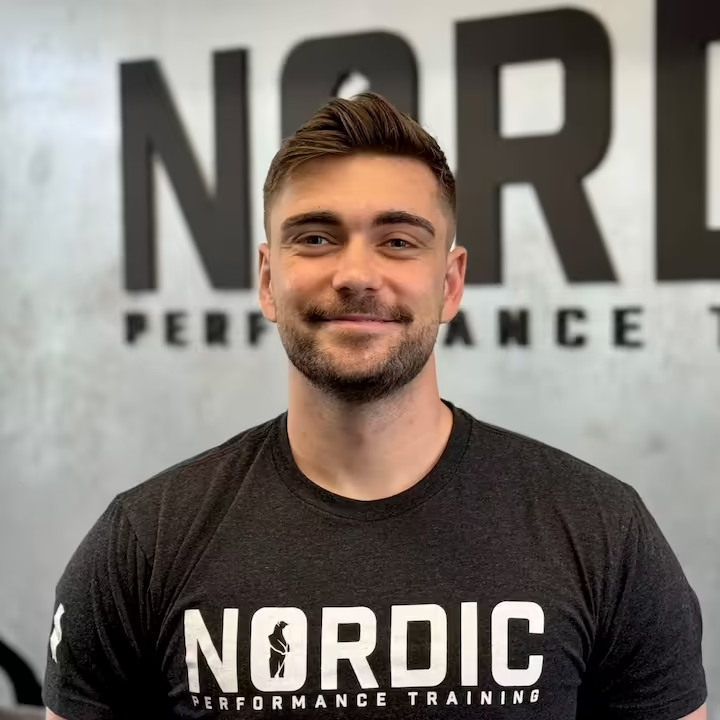
I’ve worked as a personal trainer and physiotherapist for many years and I specialize in making complex training concepts simple, practical, and easy to apply — whether the goal is building muscle, improving performance, or training with more confidence.
My focus is on combining clear communication with evidence-based methods, so clients not only know what to do but also understand why it works.
On this blog, I share the same insights and strategies we use at Nordic every day — helping you train with purpose, clarity, and results.




Related Blog Posts
.svg)