








Osteoarthritis in the Back: Symptoms, Exercises and Treatment
Joanna, 44, project manager from Sydhavn, had had periodic back pain for several years. Worst in the morning and after a long day at the office. She had never thought much about it — it had just become part of her everyday life. Until an acute episode a year ago, where it got so bad that she could barely get out of bed for several days in a row.
Her doctor sent her for an MRI to rule out a disc prolapse. There was no prolapse. But there was something else on the image: "early signs of osteoarthritis in the lower back," she was told. The explanation that followed was a mix of friendly despondency and concern: "It's early for your age, but that's how it is. You'll have to get used to it and take care of your back."
That became the starting gun for a period that did more damage than the diagnosis itself. Joanna read everything she could find online. Every article confirmed her worst suspicions. Osteoarthritis = worn out. If it was already bad now, how bad would it be when she turned 60? 70? She began to avoid everything she was afraid could "accelerate" even more wear. She stopped running — something she had loved before. She was afraid to lift her daughter. She planned her car journeys and sitting positions based on what hurt the least.
She had been to a regular physiotherapist who gave her stretching exercises, cautious movement exercises, and soothing ultrasound and laser. She had also been to a body therapist who "loosened up" the back. Both provided short-term relief — but at the same time confirmed her understanding that her back was worn down. And the fear remained.
That was approximately where she found her way to us, after a colleague had recommended strength training.
The first thing we did was give Joanna a new explanation. Osteoarthritis — or "spinal arthrosis" as it's called professionally — is not a disease where the back has been worn out. It's a common age-related change that can be seen in the vast majority of adults if you scan them.
It correlates poorly with pain. And — most importantly — people with the diagnosis respond really well to the opposite of what Joanna had done in the months prior: loading. Not further sparing of the body.
Joanna could find time in her calendar for one fixed weekly session, and since that's more than enough to counteract pain and build a stronger body, we got started right away. We adapted the load to what she could tolerate at that time and built up gradually.
She chose to continue every week for an entire year. Today she has no back pain. She runs 3-5 km per week — something she hadn't dared in months before she started with us. She's stronger than ever. And most importantly of all: she's no longer afraid of her own body.
"It's one of the biggest misconceptions that osteoarthritis means something is worn out. It's the opposite: osteoarthritis arises more often from inactivity and lack of loading than from too much use. The name the disease has been given does real damage — it makes people like Joanna avoid precisely what would help them. When I see her train today, I don't see a person limited by an irrelevant scan result. I see a person who is stronger and more robust than most — and that's precisely what her back needs for the rest of her life." — Lucas Iversen, physiotherapist and owner
What is osteoarthritis in the back?
Osteoarthritis in the back — also called spinal arthrosis — is a collective term for the age-related changes that occur in the spine's joints and structures over time. It's not one specific disease. It's a gradual change that typically involves two things:
The facet joints. The small joints that sit at the back of each vertebra and connect the vertebrae to each other. Osteoarthritis in the facet joints is principally similar to osteoarthritis in other joints in the body — the quality of the cartilage changes, minor calcifications can form, and the capsule around the joint can become a bit more irritated.
The disc between the vertebrae. The intervertebral discs that sit between each two vertebrae. They also change gradually throughout life — they typically become slightly thinner, lose some of their water content, and can develop minor bulges.
The two things are connected. When the disc changes, the pressure distribution changes in the facet joints, and vice versa. That's why "osteoarthritis in the back" is often a combination of both rather than just one.
Osteoarthritis is not wear
Let's pause here, because this is one of those places where the language does real damage.
"Slidgigt" (the Danish term, literally "wear arthritis") sounds like a disease where the back has been worn out from use — like a car engine with too many kilometres. It's the notion that makes many people "spare" the back when they get the diagnosis. Stop lifting heavy. Stop running. Avoid bending, twisting, loading. Joanna's reaction was the classic one.
But that's the opposite approach of what the evidence points to. Let's take the four most important points one at a time.
1. Osteoarthritis is extremely common — and becomes more common with age
One of the most cited MRI studies in the area (Brinjikji 2015) examined back scans in people without back pain. The results are worth remembering if you yourself have been diagnosed with osteoarthritis:
All without back pain.
These are not people who were in pain and got an MRI — these are completely normal people who experienced no pain, but where the scan still showed the "signs of osteoarthritis" that make many panic or blame it for the pain they're experiencing.
Similar patterns are seen for facet joint osteoarthritis: around 60 percent of adults over 40 years have it on CT scan — often without symptoms. This means that if we took 10 random 60-year-olds from the street, who all felt healthy, and scanned them, we would find osteoarthritic changes in almost all of them.
An MRI finding of osteoarthritis therefore doesn't necessarily tell you why you're in pain. It tells you that you have a back that has gotten older — just like the rest of your body. It's comparable to wrinkles or grey hair. It's part of getting older, and it doesn't mean something is broken.
2. Osteoarthritis and pain correlate poorly
This is probably the most important point in the entire article, and the evidence is very strong.
Research consistently shows only a moderate association between structural MRI findings (osteoarthritis, disc degeneration, disc bulging) and the experience of back pain. Many people with "bad" findings have no pain. Many people with severe pain have largely normal scans. And two people with precisely the same findings can experience the pain vastly differently.
This doesn't mean the pain is something they're imagining. It simply confirms what we know, namely that pain is multifactorial. It's influenced by loading, but also by sleep, stress, general health, physical capacity, and — most importantly — what you think about your body. When you believe the back is worn out, the brain has a tendency to turn up the sensitivity in the area. When you understand that the back is robust and can get stronger, the sensitivity goes down.
That's precisely the shift Joanna experienced. Her MRI findings didn't change over the year she trained with us. But her experience of the back changed fundamentally — because she got stronger, and because she understood what she was dealing with.
3. Movement feeds the joint — on three different time horizons
The most important physiological point to understand: movement and loading are what keeps the joint healthy. It happens on three different levels:
Short-term (minutes to hours): "Lubrication" of the joint. When you move, the synovial fluid is mixed and distributed evenly over the contact surfaces in the joint. Friction decreases, and the joint moves more easily. That's the reason a stiff back in the morning feels better after ten minutes of movement. It's nothing mysterious — it's fluid dynamics in the joint.
Medium-term (hours to days): The cartilage is fed like a sponge. The cartilage has no blood supply and therefore can't receive nutrition the classic way. It instead receives nutrition from the synovial fluid — but only when pressure variation during movement pushes the fluid in and out of the cartilage. Imagine a sponge: when you squeeze it, old water is pressed out; when you release, it absorbs new water. Movement is the sponge being squeezed and released. Inactivity means the sponge sits still — and the cartilage gradually starves.
Long-term (weeks to months): The cartilage adapts through what's called the turnover effect. The cartilage's own cells become more active in both breaking down old cartilage tissue and building new when the joint is loaded systematically. The result is over time a more robust cartilage and a better balance in the joint. It's a slow process, but it's real, and research on MRI scans has shown the pattern again and again: cartilage in joints that are loaded regularly is thicker and more robust than cartilage in joints that aren't used.
All three processes depend on the same thing: that the joint is used. Inactivity means less lubrication, poorer cartilage nutrition, and shifted turnover. That's how "osteoarthritis" actually arises — not from too much use, but from too little.
4. Running doesn't wear on the joints — on the contrary
The final point is perhaps the most counterintuitive. Many believe that high-load activities like running and heavy strength training accelerate osteoarthritis. Research shows the opposite.
A large meta-analysis from 2017 compared the risk of osteoarthritis in knees and hips across different groups:
- Inactive people: 10.2% develop osteoarthritis
- Recreational runners: 3.5% develop osteoarthritis
- Competitive runners (elite, many hours weekly over years): 13.3%
These are remarkable numbers. Recreational runners have a third of the risk of osteoarthritis compared to inactive people. Only when you get to elite level with many hours of training weekly over several years do you see a slightly increased risk — and it's still only marginally higher than being inactive.
It's worth remembering that the study looks at structural findings — not at pain or function. Elite runners have slightly more findings on an X-ray, but research also shows that their actual quality of life, function, and everyday pain are typically just as good or better than inactive people's. That ties back to the previous point: findings and pain are not the same thing.
The simplest interpretation: For almost all people, the problem is not too much activity. It's too little. And even what many perceive as "wearing" activity — like running — is protective for the joints, not harmful.
The prerequisite is of course that you start somewhere that suits your current capacity and build up gradually and in a controlled manner. It's not because you should go out and run a half marathon tomorrow — it's because loading that's dosed sensibly over time is an investment in the joint, not an exhaustion of it.
Of course, exceptions exist. A paver who has laid stones for 40 years may have developed changes driven by overload. But that's the absolute minority. For the vast majority of adults, osteoarthritis is a consequence of sedentary jobs, too little movement, and a lifestyle that doesn't feed the back the way it needs to be fed.
That's why we'd like to move away from the word "slidgigt" as an explanatory framework. A more precise term is "age-related changes" or "degenerative changes" — which doesn't say anything about why the changes occurred, other than that it's a natural part of being the biological organism we humans are. And as you can now see: For the vast majority of people, the honest explanation is that the back has lacked the loading that keeps it healthy — not that it has received too much.
Symptoms of osteoarthritis in the back
The typical symptoms are:
- Stiffness, particularly in the morning or after longer periods of sitting
- Pain or tightness that improves with movement and warming up
- Pain that can return later in the day after longer periods of loading
- Limited range of motion in the lower back or neck
- Diffuse, dull pain rather than sharp or stabbing
One of the most characteristic patterns is that it's worst when you've been inactive for a while. You get up in the morning and are stiff. You've sat in the car for two hours and can barely stand up. You've sat still in front of the computer for an hour and need a moment to get going. But when you've moved a bit, it gets better.
That's not a coincidence. It's precisely the physiology we covered above: the joint thrives with movement. It feels bad when it's been still, and better when it's in use. And when you've been doing regular, structured strength training over a longer period, we most often see these symptoms improve slowly but surely.
Osteoarthritis in the lower back vs. upper back
Osteoarthritis can occur anywhere in the spine, but the most common location is the lower back (lumbar osteoarthritis). That's because the lower back is the area that carries the most load in everyday life and has the most movement. Osteoarthritis in the lower back typically produces symptoms like local stiffness, pain with activity, and morning stiffness.
Osteoarthritis higher up — in the upper or middle back (the thoracic region) — is less common because the area is more stable anatomically. When it occurs, it can produce local pain and stiffness in the middle of the back.
Osteoarthritis in the neck is also common in adults over 50 and can produce neck and shoulder pain, stiffness, and sometimes headache.
Osteoarthritis in the back and disc prolapse — the connection
The two conditions can exist together. Osteoarthritis in the back often includes disc degeneration — gradual changes in the intervertebral discs — and a disc prolapse can occur in the same area. This means you can very well have both on an MRI.
This doesn't mean one has "caused" the other, or that it's extra serious. Both conditions respond to the same fundamental approach: gradual loading, strength training, and patience. If you've been diagnosed with disc prolapse and want to dive deeper into what that means, we've written a more detailed article about disc herniation.
Treatment of osteoarthritis in the back
The most important point first: The treatment is not to spare the body. It's gradual loading and movement.
That's the conclusion in international clinical guidelines for osteoarthritis. Strength training is the first choice, not as a supplement to medication or surgery, but as the primary treatment. And that's the approach we build our work on.
For people with osteoarthritis in the back, it's especially important because it turns the entire narrative on its head. You don't need to protect your back. You need to load it — gradually, systematically, and over a longer period.
That's precisely what we did with Joanna. She started with one weekly session, and we built up from there. No hyperfocus on the "osteoarthritis" itself. Just a full body program where we gradually increased the load. Every time she got through a session, it was also an experience for her nervous system: "okay, this is safe, this is something I can do." That's an underestimated but crucial part of the treatment — teaching the body and the mind that loading is not the enemy, on the contrary. She actually felt better after a session than when she walked through the door.
With us, we work from the same principles as we do with other back problems, such as disc prolapse and spinal stenosis: keep going, build strength, and give it time. For readers who want to go deeper into the pain physiology — why training is analgesic in itself, and how the nervous system adapts over time — our article about herniated discs can provide a more detailed explanation.
What should you avoid with osteoarthritis in the back?
One of the most asked questions. The answer is short: nothing specific — other than inactivity and unnecessary fear of moving.
There is not a specific movement that's dangerous for a back with osteoarthritis. You may bend forward. You may lift. You may squat, deadlift, and run. You may do sports. It's about finding the loading level you can tolerate at the current time and building up from there — not about avoiding specific movements.
What really backfires in the long run is inactivity. That's the one thing we warn against. The classic advice "take care of your back" is paradoxically the most harmful thing you can hear, because it makes you do precisely the opposite of what the back needs — and it makes the nervous system's alarm bells ring unnecessarily loudly.
Painkillers
The Danish Health Authority's national recommendations from 2025 are clear: paracetamol, NSAIDs, and opioids should not be used routinely for back pain. Talk to your doctor — our point is simply that painkillers are not the treatment. At most, they're a tool for getting started with what works in the longer term.
Surgery — rarely relevant
Surgery is not a standard treatment for osteoarthritis in the back. It only becomes relevant in specific situations — e.g. if spinal stenosis has developed with severe impact on walking function, or if there are major neurological deficits that don't respond to conservative treatment. We're not doctors, so that assessment should be made with a specialist. But for the vast majority of people with osteoarthritis in the back, surgery is not part of the picture.
Exercises for osteoarthritis in the back
As with all the other back conditions, we don't have a special "osteoarthritis protocol." We have a full body program that we adapt to the individual person. The exercises that are particularly central for clients like Joanna:
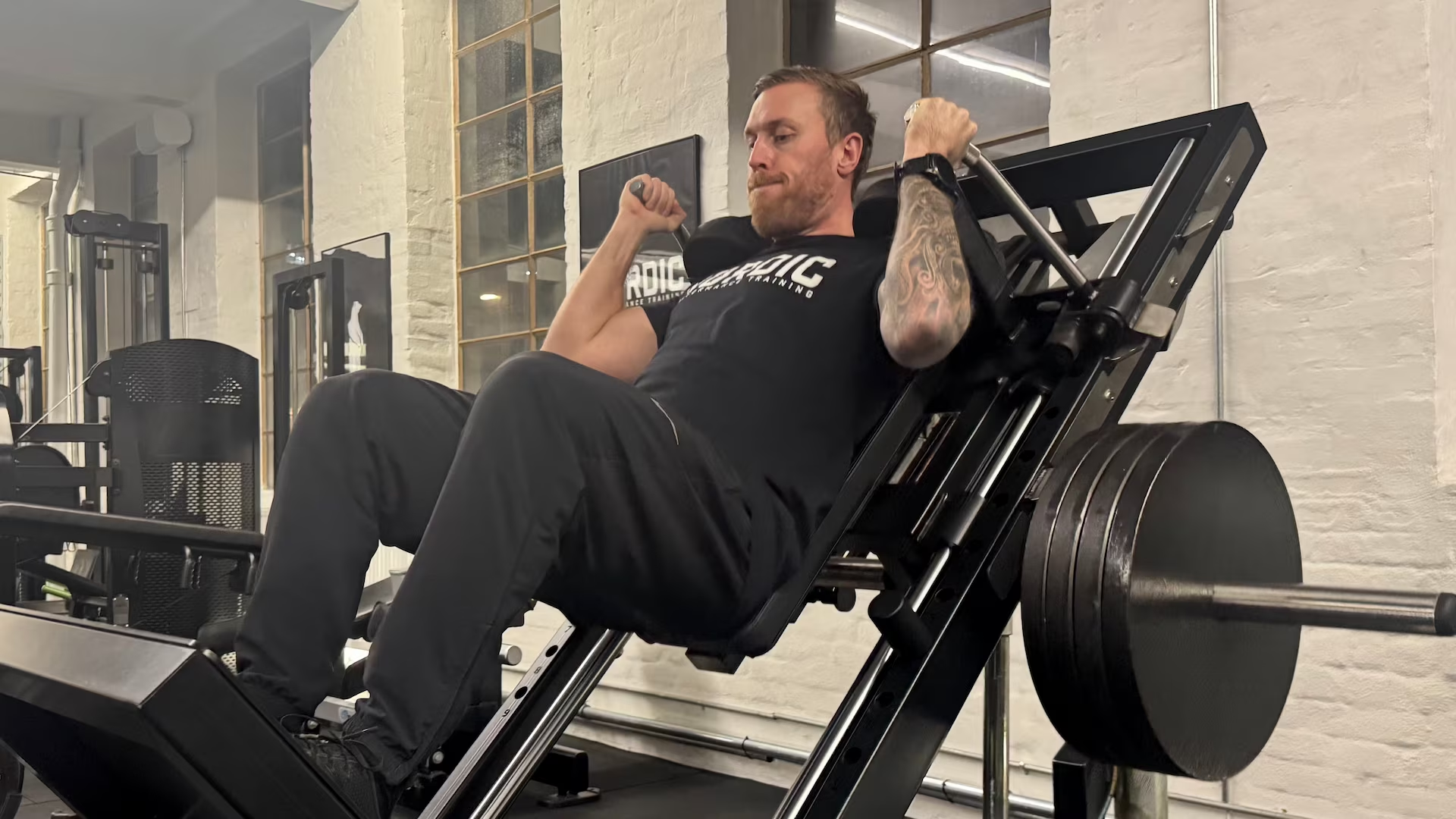
Hack Squat trains the entire lower body effectively, except for the hamstrings, which is why we always do it in combination with leg curls. But the most important thing is the axial loading down through the back, which "feeds" cartilage, bone, disc, and the rest of the structures.
Leg Curl trains what we don't get in our squat — and strong hamstrings are a necessity for being strong around the pelvis and lower back.
Bulgarian Split Squat trains one leg at a time and gives you "balance and strength training in one movement." It challenges the entire hip and lower back area in a functional position without requiring heavy loading on the back itself — but it simultaneously provides a rotational resistance that you actively have to fight against, and that makes the back more robust against that type of movement.
Glute Bridge targets the glutes directly. Strong glutes stabilise the entire lower back-pelvis-hip region and are one of the most central muscle groups to build up.
Romanian Deadlift is not an exercise we normally start our clients with. It's more technically demanding, and many are too nervous to try it. That can lead to them not getting the positive experiences we're after to get the positive loop going. But after some time, we can begin to include it in the program — to show our clients how strong their back is, and that it can also handle loading in that way.
We use double progression: you work your way up in repetitions with the same weight, and when you hit the top of the repetition range in all sets, you increase the weight. It's the simplest and most sustainable way to ensure you actually get stronger over time.
When should you see a doctor?
Most people with osteoarthritis in the back do fine with an adapted, active approach. But some situations require medical assessment:
- Pain that doesn't subside after 6-8 weeks with an active approach
- Progressive neurological deficits — growing weakness, increasing numbness
- Markedly worsened balance or walking function
- Symptoms accompanied by fever, unexplained weight loss, or general malaise
- Pain after trauma (fall, accident)
If you're in doubt, contact your doctor.
FAQ About Osteoarthritis in the Back
How does arthritis in the back feel?
The typical experience is stiffness, particularly in the morning and after longer periods of sitting. The pain is often diffuse and dull rather than sharp. It typically gets better when you've been moving for a while, and can return after longer periods of loading or sitting. Many describe it as a back that "needs to be warmed up" before it functions normally.
What is spinal arthrosis?
Spinal arthrosis is the medical professional term for osteoarthritis in the spine. It covers age-related changes in the facet joints and intervertebral discs. It's not a disease in the classic sense — it's a gradual change found in the vast majority of adults if you scan them. The changes correlate poorly with pain.
Are osteoarthritis and arthritis the same?
No, they are two different conditions that are often confused. Osteoarthritis (arthrosis) is an age-related change in the joint where the balance between breakdown and build-up of cartilage is shifted. It's not a disease in the classic sense. What many refer to as "arthritis" — typically rheumatoid arthritis — is an autoimmune, inflammatory disease where the body's own immune system attacks the joints. The two conditions have different causes, different courses, and different treatments. If you've been diagnosed with osteoarthritis, you don't have "arthritis" in the classic inflammatory sense — and the prognosis is significantly better.
What do you do about spinal arthritis?
The most effective approach is gradual strength training and movement. That's the opposite of "spare and rest" that many encounter — but it's the one with the best evidence. International guidelines recommend strength training as the first choice. Painkillers, massage, and passive treatments can dampen the symptoms short-term but don't address the cause.
What should you avoid when you have osteoarthritis in the back?
Nothing specific — other than inactivity and unnecessary fear of moving. There is not a specific movement that's dangerous for a back with osteoarthritis. You may bend forward, lift, squat, run, and do sports. It's about finding the loading level you can tolerate and building up from there.
Can osteoarthritis in the back lead to early retirement?
For the vast majority of people, the answer is no. Osteoarthritis in the back is not an automatic path to disability or retirement — it's a condition that becomes manageable with the right approach. We see it again and again with clients who were worried about the future: with systematic strength training and a plan they can maintain, the fear of losing their ability to work typically turns around within months.
Can osteoarthritis and disc prolapse be connected?
Yes, the two conditions often occur together. Osteoarthritis in the back typically includes gradual changes in the disc, and a disc prolapse can occur in the same area. This doesn't mean it's more serious — both conditions respond to the same basic approach: gradual loading and strength training. We've written extensively about disc prolapse in a separate article.
Should you have surgery for osteoarthritis in the back?
For the vast majority, the answer is no. Surgery is not a standard treatment for osteoarthritis — it only becomes relevant for specific complications like severe spinal stenosis with affected walking function, or progressive neurological deficits. Osteoarthritis alone is not an indication for surgery.
Can you run with osteoarthritis in the back?
Yes, and it's often beneficial. Joanna is a good example — she runs 3-5 km per week today after having been afraid to run for months. Research shows that recreational runners have a lower risk of developing osteoarthritis than inactive people. Loading you can tolerate is not an enemy for a back with osteoarthritis. It's part of what keeps the back healthy.
Less focus on the diagnosis, more focus on you
What typically works best for osteoarthritis in the back is not yet another treatment that circles around the diagnosis. It's a plan that builds the entire body up — and a practitioner who sees you as much more than a scan result. That's the approach Joanna found with us. And it's the one we offer you.
Book a free start-up conversation and hear how personal training in Copenhagen can look for you — either in our private gym or as a call, if that suits you better.
References
Brinjikji, W., Luetmer, P. H., Comstock, B., Bresnahan, B. W., Chen, L. E., Deyo, R. A., Halabi, S., Turner, J. A., Avins, A. L., James, K., Wald, J. T., Kallmes, D. F., & Jarvik, J. G. (2015). Systematic literature review of imaging features of spinal degeneration in asymptomatic populations. American Journal of Neuroradiology, 36(4), 811–816. https://doi.org/10.3174/ajnr.A4173
Suri, P., Hunter, D. J., Rainville, J., Guermazi, A., & Katz, J. N. (2013). Presence and extent of severe facet joint osteoarthritis are associated with back pain in older adults. Osteoarthritis and Cartilage, 21(9), 1199–1206. https://doi.org/10.1016/j.joca.2013.05.013
Alentorn-Geli, E., Samuelsson, K., Musahl, V., Green, C. L., Bhandari, M., & Karlsson, J. (2017). The association of recreational and competitive running with hip and knee osteoarthritis: A systematic review and meta-analysis. Journal of Orthopaedic & Sports Physical Therapy, 47(6), 373–390. https://doi.org/10.2519/jospt.2017.7137
Bannuru, R. R., Osani, M. C., Vaysbrot, E. E., Arden, N. K., Bennell, K., Bierma-Zeinstra, S. M. A., et al. (2019). OARSI guidelines for the non-surgical management of knee, hip, and polyarticular osteoarthritis. Osteoarthritis and Cartilage, 27(11), 1578–1589. https://doi.org/10.1016/j.joca.2019.06.011
Endean, A., Palmer, K. T., & Coggon, D. (2011). Potential of magnetic resonance imaging findings to refine case definition for mechanical low back pain in epidemiological studies: A systematic review. Spine, 36(2), 160–169. https://doi.org/10.1097/BRS.0b013e3181cd9adb
Munster, A. B., Bennell, K. L., Bricca, A., Holm, P. M., Roos, E. M., & Skou, S. T. (2023). Cartilage tissue turnover increases with high- compared to low-intensity resistance training in patients with knee OA. Osteoarthritis and Cartilage Open, 5(1), 100335. https://doi.org/10.1016/j.ocarto.2023.100335
Sundhedsstyrelsen (2025). Nationale kliniske anbefalinger for brug af paracetamol, NSAID og opioider til behandling af akutte lænderygsmerter hos voksne. https://www.sst.dk/nyheder/2025/medicin-virker-ikke-mod-akutte-laenderygsmerter
Table of Contents
Related Blog Posts


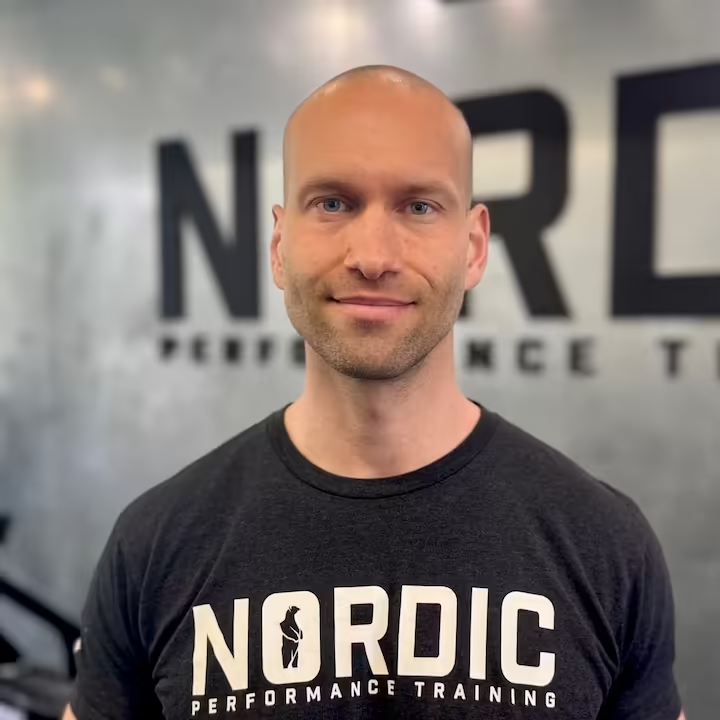
I’ve worked as a personal trainer for over 14 years and as a physiotherapist for over 8 years — and co-founded Nordic Performance Training with Kasper to give clients a professional, private, and structured training environment where results actually last. In that time, I’ve overseen more than 15,000 sessions and helped hundreds of clients rebuild after injuries, gain strength, improve their health, and stay consistent.
My approach combines practical experience with evidence from the latest research, making training both effective and realistic.
On this blog, I share the same methods we use every day at Nordic — so you can cut through the noise and focus on what truly works.



Related Blog Posts
.svg)