






Rotator Cuff: Pain, Exercises and Treatment
Nicklas, 41, accountant from Dragør, had played golf his entire life. As a child and throughout his youth, it was four to five days a week, but in recent years it had become more like a couple of times a week in the summer months. A couple of years ago, he had started playing padel, and he had played that twice a week since. It was around then that the pain in the shoulder began.
It started with a light irritation when smashing in padel. He didn't think much of it. A couple of weeks later, the irritation was also there during golf swings. A couple of months later, he couldn't sleep on his right side.
He went to the doctor, who referred him for an MRI. The answer came back with a formulation that made him nervous: "thickening of the supraspinatus tendon with signs of tendinopathy and mild fraying." His doctor recommended physiotherapy via the public health insurance card and painkillers as needed.
Nicklas started a program with a private physiotherapist. He got a leaflet with resistance band exercises, external rotations with a towel under the arm, and a couple of home exercises he was supposed to do every day. Plus manual treatment at the clinic every other week. He did it loyally for four to five months.
Some improvement, but not enough. He still couldn't play padel without pain. He had dropped his padel sessions for the last three months. He had started to fear that this was the end of his new hobby.
He was back at the doctor, who suggested a cortisone injection in the shoulder — corticosteroid that could dampen the pain for a period and hopefully give the shoulder rest. It wasn't a pleasant thought. Nicklas had read about the side effects and about how repeated injections can weaken the tendon further over time. He would rather find another way, but he was desperate, so he gave it a try. The pain was reduced for around 6-8 weeks — but then back to status quo.
A padel partner who had had a similar experience a couple of years earlier recommended him to book a start-up conversation with us.
The first thing we did was give Nicklas a more nuanced explanation of what his MRI result actually meant. Thickening and tendinopathy are some of the most common things you can find on a shoulder MRI — also in people without any pain whatsoever. His shoulder wasn't broken. It was irritated. And there's a crucial difference.
We put him on our regular full body program. No resistance band exercises. No isolated rotator cuff movements. Just completely normal strength training with an intensity that actually created adaptation, without provoking the symptoms. We took it easy the first weeks, with extra focus on the technique, so the shoulder could get going without being provoked, and he got a positive experience.
After eight weeks, Nicklas was pain-free. After three months, he was back on the padel court — at the same level as before.
He continued with us because it turned out to give him much more than a well-functioning shoulder. He had never been stronger. He had more muscle mass than he had ever had. More energy in everyday life. More confidence. And a quality of life he hadn't dared hope for when he walked through the door.
"When I see an MRI result with thickening and tendinopathy in supraspinatus, I don't see a client who is broken. I see a client who has been given a label that fits a large proportion of everyone his age — including those who play padel without problems. The most important thing we do is help people understand that such a finding is not a verdict on their shoulder. It's a description of something that's extremely common. When that fear disappears, we can get started with what actually works — making the shoulder and the rest of the body stronger." — Mikkel Krause, personal trainer & physiotherapist
What is the rotator cuff?
The rotator cuff — in Danish rotatormanchetten — is a group of four small muscles and their tendons that surround the shoulder joint. The four muscles are:
Supraspinatus — sits on top of the shoulder blade and helps bring the arm out to the side
Infraspinatus — sits on the back of the shoulder blade and rotates the arm outward
Teres minor — also on the back, helps with external rotation
Subscapularis — sits on the front of the shoulder blade and rotates the arm inward
Their combined function is not to produce large, powerful movements. It's to stabilise the shoulder joint and guide the upper arm's movement while the large muscles around it (deltoideus, pectoralis, latissimus) do the heavy work.
The shoulder joint is one of the body's most mobile joints. That also means it's structurally one of the least stable. The rotator cuff therefore contributes greatly to that stability together with the shoulder's larger muscles — it's a combined system, not isolated parts.
Supraspinatus — why it always gets the blame
Of the four, supraspinatus is the one that most often gets blamed for shoulder pain. That's due to two things.
Firstly, it sits in what many would call an exposed position. It passes through a tight space between the shoulder blade's projection (acromion) and the shoulder joint itself, and it's the one that's primarily mechanically loaded during movements above shoulder height. That's why pain in connection with lifting, throwing, and overhead activities is often attributed to supraspinatus.
Secondly — and this is the more important point — it's the muscle where MRI scans most often find changes. If you get an MRI of the shoulder after the age of 40, the probability is high that the radiologist will find "something" on supraspinatus: tendinopathy, thickening, partial tear, calcifications, or other changes.
It's precisely the same problem we see with L4/L5 in the lower back. The lower back gets scanned, and "something" is found at L4/L5 — disc degeneration, a bulge, a small prolapse — and it gets blamed for the pain. In both cases, the finding is often age-related and found equally frequently in people without pain.
The research is clear: rotator cuff changes are very common in adults without shoulder pain. Tendinopathy, thickening of the tendon, partial tears, and other changes are found in a significant proportion of adults — also in their 40s — without causing pain. A Japanese study examined 664 people from a village and found that full-thickness tears, which are the most dramatic category, were absent in people under 50, but were seen in around 11 percent of those in their 50s, 15 percent of those in their 60s, 27 percent of those in their 70s, and 37 percent of those in their 80s. Two-thirds of all tears were in people without any symptoms whatsoever. Smaller changes like tendinopathy and thickening are even more widespread and are also seen in younger people. That tells us something important: we're talking about age-related changes here, not injuries that need to be "repaired."
If you've been told that you have "tendinopathy," "thickening," or a "partial tear" on supraspinatus, and you have shoulder pain, there are two things in that. The first: yes, you probably have a finding. The second: no, the finding is not necessarily the cause of your pain.
Infraspinatus
Infraspinatus is the second most discussed. It's responsible for external rotation and is often measured in rehabilitation protocols where strength is tested during external rotation with the elbow close to the body.
The same logic applies here as for supraspinatus: findings on MRI are common with age, and the findings don't correlate well with pain experience. And the same treatment applies: a strong shoulder where the entire system works together is what helps — not isolated exercises that try to "fix" infraspinatus specifically.
Symptoms
The typical symptoms of rotator cuff irritation are:
- Pain at the top or front of the shoulder
- Pain when lifting above shoulder height
- Pain during specific sports movements (smash, throw, swing)
- Night pain — classic when you lie on the affected side
- A feeling of weakness or insecurity during specific movements
- Possibly mild radiation down along the outside of the upper arm
The symptoms most often develop gradually over weeks or months, precisely as with Nicklas. Acute traumas can happen — typically from falling on an outstretched arm or sudden overloading — but they're rarer than the gradual type.
What does your MRI result actually mean?
This is the part that frightens people the most, so we'll take it honestly.
An MRI result on the rotator cuff can cover a spectrum of findings:
Tendinopathy — irritation and change in the tendon without an actual tear. Extremely common.
Thickening — the tendon has become thicker as a reaction to loading over time. Also very common, particularly with age.
Fraying — small, superficial fibre cracks in the tendon. Sounds dramatic but is a common age-related change.
Partial tear — a partial tear in the tendon, not through the full thickness. Becomes more common with age.
Full tear — the tendon is torn through completely. More serious, but even here conservative treatment (without surgery) is often the first choice.
Massive tear — multiple tendons are torn. Rare, and typically requires medical assessment to determine next steps.
Most people who are told about "something" on the rotator cuff have a tendinopathy, thickening, fraying, or a partial tear. That's something entirely different from having "torn something." The shoulder is not broken. It's irritated, and perhaps in a condition that isn't optimal — but it's not destroyed, and it responds well to the right approach.
Even a confirmed full tear doesn't automatically mean surgery. Research shows that conservative treatment — gradual loading and strength training — produces good results for a majority of patients with full tears, particularly in those over 60.
That's the most important point in the entire article: an MRI finding on the rotator cuff is not a verdict on your shoulder.
Treatment
The most important point first: The shoulder needs loading — not protection.
That's the opposite approach of what most people are recommended. The classic rehabilitation protocol for rotator cuff problems typically consists of resistance band exercises with external rotations, light isometric exercises, isolated scapular stability exercises, and a gradual return to activity — all with very low load.
It's not because the exercises themselves are wrong. It's because the intensity is too low to create real adaptations. One of the world's leading shoulder physiotherapists has put it sharply: prescribing exercises without thinking about intensity is like prescribing medication without a dosage.
That's precisely what we often see with clients who have done rehabilitation exercises for months without progress. The exercises are perhaps fine enough. The intensity isn't. The shoulder hasn't been given a reason to get stronger — it's just been confirmed that it should be careful.
Our approach is different. We put clients on our regular full body program and adapt the load to what the shoulder can tolerate at the current time. Research shows that compound exercises like cable pulldown, chest press, and lateral raise activate the rotator cuff to a high degree — with an intensity that actually creates adaptation. The specific rotator cuff protocol has not been shown to be better than general structured strength training.
If you have the diagnosis "subacromial pain syndrome" or have been told you have "impingement in the shoulder," the principle is the same — we've written a more detailed article about impingement in the shoulder that covers that side of it.
Should you have surgery?
For the vast majority, the answer is no. Conservative treatment — structured strength training over 3-6 months — is the first choice for both tendinopathy, thickening, partial tears, and even many full tears.
Surgery is only a real consideration with specific criteria: acute complete tear after trauma (particularly in younger, active people), persistent weakness that doesn't respond to conservative treatment after 6-12 months, or progressive functional decline. It's a medical assessment, not a physiotherapy one — but it's worth knowing that an MRI finding doesn't automatically mean surgery is on the table.
Exercises
We don't have a special rotator cuff protocol. We have a full body program that we adapt. For clients like Nicklas, it's these three exercises that do by far the most work:
Cable Pulldown is one of the most fundamental exercises in our program. It trains the entire back's musculature effectively in a controlled path with high stability and easily adjustable weight — and involves significant activation of the rotator cuff, particularly subscapularis and infraspinatus.
Chest Press builds strength in the chest, shoulders, and triceps in a very stable position. It's an exercise where the rotator cuff works hard to stabilise and guide the shoulder joint while the larger muscles produce the movement — precisely the function the rotator cuff is built for.
Dumbbell Lateral Raise builds strength in the shoulder's lateral head, trapezius, and — particularly relevant here — supraspinatus, which is actively involved in the initial part of the movement where the arm begins to be lifted out to the side.
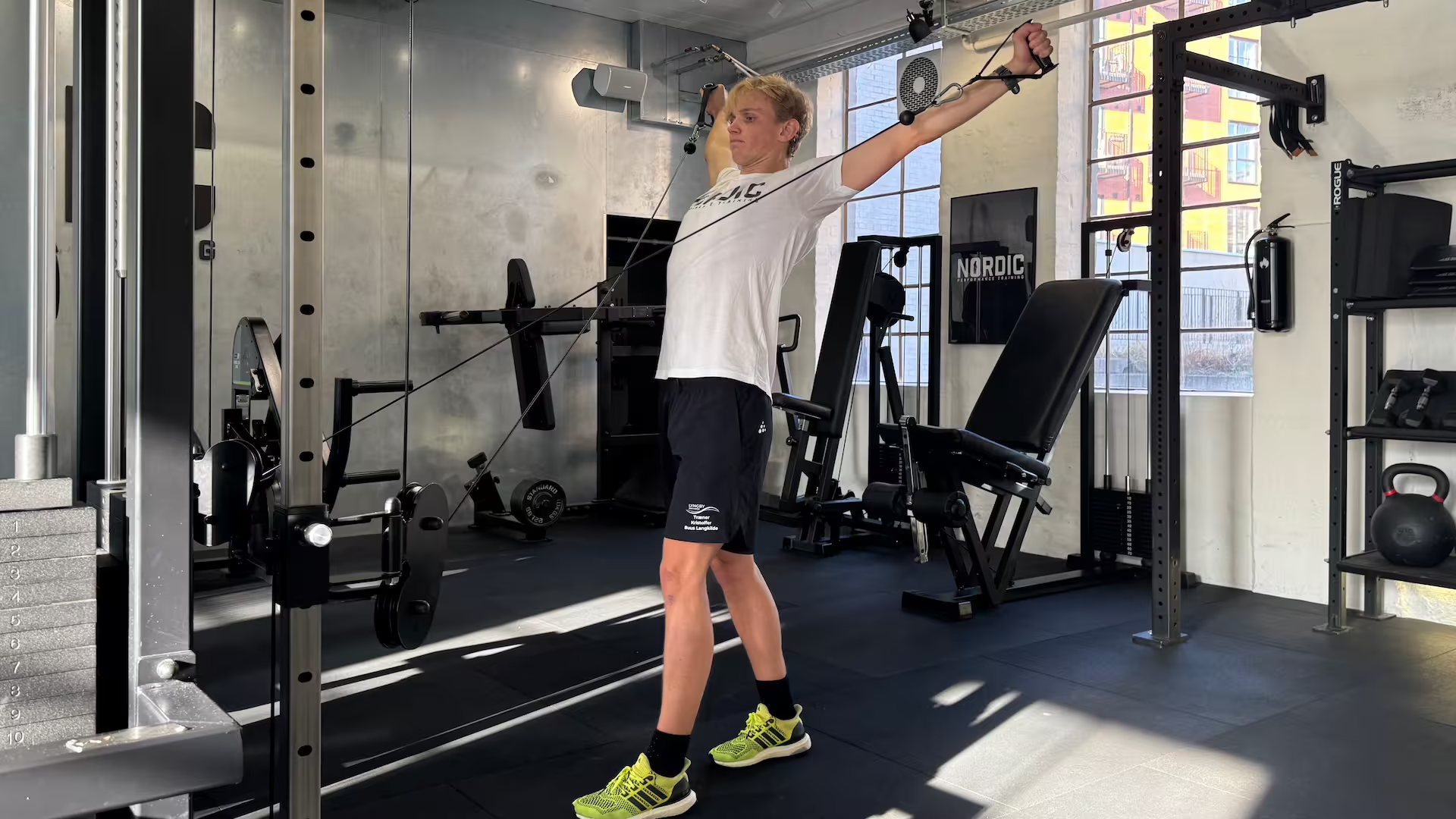
In cases where clients have specific limitations — e.g. with large mobility limitations or particular pain responses — we sometimes supplement with Cable Y-Raise or Cable Row, because cables provide the opportunity to adjust the resistance profile and find a range of motion that's best tolerated. But for the vast majority of clients with rotator cuff-related pain, our classic full body program is sufficient.
We use double progression: you work your way up in repetitions with the same weight, and when you hit the top of the repetition range in all sets, you increase the weight. It's the simplest and most sustainable way to ensure you actually get stronger over time.
When should you see a doctor?
Most cases of rotator cuff irritation respond well to structured strength training. But some situations require medical assessment:
- Acute trauma with sudden loss of strength — can indicate a complete tear
- You can't lift the arm actively, but passive range of motion is preserved
- Persistent pain that doesn't improve after 8-12 weeks with an active approach
- Progressive weakness over time
- Neurological symptoms like numbness or radiating tingling sensation down into the arm
If you're in doubt, contact your doctor.
FAQ About Rotator Cuff
How does supraspinatus pain feel?
Pain from supraspinatus is typically experienced at the top or front of the shoulder and can radiate slightly down the outside of the upper arm. It worsens with lifting above shoulder height and specific sports movements. Night pain — particularly when lying on the affected side — is classic and one of the most frequent reasons people seek help.
What does thickening of supraspinatus mean?
Thickening is one of the most common changes seen on MRI of the shoulder. The tendon has become thicker as a reaction to loading over time. It sounds dramatic but is found in many people without any pain whatsoever. It's an age-related adaptation — not an injury. It responds well to structured strength training.
What does fraying of the supraspinatus tendon mean?
Fraying describes small, superficial fibre cracks in the tendon — like an edge of fabric that has started to fray slightly. It sounds dramatic but is a common age-related change and is frequently seen on MRI in adults without pain. It's not a tear in the classic sense, and it responds well to structured strength training.
What does tendinopathy in supraspinatus mean?
Tendinopathy is a collective term for changes in the tendon — typically irritation, changes in the tendon's structure, or mild thickening — without an actual tear. It's one of the most common changes found on MRI of the shoulder, also in people without pain. The treatment is gradual loading and structured strength training, not rest.
Can a supraspinatus tear heal on its own?
This is a frequently asked question, and the answer is nuanced. A tear rarely heals in the sense that the tissue "grows back together." But that's the wrong way to think about it. Many people with a tear on MRI are completely pain-free and functional — without the tear having disappeared. What changes is not the finding itself, but how well the shoulder functions around it. With structured strength training, most people with a partial tear can become pain-free and functional, even though the tear will still be visible on a new scan.
How serious is a supraspinatus tear?
For most, the answer is: less serious than it sounds. This is one of those diagnoses where the language does real damage. "Tear" sounds dramatic and irreversible, but a partial tear is a completely common change that over half of all older adults have. Even a full tear is not automatically a serious matter — many respond well to conservative treatment. The situations that are truly serious are acute massive tears after trauma in active people — and that's a small minority.
How do you treat a supraspinatus tear?
For the vast majority, the answer is: gradual loading and structured strength training. Surgery is rarely the first choice, even with a confirmed tear. The short-term relief you can achieve with cortisone injections, massage, and manual treatment doesn't address the underlying problem — that the shoulder lacks the capacity to handle the load it's exposed to. What works long-term is making the shoulder and the rest of the body stronger.
Do you need isolated rotator cuff exercises?
For most: no. The classic rehabilitation with resistance bands and external rotations isn't wrong — it's just typically not intense enough to create real adaptation. Compound exercises like cable pulldown, chest press, and lateral raise activate the rotator cuff effectively and with sufficient intensity for the shoulder to actually get stronger over time.
Should you have surgery for rotator cuff?
Rarely, and only with specific criteria — acute complete tear after trauma, persistent weakness that doesn't respond to 6-12 months of conservative treatment, or progressive functional decline. For the vast majority with tendinopathy, thickening, partial tear, or other findings on MRI, conservative treatment is the first choice and produces good results.
What is rotatormanchetten?
Rotatormanchetten is the Danish name for the rotator cuff. It's a group of four small muscles — supraspinatus, infraspinatus, teres minor, and subscapularis — that surround the shoulder joint and stabilise it during movement.
Ready to get your shoulder back?
If you've been told you have "something" on the rotator cuff — a tendinopathy, a thickening, a partial tear, or something else — and have become afraid of what it means for your future and your sport, we understand. It's a fear we encounter every week.
It's also a fear that typically disappears when you experience that the shoulder actually responds to the right approach — and that it's not as fragile as the diagnosis sounds.
Book a free start-up conversation and hear how personal training in Copenhagen can look for you — either in our private gym or as a call, if that suits you better.
References
Kuhn, J. E., Dunn, W. R., Sanders, R., An, Q., Baumgarten, K. M., Bishop, J. Y., Brophy, R. H., Carey, J. L., Holloway, G. B., Jones, G. L., Ma, C. B., Marx, R. G., McCarty, E. C., Poddar, S. K., Smith, M. V., Spencer, E. E., Vidal, A. F., Wolf, B. R., & Wright, R. W. (2013). Effectiveness of physical therapy in treating atraumatic full-thickness rotator cuff tears: A multicenter prospective cohort study. Journal of Shoulder and Elbow Surgery, 22(10), 1371-1379. https://doi.org/10.1016/j.jse.2013.01.026
Littlewood, C., Bateman, M., Connor, C., Gibson, J., Horsley, I., Jaggi, A., Jones, V., Meakins, A., & Scott, M. (2019). Physiotherapists' recommendations for examination and treatment of rotator cuff related shoulder pain: A consensus exercise. Physiotherapy Practice and Research, 40(2), 87-94. https://doi.org/10.3233/PPR-190129
Minagawa, H., Yamamoto, N., Abe, H., Fukuda, M., Seki, N., Kikuchi, K., Kijima, H., & Itoi, E. (2013). Prevalence of symptomatic and asymptomatic rotator cuff tears in the general population: From mass-screening in one village. Journal of Orthopaedics, 10(1), 8-12. https://doi.org/10.1016/j.jor.2013.01.008
Escamilla, R. F., Yamashiro, K., Paulos, L., & Andrews, J. R. (2009). Shoulder muscle activity and function in common shoulder rehabilitation exercises. Sports Medicine, 39(8), 663-685. https://doi.org/10.2165/00007256-200908080-00004
Pavlova, A. V., Shim, J. S. C., Moss, R., Maclean, C., Brandie, D., Mitchell, L., Greig, L., Parkinson, E., Alexander, L., Brown, V. T., Morrissey, D., Cooper, K., & Swinton, P. A. (2023). Effect of resistance exercise dose components for tendinopathy management: A systematic review with meta-analysis. British Journal of Sports Medicine, 57(20), 1327-1334. https://doi.org/10.1136/bjsports-2022-105754
Table of Contents
Related Blog Posts
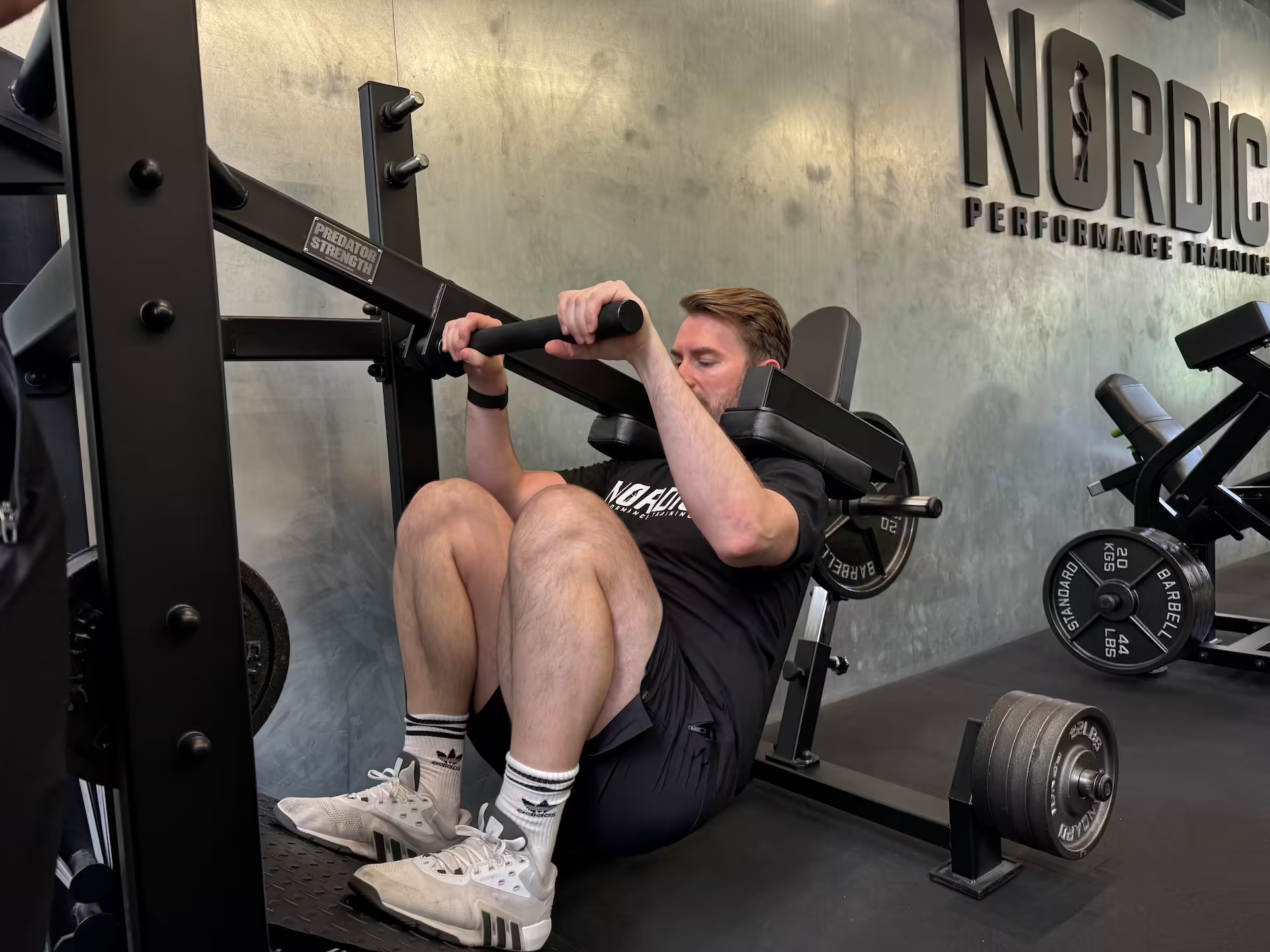


I have worked as a personal trainer and physiotherapist for many years, and I bring a calm, attentive approach to every session — taking the time to listen and understand the person I'm working with. I believe the best results come when training fits your life and your body, not the other way around.
My background in clinical practice gives me a solid foundation for working with people at any starting point — and I'm always mindful of when to push and when to hold back.
On this blog, I share the same methods and insights we use every day at Nordic — so you can train smarter, stay consistent, and achieve results that last.



Related Blog Posts
.svg)