





Hip Thrust: Complete Guide to Technique and Muscles
Hip thrust is one of the most well-known and popular exercises for the glute muscles — and if you search for "glutes of steel," it's probably the first exercise you come across. And that's with good reason, because hip thrust is an extremely effective hip extension exercise that trains especially the large glute muscle, gluteus maximus (also called glutes), directly and the quads (quadriceps) statically, with heavy load.
But it's also one of the exercises we see the most people do incorrectly. Or at least with less than optimal technique. And we also find that people burn out on it due to the large, impractical time requirement for setting up the exercise and all the many weight plates that need to go on to load it heavy enough. That's also why it's not the exercise we primarily use with our clients in our private training centre, and in this article we explain precisely why.
Katrine, 38, marketing manager from Frederiksberg, came to us after half a year of hip thrusts at her previous fitness centre. She had learned about the exercise on Instagram, become quite good at the exercise, and seen quite impressive progress in the weight she could get on the bar — but also increasing discomfort in the lower back after each session, and it actually burned more in the quads, which became fatigued long before the glutes got to be the limiting factor in the exercise.
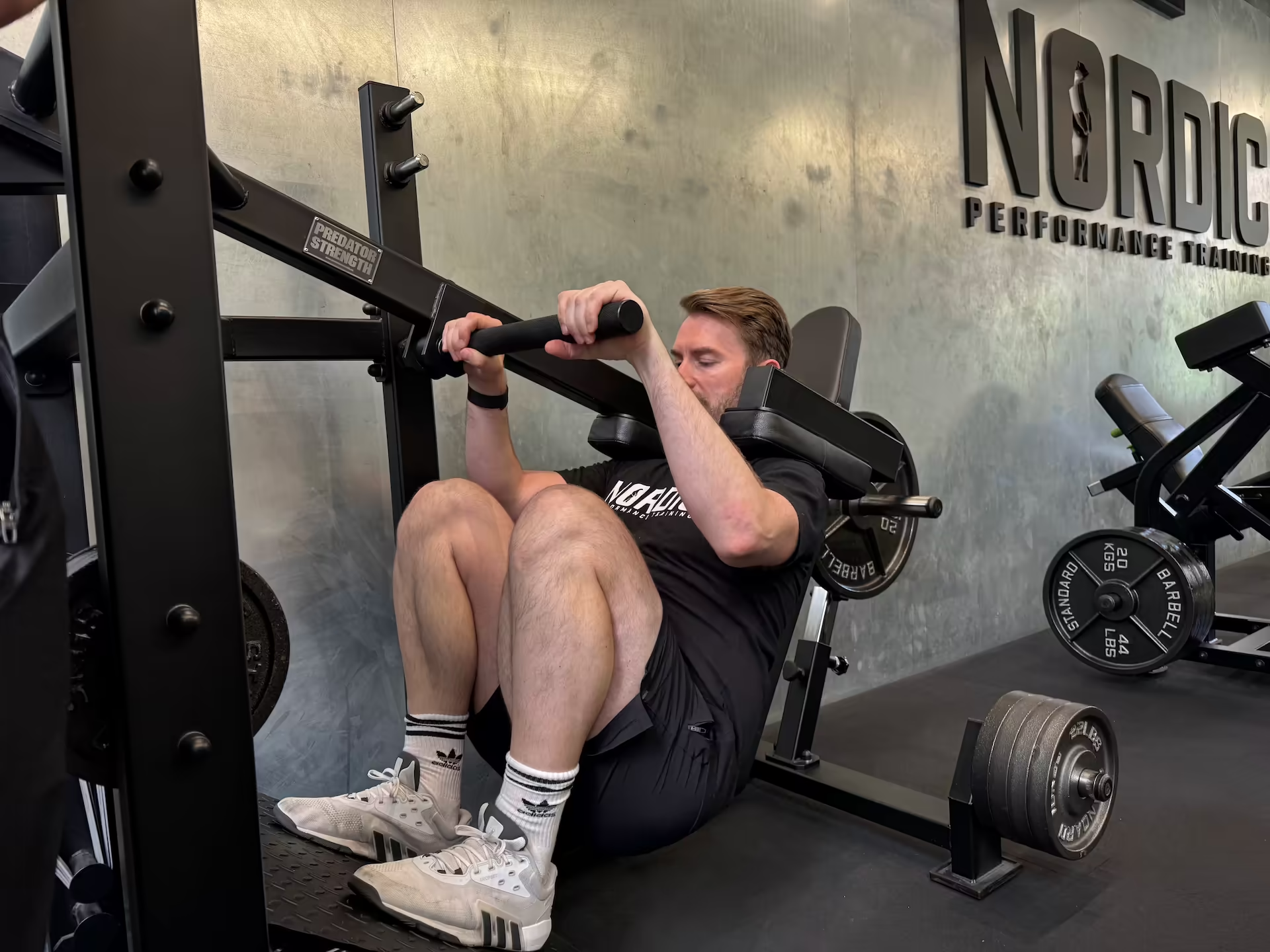
When we saw her perform the exercise, it was clear: She was hyperextending the lower back at the top of every single rep and pushing herself backward, so her body "slid" backward via knee extension, rather than upward via hip extension. We taught her a different way to perform the exercise, in our glute drive machine. And after a couple of sets, it was quickly the glutes she felt working and she achieved the "pump" she wanted from the exercise, rather than a sore lower back and exhausted quads.
If you've experienced the same problem when you've tried hip thrust, this guide gives you everything you need to learn how to fix it: What hip thrust is, which muscles it trains, how to perform it correctly — and why we at Nordic Performance Training prefer a hip thrust execution that leans more towards what most people characterise as a glute bridge.
What is a hip thrust?
A hip thrust is a hip extension exercise where you sit on the floor with the upper back resting against a bench and a barbell resting over the hips. From that position, you drive the hips upward to full hip extension at the top — and lower them in a controlled manner back to the starting point.
It's a relatively simple movement. The purpose is to fully extend the hip joint under load and thereby train gluteus maximus — the large glute muscle — directly and heavily. This makes it popular both with people who specifically want to develop their glutes and in sports contexts where hip extension strength is crucial — sprinting, jumping, and explosive direction changes all require powerful hip extension.
The hamstrings contribute secondarily, but to a limited extent: because the knee is bent in the setup, the hamstring muscles are already shortened over the knee joint and cannot produce much force. Adductor magnus assists in the lower part of the movement, below 90 degrees of hip flexion. And the quads work isometrically — they actively press the torso back against the bench at the bottom and counteract the body falling toward the floor.
The most important thing to understand about hip thrust is that you are markedly stronger at the bottom of the movement than at the top. The top is the weak part — and that's precisely where the exercise gives the most. Gluteus maximus is strongest at full hip extension, in the fully shortened position. If you can't achieve and control the top position, the weight is too heavy — and that's the mistake we see most often. More on that in the technique and mistakes sections below.
How to do hip thrust correctly
Setup
Position yourself on the floor with the upper back against the edge of a bench — the edge should sit right at the lower edge of your shoulder blades. The ideal bench height is 30–40 cm. A standard training bench is typically 43–50 cm high and is too high for most people — it makes it harder to achieve correct pelvic position and full hip extension at the top. A plyo box or a dedicated hip thrust bench are better alternatives. If you're under 175 cm, 30 cm is typically ideal. If you're over 175 cm, 35–40 cm works better.
The feet are at hip-width distance, slightly externally rotated. The knees should be approximately 90 degrees bent — neither too close to the body nor too far away. Check it at the top: when the hips are fully extended, the shin should be vertical and the knee placed over the ankle.
The barbell is placed low over the hips — close to the groin, not over the stomach. A bar placed too high facilitates a forward-tilted pelvis already from the start and makes it harder to achieve full hip extension at the top. Use a barbell pad or a towel to reduce discomfort. Take a slightly wider grip on the bar, extend the elbows, and pull the shoulders up — this gives a stable base to press from.
Start with slight hip flexion and find a neutral pelvic position before you begin.
Execution
The movement starts from the hips — not from the spine. You should drive the hips upward with active hip extension, not use momentum to fling the weight up.
Think "up and forward" — not "backward and up." If you push the hips backward instead of forward, the body slides along the bench and the quads begin to take over via knee extension. Press the feet actively down into the floor — not forward — and drive the hips up and forward.
At the top, the hips should be fully extended with a neutral pelvis. This is where gluteus maximus is strongest — in the fully shortened position. Hold the top position for a moment. The neck remains neutral throughout.
Lower the hips in a controlled manner back to the starting point and repeat.
Tempo and control
Hip thrust is traditionally used as an explosive exercise to train force production in sport — you "thrust" the weight up from the bottom at high speed. That's a legitimate approach with a specific purpose.
But when the goal is to train the glutes effectively, control is more important than explosiveness. Control the weight slowly down, and gradually squeeze harder and harder on the way up — rather than launching the weight with a jerk from the bottom. This ensures the glutes do the work throughout the entire part of the movement where they are trained most effectively.
If you can't control the top position, the weight is too heavy. You are markedly stronger at the bottom than at the top, and it's easy to use that strength to launch the weight with momentum. Resist the temptation. See a demo-video here.
The 5 most common mistakes
The weight is too heavy to control the top position. This is the mistake we see most often — and the one that ruins the entire purpose of the exercise. You are markedly stronger at the bottom than at the top, and it's easy to launch a heavy bar from the bottom with momentum. But if you can't achieve and hold full hip extension with a neutral pelvis at the top, you miss precisely the part of the movement where the glutes are strongest and trained most effectively. Start lighter than you think you need to. The top is what matters most — not how much is on the bar.
The entire body slides backward instead of up. When the movement isn't controlled correctly, the entire body slides backward along the bench — and the quads begin to drive the movement via knee extension instead of the hip extensors. Use the hips as your aiming point on the way up: drive them up and forward. At the same time, press the feet actively down into the floor — not forward — and the body follows upward instead of backward.
The lower back arches at the top as compensation. When the weight is too heavy for full hip extension, it's tempting to tip the top of the pelvis and the stomach forward to get the bar all the way up. But that's not the same as extending the hip joint into neutral — and it's precisely in the neutral top position that gluteus maximus is strongest and trained most effectively. If you arch the lower back, you cheat yourself out of the part of the movement that provides the most glute training.
The bar is placed too high. A bar that sits over the stomach instead of low over the hips, close to the groin, facilitates a forward-tilted pelvis already from the starting position. This makes it structurally harder to achieve full hip extension at the top — regardless of how good your technique otherwise is. The bar should sit low.
The bench is too high. A standard training bench at 43–50 cm is too high for most people. It forces the shoulders up at an awkward angle, reduces the range of motion, and makes it harder to find a neutral pelvic position from the start. Use a plyo box or dedicated hip thrust bench at 30–40 cm.
Variations and progressions
Variations of hip thrust
The classic barbell hip thrust is the standard. But the exercise can be performed in several ways depending on equipment and purpose.
Hip thruster machine: Easy to get into, easy to adjust the load, and easy to focus exclusively on the movement itself. Removes all the setup hassle with bar, weight plates, bench, and pad. It's the variant we primarily use at Nordic Performance Training — more on that in the next section.
Dumbbell or kettlebell: Held in the lap instead of a barbell. Simpler to get into position with and a good choice when you start adding load. But as the weight increases, it quickly becomes impractical — a 40 kg dumbbell is both awkward to lift into the lap and hard to keep stable during the exercise. At that point, a barbell or a machine is the more manageable choice.
Single-leg hip thrust: One foot on the floor, the other leg extended. Places greater demands on balance and coordination — but that doesn't make it a better exercise than the classic variant with both legs. It's a specific choice that can be used to reveal and work on strength imbalances or with limited equipment, e.g. home training.
B-stance hip thrust: A middle ground between the classic with both legs and the single-leg variant — one foot carries the majority of the weight, the other is used primarily for balance. Gives more focus on one leg at a time without the full balance demands of single-leg. A variation that can make sense for those who want more focus on one leg at a time without going fully to single-leg.
Resistance bands around the knees: A popular variation where a band is placed just above the knees to create resistance against abduction. Many find that it gives a feeling of more "tension" in the glutes — but research suggests that the band can actually reduce gluteus maximus activation rather than increase it. This is because full shortening of gluteus maximus requires hip extension combined with slight external rotation — and a band that constantly pulls the knees inward can interfere with the natural movement pattern.
How to ensure progression in hip thrust
Progression in hip thrust is simple: a bit more weight or one more repetition than last time — with the same good technique. That's the only thing that counts.
Switching from glute bridge to hip thrust to single-leg is not a progression. It's an exercise switch. Choose the variant that suits you and stick with it. Increase the load systematically over time.
The most reliable method is double progression: You train within a fixed repetition range — e.g. 6–8 repetitions. When you can do 8 repetitions with good technique, you increase the weight next time and start over at 6. Read more about how to use double progression in practice in our guide to progress in strength training.
Hip thrust vs. glute bridge — what's the difference, and what do we choose?
We get that question often. And it makes good sense to ask it — because the two exercises resemble each other, but they're not exactly the same.
Technically, the difference is simple. In hip thrust, the upper back is placed on a bench, and the hips can therefore move through a greater range of motion before the buttocks hit the floor. In glute bridge, the shoulders lie flat on the floor, and the range of motion is shorter — the work is therefore performed exclusively at the top of the movement. Both are hip extension exercises. Both train the glutes.
But as we've covered earlier in this article, it's precisely the top of the movement that is the most important. That's where gluteus maximus is strongest compared to the other muscles that can perform hip extension. And that's precisely where glute bridge takes place. Because you can't go far down into hip flexion and can't assist with the quads in the same way, it's much harder to use momentum and "thrust" the weight up. It becomes more focused glute work.
Hip thrust covers a greater range of motion, which means the quads have to work harder to push the back against the bench and counteract gravity pulling the body down toward the floor. That's smart if you want to allow a more explosive movement where you build momentum from the bottom and therefore can lift a significantly heavier weight. But as we saw with Katrine, it's precisely that combination — quad involvement and heavy weights — that caused her to compensate at the top. Because when an exercise is sufficiently hard, the body finds the easiest way to move the weight from point A to B. And that's rarely via full hip extension at the top if the weight is too heavy — but rather by pushing itself backward on the bench and arching the pelvis forward. Precisely what caused Katrine to no longer feel it in the glutes, but burned out in the lower back instead.
At Nordic Performance Training, we perform our hip thrust more as a glute bridge movement in our glute drive machine rather than classic barbell hip thrust. This way, we avoid the pitfalls that most people fall into and choose the most practical and effective way to achieve a good training of the glute musculature. It's a professional choice based on four concrete reasons.
We train the glutes where they are strongest. Glute bridge is hardest at the top — precisely where gluteus maximus produces the most force relative to the other hip extensors. It's the same principle we covered in the technique section: the top is the purpose, not the bottom.
It fits better into our programme design. We already train hamstrings specifically with leg curl and quads with hack squat as a part of our Full Body program. We want an exercise that is focused on gluteus maximus in its strongest position — not one where you can use the quads to compensate through the part of the movement.
It's easier to standardise and requires less weight. Because the exercise works more focused at the top, you don't need the same heavy load as with hip thrust to give the glutes an effective training stimulus. This makes the exercise more practical to approach, easier to set up, and far more sustainable to keep doing over time. For us, this means that clients actually get the exercise done regularly and feel motivated for it — rather than burning out on it due to the hassle with bar, weight plates, and pad.
The machine gives better control and progression. The glute drive machine removes all the setup hassle and lets you focus exclusively on the movement itself and the load from the first session. The controlled tempo we use — slowly down, gradually harder and harder up — is far easier to keep consistent in a machine than with a heavy barbell.
That's why we prefer hip thrust performed as a glute bridge movement in a glute drive machine — and it's a professional and practical decision, not a dogma. Read our complete glute bridge guide, where we cover the exercise in detail. If you’re looking to add an exercise that targets the gluteus maximus in its lengthened position—at the bottom of the movement—the Bulgarian split squat is a great choice.
“Glute bridge is our choice because it’s easy to standardize — a defined range of motion, consistent tempo, almost pure glute work which makes it easy to control the weekly training volume — and with the machine we remove all the hassle.” — Kasper, physiotherapist at Nordic Performance Training.
Frequently Asked Questions About Hip Thrust
What does hip thrust train?
Hip thrust primarily trains gluteus maximus — the large glute muscle that drives hip extension. Secondarily, the hamstrings contribute, and the quads work isometrically to hold the body stable against the bench. Gluteus maximus is strongest at the top of the movement at full hip extension — and that's precisely where the exercise gives the most.
How many sets and repetitions should you do in hip thrust?
3 sets of 6–8 repetitions is a good starting point. The weight should be challenging, but not so heavy that you can't control the top position. When you can do 8 repetitions with good technique, you increase the weight next time. Read more in our complete strength training guide.
Is hip thrust better than squat for glutes?
No — they train the glutes in different positions and complement each other. Squat loads gluteus maximus in the stretched position at the bottom. Hip thrust loads it in the shortened position at the top, at full hip extension. If your programme already has a squat variant, hip thrust adds something the squat doesn't cover.
What's the difference between hip thrust and glute bridge?
In hip thrust, the upper back rests on a bench and the hips move through a greater range of motion. In glute bridge, the shoulders lie on the floor and the work takes place exclusively at the top — where gluteus maximus is strongest. At Nordic Performance Training, we prefer the glute bridge movement in a machine, because it's more focused, easier to standardise, and requires less weight. Read our complete guide to glute bridge.
Can you do hip thrust at home?
Yes — start with glute bridge from the floor, where the shoulders lie flat and the knees are bent. Requires no equipment. If you want to add load, you can hold a dumbbell in the lap. For full hip thrust at home, you need a stable surface at 30–40 cm. Remember to work close enough to fatigue — if you can easily do 20+ repetitions with body weight, you need extra load.
Should I use resistance bands around the knees during hip thrust?
No — it can actually counteract the purpose. Full shortening of gluteus maximus requires hip extension combined with slight external rotation, and a band that constantly pulls the knees inward can interfere with precisely that. Focus instead on achieving and controlling the top position with a neutral pelvis.
Ready to train the glutes more effectively?
Hip thrust is a good exercise — but as we've covered in this article, the results depend heavily on the technique. And technique is precisely what we help with.
If you'd like help getting started, or want to make sure you actually feel it in the glutes and not in the lower back and quads — then book a free start-up conversation. Either in our private gym in Copenhagen or as a phone call, if that suits you better. We'll go through what makes sense for you specifically.
References
Contreras, B., Vigotsky, A. D., Schoenfeld, B. J., Beardsley, C., & Cronin, J. (2015). A comparison of gluteus maximus, biceps femoris, and vastus lateralis electromyographic activity in the back squat and barbell hip thrust exercises. Journal of Applied Biomechanics, 31(6), 452–458. https://doi.org/10.1123/jab.2014-0301
Contreras, B., Vigotsky, A. D., Schoenfeld, B. J., Beardsley, C., & Cronin, J. (2016). A comparison of gluteus maximus, biceps femoris, and vastus lateralis electromyography amplitude for the barbell, band, and American hip thrust variations. Journal of Applied Biomechanics, 32(3), 254–260. https://doi.org/10.1123/jab.2015-0091
Kennedy, D., Casebolt, J. B., Farren, G. L., Bartlett, M., Strong, L., & Lane, C. (2023). Electromyographic differences of the gluteus maximus, gluteus medius, biceps femoris, and vastus lateralis between the barbell hip thrust and barbell glute bridge. International Journal of Strength and Conditioning, 3(1). https://journal.iusca.org/index.php/Journal/article/view/223
Plotkin, D. L., Rodas, M. A., Vigotsky, A. D., McIntosh, M. C., Breeze, E., Ubrik, R., Robitzsch, C., Agyin-Birikorang, A., Mattingly, M. L., Michel, J. M., Kontos, N. J., Lennon, S., Frugé, A. D., Wilburn, C. M., Weimar, W. H., Bashir, A., Beyers, R. J., Henselmans, M., Contreras, B. M., & Roberts, M. D. (2023). Hip thrust and back squat training elicit similar gluteus muscle hypertrophy and transfer similarly to the deadlift. Frontiers in Physiology, 14, 1279170. https://doi.org/10.3389/fphys.2023.1279170
Table of Contents
Related Blog Posts


I’ve worked as a personal trainer for over 12 years and as a physiotherapist for over 10 years — and co-founded Nordic Performance Training with Lucas 8 years ago to give clients a professional and structured way to train. Since then, I’ve helped hundreds of people build strength, stay consistent, and feel better through evidence-based methods that actually work.
Along the way, I’ve completed advanced certifications and mentored under leading experts in various fields, and I’ve taught many trainers and physiotherapists internationally.
On this blog, I share the same practical tools, insights, and strategies we use every day at Nordic — so you can train smarter, stay consistent, and get real results.



Related Blog Posts
.svg)