









Ab Exercises: The Best Exercises for Core and Abs
Most people we talk to have an expectation that ab training involves a program filled with exercises like planks, crunches, and Russian twists. Which are all good exercises, but far from a necessity if you want the visible six-pack look many strive for. And if your goal is to build a strong core and get rid of lower back pain, then too much focus on such core-specific exercises can actually work against that goal.
That was also the experience for our client Patricia, 36, from Amager, who works in marketing. She had struggled with lower back pain to varying degrees for many years. She had tried most things — traditional physiotherapy, body SDS, acupuncture, osteopath, chiropractor. And the common denominator from most treatments was that she had been given various mechanical causal explanations, such as something being crooked or specific stabilising muscles not being strong enough, and had therefore been given a lot of different stabilising ab exercises that were supposed to correct and fix it. She had therefore spent a lot of time and energy on activating her core correctly and had developed an understanding that something was wrong with her back.
All the treatments and advice certainly came from a good place. But the big focus on the specific area where she had pain actually just made things worse, not better.
The pain simply began to take up more and more space in her consciousness and everyday life.
When she came to us for help, it was therefore clear to us that the approach should be completely different. We gave her no ab exercises at all during her first program. Just our simple full body program with primary focus on the big compound exercises. After three months, the lower back pain was as good as gone. She still trains with us once per week to this day, and now she has reached a point where she has an ab exercise in the program that she actually looks forward to doing.
"When something hurts, the natural reaction is to focus on it. But that's rarely the right approach — it should at least be done in moderation. The brain is plastic, which means the more you focus on a painful area, the more you think about what's wrong, the more you're confirmed that something is broken, crooked, or weak, the more the nervous system learns that this is the truth and that you're in danger — which naturally results in you becoming more sensitive over time and in a way better at feeling the pain. Fortunately, the opposite is also true: When you start using the body again — calmly, systematically, and without provoking and focusing too much on the pain — the nervous system learns that movement is safe. And pain sensitivity decreases over time." — Kasper Vinther, personal trainer & physiotherapist at Nordic Performance Training
Another example is August, 29, pharmacist from Holte, who wanted a well-defined stomach. He did lots of different ab exercises with many repetitions, so it really burned in the abs. He did this several times per week. It was time-consuming and mentally challenging, and the results he wanted didn't come.
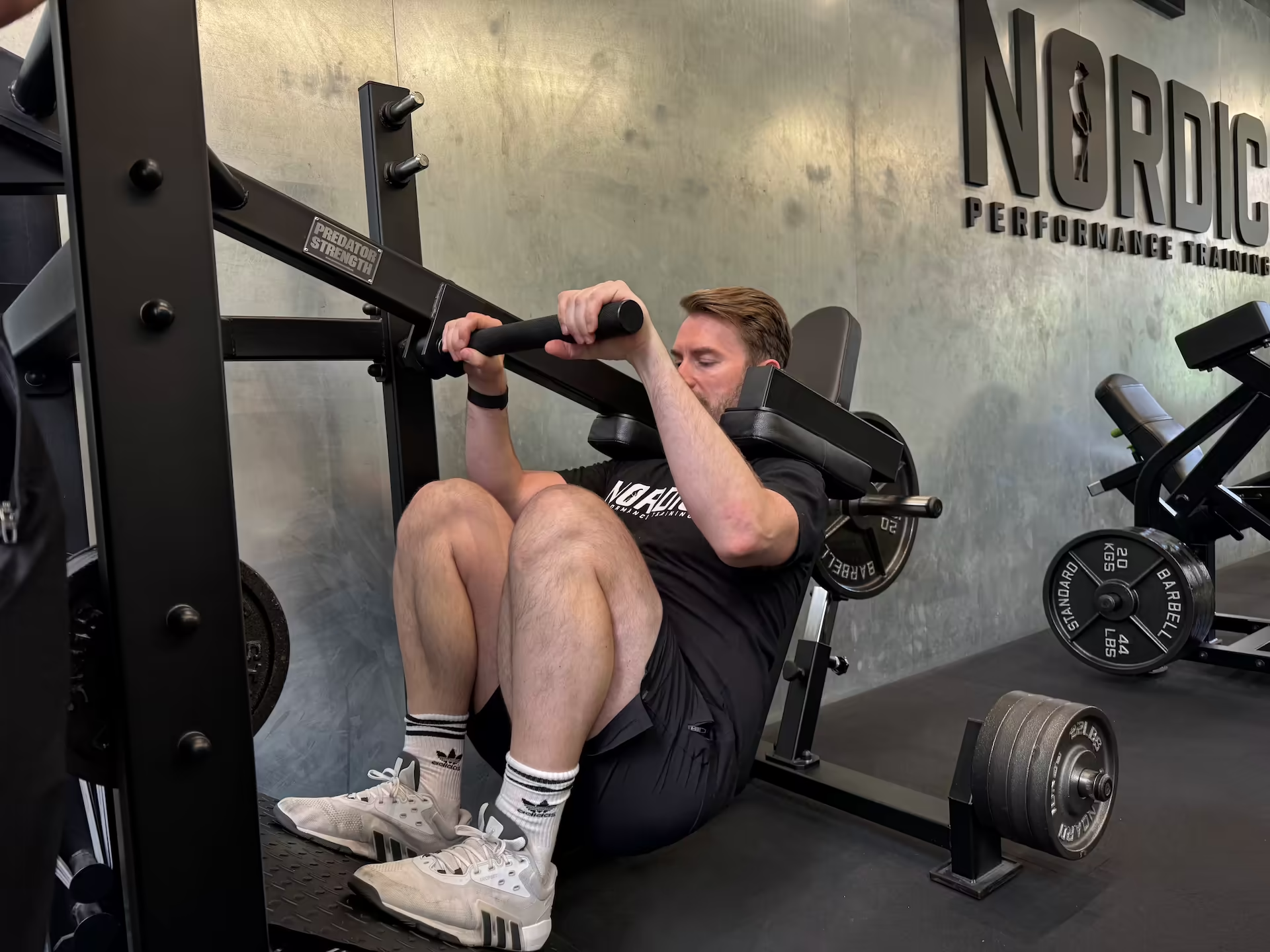
We immediately understood what the problem was and cut it down to one exercise: reverse ab crunch, 3 sets, 6-8 repetitions, 2 times per week, in connection with his full body sessions. We followed double progression — the same system as all other exercises — and increased the load systematically over time. After 24 weeks, he had better results than ever and clear data showing he was actually getting stronger week by week. As opposed to before, where he just trained a lot, got it to burn, and hoped for the best.
"Many believe the abs need to be trained in a completely special way — with hundreds of repetitions, special breathing techniques, or isolated core exercises. But we do the same as with all other muscles: 3 sets of 6-8 repetitions with a challenging weight, 1-2 times per week. It works. And it's something you can stick with." — Lucas Iversen, personal trainer & physiotherapist at Nordic Performance Training
What is core — and is it the same as abs?
Core and abs are often used as synonyms. They're not.
Abs typically refers to rectus abdominis — the muscle responsible for the classic six-pack appearance. It flexes the spine and also ensures the lower back stays stable, e.g. when you hold a plank and counteract the stomach sinking down toward the floor.
Core is much broader. It covers the entire stabilising musculature around the spine and pelvis: the obliques, the deep transverse abdominal muscle (transversus abdominis), the back extensors (erector spinae), the diaphragm, and the pelvic floor. Together, it's these muscles that keep the spine stable during movement and loading.
But here's the point many overlook: core is already trained hard enough in our basic exercises. Exercises like hack squat, leg curls, split squat, leg extensions, and lateral raises require active stabilisation of the entire trunk musculature under real load — without you actively thinking about it. And our training incidentally covers all the movement directions the spine benefits from: axial loading in squat, rotation in split squat and single arm exercises, lumbar extension in pulldowns, and flexion in ab exercises. This promotes circulation and nutrition in disc tissue, ligaments, and muscles — and is one of the reasons structured strength training is so effective for the back's health in the long term.
Personally, I only do reverse ab crunch and hanging ab crunch as direct ab training — and in periods no ab exercises at all. Yet I run marathons, complete Ironmans, and lift heavy in everyday life without problems. Not despite skipping core exercises — but because my core is already strong from years of structured strength training.
And there's yet another practical point: When you already have press, pull, squat, leg curl, lateral raise, and perhaps arm exercises in the program, there isn't much time and surplus left. We work according to an essentialist principle — we don't add exercises unless they're essential and something you'll realistically keep doing over time. An ab exercise has to earn its place. For most, it doesn't. For some, it does.
The best core exercises are not ab exercises
It may sound counterintuitive — but the exercises that train your core most effectively are probably already in your program. Hack squat, split squat, and leg curl all require active stabilisation of the trunk musculature under real load, week after week, with gradually increasing weight. For the vast majority, that's more than sufficient.
It's comparable to hack squat and legs: hack squat trains quads and glutes effectively and provides most of the stimulus you're after. Leg extension and glute bridge can be added if you want to maximise — but it requires more time and surplus, and for most it's not necessary.
The same logic applies to core. Direct ab exercises are not harmful or wrong — they just don't always fit into a program where we already have press, pull, squat, and leg isolation. We only add them when there's a good reason for it.
What we are sceptical of, however, is the use of core exercises as treatment for back pain. Research and clinical experience — including Professor Eyal Lederman's work "The Myth of Core Stability" — shows that the premise of isolating and strengthening specific deep muscles to fix the back is not evidence-based. And as Patricia's story illustrates, too much focus on the painful area can actually make back pain worse. Read more in our guide to lower back pain.
Ab exercises you can supplement with
When it makes sense to add direct ab training — either because you train two or three times per week and have time for it, or because you have a specific aesthetic goal — here are the exercises we use.
Reverse ab crunch on bench
Our starting point for most. You lie on your back on a bench and pull the knees in a controlled manner toward the chest. The incline of the bench can be increased gradually to increase the intensity — that's our primary progression method. Start flat, increase the angle as you get stronger.
Simple to learn, quick to set up, and simple to increase systematically in repetitions and incline.
Hanging ab crunch
The most advanced variant — and the exercise we use for clients who are ready for it, like August. You hang from a bar — or in hanging ab crunch straps like we use, where you put your arms through and therefore don't have to spend energy on the grip — and pull the knees or legs up toward the chest. Places large demands on the upper body to stabilise the torso and shoulder joint, and simultaneously provides a powerful stimulus to the entire abdominal musculature.
Progression happens by gradually extending the legs more — from bent knees to straight legs — and by adding weight to the ankles.
Progression
Ab exercises follow the same principle as all other exercises. 2-3 sets of 6-8 repetitions with a load that's challenging enough — and increases over time. Use double progression and increase the load systematically over time. That's precisely what made the difference for August.
A final point: it's not the case that ab exercises are bad for the back and we actively avoid them — on the contrary. The spine benefits from going into full flexion, just as it benefits from axial loading, rotation, and extension in other exercises. It promotes circulation and nutrition in the soft structures and is healthy for the back in the long term. The point is not to avoid ab exercises — but to have the right context. As completely simple and effective strength training, not as targeted treatment of back pain.
The most common mistakes
Too many repetitions with too low load. The classic mistake with ab training. Many do 50-100 crunches at a time believing it's effective. But research shows that above approximately 30 repetitions, CNS fatigue begins to reduce the nervous system's ability to recruit the high-threshold motor units — the fibres that have the greatest potential for strength and growth. A study showed that 100 repetitions can reduce muscle activation by 20-30%. The last many repetitions probably don't stimulate any hypertrophy at all.
And there's yet another reason to avoid it: training with many light repetitions to failure is uncomfortable in a way that's hard to stick with. Research with Schoenfeld as co-author showed that moderate load gave a positive experience after training, while light load to failure gave a markedly worse experience and more discomfort. It's no coincidence that many drop out. 3 sets of 6-8 repetitions with a proper weight is both more effective and far more pleasant to come back to week after week.
Belief in spot reduction. Ab exercises don't remove belly fat locally. It's one of the most persistent myths in the training world. Belly fat is reduced via a calorie deficit — no exercise can control where on the body fat disappears from.
Use of core exercises as treatment for back pain. As Patricia's story shows, too much focus on the painful area can amplify the nervous system's sensitivity over time and make back pain worse. A well-structured full body program is almost always a better solution than an isolated core program. Read more in our guide to back strain.
Can ab exercises remove belly fat?
No. Spot reduction — the idea that you can burn fat locally by training a specific area — has been thoroughly debunked in research. You can't determine where on the body fat disappears, no matter how many ab exercises you do.
Belly fat is reduced via a sustained calorie deficit over time. Strength training helps by building muscle mass and increasing metabolism, but it's diet that primarily drives fat loss. A well-defined stomach is to a far greater degree a result of low body fat percentage than of many ab exercises.
This doesn't mean ab exercises are a waste of time — they build strength and larger abs. But they don't remove the fat on top. Those are two separate processes.
Frequently Asked Questions About Ab Exercises
Which exercises are best for the abs?
It depends on the goal. If you want a strong and functional core, the big compound exercises such as the various squat variations as well as exercises like leg curl and leg extension are super effective, as they train the core musculature the way it's designed to be used — keeping the back and torso stable enough during work. If you want more direct and targeted stimulus to the abdominal musculature, reverse ab crunch on bench and hanging ab crunch are the exercises we use as supplement and which are best for building the muscles that give the six-pack look.
What is the most effective ab exercise?
For core strength in general, all the exercises in our full body program are effective. For direct and targeted ab training, hanging ab crunch is the most challenging variant — but reverse ab crunch on bench is the best starting point for most.
Which exercise gets rid of belly fat?
None. Spot reduction is a myth — no exercise can remove fat locally. Belly fat is reduced via a sustained calorie deficit over time.
Is it good to do ab exercises every day?
No — if the abs are trained effectively, they have the same need for recovery as other muscle groups. 2-3 sets a couple of times per week with proper load and progression is more than sufficient. If you only train once per week, direct ab training is probably not necessary — the big compound exercises cover core amply.
What is core training?
Core training is training that strengthens the stabilising musculature around the spine and pelvis. It includes not just abs, but also back extensors, obliques, diaphragm, and pelvic floor. The most effective core exercises are heavy compound exercises — not necessarily isolated ab exercises.
Are core and abs the same?
No. Abs typically refers to rectus abdominis — the six-pack muscle. Core is the entire stabilising musculature around the spine and pelvis, including back extensors, obliques, and pelvic floor.
Ab exercises for beginners — where do you start?
Start with the big compound exercises like hack squat and split squat — they train core effectively without you needing to think about it. If you want to add direct ab training, reverse ab crunch on a flat bench is the best starting point. Focus on control and technique rather than number of repetitions.
Ab exercises for older adults — what works?
The same principles apply. The big compound exercises are particularly important for older adults, as they train core, legs, and back simultaneously and provide the best general health effects. If you want to supplement with direct ab training, reverse ab crunch on bench is a good and gentle start.
Standing ab exercises — are they effective?
It's difficult to do effective direct ab training standing without access to cables. If you have cables available, standing cable exercises for the abs can work as a supplement. But for most, reverse ab crunch and hanging ab crunch are better alternatives. If you train at home with dumbbells or resistance bands, our full body home training program is a good starting point.
Want to train with us?
We help you find the program that works — without unnecessary complexity and without a separate core program you'll never do anyway.
Book a free start-up conversation and hear how personal training in Copenhagen can look for you — either in our private gym or as a call, if that suits you better.
References
Lederman, E. (2010). The myth of core stability. Journal of Bodywork and Movement Therapies, 14(1), 84–98. https://doi.org/10.1016/j.jbmt.2009.08.001
Ribeiro, A. S., Dos Santos, E. D., Nunes, J. P., & Schoenfeld, B. J. (2019). Acute effects of different training loads on affective responses in resistance-trained men. International Journal of Sports Medicine, 40(13), 850–855. https://doi.org/10.1055/a-0997-6680
Schoenfeld, B. J., Grgic, J., Ogborn, D., & Krieger, J. W. (2017). Strength and hypertrophy adaptations between low- vs. high-load resistance training: A systematic review and meta-analysis. Journal of Strength and Conditioning Research, 31(12), 3508–3523. https://doi.org/10.1519/JSC.0000000000002200
Table of Contents
Related Blog Posts


I’ve worked as a personal trainer for over 12 years and as a physiotherapist for over 10 years — and co-founded Nordic Performance Training with Lucas 8 years ago to give clients a professional and structured way to train. Since then, I’ve helped hundreds of people build strength, stay consistent, and feel better through evidence-based methods that actually work.
Along the way, I’ve completed advanced certifications and mentored under leading experts in various fields, and I’ve taught many trainers and physiotherapists internationally.
On this blog, I share the same practical tools, insights, and strategies we use every day at Nordic — so you can train smarter, stay consistent, and get real results.



Related Blog Posts
.svg)