







Every transformation here is real — written by the client’s own coach.
These stories show how structured, consistent strength training works across different goals, ages, and starting points.
Each story shows a real process — what the client struggled with, how we structured the training, and the results that followed.
Olivia, 29: Stronger results with fewer and shorter workouts
Olivia had always trained. Running, CrossFit, group classes. Often daily. And always at full throttle.
"I thought you had to leave every workout completely exhausted and be sore the day after to get the best results," Olivia told us. "That was the culture I came from."
As a personal trainer and group instructor, training was both her passion and her work. But despite all the time and effort she put into her training, she never reached the level she wanted. Strength stagnated. Minor injuries popped up now and then. And the body was constantly exhausted because she never gave it time to recover properly between her workouts.
Her CrossFit coach had given her a strength program, but it lacked a common thread. There was no clear progression, no systematics and no one with the competencies to build the strength foundation she needed.
She contacted us because several people in her circles had gotten good results with us. And what they all had in common was that they had become stronger with fewer and more focused workouts.
After three blocks of structured strength training 3 times per week, Olivia is not just stronger than ever. She completes Ironman competitions and runs marathons — injury-free. And she uses what she has learned in her own work with clients.
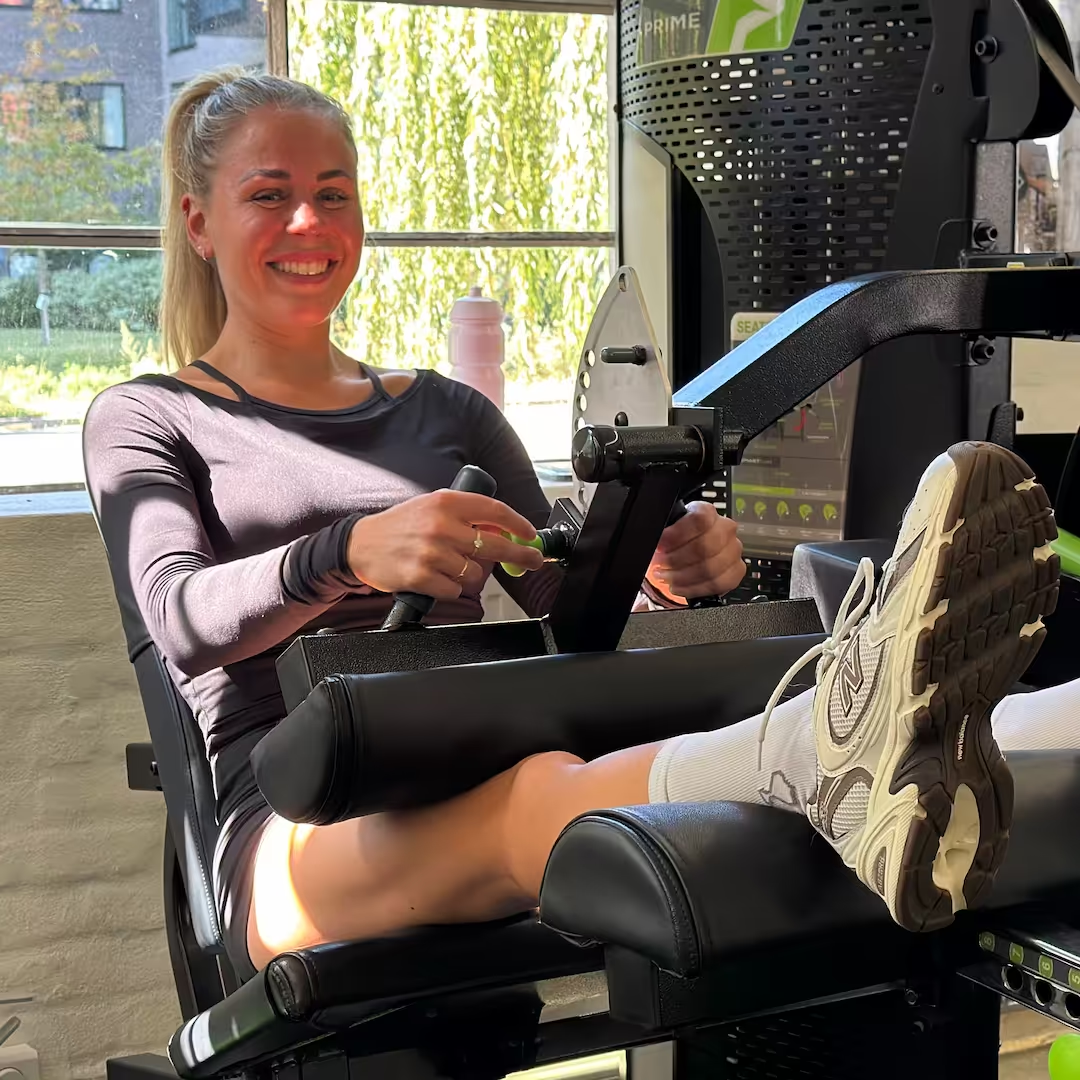
When more doesn't give more
Olivia trained every day. Long, hard training sessions with constant variation. It felt productive. It felt like she was giving everything. But the numbers told a different story.
Strength stagnated. Minor injuries came and went. And the constant exhaustion meant she never showed up to a workout fully fresh. Each session built on top of fatigue from the previous one.
"I wasn't strong enough for the level I wanted to be at," Olivia said. "And it was frustrating, because I trained more than most people."
It is something we often see: People who train enormously but don't see results that match the effort. Not because they lack willpower, but because the body doesn't get time to adapt. For muscles and the nervous system to become stronger, they need enough rest between workouts to recover. Without it, fatigue just builds up and progress stalls.
When Olivia started with us, the biggest change was not the exercises in her program. It was the intensity.
"Kasper taught me that you can get really far without destroying yourself every session," Olivia said. "Here I had my eyes opened to what it means to control your intensity. It gave me much more energy for each workout, because I hadn't run myself completely into the ground in the previous sessions."
In contrast to how she had strength trained before, the theme was clear: same exercises every time. Fixed, systematic progression. Which together constituted a structure that ensured she always trained hard enough to create progress, but never so hard that it came at the expense of recovery — and life outside the training center.
"I had probably been in the program for four to six weeks before I really started to catch his cues and understand the principles," Olivia told us. "I learned to perform the exercises correctly, which gave me better results faster — and at the same time I trusted the plan because I understood the purpose of it."
Holding back a little felt like cheating at first. But the training was still hard and challenging. The difference was that she stopped her sets a bit earlier than she was used to — and that had an accumulating effect she hadn't experienced before. Instead of building fatigue from session to session, she was building strength. Each workout added a little on top of the previous one instead of subtracting. It created a positive spiral that built her up, rather than one that slowly drained her.
But the results spoke for themselves.
And it wasn't only the numbers that changed. It was also how she felt outside of the workouts.
"When I trained daily and ran myself completely into the ground, I thought it was a sign that I was working hard enough. But in reality I was constantly tired, irritable and never really recovered. It affected everything — my energy, my mood, my sleep, my capacity."
When the body is never allowed to recover properly, the feeling of exhaustion builds up. Not just in muscles and joints, but in the entire system. What is supposed to make you stronger, healthier and happier ends up dragging you down.
With the right structure and intensity, the opposite happened. Olivia trained fewer times but felt better — both in and outside the training center. Training became what it always should have been: something that gives energy to the rest of life, not something that drains it.
"We found that balance together," Olivia said. "Kasper understood where I came from, and he knew exactly what it took for me to still feel like I was training hard enough — but without it coming at the expense of everything else."
"I thought you had to leave every workout completely exhausted and be sore the day after to get the best results. It turned out that was exactly what was holding me back." — Olivia
Strength as the foundation for everything else
What surprised Olivia the most was not just the strength gains. It was what the strength did for everything else she loved.
With a stronger foundation, she could run longer, train harder in CrossFit and handle more — without the minor injuries and general exhaustion that had previously held her back. The strength training didn't become a replacement for her other activities. It became the foundation that made it possible for her to improve in them and most importantly, to enjoy them.
"I know now that strength training is the foundation for a long, healthy and pain-free life," Olivia said. "Regardless of which sport I do, strength training will always be a part of my lifestyle."
Today she completes Ironman competitions and runs both half and full marathons — injury-free.
"I am confirmed in that when I can do Ironman and run marathon without injuries," she said. "I can see that there are many elite athletes in endurance sports who don't use strength training. I think that's a mistake."
"I know now that strength training is the foundation for a long, healthy and pain-free life. I am confirmed in that when I can do Ironman and run marathon injury-free." — Olivia
Olivia's transformation
After 3 blocks of 12 weeks with structured strength training — 3x Full Body per week:
Strength gains:
- Barbell Romanian Deadlift: 70 kg x 6 → 97.5 kg x 6 (+39%)
- Leg Extension: 40 kg x 6 → 70 kg x 7 (+75%)
- Glute Bridge: 100 kg x 6 → 120 kg x 8 (+20%)
- Dumbbell Chest Press: 15 kg x 6 → 20 kg x 6 (+33%)
Consistency:
- 97% attendance
- Structured progression over three blocks
Performance:
- Completes Ironman competitions
- Runs half and full marathons injury-free
- Stronger than ever in CrossFit
Identity shift:
- From "training has to hurt to work" to "structure and intensity control gives better results"
- From plateaus and minor injuries to consistent progress
- From training the most to training the smartest
Why the right dose beats the biggest dose
Olivia's story shows a trap that many active people fall into: They believe that more is always better.
More training. More soreness. More exhaustion. And if a workout doesn't leave you completely wrecked, it feels as if you haven't done enough.
But results from training don't come from effort alone. They come from the balance between the principles the body works by: sufficient intensity, enough volume, good technique, often enough — and enough recovery for the body to actually adapt and become stronger between workouts. These are not rules you can choose to follow or not. They are the laws of physiology.
But knowing the principles is not enough. They need to make sense to the person standing in front of you. For Olivia, who came from a CrossFit culture where everything was about giving maximum, it was crucial to explain the difference in a language she could recognize: That the hard work she was already putting in wasn't the problem. It was the absence of a structure that made the work productive.
Olivia had plenty of intensity and volume. But she never got enough recovery for the body to express the positive adaptations her hard work should have created. The effort was there. The structure was not.
What we did with Olivia was to put her hard work into a framework where all the principles worked together. Sufficient intensity and volume, good technique, consistent frequency — and for the first time: enough rest for the body to actually build on top.
For Olivia, it was the difference between years of stagnation and minor injuries — and three blocks with consistent progress, while she actually felt good.
Ready to get more out of your training?
Olivia trained daily and ran herself into the ground. With structured strength training 3 times per week, she became stronger, injury-free and now completes Ironman and marathon — with more energy and capacity than when she trained twice as much.
If you train a lot but don't see the results you expect, you rarely need more effort. You need a structure that makes your effort productive — with the right balance between intensity, volume, technique and recovery.
Book a free start-up conversation at our private gym in Copenhagen, and experience how the right dose of training can give you better results than the biggest dose.
Because the principles are simple. It's just about putting them into a system.
Table of Contents
Other Client Stories


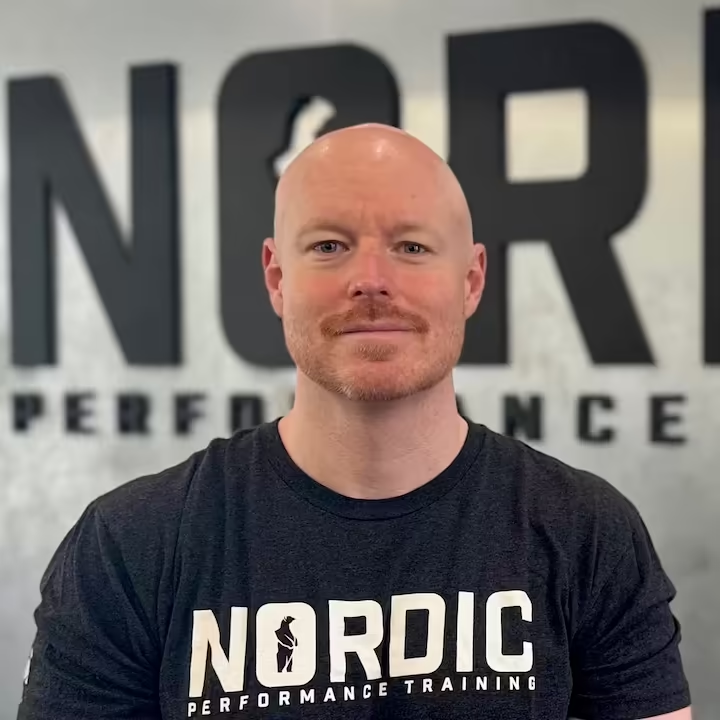
I’ve worked as a personal trainer for over 12 years and as a physiotherapist for over 10 years — and co-founded Nordic Performance Training with Lucas 8 years ago to give clients a professional and structured way to train. Since then, I’ve helped hundreds of people build strength, stay consistent, and feel better through evidence-based methods that actually work.
Along the way, I’ve completed advanced certifications, mentored under leading experts, and I’ve taught many trainers and physiotherapists internationally.
On this page, I share real client stories — so you can see what structured, consistent training looks like in practice.


Other Client Stories


.svg)