






What Does Personal Training Cost in Copenhagen?
The prices of personal training in Copenhagen have changed in 2026. This article gives you an updated overview of what personal training actually costs in Copenhagen in 2026, what affects the price, and how you ensure that you get real value for your money — not just an expensive training session.
We've had over 3,000 clients at Nordic Performance Training and conducted more than 50,000 hours of personal training in Copenhagen over the past 8 years. Again and again, we see the same pattern: people who chose the cheapest option and ended up paying double — first for the training that didn't work, and then for the training that actually delivered results. But we see the opposite just as often: people who paid a high price without researching properly and ended up with a trainer who was expensive but not skilled. Price alone doesn't tell you whether you're getting quality. Research does.
If you also want to know how to find the right trainer beyond price, we've written a complete guide to choosing a personal trainer in Copenhagen.
Price Overview: What Does Personal Training Cost in Copenhagen in 2026?
In 2026, the price for personal training in Copenhagen ranges from 600 and up to 1,500 kr. per session — but for a qualified trainer, the price now sits in the range of 900–1,200 kr. A noticeable jump from before 2026, when many sessions could be had from 650–750 kr.
Prices vary depending on whether you train at a large chain, with an independent trainer, or at a specialised private training centre. Here is a realistic picture of the market in 2026:
Large fitness chains
Typically sit at 700–1,000 kr. per session. You buy punch cards of 10–50 sessions and pay a separate membership on top. The session price drops with larger packages, but you train in an open centre with other members, and trainers vary greatly in experience and education level — many are unqualified. It's rarely the same trainer each time, and the training programme is often generic or random from session to session. In return, the chains are easy to get started with — they have many locations, flexible times, and often short commitments.
Independent personal trainers
Typically sit at 800–1,100 kr. per session. The quality varies enormously — from very experienced trainers with health science backgrounds to unqualified ones with no experience. Most sell either subscriptions or defined packages. The advantage is often a close personal relationship and flexibility in scheduling. The disadvantage is that you have to assess the quality yourself — there's no institution behind it trying to ensure quality.
Specialised private training centres and clinics
Typically sit at 900–1,500 kr. per session. You train in private surroundings often with experienced and educated trainers, and follow a structured training programme. The price often includes more than just the training session — programming, tracking, professional guidance, and training in a private training centre without distractions. You typically have the same trainer throughout the entire programme, and your progression is documented and adjusted on an ongoing basis.
Small group personal training
Many places also offer small group personal training programmes with 4–8 people, where you typically pay 400–800 kr. per session. It's cheaper than 1-to-1 and provides more structure than regular group training. In return, you share the trainer's attention with others, and the quality depends heavily on both the trainer and the facilities. The concept can work well — if the centre has the equipment for everyone to train the same programme simultaneously, but with individual coaching. But very few centres have that kind of capacity, meaning e.g. 4–8 of every single piece of equipment that needs to be used. In practice, it therefore often turns into circuit training where clients rotate between whatever machines and equipment happen to be available — and then you're closer to glorified group training than real personal training.
Price Comparison: Personal Training in Copenhagen (2026)
To read more about our prices, click here.
What Does a Personal Trainer Cost Per Month?
For most Copenhageners who train 1–2 times per week, the monthly budget looks roughly like this in 2026:
- 1 session per week: 3,000–4,500 kr. per month
- 2 sessions per week: 6,000–9,000 kr. per month
- 3 sessions per week: 9,000–13,000 kr. per month
Many trainers and centres offer lower session prices when you buy larger packages or longer-term programmes with more commitment. It's normal to save 10–15% by committing to a structured programme rather than standalone sessions. And the savings are rarely just financial — structured programmes typically also deliver better results, because the training builds on itself with a clear plan and progression.
What Affects the Price of Personal Training?
The price per session is rarely random. It reflects a number of factors that are worth understanding before you compare offers.
Trainer's experience and education
A trainer with a health science education, several years of experience, and hundreds of clients behind them will naturally cost more than a newly qualified one with a weekend course. In Denmark, "personal trainer" is not a protected title — the quality varies enormously, and that's reflected in the price differences.
Facilities
There's a big difference between training in a busy fitness centre where you share equipment with others and training in a private training centre with peace and focus. Private facilities cost more to operate, and that naturally affects the price.
Programme structure
Standalone sessions are almost always more expensive per session than structured programmes. This is partly because the trainer can plan better, and partly because programmes create the continuity that actually delivers results.
Training format
1-to-1 personal training is more expensive than partner programmes or small group personal training. You pay for undivided attention, and that makes a difference in the quality of coaching and adaptation.
What's included
Some trainers only sell the hour you're in the centre. Others include programming, tracking in an app, guidance between sessions, and ongoing adjustments to your programme. Two sessions at the same price can deliver vastly different value, depending on what comes with it.
The Price Is Not the Same as the Cost
This is the part most people overlook — and the part that actually matters.
We regularly meet people who have spent 15,000–30,000 kroner on personal training without getting anywhere. Some chose the cheapest option and got random training without structure. Others paid a high price and assumed that automatically meant quality — but ended up with a trainer without a real method behind the price tag.
In both cases, the result was the same: wasted money, wasted time, and the frustration of having to start over.
That's why research is so important, regardless of price level. Read Google reviews. Ask for concrete client stories. Ask about documented results and a structured methodology. A professional trainer is proud of their results and happy to share them — if they can't show them, it's worth considering whether the price reflects real quality.
Let's lay it out:
An experienced trainer at 800 kr. per session in a structured 12-week programme with 2 weekly sessions costs 19,200 kr. You get stronger, you feel better, and you've learned an approach to training you can use for the rest of your life.
A cheaper, inexperienced trainer at 600 kr. per session over 10 sessions costs 6,000 kr. But if the training is random, you don't see progress, and you stop after 2 months — what did you get for your money? And what does it cost when you have to start over with a better trainer? Total bill: 6,000 + 19,200 = 25,200 kr. — and you've lost the months that went to waste.
"Price alone tells you nothing. What matters is whether you enjoy training with that specific trainer, whether the trainer can make the training make sense for you, and whether a documented methodology is being followed. Without those three things, you're paying for supervised exercise — not for long-term results." — Kasper Vinther, Co-owner, Nordic Performance Training
Johanne, 39, from Amager, experienced exactly this. She spent 12,000 kroner on a trainer without structure or strength progression. After switching to a structured programme with an experienced trainer, she was stronger than ever after 3 months — and her pain was completely gone. "The expensive trainer actually turned out to be the cheapest solution," she said.
Can You Get Subsidies or Tax Deductions for Personal Training?
As a private individual, you cannot deduct personal training from your taxes — SKAT considers it personal consumption. But there are a couple of options worth knowing about:
The exercise deduction (new in 2026)
As compensation for the new VAT, the government has proposed legislation for an exercise deduction of up to 1,750 kr. annually for persons over 30 years of age. The bill is expected to pass in spring 2026 with retroactive effect from 1 January. The actual tax saving is approximately 450 kr. annually. Save your receipts.
Self-employed or business owner
The rules for deducting personal training as a business expense are narrow. Talk to your accountant about the options in your situation.
Health insurance
If you train with an authorised physiotherapist in connection with a specific issue — e.g. back or neck pain — many private health insurance policies cover the treatment fully or partially. Coverage varies, so check your terms.
Frequently Asked Questions About Personal Training Prices in Copenhagen
What does a personal trainer cost per month in 2026?
A personal trainer in Copenhagen typically costs 3,000–4,500 kr. per month at 1 session per week and 6,000–9,000 kr. at 2 sessions per week. The price depends on the trainer's experience, the facilities, and whether you buy individual sessions or a structured programme. Most centres offer lower session prices for longer-term programmes.
Is personal training worth the money?
Yes — provided you choose a trainer with structure, documented results, and a method that actually works. You're not just paying for a training session, but for expert guidance, progression, and long-term results that affect how you feel in your entire everyday life. The cheapest session is rarely the best investment.
Can I get results with only 1–2 sessions per week?
Yes. Research shows that 1–2 structured training sessions per week is enough to improve strength, muscle mass, and general health. The key is that the training follows a clear plan that ensures progress — not just random sessions that exhaust you.
What's the difference between a punch card and a programme?
A punch card is a number of sessions you use when it suits you. A training programme is a fixed period — typically 6 or 12 weeks — with scheduled training times and a programme that has a clear plan. A programme typically delivers better results because it creates the structure and commitment most people need.
Can I deduct personal training from my taxes?
As a rule, no — SKAT considers it personal consumption. There is a new exercise deduction in 2026 and certain options for business owners, but it depends on your situation. Talk to your accountant.
What should I look for when comparing prices?
Look at what's included — not just the price per session. Ask whether there's a structured programme, whether your progress is documented, and what happens between sessions. Two sessions at the same price can deliver vastly different value. Read our complete guide to choosing the right personal trainer for a deeper walkthrough.
Ready to invest in training that actually works?
If you want to hear more about what a structured training programme at Nordic Performance Training costs and includes, we offer a free introductory consultation with no obligation.
In the consultation, you get personal guidance on your goals, insight into our approach, and answers to all your questions about prices, programmes, and expectations.
Book your free start-up conversation here.
No obligation — just an honest conversation about what makes sense for you.
Referencer
Grgic, J., Schoenfeld, B. J., Davies, T. B., Lazinica, B., Krieger, J. W., & Pedisic, Z. (2018). Effect of resistance training frequency on gains in muscular strength: A systematic review and meta-analysis. Sports Medicine, 48(5), 1207–1220. https://doi.org/10.1007/s40279-018-0872-x
SKAT (2026). Moms på motions- og musikundervisning, tankesport og andre aktiviteter. https://skat.dk/erhverv/moms/andre-momsemner/moms-paa-motions-og-musikundervisning-tankesport-og-andre-aktiviteter-1
Skatteministeriet (2025). Motionister skal kunne trække en del af motionsregningen fra i skat. https://skm.dk/aktuelt/presse-nyheder/nyheder/motionister-skal-kunne-traekke-en-del-af-motionsregningen-fra-i-skat-1
Table of Contents
Related Blog Posts

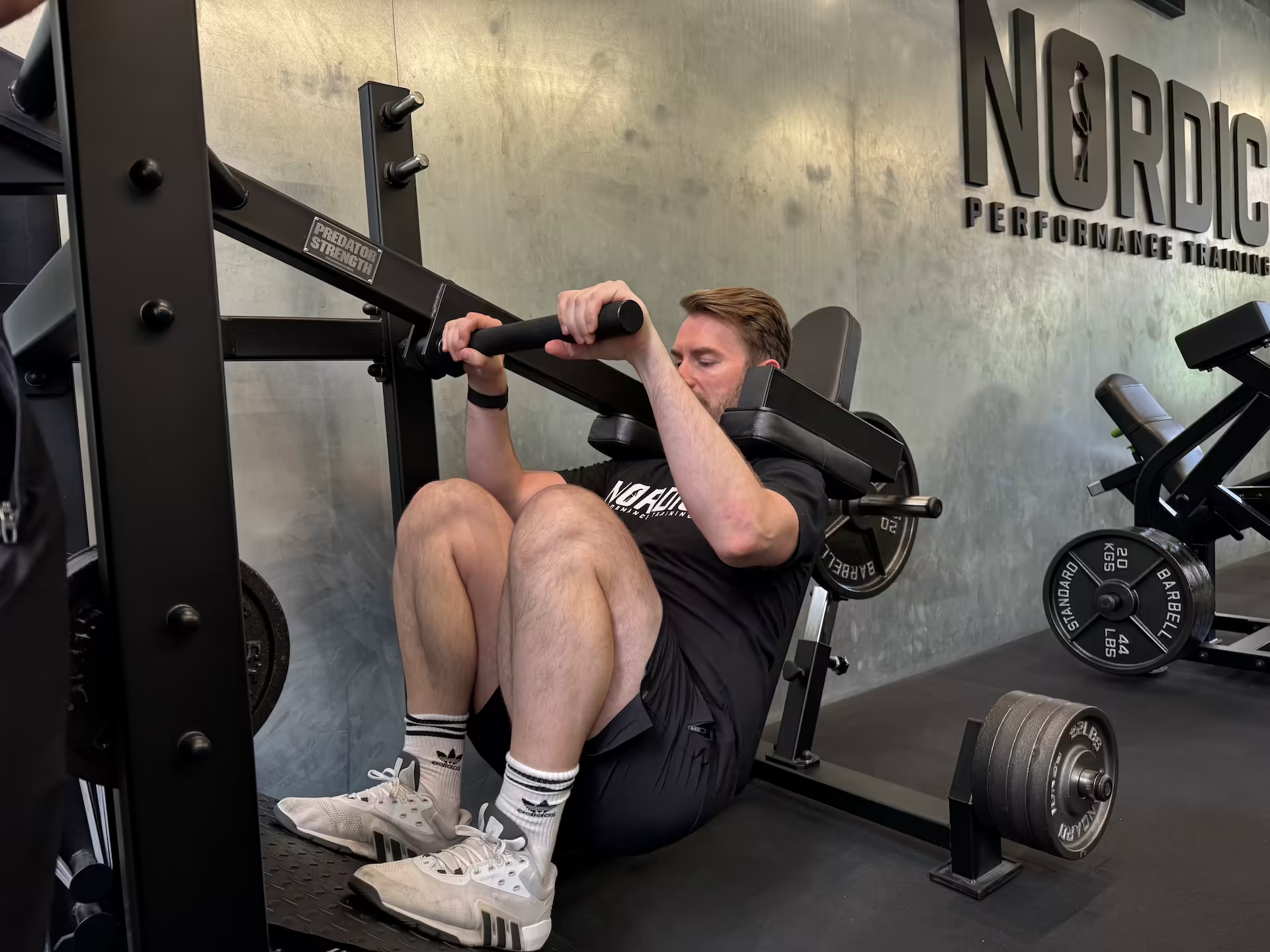

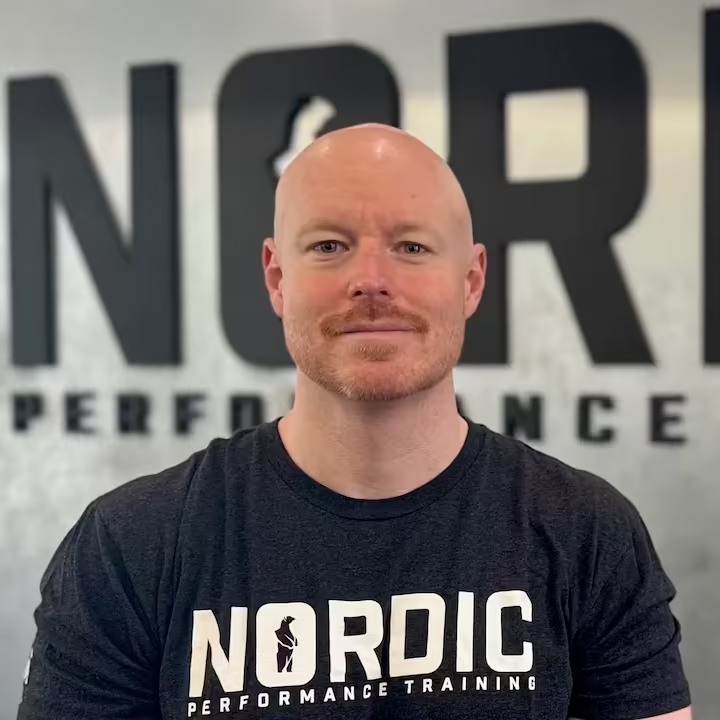
I’ve worked as a personal trainer for over 12 years and as a physiotherapist for over 10 years — and co-founded Nordic Performance Training with Lucas 8 years ago to give clients a professional and structured way to train. Since then, I’ve helped hundreds of people build strength, stay consistent, and feel better through evidence-based methods that actually work.
Along the way, I’ve completed advanced certifications (N1, Kilo Strength, Prescribe), mentored under leading coaches, and I’ve taught many trainers and physiotherapists internationally.
On this blog, I share the same practical tools, insights, and strategies we use every day at Nordic — so you can train smarter, stay consistent, and get real results.



Related Blog Posts
.svg)