






How to Lose Weight With Strength Training — Without Diets
Most people who want to lose weight start by doing a lot of cardio. Or by making radical changes to their diet. Or both at the same time — and then they wonder why they're hungry all the time, tired during training, and end up falling back into exactly the habits that created the problem.
It's not necessarily the willpower that's lacking. It's the approach that's not sustainable.
Effective and lasting weight loss comes down to two things: a sensible approach to diet and strength training to build and maintain your muscles while you lose weight. And if cardio is added, it's with the purpose of improving your fitness — not burning as many calories as possible.
It sounds simple. And it's actually quite simple. But simple is not the same as easy.
If you zoom out and look at how the people with the body weight you're striving for actually live, it rarely fits the weight loss strategies and training methods that are marketed — and that people who want to lose weight try their hand at again and again.
Radical approaches most often work quickly in the beginning. But what worked early in the process gradually becomes more and more unsustainable. If you try to do more than your best, and it goes too fast without a real structure, then it becomes chaos.
We help our clients consistently do the basic things that slowly but surely lead to sustainable results.
A large part of that work is not about adding more. It's about not doing things. People naturally seek complexity — the next exercise, the next supplement, the next strategy. Our job is to remove the unnecessary and help you understand why you do what you do — and equally importantly, why you don't do everything you don't do. It's that reassurance that allows you to keep going instead of constantly doubting whether you're doing enough.
One of them is Mette, 43, project manager from Amager. She had tried most things before starting with us. Counted calories on her phone in MyFitnessPal for three months. A strict 1,200-calorie meal plan from an online coach. Intense bootcamp programs with 3-4 training sessions per week. Every spring she tried something new — and every autumn the same habits and kilos returned.
"I was so tired of starting over. Not just physically, but mentally. The feeling that it never worked in the long run — even though I did everything 'right'."
It turned out that Mette wasn't doing anything "wrong." She followed the plans she was given. The problem was simply that they followed a strategy that most often only works in the short term. Research shows that nearly 40% give up during a weight loss program. And of those who complete it, more than half of the lost kilos are back within two years — and after five years, over 80% of the weight loss is gone.
When she came to us for personal training, we changed two things: She started strength training twice per week with our simple Full Body program — and she dropped calorie counting in favour of the T-plate method. In four months, she lost 7 kg. 14 months later, she still weighs the same.
This guide explains what works — and why most of what you've heard about weight loss and training is most often designed as short, intense programs that aren't sustainable in the long run.
Diet drives your weight loss — not training
You lose weight when you eat fewer calories than you burn. No superfoods, no supplements, and no magical combination of macros can bypass that principle.
But that doesn't mean you should count calories. Most people have neither the desire, the surplus, nor the mental benefit of logging every meal in an app. On top of that, even trained dietitians underreport their own intake by over 10% — and completely ordinary people miss by even more. That says something about how difficult precise calorie counting actually is. And most people stop after a few weeks anyway.
If you can't find the surplus to make better choices in everyday life or train regularly — where would you find the surplus to weigh, scan, and note everything you eat?
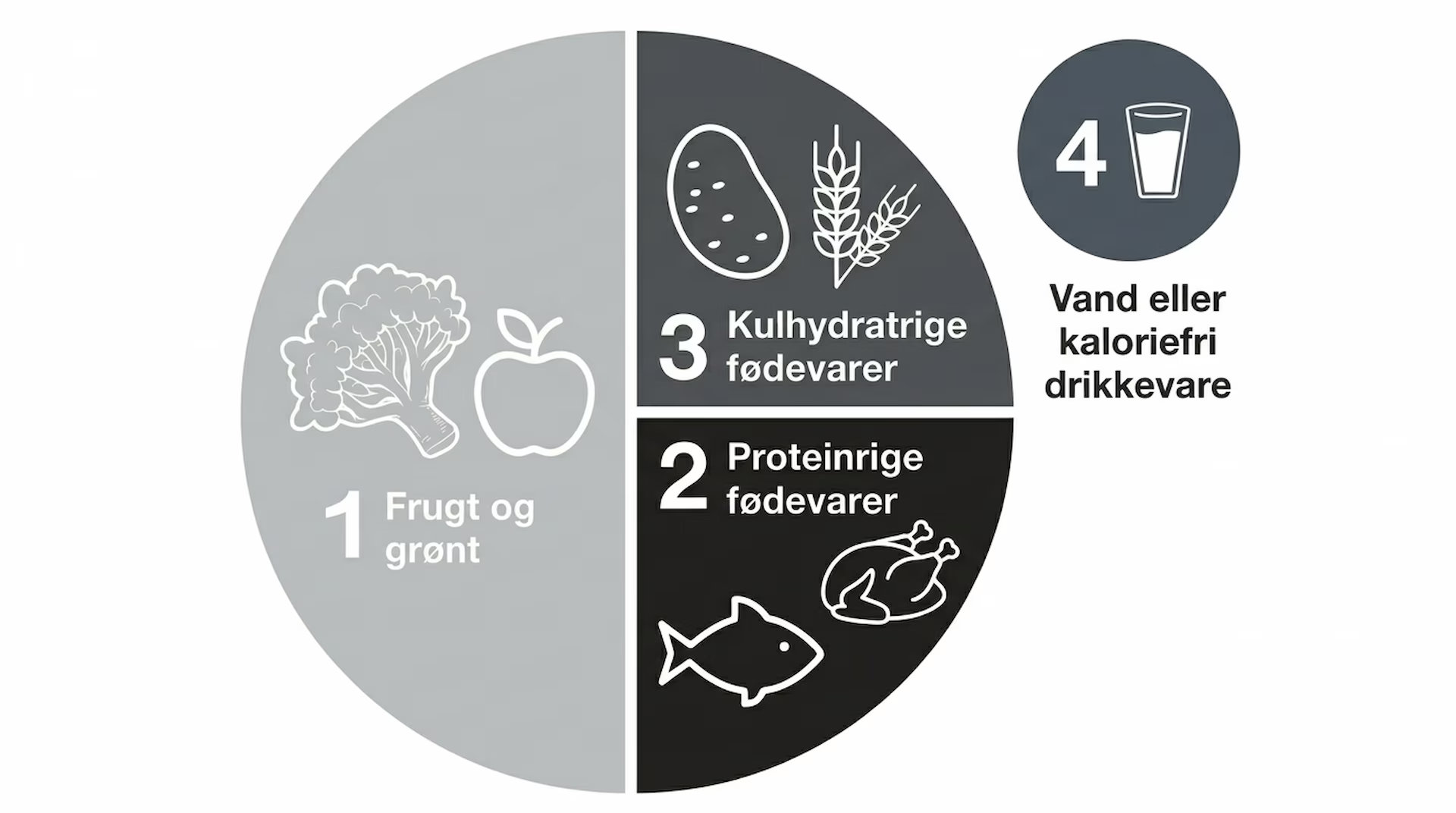
Use the T-plate instead. Half the plate with vegetables, a quarter with protein, a quarter with carbohydrates. No weighing. No barcodes. It's something you can actually use for the rest of your life — and a method where you stay present in the kitchen and the cooking instead of staring at a screen.
Large cohort studies show that people who eat more fruit, vegetables, and whole foods naturally maintain a lower body weight over time — without counting a single calorie. Not because vegetables are magical, but because they fill more and satisfy better per calorie. When half your plate is vegetables, there's simply less room for what drives the weight up.
Also prioritise protein in every meal. Protein satisfies more per calorie, helps build your muscle mass after strength training sessions, and requires more energy to digest. Research shows that strength training combined with a sufficiently high protein intake during a calorie deficit doesn't just preserve muscle mass — it can actually increase it.
If you stick with the simple strategy, you can expect to lose between 0.25 and 1 kg per week. But expect that the numbers will naturally fluctuate a bit. Hormones, fluid balance, and sleep affect the weight day by day. That doesn't mean it's not working — it's just how the body functions.
The T-plate — the only diet method you need
Most diet plans don't fail because they're wrong. They fail because they're too complicated to maintain. The T-plate is the opposite: a simple visual method that works — without apps, without weighing, and without barcodes.
How the T-plate works
Half of your plate is vegetables. A quarter is protein. A quarter is carbohydrates. That's the entire system.
The vegetables take up the most space because they satisfy the most per calorie and give you a lot of nutrition. The protein ensures you preserve and build muscle mass via strength training. The carbohydrates give you energy to perform during training and in everyday life. And the distribution automatically creates a moderate calorie deficit for most people — without you needing to count a single calorie.
A typical day with the T-plate
Breakfast: Oatmeal with skyr, berries, and a handful of nuts.
Lunch: Rye bread with chicken or eggs, avocado, and a large portion of salad. Or leftovers from the previous night's dinner (a preferred choice for many due to the simplicity).
Dinner: Protein of your choice (fish, meat, beans), rice, noodles, or potatoes and vegetables (steamed or as part of a stir-fry).
Snacks: Fruit and vegetables. An apple, a carrot, a handful of cherry tomatoes — whatever is easiest and requires the least.
None of the meals are weighed. No calories are counted. The plate is just built up according to the same principle every time. And what you can focus your energy on is the quality of the ingredients and the composition to maximise the flavour, rather than making a calculation add up.
Why the T-plate works better than calorie counting
Calorie counting requires you to weigh, scan, and log everything you eat. It's time-consuming, it's imprecise, and it's not a way most people want to live their lives. Which is why most people also stop after a few weeks.
The T-plate requires you to look at your plate. That's it.
It's not perfect. It's not precise down to the last calorie. But it doesn't need to be either — because calorie counting isn't either. The difference is that the T-plate is something you can actually use for the rest of your life, without it feeling like a project.
Why strength training and weight loss belong together
Training is not a particularly effective way to increase your energy expenditure — the body turns down other processes when you move more, so the total calorie expenditure changes far less than you think. But strength training during weight loss is not about burning calories for the sake of calories. It's about sending a signal to your body to keep the muscles while the fat is burned via the calorie deficit.
Without that signal, the body has no reason to prioritise the muscle mass — and then you lose both fat and muscle. That's precisely what happens with aggressive diets and hard cardio: the body loses what it isn't asked to keep.
If you lose weight too quickly, the body's metabolism also adapts downward — you burn fewer calories at rest than before, and that makes it harder to maintain the weight afterwards. That's a problem — not because muscles burn enormous amounts of calories at rest, but because muscle mass is crucial for your strength, your quality of life, and your body composition on the other side of the diet.
This is where most weight loss programs fail. They focus on burning calories with bootcamp training that combines high repetitions in "strength training exercises" with cardio exercises in a circuit training format — and ignore the fact that you don't manage to send the necessary signals to the body to preserve the muscles.
Especially because that type of training exhausts you far more than necessary, both during and after the training. It might feel effective when you sweat and get out of breath — but the effect in terms of long-lasting and sustainable weight loss is an illusion.
It's the same principle as with fruit and vegetables: it can seem counterintuitive that you lose weight by consuming food — but it's not the consumption of the fruit itself that causes weight loss, it's that it satisfies you so you naturally make better choices the rest of the day.
In the same way, the training itself shouldn't be different during a weight loss phase — it should still feel challenging. But it shouldn't be unnecessarily exhausting just because you want to lose weight. And that difference means everything.
It's easy to train hard. It's easy to make something feel effective. And it's easy to lose weight for a short period. The art is to train hard enough for the body to develop, but fresh enough for you to train a little harder next time — and keep doing it going forward. You need to stay fresh enough to have the surplus to make the good decisions with diet, sleep, and everything else that actually drives your weight loss. That's why we train the way we do — and that's why we follow a simple strength training system that is precisely hard enough, not as hard as possible.
What your training should look like
Your training during a weight loss phase should look identical to your training outside a weight loss phase. Challenging, heavy enough, controlled — but not unnecessarily exhausting.
Full Body — not split program
Full Body training lets you train all muscle groups during each session. It's the most effective structure during a weight loss phase, because your body needs regular signals that the muscles are still necessary — without you needing to be at the gym more than 1-2 times per week.
Once per week is enough. Research shows that as little as 3-4 sets per muscle group per week can preserve muscle mass during a calorie deficit. Twice per week is better — you double the frequency of the muscle-building signal. But as always, the effect you get from the jump from zero to one session is far greater than the jump from one to two.
The most important thing is simply that you start with what you can maintain regularly. One session per week that you actually show up to beats three sessions you often skip. Or daily sessions you end up skipping and feeling guilty about.
Heavy load — not high repetitions
We use 6-8 repetitions per set. Many note that research shows you can build muscle mass with sets of between 5-30 repetitions, as long as they're taken to or close to the point where you can't do more. But that's seen in isolation. A set of Hack Squats with 30 repetitions will leave you so exhausted for the rest of the session and the following days that the net effect of your training and entire training week becomes far worse — and you become unnecessarily exhausted.
It's the accumulation of metabolites and the resulting discomfort signals to the brain that creates an environment that necessitates the brain activating the largest and strongest muscle fibres during the last 2-3 repetitions of sets with many repetitions. It's a super inefficient way to achieve what's called effective repetitions — it's like driving to a petrol station that's 10 km away instead of the one that's 2 km away. By increasing the weight to your 8-10 RM and doing 6-8 repetitions, you get the same — or actually better — effect seen in isolation, but with far less accumulated fatigue and discomfort.
You therefore also see that people report more discomfort with high repetitions, and more drop out of their training program compared to those who train with moderate repetitions. Again, the approach becomes too short-term and extreme with the high repetitions — you make it harder than it needs to be.
"It's easy to train too hard. The art is to train hard enough — and keep doing it." — Mathias Busk, personal trainer and physiotherapist at Nordic Performance Training
Long rests and simple exercises
2-3 minutes of rest between sets. Not 30-60 seconds. Research shows that longer rests beat short rests for both strength and muscle growth — because they let you maintain a high intensity in each set and again reduce the degree of accumulated fatigue and discomfort.
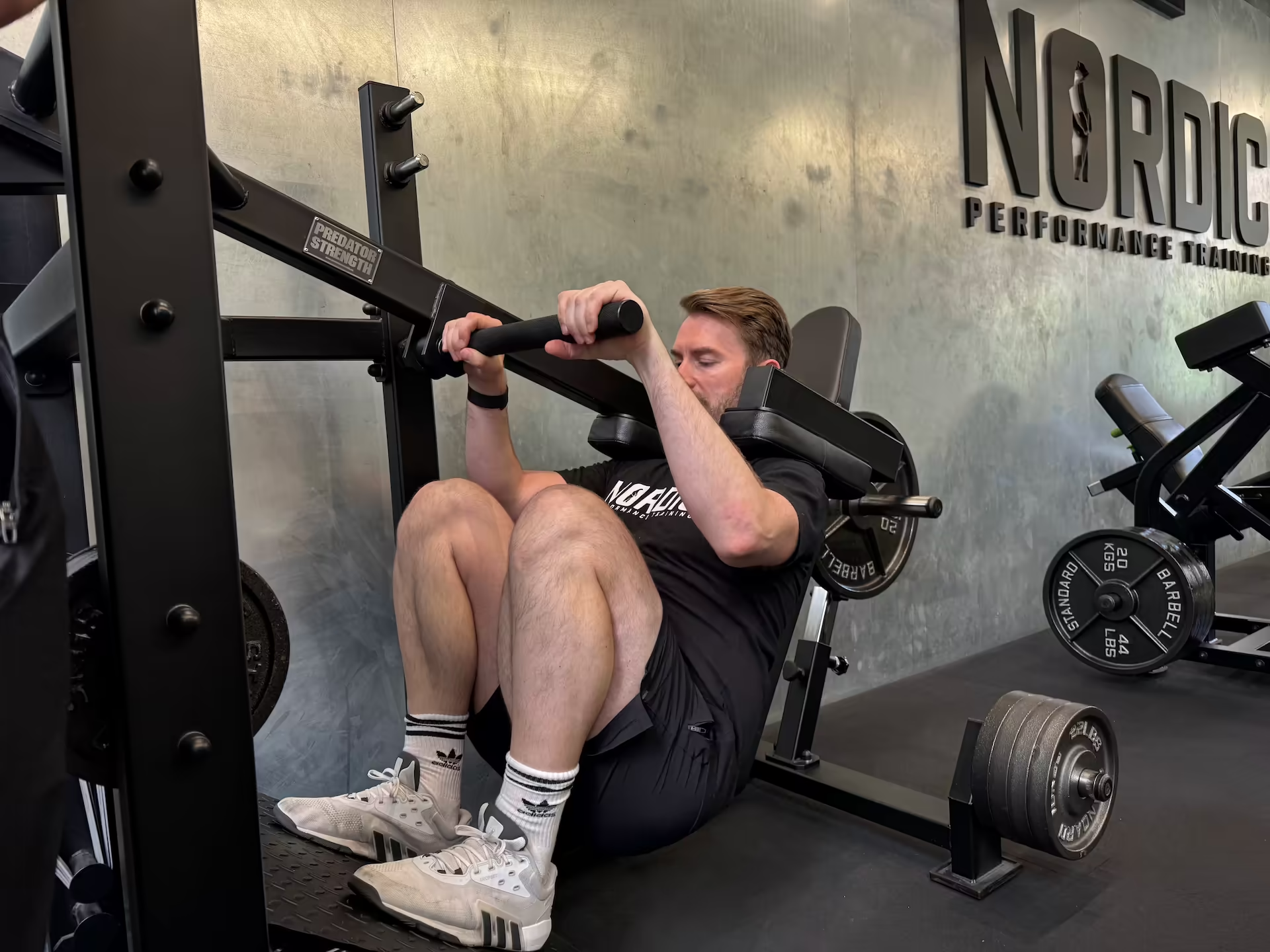
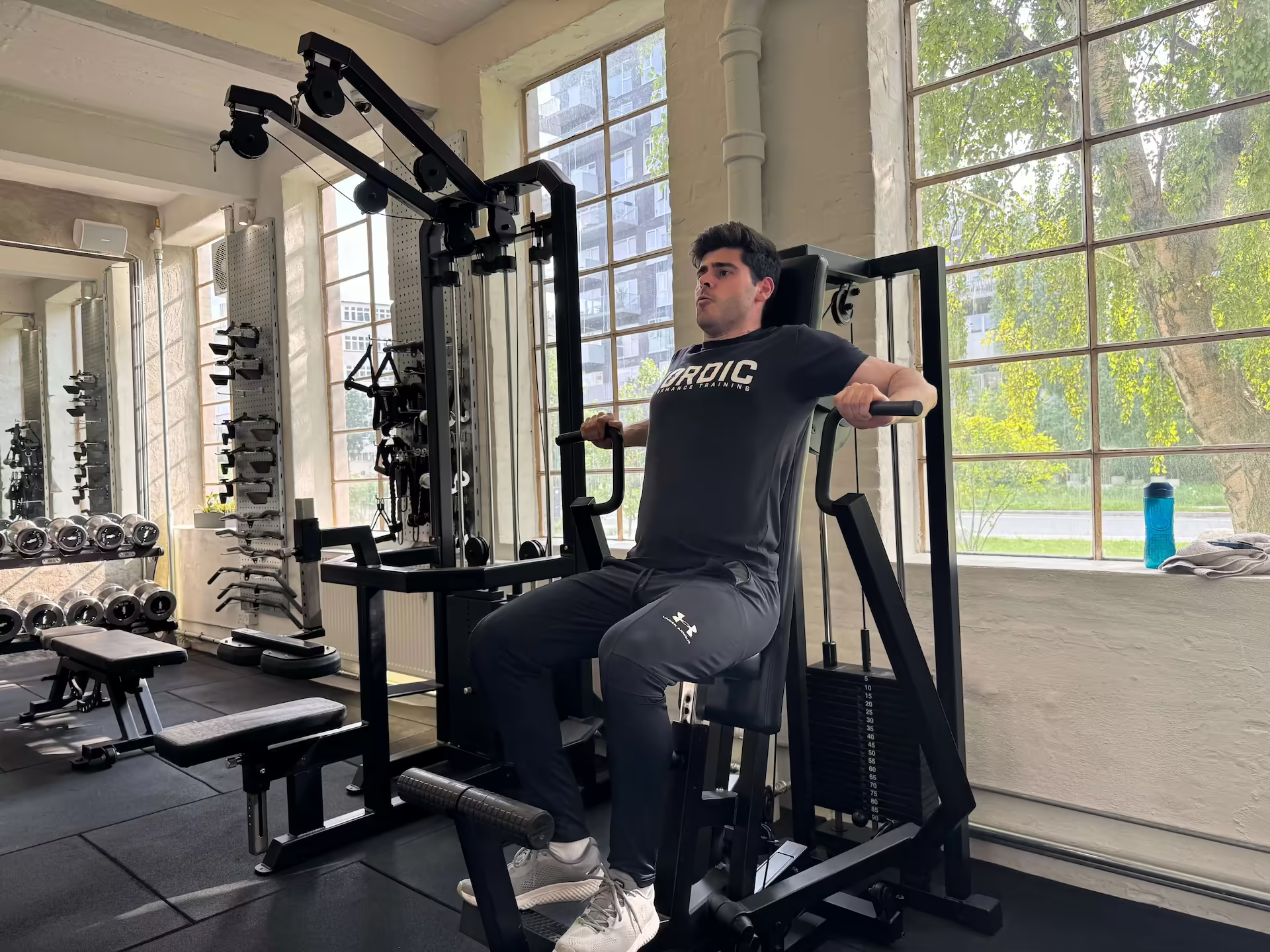
Machine Chest Press, Cable Pulldown, Hack Squat, Leg Curl, Leg Extension, and Lateral Raise. Simple, machine-based exercises that let you load the muscles heavily and safely, without a steep learning curve. No kettlebell swings, no box jumps, no burpees, no farmer walks, and no sled pushes. Just simple, practical exercises that within our system are guaranteed effective.
Why "fat burning training" doesn't work
Mette trains twice per week with us. 55 minutes per session. Six simple exercises. That's all.
Example of a program during weight loss
- A-series: Machine Chest Press + Cable Pulldown — 3 sets × 6-8 repetitions
- B-series: Hack Squat + Leg Curl — 3 sets × 6-8 repetitions
- C-series: Leg Extension + Lateral Raise — 2 sets × 6-8 repetitions
Use double progression: Start with 6 repetitions, build systematically up to 8, increase the weight. Keep 2-3 minutes of rest between sets. Write down weight and repetitions — so you can see that you're actually progressing. Read more in our guide to how you ensure progress in strength training.
For a complete walkthrough of the program and the science behind it, read our Full Body program guide.
The most important principles for lasting weight loss
Let the diet drive your fat loss. Not your training. Start with the food — the T-plate is your operating system.
Strength train 1-2 times per week. Not to burn calories — but to send a signal to the body to keep the muscles.
Sleep well. Sleep deprivation increases hunger hormones and lowers satiety hormones. Good sleep is part of your weight loss strategy.
Give it time. Mette lost 7 kg in 4 months. It doesn't sound impressive compared to "lose 10 kg in 30 days" ads. But 14 months later, she still weighs the same. That's the difference.
Maintenance is the hard part
The weight loss is often the "easy" part. Maintenance is often harder. And that's also what the research shows.
And that's because strategies are used during the weight loss that can't be maintained afterwards. Large calorie deficits. Complicated meal plans. Too frequent and exhausting training sessions.
The best results come from habits you don't need a high degree of willpower to maintain.
Mette still trains with us twice per week. Not because she needs to lose weight. But because it's become part of her lifestyle.
"It's not a diet or a 'weight loss journey.' It's just how I live now. I keep getting stronger and happier. Without worrying about my weight." — Mette
Want to know more about why strength training is the most important thing you can do for your health — regardless of whether you want to lose weight or not? Read our complete strength training guide.
Frequently Asked Questions About Strength Training and Weight Loss
Can you lose weight with strength training alone?
No — weight loss requires a calorie deficit, and that's created primarily through diet. Strength training ensures you preserve muscle mass and lose fat rather than both. The combination of sensible diet and strength training gives the best and most sustainable results.
How often should you strength train to lose weight?
1-2 times per week with a Full Body program is sufficient. Research shows that 3-4 sets per muscle group per week can preserve muscle mass during a calorie deficit. The jump from zero to one weekly session is far greater than from one to two.
How quickly do you see results from strength training during weight loss?
Most people experience strength gains within 4-6 weeks and visible changes in body composition after 8-12 weeks. Expect 0.25-1 kg weight loss per week with a sensible approach. If you lose weight faster, it's often a sign that you're also losing muscle mass — not just fat.
Which form of training do you lose the most weight from?
Diet drives your weight loss — not the form of training. But strength training is the most valuable form of training during weight loss because it preserves muscle mass and improves body composition. Bootcamps and circuit training burn calories but don't send the signal the body needs to keep the muscles — and exhaust you unnecessarily.
How do you lose belly fat?
Spot reduction is a myth. You can't choose where the body loses fat. Focus on a moderate calorie deficit and strength training — then the body takes care of the rest over time.
Does counting calories work?
In theory yes, but rarely in practice. Nutrition labels may deviate by up to 20%, even dietitians underreport by over 10%, and most people stop after a few weeks. The T-plate is more realistic and equally effective.
Should you train differently when you want to lose weight?
No. Your training should look identical to your training outside a weight loss phase — challenging, heavy enough, and controlled. The only difference is that the diet creates the deficit. The training preserves the muscles.
Why don't bootcamps work for lasting weight loss?
Bootcamps focus on calorie burning with high repetitions, short rests, and hectic tempo. It exhausts you more than necessary, makes recovery harder, and doesn't send the signal the body needs to preserve muscle mass. And the more exhausted you are, the harder it is to keep diet and sleep in check the rest of the day.
Ready to make it simple — and actually stick with it?
Mette spent years on calorie apps, bootcamps, and diets that worked for 6-12 weeks only to start over again. Two training sessions per week and a plate built according to the T-model later, she has lost 7 kg — and kept them off for over a year.
If you're tired of starting over — book a free start-up conversation. Either in our private gym in Copenhagen or as a call, if that suits you better. We'll go through what makes sense for you specifically.
Everyone can suffer for 6-12 weeks. The art is to find something you can endure forever.
References
Ballou, T. M., et al. (2025). Resistance training during caloric restriction promotes muscle hypertrophy in men and women. Frontiers in Endocrinology. https://doi.org/10.3389/fendo.2025
Schoenfeld, B. J., Pope, Z. K., Benik, F. M., et al. (2016). Longer interset rest periods enhance muscle strength and hypertrophy in resistance-trained men. Journal of Strength and Conditioning Research, 30(7), 1805–1812. https://doi.org/10.1519/JSC.0000000000001272
Schoenfeld, B. J., Ogborn, D., & Krieger, J. W. (2016). Effects of resistance training frequency on measures of muscle hypertrophy: A systematic review and meta-analysis. Sports Medicine, 46(11), 1689–1697. https://doi.org/10.1007/s40279-016-0543-8
Lemstra, M., Bird, Y., Nwankwo, C., Rogers, M., & Moraros, J. (2016). Weight loss intervention adherence and factors promoting adherence: A meta-analysis. Patient Preference and Adherence, 10, 1547–1559. https://doi.org/10.2147/PPA.S103649
Lichtman, S. W., Pisarska, K., Berman, E. R., et al. (1992). Discrepancy between self-reported and actual caloric intake and exercise in obese subjects. New England Journal of Medicine, 327(27), 1893–1898. https://doi.org/10.1056/NEJM199212313272701
Table of Contents
Related Blog Posts



I’ve worked as a personal trainer and physiotherapist for many years and I bring a calm, professional presence to every session, helping people feel comfortable and confident in the gym no matter their starting point.I help my clients build structure and consistency and the habits that drive real, lasting progress.
My approach is clear, effective, and sustainable, and I have extensive experience helping clients train safe and effectively with pain.
On this blog, I share the same practical methods we use at Nordic every day — so you can train with confidence and keep moving forward.



Related Blog Posts
.svg)